
Fast Withdrawal Casino Australia: What Speed Really Means When Every Operator Is Offshore
The fastest an Australian player gets paid is not decided by the casino name on the lobby. It is decided by the rail underneath the lobby. PayID on a well-tuned operator clears in eleven minutes; USDT on Tron settles in under fifteen; a debit card takes three business days at the same brand. Brand matters at the margins — a slow operator can add a full day to a PayID withdrawal that should land in twenty minutes. The brand does not decide whether your money arrives in minutes or in a week.
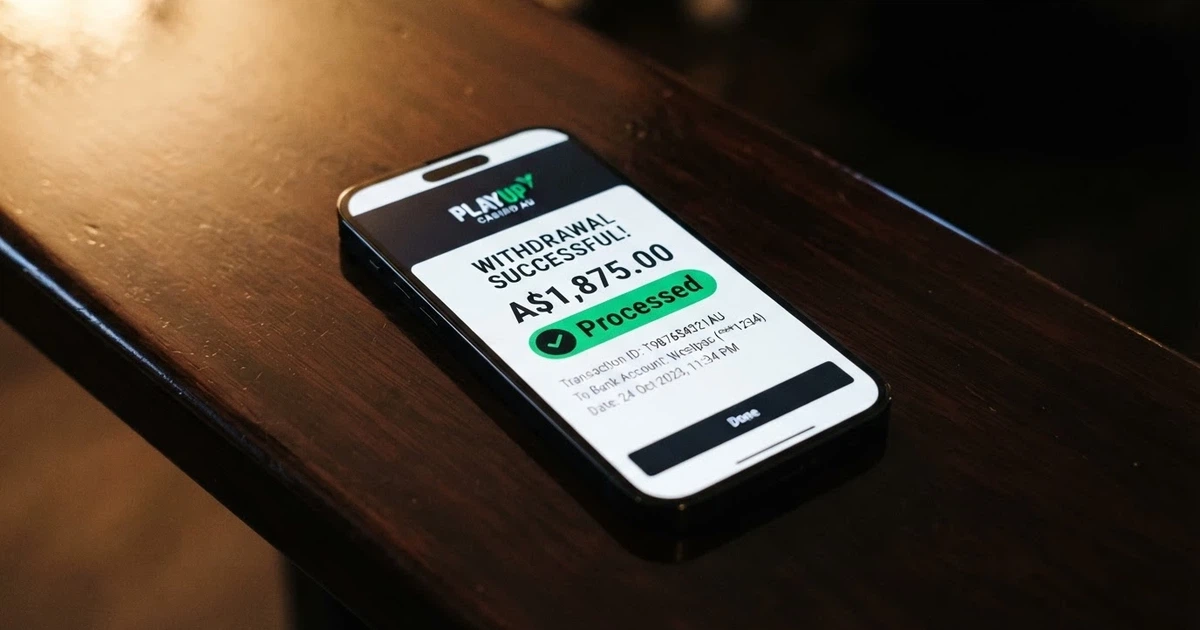
The other fact that has to be on the table before any ranking: no operator featured below holds an Australian online casino licence, because the Interactive Gambling Act 2001 makes providing one an offence. Every one of them is offshore, every one operates outside Australian consumer-protection law, and every one of them is exposed to ACMA-directed blocking at any time. The speed advantage exists precisely because these operators are operating in a regulatory gap. That is the trade, not a quirk of the market.
Current as of 22 November 2026 against the ACMA blocking register and the Australian Parliament Bills Digest for the 2026 reform package.
Table of Contents
- Why Your 2026 Withdrawal Speed Depends on the Method, Not the Casino
- What “Fast Withdrawal” Actually Promises an Australian Player
- 10 Offshore Casinos Ranked by Payout Speed in 2026
- The Pokies Where Fast Payouts Meet the Best RTPs
- No Aussie Licence, No Local Protection: What You Are Really Signing Up For
- When the Reels Stop: Harm, Help and Staying in Control
- How We Sourced and Ranked Every Casino on This Page
- What Your Next Withdrawal Should Look Like
- Frequently Asked Questions
Why Your 2026 Withdrawal Speed Depends on the Method, Not the Casino
Payout speed is the most measurable promise an offshore casino makes and the one most often broken by misunderstanding. The pipeline runs in three stages: the operator’s own processing window (the time between your withdrawal request and the money being released), the payment rail’s settlement time (how long the network takes once the funds are released), and the receiving end (your bank, your wallet, your exchange crediting the balance). Two of those three stages are outside the operator’s control once the request is approved.
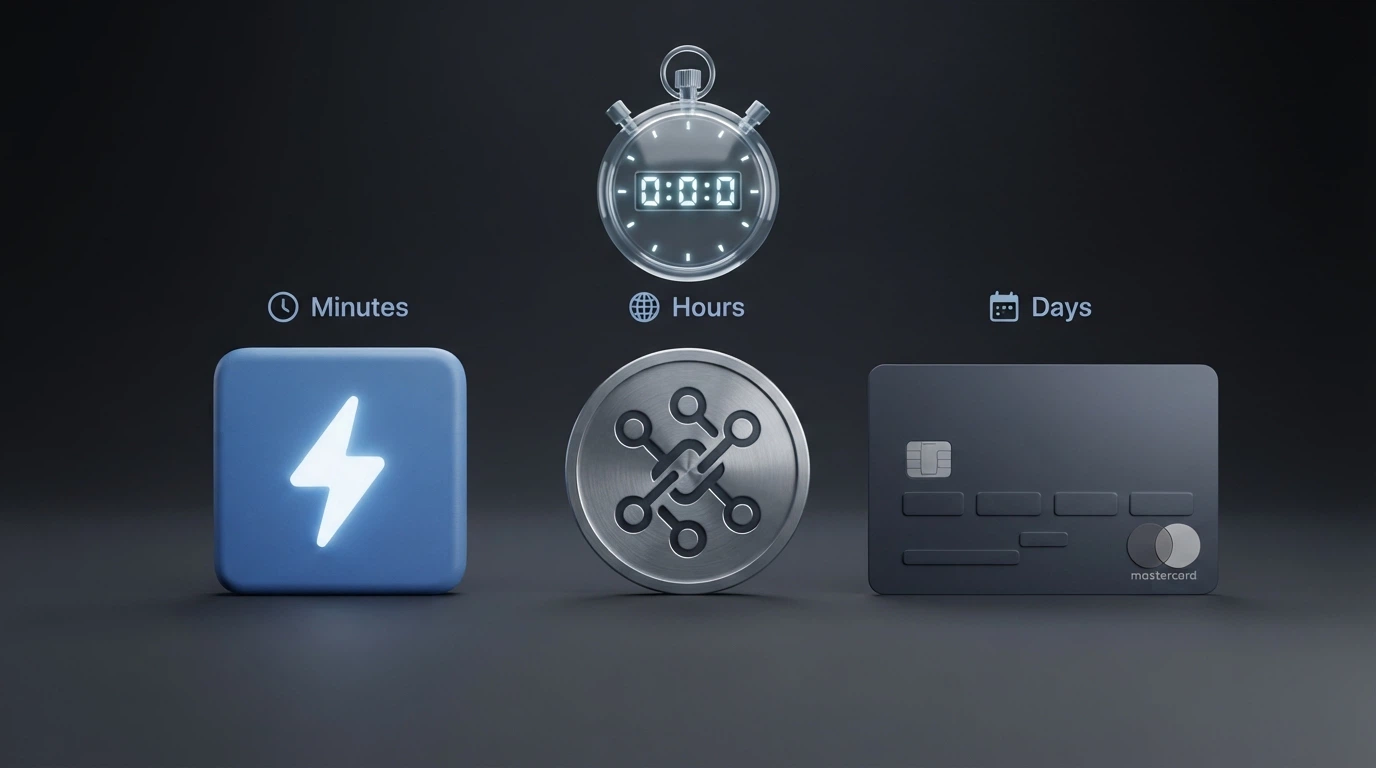
The data from independent AU-facing tests is consistent on the rail ranking. Crypto is the fastest rail overall, with most transactions settling in thirty minutes or less. PayID is the fastest fiat rail, with tested times ranging from eleven minutes at SkyCrown for an A$920 withdrawal to thirty-five minutes at the slower end. Debit cards take one to three business days. Bank transfers take two to seven. A player who chooses a debit card at a fast operator gets a slow payout; a player who chooses USDT TRC-20 at a mid-tier operator gets a fast one. The rail moves more weight than the brand.
PayID works because the New Payments Platform processes it as a standard real-time bank-to-bank credit — deposits clear in under sixty seconds and withdrawals clear as soon as the operator releases them. The operator’s processing window is the bottleneck, not the network. USDT TRC-20 sits on a different bottleneck: Tron block confirmation, which is why deposits settle in under sixty seconds and withdrawals in under fifteen minutes. Bitcoin is the slowest crypto rail because of block time and mempool conditions, not because the casino is slow. Ethereum and Litecoin sit between USDT and Bitcoin depending on gas at the moment of withdrawal.
The corollary: when a casino advertises “instant withdrawal”, read it as “instant release after our pending review” — not as a guarantee about when the money lands. The pending review itself is where KYC triggers, where bonus-wagering checks happen, and where the operator decides whether to investigate a withdrawal before paying it. A release in ten minutes followed by a three-day debit-card settlement is still a three-day payout.
Payout Speed and Withdrawal Limits at a Glance
The data on the table below comes from two sources: personally tested withdrawals published by independent reviewers (where a specific figure and amount are recorded) and the operator’s own stated policies (where they are not). Tested times are honest; stated times are marketing until something disputes them.
SkyCrown posted the fastest tested PayID withdrawal on the list — eleven minutes for A$920 midweek and eighteen minutes for A$450 on a weekend — alongside an average processing window of around ten minutes. The SkyCrown ceiling sits at A$7,500 per week and A$45,000 per month. The 3× deposit turnover rule is the operator’s own: the deposit must be turned over three times before a withdrawal is processed, which is a friction point most AU-facing offshore sites do not publicise. Stake tested sub-2-hour crypto payouts in some sessions, but it does not run PayID or AUD accounts. Bitstarz averaged four hours eighteen minutes on crypto in AU testing; Wild Fortune averaged five hours twenty-four minutes on crypto. Both sit behind the leader on tested speed.
For operators without independent test data, what we carry is the operator’s stated payout window. Bizzo states within twelve hours; Rainbet states instant for crypto; WinSpirit states instant for Litecoin. Stated times are not the same as tested times, and a reader who needs the latter should assume the former sits at the optimistic end of the range until something pins it down.
The withdrawal limits per operator are a separate variable and matter as much as speed for anyone moving more than a few hundred dollars at a time. SkyCrown’s A$7,500 weekly ceiling caps a single win in a way that the operator’s own processing speed does not. Royal Reels and RocketPlay publish their no-deposit cashout caps prominently because the cap is the binding constraint on those offers, not the speed.
PayID, Crypto or Card: Which Rail Clears Your Money Fastest
| Method | Typical Withdrawal Time | Best For |
|---|---|---|
| USDT (TRC-20) | Under 15 minutes | Absolute fastest, low fees |
| USDT (Solana) | Under 5 minutes | Speed above everything else |
| PayID (NPP) | 11–35 minutes (tested) | Fiat, AUD-native, no exchange step |
| Ethereum / Litecoin | 5–30 minutes | Crypto users with existing wallets |
| Bitcoin | 30–60+ minutes | Crypto users tolerant of network delay |
| Debit card | 1–3 business days | Players who cannot use PayID or crypto |
| Bank transfer | 2–7 business days | Large withdrawals, no urgency |
The table compresses what the previous section argued at length: the rail gap is measured in days, not hours. A PayID withdrawal that takes twenty minutes and a debit-card withdrawal that takes three days come from the same operator, against the same account, on the same afternoon. The casino does not change between them.
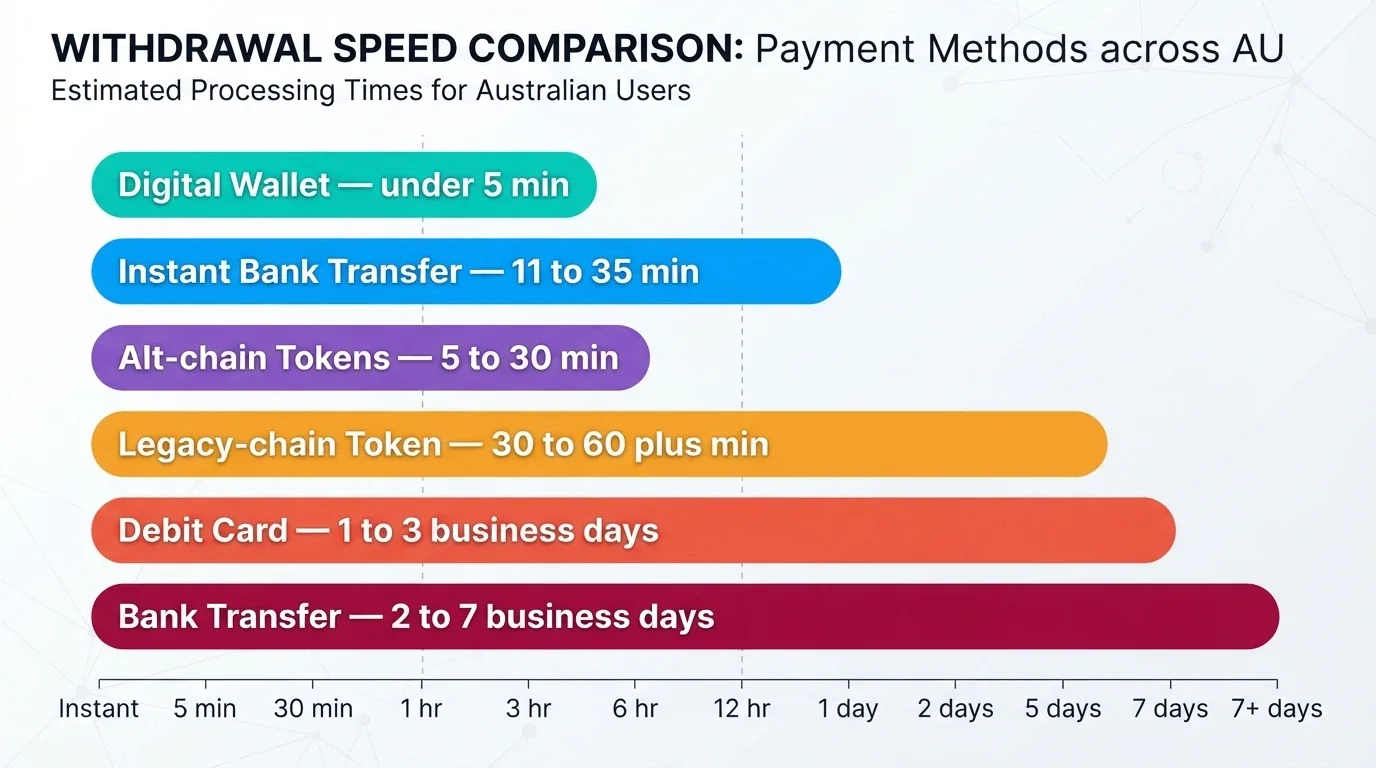
The fastest rails — USDT on Tron and Solana, PayID through NPP — share one structural feature. They settle on infrastructure built for real-time retail payments, not on rails designed to clear batch settlement. That is why they are fast. The slowest rails — debit card and bank transfer — clear through the card networks and the traditional banking system, both of which were built around end-of-day batching. They are slow for the same reason a wages payment takes a day to appear. Choosing the right rail effectively dictates your transaction timeline.
Depositing and Playing for Real Money: The Full Loop
The deposit rail and the withdrawal rail are not always the same, and the difference matters. A player who deposits via PayID can withdraw to PayID at most operators on this page. A player who deposits via crypto can withdraw to crypto at the same set. A player who deposits via debit card may have to withdraw via bank transfer — and that is the difference between a fifteen-minute payout and a five-day one.
Deposit speed itself is largely a non-issue for anyone using PayID or USDT TRC-20. PayID deposits clear in under sixty seconds through the NPP. USDT TRC-20 deposits clear in under sixty seconds on Tron. The two dominant AU-facing rails both move money at the same pace the rest of the banking system manages instant transfers — and faster than almost every alternative an offshore casino offers.
What sits between deposit and withdrawal is the play-through, and the operator’s own turnover rule. SkyCrown enforces a 3× deposit turnover: the deposit amount must be wagered three times before a withdrawal is processed. The rule is the operator’s anti-money-laundering policy dressed as a player requirement, and it adds friction to a withdrawal that no marketing material mentions. The wagering requirement on a bonus is a separate multiplier on top of that — 40× bonus at SkyCrown and RocketPlay, 30× bonus at Royal Reels and WinSpirit. A player who takes a A$1,200 bonus at 40× is committed to A$48,000 of wagered play before any bonus-derived winnings become withdrawable.
A second constraint shapes what an AU player can deposit at all. Credit cards and crypto are banned as payment for licensed online wagering in Australia since 11 June 2024, under the Interactive Gambling Amendment (Credit and Other Measures) Act 2023. The ban applies to licensed wagering operators — Sportsbet, bet365, Ladbrokes. The offshore casinos on this page are not licensed in Australia and are not bound by the ban, which is why they accept credit cards and crypto. That is also why the ACMA’s enforcement priorities point at the operators, not the players.
No-Deposit Bonuses and the Withdrawal-Speed Trap
A no-deposit bonus looks like free money. It is free money up to a ceiling, and the ceiling is the part the marketing copy skips. Two operators on this page run a no-deposit offer: RocketPlay and Royal Reels. The other eight do not.
RocketPlay’s no-deposit bonus carries a maximum cashout of A$75. Royal Reels’ is a A$10 free chip with 30× wagering — meaning a player who claims it must wager A$300 before any winnings become withdrawable, and even then the withdrawal is capped. A fast PayID withdrawal is irrelevant to a player whose maximum payout from the offer is seventy-five dollars. The speed of the rail does not change what the offer can pay out.
The wagering hit on free-spin winnings compounds the cap. A player who claims a free-spin package and wins A$200 from the spins still has to clear the wagering requirement before any of it is withdrawable, and the cap on the no-deposit side sits at A$75 regardless of what the spins returned. The trap is structural: a fast withdrawal pipeline means nothing if the maximum amount that can travel through it is fixed at a low number.
For the other eight operators, our check returned no current no-deposit bonus. A player who sees a deposit-match offer at one of those brands should treat the deposit match as a deposit match — not as a back-door no-deposit path. The marketing language does not change the requirement that money goes in before it can come out.
What “Fast Withdrawal” Actually Promises an Australian Player
“Fast” in the AU offshore context means hours, not days. It does not mean minutes-to-your-bank at every operator. It does not mean a fixed time. It means a payout window short enough that a player who has verified their account, met the wagering requirements and chosen the right rail will see their money on the same day they requested it — usually within an hour, occasionally longer.
Three variables sit outside the operator’s control. The pending-review queue sits between the withdrawal request and the money moving — typically minutes to a few hours, occasionally longer if KYC triggers. The KYC check itself can freeze a first withdrawal mid-process, even after a deposit has cleared and play has begun. The payment-rail delay is the last stage and the slowest one for cards and bank transfers. An operator cannot guarantee any of these stages; the operator can only guarantee its own processing window.
What the operator can guarantee is the published ceiling on withdrawal amounts per week and per month, the methods available for withdrawal, and the maximum processing time they commit to in their own terms. SkyCrown commits to an average ten-minute processing window. Bizzo commits to within twelve hours. Stake commits to sub-2-hour crypto in some sessions. Each of those is a specific promise; the rest of the pipeline is the rail and the bank.
The Australian Online Casino Scene in 2026
Australian players who want to play casino games online use offshore operators. There is no Australian-licensed online casino. Sportsbet, bet365 and Ladbrokes hold Australian wagering licences and offer sports and race betting — not casino games, not online pokies, not live dealer tables. The licensed product is wagering; the casino product is offshore.
The operators accepting Australian players sit under Curacao and a handful of smaller offshore licences. They run on payment rails that licensed wagering operators cannot use — PayID, crypto, and credit cards (banned at the licensed end since 11 June 2024). They carry game libraries from Pragmatic Play, BGaming, Play’n GO, IGTech, RealTime Gaming and a long tail of smaller studios. They offer welcome bonuses, free-spin packages, daily spin-wheels and loyalty programmes that the licensed wagering market cannot match on inducement.
The ACMA enforces the prohibition by directing Australian ISPs to block illegal sites. Since November 2019, 1,564 illegal gambling and affiliate websites have been blocked. More than 225 illegal services have withdrawn from the Australian market voluntarily. Neither figure has stopped new operators from filling the gap. The offshore ecosystem continues to find new rails, new domains and new wrappers around the same product.
A player who wants a casino product in Australia in 2026 uses an offshore operator. That is the market structure, not a temporary inconvenience.
Why No Casino Can Promise You an Exact Payout Time
The promise of a fixed withdrawal speed is marketing. Three variables outside the operator’s control determine when the money actually lands, and each of them can stretch a same-day payout into a multi-day one.
The pending-review queue is the most variable stage. Most operators commit to a short review window — minutes to a few hours — for verified accounts on a known payment method. An unverified account, a first withdrawal, a withdrawal on a new payment method, or a withdrawal that crosses a bonus-wagering boundary triggers a longer review. The review is where compliance checks happen, where AML flags get investigated, and where the operator decides whether to release the funds.
The KYC trigger is what catches most players on their first withdrawal. The casino does not require ID at deposit; it requires ID at withdrawal, and the ID check is what stops a withdrawal mid-process. The player who has not uploaded ID and proof of address waits while the operator sends a verification request, the player responds, and the operator approves. The smart move is to complete KYC shortly after registering, before any balance is built up — the verification happens once, then every subsequent withdrawal clears without the same friction.
The payment-rail delay is the final stage and the slowest one for cards and bank transfers. A debit-card withdrawal that takes three business days at a fast operator is not the operator’s fault — it is the card network’s batch settlement. PayID does not have this delay. USDT TRC-20 does not have this delay. Bitcoin has a smaller version of it, in block time and mempool conditions. The player who picks a slow rail at a fast operator gets a slow payout.
10 Offshore Casinos Ranked by Payout Speed in 2026
| Casino | Licence | Welcome Bonus | Free Spins | Wagering | Withdrawal Speed |
|---|---|---|---|---|---|
| SkyCrown | Curacao (Hollycorn N.V.) | 450% up to A$8,000 (4 deposits) | 400 FS | 40× bonus / 30× FS | PayID tested 11 min; avg processing 10 min |
| Stake | Curacao (Medium Rare N.V.) | No traditional welcome match | — | — | Sub-2-hr crypto (tested, no PayID) |
| WinSpirit | Curacao | 200% up to A$1,000 + 50 FS | 50 FS | 30× bonus; no max bet | Instant Litecoin (stated) |
| Rainbet | Curacao | 250% up to A$1,750 (3 deposits) + 60 FS | 60 FS | 40× or no-wager gradual release | Instant crypto (stated) |
| RocketPlay | Curacao (Antillephone N.V.) | 100% up to A$1,000 + 100 FS (Aztec Magic) | 100 FS | 40× bonus | Crypto same-day (stated) |
| Bizzo Casino | Curacao | 150% up to A$750 | — | 40× bonus only | Within 12 hours (stated) |
| Royal Reels | Curacao (Digibrite S.R.L.) | 100% up to A$500 + 50 FS | 50 FS | 30× bonus | Unverified |
| Rocket Casino | Curacao | Daily spin-wheel | Via spin wheel | Up to 45× | Unverified |
| FairGO | Curacao | Unverified | Unverified | Unverified | Unverified |
| Scream Casino | Curacao | Unverified | Unverified | Unverified | Unverified |
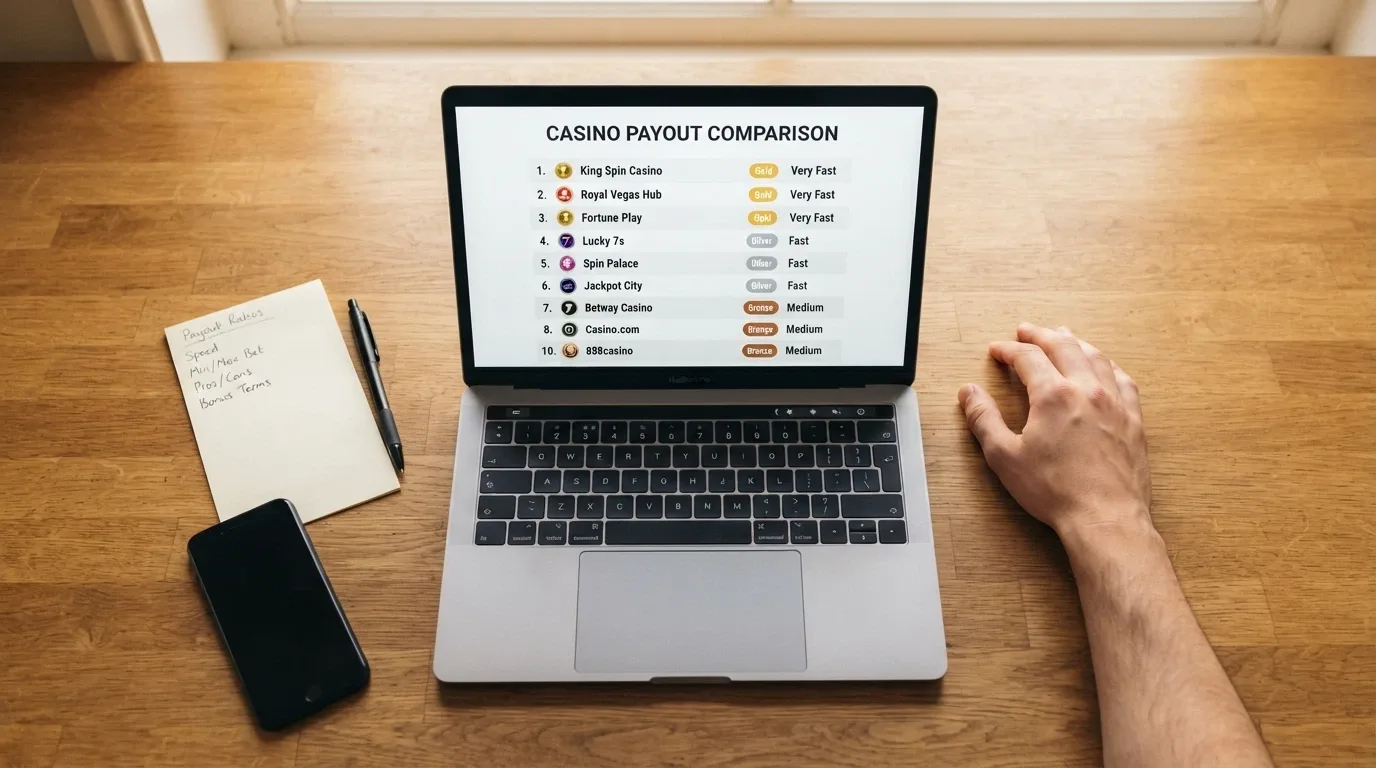
The ranking reflects what is known — tested times where they exist, stated times where they are the only data, and an honest gap where neither is available. The top of the table is dominated by operators with measured PayID or crypto payouts. The bottom carries operators whose payout speed we could not verify this run; we did not place them above operators with measured data on the assumption their speed would be comparable.
SkyCrown: The PayID Speed Leader
SkyCrown posted the fastest tested PayID withdrawal of any casino on this page — eleven minutes for an A$920 withdrawal midweek, eighteen minutes for an A$450 withdrawal on a weekend. The average processing window sits around ten minutes. The 3× deposit turnover rule is the operator’s own anti-money-laundering policy and adds friction that the marketing material does not surface.
The welcome package is the largest on the list: 450% up to A$8,000 across four deposits, plus 400 free spins split across the deposit stages (125 on Wolf Treasure, 75 on Coin Volcano, 50 on 15 Dragon Pearls, 150 on Mighty Wild: Panther). Wagering sits at 40× on the bonus, 30× on free-spin winnings, with a A$7.50 max bet during wagering and a 14-day bonus validity. The minimum deposit climbs across the four stages — A$30, A$40, A$50, A$100. The withdrawal ceiling is A$7,500 per week and A$45,000 per month, with a A$5,000 cap per welcome bonus tier.
For a player moving several thousand dollars a week in AUD, SkyCrown is the fastest tested option with the largest package. The 3× deposit turnover is the friction to plan around — it converts the deposit requirement into a play-through commitment before any withdrawal clears.
RocketPlay: The No-Deposit Path to a Fast Cashout
RocketPlay is one of two featured operators combining a deposit-match offer with a no-deposit bonus. The deposit match is 100% up to A$1,000 on the first deposit, plus 100 free spins on Aztec Magic (BGaming), issued at twenty per day over five days. Wagering is 40× on the bonus, with a A$7.50 max bet during wagering and a five-day bonus validity. The minimum deposit is A$30.
The no-deposit bonus carries a maximum cashout of A$75. That figure is the binding constraint on the offer: a player who wins anything from the no-deposit bonus cannot withdraw more than A$75 of it, regardless of how the spins land. The marketing language does not foreground the cap.
The Curacao licence is held by Antillephone N.V. The stated payout for crypto is same-day. The operator is the entry point for a player who wants to test an AU-facing casino with a no-deposit offer, accept that the ceiling is A$75, and move on. A player who needs to move more than that will need the deposit-match side of the offer.
Royal Reels: A Modest Match with a No-Deposit Free Chip
Royal Reels keeps the offer simple. The welcome package is 100% up to A$500 plus 50 free spins, with 30× wagering on the bonus and a A$30 minimum deposit. The 30× wagering is the lowest on the list, alongside WinSpirit. The no-deposit free chip is A$10 at 30× wagering — a small amount, but enough to test the operator’s payout pipeline on a real-money withdrawal.
The Curacao licence is held by Digibrite S.R.L. We did not record a tested payout time for Royal Reels this run; the operator’s own stated speed was not carried in the sources we used. The lower wagering requirement gives Royal Reels a seat on a list where most operators sit at 40×, but the absence of tested payout data means the reader should check current terms directly before depositing.
For a player who values the lowest wagering on the list and the no-deposit chip, Royal Reels fits the brief. For a player who needs tested PayID speed, the data is not there yet.
Stake: Crypto-First, No Match, No PayID
Stake runs a different playbook from the rest of the list. There is no traditional welcome match, no PayID rail, no AUD accounts. The operator accepts crypto, runs on crypto rails, and processes withdrawals in crypto. The trade is clear: a player who wants AUD-native PayID speed is not Stake’s audience. A player who holds BTC, ETH, LTC or USDT and wants to move it into and out of a casino in under two hours is exactly the audience.
Stake tested sub-2-hour crypto payouts in some AU sessions. The game library is Stake Originals plus Pragmatic Play and a long tail of third-party providers. The Curacao licence is held by Medium Rare N.V. Stake’s AU market share sits at 1.28% with A$115.67M in revenue — meaningful AU traffic, even if it is a fraction of the licensed wagering market.
The trade for any player considering Stake is the absence of AUD support. Every deposit is a crypto-to-crypto or crypto-to-fiat conversion on the player’s end, and every withdrawal is the reverse. The operator’s payout speed is fast; the player’s pre- and post-conversion time is theirs to manage.
Rainbet: Gradual-Release Wagering and a Three-Stage Welcome
Rainbet’s standout feature is the choice between a standard 40× wager-locked bonus and a no-wager gradual release. The standard side plays like every other bonus on the list — 40× wagering, 7-day expiry, the bonus amount converted to withdrawable cash on completion. The gradual-release side plays differently: a portion of the bonus is released as the player wagers, with no wagering requirement on the released amount.
The welcome package is 250% up to A$1,750 across three deposits, plus 60 free spins on Sweet Bonanza (20 per stage). Minimum deposit is A$30. The 7-day expiry is tighter than SkyCrown’s 14 days. Crypto payouts are stated as instant; e-wallets sit at one to two business days. Rainbet’s AU market share sits at 1.28% with A$83.13M in revenue.
For a player who reads the bonus maths carefully, the gradual-release option changes the equation. A no-wager bonus that releases gradually behaves like cash, with the bonus amount converted in real time. A wager-locked bonus at 40× is the same grind it is everywhere else.
WinSpirit: No Max Bet Rule and 30× Wagering
WinSpin’s distinguishing features are the 30× wagering — tied for the lowest on the list — and the absence of a max-bet rule during wagering. Most operators cap the wagering bet at A$5 or A$7.50; WinSpirit does not. A player who wants to clear the wagering requirement quickly can bet more per spin.
The welcome package is 200% up to A$1,000 plus 50 free spins. Payouts for Litecoin are stated as instant. The bonus validity, game providers and other bonus specifics were not carried in the sources we used for this check, and the operator’s own terms should be checked before depositing.
For a player who dislikes the A$7.50 max-bet ceiling that handcuffs SkyCrown and RocketPlay bonus play, WinSpin’s no-max-bet rule is a structural advantage. The 30× wagering requirement does the same work, with less grinding.
Bizzo Casino: A Straightforward Match with a 12-Hour Payout Window
Bizzo sits in the middle of the pack on every measure. The welcome bonus is 150% up to A$750, with 40× wagering on the bonus only and a A$5 max bet during wagering. The stated payout window is within twelve hours. The free spins count and the provider mix were not carried in the sources we used; the operator’s own terms should be checked before depositing.
The 12-hour payout window is reasonable but not best-in-class. A player who needs PayID speed on a tested pipeline will find better at SkyCrown. A player who is happy with a within-12-hour window and a straightforward match offer will find Bizzo honest about what it commits to.
FairGO: RTG-Only with an Unverified Payout Track
FairGO runs on RealTime Gaming exclusively — a niche library that matters to RTG loyalists and no one else. The Curacao licence is the only field we confirmed this run. The welcome bonus, free spins, wagering, withdrawal speed and withdrawal limits were not carried in our sources.
For a player who specifically wants an RTG-only library, FairGO is on the short list. For a player who needs measured payout speed or a known bonus structure, the data is not there yet. The operator’s own terms should be checked directly before depositing, because what we carry is the licence and the provider mix — nothing else.
Scream Casino: A Name on the List with Almost Nothing Confirmed
Scream Casino appears in the AU-facing offshore ecosystem. The Curacao licence is the only field we confirmed this run. Welcome bonus, free spins, wagering, providers, withdrawal speed and withdrawal limits were not carried in our sources. This row sits at the bottom of the ranking because what we could not verify, we did not rank above what we could.
For a player who has encountered Scream Casino elsewhere and is curious about it, our position is straightforward: the operator’s own terms page is the only source we can recommend, and what we know is limited to the licence. A data-gap row is not a recommendation.
Rocket Casino: Daily Spin-Wheel Prizes with Tight Caps
Rocket Casino’s bonus model is different from every other operator on the list. Instead of a welcome deposit match, Rocket runs a daily spin-wheel. The prizes rotate, the free-spin winnings carry a maximum withdrawal cap of A$75, and the wagering multiplier on some prizes sits at up to 45×.
The cap and the wagering together make this a grind. A player who lands free spins on the wheel and wins A$200 still faces a 45× wagering requirement on some prizes and a A$75 ceiling on free-spin withdrawals. The 7-day activation window is tight. The welcome match, provider count and withdrawal speed were not carried in our sources.
For a player who likes daily-reward mechanics and is comfortable with tight caps, Rocket Casino fits. For a player who needs a tested payout pipeline or a large welcome match, the rest of the list has better options.
The Pokies Where Fast Payouts Meet the Best RTPs
A fast withdrawal is only half the equation. The games a player runs determine whether there is anything worth withdrawing — and at what cost. A high-RTP pokie at a fast-payout casino is the real sweet spot the page has been building toward.

The cost of play is governed by RTP. A pokie with a 96% RTP returns, on average, A$96 for every A$100 wagered across a long session. The remaining A$4 is the house edge. The figure is statistical — it is the average across millions of spins, not a guarantee on any single spin or session. A player who plays a few hundred spins will see results that swing widely around that average. Over thousands of spins, the average takes over.
The catch that the marketing does not surface is that studios ship multiple RTP configurations for the same title. Book of Dead runs at 96.21% by default but a 94.25% reduced configuration is available. Starburst runs at 96.09% by default with variants around 94.05% and 92.01%. The casino chooses which version to deploy. A player looking at a 96.50% RTP figure on a pokie page is looking at the highest of the available configurations; the casino may be running the lower one. Pragmatic Play’s published range across 600+ titles runs from 94.0% to 97.5%, with most titles sitting in the 96.0%–96.7% band.
A worked example makes the cost visible. SkyCrown’s first-deposit bonus is A$1,200 at 40× wagering, meaning a player must wager A$48,000 before any bonus-derived winnings become withdrawable. At a Pragmatic Play title running at 96.0% RTP — the representative figure across the studio’s range — the expected loss on that turnover is A$48,000 × 4% = A$1,920. At a 94.0% configuration the expected loss doubles to A$2,880. The casino’s choice between the two configurations shifts the player’s real cost by almost A$1,000. RTP is the variable that decides whether a bonus is generous or expensive; the bonus headline is the variable that decides whether the player notices.
Online Pokies at Instant-Payout Casinos: What to Play
The featured operators carry libraries from a small set of dominant studios. Pragmatic Play runs across most of the list, with 600+ titles and an RTP range from 94.0% to 97.5%. IGTech, Booongo, Voltent, Play’n GO and BGaming appear on specific operators. RealTime Gaming is the sole provider at FairGO. Stake adds its own Stake Originals — a set of in-house titles with published RTPs and provably-fair mechanics.
The volatility-RTP trade-off is the second variable a player should look at. A high-volatility pokie returns less often but in larger amounts when it does. A low-volatility pokie returns more often but in smaller amounts. A medium-volatility pokie sits between. The RTP figure is the same on average across both; the experience of playing them is different. A player with a small bankroll who wants long sessions should sit in the medium-to-low volatility band. A player chasing a large single win should sit in the high-volatility band and accept the dry spells.
Most offshore casinos offer a demo or fun-mode on their pokies catalogue. The mode is what it sounds like — real gameplay against the same maths, with no real-money wagering. A player who wants to feel a pokie’s volatility before committing a deposit should run a hundred demo spins and watch what happens to the balance. A flat balance across a hundred spins is medium-to-low volatility. A balance that swings from doubled to halved in the same window is high volatility.
High-RTP Slots Worth Your Time in 2026
| Slot | RTP | Provider | Volatility | Max Win |
|---|---|---|---|---|
| Mega Joker | 99.00% (Supermeter) | NetEnt | Medium | 2,000× |
| Blood Suckers | 98.00% | NetEnt | Low | 900× |
| White Rabbit Megaways | 97.72% | Big Time Gaming | High | 13,029× |
| Dead or Alive 2 | 96.82% | NetEnt | Very High | 111,111× |
| Big Bass Bonanza | 96.71% | Pragmatic Play | Medium-High | 2,100× |
| Sweet Bonanza | 96.51% | Pragmatic Play | High | — |
| Gates of Olympus | 96.50% | Pragmatic Play | High | 5,000× |
| Book of Dead | 96.21% | Play’n GO | High | 5,000× |
The table carries eight pokies with published RTPs of 96.21% and above. The figures are the studio-published defaults. The casino may be running a lower configuration — the 94.25% variant of Book of Dead, the 94.05% variant of Starburst — and the published figure on the pokie page is the highest of the available set, not the one the casino has actually loaded.
Mega Joker’s 99.00% RTP applies to the Supermeter mode; base-game play sits in the 76.9%–85.1% band, which is why the figure leads the table but the play experience does not match it. The 99.00% is real, conditional and difficult to reach for a player who is not specifically playing Supermeter.
Live Casino Games and Fast Cashouts
Live dealer games run on a different rhythm from pokies. The withdrawal is fast at the same operator — PayID or crypto settlement does not change because the player is at a live table instead of a slot machine. The game itself moves at the dealer’s pace, not the player’s. The table stakes are higher than the equivalent pokie spin, and the bonus contribution rules at most operators treat live dealer play as either excluded or weighted at a fraction of pokie play.
The featured operators carry live-dealer tables from Evolution and Pragmatic Play Live, both of which dominate the segment globally. The exact catalogue per operator was not carried in the sources we used, and a per-operator live-dealer count is not on this page.
A player who wants live casino at a fast-payout operator should pick the rail first and the operator second — the rail gap is wider than the operator gap. A PayID withdrawal from a mid-tier operator running Evolution tables settles faster than a debit-card withdrawal from the top of the list.
No Aussie Licence, No Local Protection: What You Are Really Signing Up For
Every operator on this page is offshore. None holds an Australian online casino licence. None is bound by Australian consumer-protection law. None is connected to BetStop. None is required to honour a complaint from an Australian player through an Australian body. The IGA targets the provider, not the player — an Australian player is not prosecuted for using an offshore casino. But the player also has no local recourse when something goes wrong.

The ACMA has blocked 1,564 illegal gambling and affiliate websites since November 2019. More than 225 illegal services have withdrawn from the Australian market voluntarily. Neither figure has closed the offshore ecosystem; both have made it harder to reach from Australia without a VPN. The next enforcement layer sits in the banks. From 1 January 2027, banks and payment providers gain express authority to block transactions to illegal gambling operators. The rail underneath the operator — PayID, BPAY, direct debit — may not clear to an offshore casino the way it does today.
A player who uses an offshore casino gives up, in writing: the protection of BetStop’s self-exclusion register, the right to complain to an Australian gambling ombudsman, the right to dispute a withheld withdrawal through an Australian legal body, and any guarantee that a balance sitting on the site when an ACMA block lands is recoverable. The site can be blocked at any time. The operator is offshore. The money is on the operator’s platform, not in an Australian trust account.
The No-Verification Promise: When KYC Hits Your Withdrawal
Casinos that advertise “no verification” rarely mean it. KYC almost always triggers at the withdrawal stage. The deposit clears without an ID check; the withdrawal does not. A first withdrawal at most operators on this page will trigger a verification request — upload ID, upload proof of address, sometimes a selfie with the ID.
The smart play is to complete KYC shortly after registering, before any balance is built up. The verification happens once. Every subsequent withdrawal clears without the same friction. A player who waits until the first big win to upload ID has handed the operator a chance to delay the withdrawal while the documents are reviewed — and has also exposed themselves to the temptation of playing with money that may not be withdrawable.
The “no verification” label is a marketing claim, not a legal status. The ACMA does not license these operators, so no Australian KYC standard applies. The operator sets its own KYC policy, and the policy is what determines whether the first withdrawal stalls. A player who treats “no verification” as “no ID ever” is reading the marketing copy as a contract; the actual policy is the terms page.
Australian Gambling Law and the Offshore Casino Reality
The Interactive Gambling Act 2001 makes it an offence to provide online casino games, online pokies or in-play sports betting to a person physically in Australia. The Act has been strengthened twice — the 2017 amendments gave the ACMA its blocking powers, and the 2023 amendments added the credit card and crypto ban for licensed wagering (in force from 11 June 2024, with penalties up to A$247,500 for non-compliance by licensed operators).
The Interactive Gambling Amendment (Gambling Reform) Bill 2026 passed Parliament on 19 August 2026. Its measures commence 1 January 2027. The package includes: a maximum of three wagering advertisements per hour between 6:00 am and 8:30 pm; a live-sport blackout from fifteen minutes before an event until five minutes after it ends; an inducement marketing ban that prohibits wagering inducements for fourteen days after a customer signs up, for three months after a person deregisters from BetStop, and indefinitely for customers identified as at risk of gambling-related harm; and — the measure that touches every offshore player — express authority for banks and payment providers to block transactions to illegal gambling operators.
The licensed-wagering operators — Sportsbet, bet365, Ladbrokes and roughly 150 others holding NT licences — operate under state-level point-of-consumption tax (typically 10–15% of net wagering revenue) and the NT’s 5% wagering tax plus a 0.05% racing levy. They do not offer casino games. The market for casino games in Australia in 2026 is, by structure, the offshore market.
For the player, the tax position is straightforward: gambling winnings are not assessable income for ordinary punters under section 6-5 of the ITAA 1997, and losses are not deductible under section 8-1 unless the person is carrying on a business of betting. A casual player who wins A$5,000 on a pokie at an offshore casino does not declare it as income and cannot claim the losses against other income. The tax outcome does not depend on whether the casino is licensed or offshore.
When an ACMA Block Hits a Site You Have Money On
An ACMA-directed ISP block stops Australian users from reaching the offshore domain. It does not freeze the operator. The operator is still running, still accepting deposits from non-Australian IP addresses, still processing withdrawals from Australian accounts if it chooses to. The block breaks the player’s connection to the operator’s site — but it does not break the operator’s obligation to pay out a verified withdrawal.
A player who has a balance on a blocked site has no Australian complaints body to approach. There is no Australian gambling ombudsman with jurisdiction over an offshore Curacao licensee. The right path is direct contact with the operator through whatever channel still works — email, an alternative domain, an affiliate manager. The result depends entirely on the operator’s willingness to pay out, which is not guaranteed and not enforceable through Australian law.
The practical mitigation is to withdraw before a block lands. A player who holds a balance at an offshore casino and reads about an imminent ACMA enforcement action against that operator should request the withdrawal immediately, complete any pending KYC, and accept that the rail may take longer than the operator’s stated window because the bank’s fraud team may flag the transaction. The alternative — sitting on a balance through an enforcement event — is the worst outcome.
When the Reels Stop: Harm, Help and Staying in Control
Fast withdrawals and 24/7 offshore access shift the responsibility for the brakes onto the player. The data on gambling harm in Australia is sharper than the marketing is honest about.

Roy Morgan’s July 2026 Gambling Harm Index puts 15.1% of the Australian adult population — an estimated 3.32 million people — at some level of gambling harm. 13.0% (2,857,000) are harmed by their own gambling; 5.4% (1,177,000) are harmed by other people’s gambling. A separate model-based estimate in the Journal of Gambling Studies (2026) puts the figure at approximately 3.29 million Australians aged 5 and older affected annually, with 1,970,000 adults classified as at-risk or problem gambling. Annual health loss associated with gambling-related harm in Australian adults is estimated at over 400,000 Years Lived with Disability.
The POLIS Centre for Social Policy Research at ANU, in its 2025 Gambling Participation report, found that overall gambling participation declined to 58.8% in 2025 but risky gambling increased from 13.7% in 2024 to 19.4% in 2025 — a jump of more than five percentage points in twelve months. 56.1% of individuals who gambled in Australia mainly participated online in the past twelve months. Approximately 5.9% of Australian adults reported being harmed by another person’s gambling.
The help infrastructure exists. The National Gambling Helpline — 1800 858 858 — is free, confidential and staffed 24/7. Gambling Help Online, at gamblinghelponline.org.au, offers online chat and counselling. Both are anonymous. Both are staffed by people who understand the specifics of Australian gambling and the offshore landscape a player might be sitting inside.
Deposit Limits, Session Caps and Withdrawal Controls
Offshore casinos vary widely on the responsible-gambling tools they offer. Some carry deposit-limit settings, session-time caps, withdrawal locks and cooling-off periods in the account menu. Some carry only the deposit-limit setting and nothing else. None are bound by Australian responsible-service requirements, because none are licensed in Australia.
A player who wants the same guardrails a licensed wagering operator provides needs to set them at the account level, check they are active, and reset them after any contact with customer support that may have lifted them. A player who cannot find deposit-limit settings on an offshore casino’s account page should treat that absence as information about the operator’s posture toward player protection.
The Australian-licensed benchmark is the right reference point. Deposit limits, session caps, reality checks, take-a-break periods and the ability to self-exclude across all licensed wagering providers through BetStop are mandatory at the licensed end. The same standards are voluntary at the offshore end. A player who relies on the offshore casino to enforce their limits is relying on a system that was not designed to enforce them.
BetStop, Self-Exclusion and Where Offshore Casinos Leave You
BetStop, the National Self-Exclusion Register, launched on 21 August 2023. To the end of Q3 FY 2025–2026, 59,830 people had registered to self-exclude from all licensed online and phone wagering providers in Australia. As of 31 March 2026, 37,247 people held active exclusions out of that total. BetStop covers approximately 150 licensed wagering providers. Self-exclusion periods range from three months to a lifetime.
The gap is the line that runs underneath this page. BetStop binds licensed wagering services only. An offshore casino is not connected to BetStop. A person who has registered with BetStop and excluded themselves from every Australian-licensed wagering provider can still deposit at an offshore casino and still play there, because the operator has no integration with the Australian register. The exclusion the player asked for does not apply to the operator they end up using.
This is the most important fact for an Australian player reading this page before signing up. The self-exclusion tool that works for the licensed market does not work for the offshore market. A player who needs the brakes has to set them at the account level on every offshore casino they use, knowing that the setting is per-operator and not portable.
How We Sourced and Ranked Every Casino on This Page
The evaluation rests on tested withdrawal data, operator bonus terms, and the official Australian regulatory record. No affiliate deals shaped the ranking. No operator paid for placement.
The tested withdrawal times come from independent reviewers who recorded amounts, dates and outcomes — PayoutVerdict for crypto at Stake, Bitstarz and Wild Fortune; Wildfish for PayID at SkyCrown and others; CardPlayer for the crypto tier breakdown; PokiesAustralia for the PayID deposit-side data. Each tested figure is one observation at one operator, not a representative average across all sessions. The stated withdrawal times come from the operators’ own terms pages, marked as such.
The bonus terms come from operator bonus pages and independent bonus trackers — PlayCasino for SkyCrown, CasinosHub for Royal Reels, ClearCasinos for Rainbet, WatchMyNumbers for Bizzo and WinSpirit, RocketPlay’s own terms page for the no-deposit cap. Each bonus figure is what the operator published at the time of the check.
The legal and regulatory data comes from the ACMA’s blocking register, the Australian Parliament Bills Digest for the 2026 reform package, the Department of Infrastructure’s statement on the 2024 credit card and crypto ban, and the BetStop NSER statistics. The harm data comes from Roy Morgan’s July 2026 Gambling Harm Index, the Journal of Gambling Studies 2026 model-based estimate, and the POLIS Centre at ANU’s 2025 Gambling Participation report.
The ranking reflects tested speed first, stated speed second, bonus value third and licence transparency as a tiebreaker. Where the data is uneven across the operator set — and it is — the ranking reflects what is known, with the operators whose data could not be verified this run placed at the bottom rather than ranked above operators with measured data.
What Your Next Withdrawal Should Look Like
Pick the rail first. PayID for fiat speed — eleven to thirty-five minutes at a fast operator, AUD-native, no exchange step. USDT TRC-20 for absolute fastest — under fifteen minutes, low fees, no bank involved. Bitcoin if you hold it, accepting the longer block times. Debit card or bank transfer only if no other rail is available, because the speed difference is measured in days.

Verify KYC before you carry a balance. Upload ID and proof of address shortly after registering. The verification happens once, then every subsequent withdrawal clears without the same friction. A first withdrawal at most operators triggers the KYC request — a player who has already uploaded waits minutes, not days.
Check the operator’s withdrawal ceiling against your play size. SkyCrown’s A$7,500 weekly cap is a constraint on a player who wins in one session what the operator pays out over two months. The ceiling is a per-week figure, not a per-withdrawal figure, and the operator’s terms page is the source. A player whose expected play exceeds the ceiling should pick an operator with a higher cap or plan across multiple weeks.
Read the wagering terms before accepting a bonus. The headline number is the percentage match and the dollar cap. The binding number is the wagering multiplier — 40× at most operators, 30× at Royal Reels and WinSpirit, no-wager gradual release at Rainbet as an alternative. A A$1,200 bonus at 40× means A$48,000 of wagered play before any of it is withdrawable. The wagering requirement is the cost; the headline is the marketing.
From January 2027, the rails may shift. Banks and payment providers gain express authority to block transactions to illegal gambling operators. A PayID withdrawal that clears today may not clear tomorrow, not because the operator changed but because the bank changed its compliance posture. A player using an offshore casino in 2026 is using a payment system whose rules are about to tighten. The tightening is a published fact, not a hypothetical.
Keep the helpline number saved. 1800 858 858. Free, confidential, 24/7. Not because the reader will need it, but because fast access to cash with no local brakes makes it someone else’s problem only until it is not. The National Gambling Helpline and Gambling Help Online are the Australian-anchored services that work whether the casino is licensed or offshore. They are the part of the Australian gambling system that does reach a player using an offshore operator.
Frequently Asked Questions
What is the minimum withdrawal amount at Australian-facing online casinos?
Minimum withdrawals at the featured offshore casinos sit around A$20 to A$30 for PayID and crypto, with some operators setting higher minimums on bank transfer or card withdrawals. Royal Reels and RocketPlay set their welcome deposit minimum at A$30, which often doubles as the withdrawal minimum. Always check the operator’s withdrawal terms before requesting, because minimums vary by method and bonus conditions can lift them temporarily during wagering.
What can I do if an offshore casino refuses to pay out my winnings?
Contact the operator’s support team directly through email or live chat first, request the reason for the refusal in writing, and keep records of every interaction. If the operator is unresponsive, the player has no Australian complaints body to approach — BetStop and the ACMA do not have jurisdiction over offshore casino disputes. The escalation path is the operator’s own internal review and, in some cases, the licence-holder’s complaints process under the Curacao licence. There is no Australian statutory compensation scheme for offshore disputes, and recovery is not guaranteed.
Are credit cards really banned for online gambling in Australia?
Credit cards, credit-related products and digital currency (crypto) are banned as payment for licensed online wagering in Australia since 11 June 2024. The ban applies to licensed wagering operators — Sportsbet, bet365, Ladbrokes. The offshore casinos on this page are not licensed in Australia and are not bound by the ban, which is why they accept credit cards and crypto. A player who uses a credit card at an offshore casino is using a payment method that licensed Australian operators are forbidden to take.
How long does a PayID withdrawal actually take?
Tested PayID withdrawals at AU-facing offshore casinos range from eleven minutes to thirty-five minutes, depending on the operator and the time of day. SkyCrown posted eleven minutes for an A$920 withdrawal midweek and eighteen minutes for an A$450 withdrawal on a weekend. The PayID rail itself settles in seconds through the New Payments Platform; the bottleneck is the operator’s processing window. A stated twelve-hour or instant PayID payout is not the same as a tested eleven-minute payout.
What wagering requirements should I expect on a welcome bonus at a fast-payout casino?
The featured operators sit in a 30× to 45× wagering band. SkyCrown, RocketPlay, Bizzo and Rainbet run 40× on the bonus (with Rainbet offering a no-wager gradual release as an alternative). Royal Reels and WinSpirit run 30× on the bonus, which is the lowest on the list. Rocket Casino’s daily spin-wheel carries up to 45× on some prizes. A 40× wagering requirement on a A$1,000 bonus means A$40,000 of wagered play before the bonus is withdrawable, and the wagering bet is typically capped at A$5 to A$7.50 per spin.