
Aussie Crypto Casinos in 2026: The Offshore Reality, Ranked and Explained
 Available in AU
Australian players searching for a crypto casino in 2026 are signing up at offshore sites — and every one of them is doing so outside Australian law. The Interactive Gambling Act 2001 makes it an offence for any provider to offer online casino games to a person physically in Australia. No licence for online casino exists, federally or in any state or territory. Crypto as a payment method for licensed Australian wagering was banned outright on 11 June 2024. Yet the traffic flows: more than half of Australians who gambled in 2025 did so mainly online, and risky-gambling scores climbed from 13.7% to 19.4% in twelve months, almost doubling since the COVID lockdowns. This guide ranks the ten offshore crypto casinos Australians are actually playing at, examines the bonuses, payout speeds and licence claims behind each one, and lays out the legal reality and the consumer-protection gap that comes with every deposit. It is not a recommendation to play. It is the analysis a person deserves before they wire a single coin to an operator the ACMA cannot regulate.

Current as of 18 October 2026 · Operator licence claims verified against the Curaçao Gaming Authority register, the Kahnawake Gaming Commission register and the ACMA register of blocked services.
Table of Contents
- What Is a Crypto Casino? (And Why Australians Are Flocking to Them)
- The 10 Crypto Casinos Australians Are Actually Playing in 2026: Ranked
- Why Your 2026 Crypto Casino Bonus Is Smaller Than It Looks
- Crypto Withdrawals in Australia: What “Instant” Actually Means
- The Legal Reality: Crypto Casinos and Australian Law in 2026
- Crypto Pokies and Slots: The Titles AU Players Actually Spin
- No-KYC Crypto Casinos: The Promise and the Reality for Australian Players
- Crypto Casinos on Mobile: Playing Pokies From Your Phone in 2026
- How We Chose and Ranked These Crypto Casinos
- The Bottom Line: What Every Australian Crypto Player Needs to Know Before Depositing
- Frequently Asked Questions
What Is a Crypto Casino? (And Why Australians Are Flocking to Them)
A crypto casino is an online casino that takes deposits and pays withdrawals in cryptocurrency — Bitcoin, Ethereum, Tether, Litecoin and a rotating roster of altcoins — instead of, or alongside, traditional payment rails. Some operators run exclusively on crypto; others, including several ranked below, accept AUD through PayID or card and settle on a crypto ledger behind the scenes. What unites them is wallet-to-wallet settlement and the absence of a fiat intermediary sitting between player and operator.
That distinction matters more in Australia than almost anywhere else. Australians lose roughly A$25 billion on legal gambling each year, and the licensed domestic market covers wagering, lotteries and keno — not online casino. The IGA 2001 closes that gap by making the product illegal to provide, which is the structural reason the offshore crypto casino exists at all for an Australian player. The same law that prohibits the product has not stopped the demand, and crypto rails have become the path of least resistance for the player who wants what the licensed market will not sell.
The individual player, importantly, is not prosecuted. Section 8AA of the IGA targets the provider, not the person sitting in Australia. What the player loses is everything on the other side of that line: no BetStop coverage, no ACMA dispute resolution, no Australian Consumer Law protection, and the quiet risk that the site they are playing at gets added to the next blocking list. Crypto casinos serving Australians are not licensed in Australia — by definition, because no such licence can exist. They run on Curaçao, Kahnawake or Anjouan credentials and on the willingness of their payment and software partners to keep serving them.
The rest of this guide treats that reality as fixed and works forward from it. What follows is a description of the ten operators Australians are actually depositing at, an honest read of what each bonus costs, a look at how crypto withdrawals actually behave, and the law and the player-protection infrastructure that applies — and that stops applying — at the moment a deposit crosses to an offshore site.
Crypto Casinos vs Traditional Online Casinos: What Actually Changes
Three things change for an Australian player when a casino runs on crypto rather than fiat rails, and the marketing tends to overstate the first two while staying silent on the third.
The first is payment speed. A traditional online casino pays out to a bank account in three to seven business days; the crypto version settles on a blockchain in minutes to hours, depending on the coin and the operator’s internal processing window. The second is the menu of coins. A fiat casino takes AUD, sometimes USD or EUR; the crypto version takes BTC, ETH, USDT, LTC, DOGE and several more, and the player chooses which wallet to deposit from. The third is the absence of an Australian banking layer between player and operator. This is the change the marketing leads with — “instant withdrawals”, “no bank delays”, “no third-party processors” — and it is also the change that removes the bank from the dispute resolution chain.
The “anonymity” claim sits inside that third change and is mostly rhetorical. On-chain transactions are pseudonymous, not anonymous: every wallet address and every transfer sits on a permanent public ledger, and the bridge between that ledger and a real-world identity is the exchange the player bought the coin at. CoinSpot and Independent Reserve, the two Australian exchanges the cleanest deposit routes run through, hold verified identity on every account from the moment of sign-up. Add the AUSTRAC Travel Rule, which kicks in at A$10,000 per crypto transaction, and the practical ceiling on anonymity is much lower than “no KYC” implies.
What does not change is the structural consumer-protection gap. An Australian depositing at a Curaçao-licensed crypto casino has no ACMA recourse if the operator refuses a withdrawal, no BetStop coverage if they want to stop, and no Australian Consumer Law to lean on if a bonus is paid out at a lower value than advertised. The rails are faster and the marketing is louder. The recourse is thinner.
How a Crypto Casino Operates Behind the Scenes
Two mechanics are worth understanding, because they are the basis for almost every claim the marketing makes — and for almost every way that claim falls apart.
The first is provably fair. A provably fair game lets the player verify, after each spin or hand, that the outcome was not altered by the operator. The mechanic works by combining a server seed the operator generates, a client seed the player supplies and a nonce that increments with each bet, then hashing the result so the player can re-check it. Provably fair is a real cryptographic primitive and it does what it says — within the game round it covers. It does not cover the bonus terms, the withdrawal queue or what happens when a player tries to cash out a large balance. The “provably fair” stamp on an operator’s homepage tells you nothing about whether they will pay your winnings.
The second is blockchain settlement. A fiat withdrawal runs through a payment processor, an acquiring bank, the player’s bank and any sanctions or fraud screen each of them applies. A crypto withdrawal runs through the operator’s internal queue, the blockchain network and the player’s wallet. The casino controls the first stage — which is where most delays live — and the network controls the second. Bitcoin confirmations take longer than Litecoin confirmations, USDT on TRC-20 settles faster than USDT on ERC-20, and a casino that processes its end in fifteen minutes looks very different from one that holds withdrawals for “enhanced security review” for forty-eight.
Underneath both, the operator’s revenue model is unchanged. The house edge applies to every spin, every hand and every round of dice. On a 96.5%-RTP slot, the house keeps 3.5% of turnover in expectation — which is the figure the calculation later in this guide works from. Crypto rails do not compress that margin; they compress the time it takes for the player to deposit and to (try to) withdraw it. The operator’s take is the same shape, paid in coin rather than in AUD.
How to Choose a Crypto Casino You Can Actually Trust
The verification checklist an Australian player needs before depositing is short, mechanical, and partly outside the player’s control.
- Check the licence jurisdiction, then verify the licence number on the regulator’s own register. A Curaçao licence OGL/2024/1451/0918 should resolve to a named operator on the Curaçao Gaming Authority’s verification page. A licence that does not resolve is not a licence.
- Look for independently tested withdrawal times rather than marketing copy. “Instant” means nothing without a third party timing it; “near-instant” without a number means less.
- Read the bonus terms before depositing — the wagering multiple, the maximum bet during wagering, the bonus validity window and the max cashout from the offer. The bonus page is where the operator’s true terms live.
- Confirm the operator’s corporate entity and check it against the ACMA register of blocked services. Fair Go’s domains — fairgo.com, fairgo.info, fairgocasinokev.com — were among 133 sites blocked in Q4 2025 alone. The site you deposit at this week can be on the block list next month.
The ACMA has blocked 1,518 illegal gambling and affiliate websites since November 2019, and the blocks accelerate when an operator runs the same product under a fresh domain. That practice — domain-hopping to evade ISP-level blocks — is exactly how Fair Go, BitStarz and Casino Rocket showed up in the Q4 2025 enforcement round. The deposit you make tonight may be into a site the ACMA has asked Australian ISPs to take offline by the time you want to withdraw.
The 10 Crypto Casinos Australians Are Actually Playing in 2026: Ranked
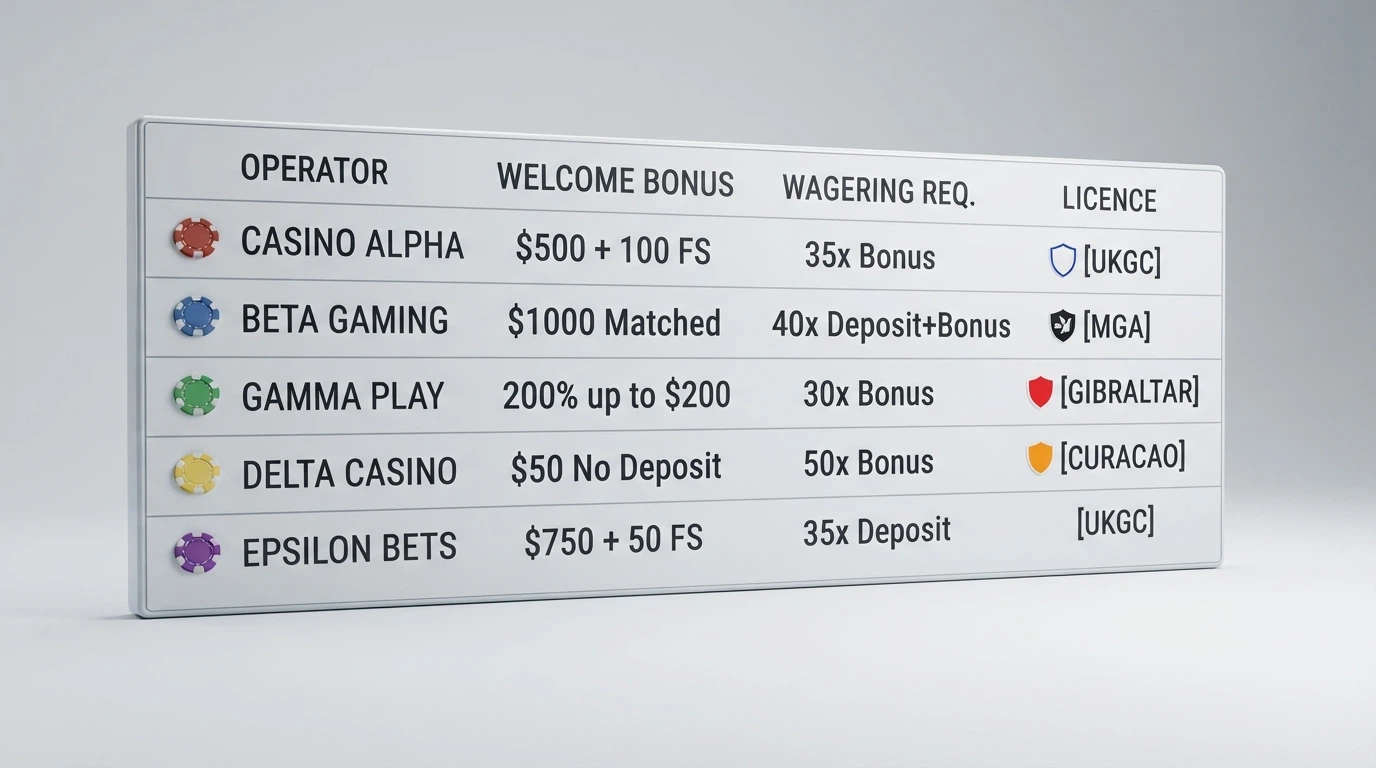
The ranking below was built from three checks applied to every operator: licence verification on the relevant regulator’s register, a bonus-terms read against the operator’s own terms page, and a withdrawal-speed check wherever third-party testing data was available. Where independent data was thin — as it was for Scream Casino and a few terms fields for the smaller operators — the gap is shown as a dash rather than papered over with a guess. No operator paid for placement and no weighting was invented to fit a preferred order.
| Operator | Licence | Welcome bonus | Wagering (bonus ×) | Crypto supported | Withdrawal speed |
|---|---|---|---|---|---|
| Stake | Curaçao (OGL/2024/1451/0918) | No standard welcome — daily races and promotions | N/A | BTC, ETH, USDT, LTC, DOGE, SOL, TRX, EOS, XRP | Near-instant to under 1 hour |
| Rocket Play | Offshore (Dama N.V.) — not AU-licensed | A$1,000 first-deposit match | 40× | BTC, ETH, LTC, DOGE, BCH, USDT | Instant crypto; 3–7 business days bank |
| Skycrown | Offshore (Hollycorn N.V.) — not AU-licensed | Up to C$7,500 + 400 free spins | 40× | BTC, ETH, LTC, USDT | 0–24 hours crypto; 1–4 days cards; 2–6 days bank |
| Royal Reels | Offshore — not AU-licensed | A$2,500 + 50 spins across three deposits | 35× (bonus only) | BTC, ETH, LTC, USDT, DOGE | PayID 5–24 hours; crypto within 1 hour |
| Fair Go | Curaçao eGaming (Deckmedia N.V.) — not AU-licensed | A$1,000 across five deposits (5 × A$200) | 30× (deposit + bonus) | BTC, ETH, LTC | BTC 35 min, LTC 18 min (third-party tested) |
| Bizzo Casino | Curaçao (8048/JAZ2017-067) + Kahnawake — not AU-licensed | A$7,250 + 175 free spins across four deposits | 40× | 22+ cryptos incl. BTC, ETH, USDT, LTC | Within 12 hours crypto |
| Rainbet | Offshore — not AU-licensed | $2,100 + 60 free spins across three deposits | 40× or no-wager gradual release | BTC, ETH, LTC, USDT | — |
| WinSpirit | Offshore — not AU-licensed | A$1,000 + 50 free spins | — | BTC, ETH, LTC | Instant LTC (third-party tested) |
| Scream Casino | Offshore — not AU-licensed | — | — | — | — |
| BitStarz | Offshore (Dama N.V.) — not AU-licensed | Up to A$10,000 or 5 BTC + 180 free spins | — | BTC, ETH, LTC, USDT, DOGE | Sub-60 minutes crypto |
Every operator on this table is offshore. None holds an Australian licence, because no Australian licence for online casino exists. The ACMA has the power to direct ISPs to block any of these services, and the blocks apply at the domain level — which is exactly why the same brands appear in the blocking register under alternative URLs after enforcement. Treat every deposit as potentially a deposit into a site the next quarterly enforcement round reaches.
Use this ranking to narrow, not to commit. The order reflects an editorial read of how the operators stack up against each other on licence transparency, bonus fairness and withdrawal-speed evidence — not a recommendation that any one of them is safe or suitable. The legal reality, the consumer-protection gap and the responsible-gambling infrastructure that exists on the licensed side all sit underneath this table and apply to every name on it.
Stake
Stake is the crypto-native giant at the top of this ranking, and the most distinctive feature of its offer to an Australian player is what is not on the page: there is no traditional welcome bonus. Stake replaced the deposit-match model with daily races, weekly promotions and a level-up rakeback structure that returns a percentage of house edge to active players. For a player who values ongoing promotional value over a single front-loaded bonus, that is a meaningful trade. For a player who wants the headline figure to compare against the rest of the table, it is a nothing.
Stake operates under Curaçao Gaming Authority licence OGL/2024/1451/0918, held by Medium Rare N.V. The library runs to 4,000-plus titles from Pragmatic Play, Evolution, Hacksaw, Nolimit City, Push Gaming and others, which is broader than any other operator in the set. Crypto withdrawals cover nine coins — BTC, ETH, USDT, LTC, DOGE, SOL, TRX, EOS and XRP — and the operator reports near-instant processing on its end, with the final settlement speed determined by the coin and the network.
The verdict on Stake depends on what the reader is optimising for. A high-volume crypto player who wants the deepest game library and the broadest coin menu, and who is comfortable forgoing a welcome bonus in exchange for daily promotional value, gets more from Stake than from any other operator in this ranking. A bonus-comparison shopper who wants a four-figure headline to clear at 35x should look elsewhere — but should also read the section that follows on what that headline actually costs.
Rocket Play
Rocket Play’s first-deposit bonus offers up to A$1,000 in matched funds at 40x wagering, with a A$30 minimum deposit and a A$7.50 maximum bet during wagering. The number that matters is the validity window: 5 days from activation. That is the shortest fuse in the set, and it materially changes what the bonus is worth. A player who lands the full A$1,000 in bonus funds owes A$40,000 in turnover and has roughly 120 hours to put it through — about A$333 an hour if they play continuously, with no margin for sleep or a session that goes cold.
Crypto withdrawals process instantly across all six supported coins — BTC, ETH, LTC, DOGE, BCH and USDT — with no platform fee, which puts Rocket Play at the fast end of the set. Bank transfer is 3–7 business days, and the A$5,000 weekly withdrawal cap is worth knowing before a big win. The no-deposit bonus carries a A$75 cashout cap, and bonus winnings overall are capped at A$5,000.
The verdict: Rocket Play is built for players who will move fast and clear the bonus inside the window. The 5-day validity is a feature for a sharp, high-volume player and a trap for anyone who treats a bonus as something to clear at leisure. If you are the second kind of player, this is not your bonus.
Skycrown
Skycrown runs the largest welcome package in the set on paper: up to C$7,500 plus 400 free spins across multiple deposits, at 40x wagering with a C$30 minimum deposit. The headline stops being impressive once the daily caps are read. The maximum withdrawal from a single bonus day is C$7,500, and crypto withdrawals are capped at A$15,000 per day — generous by industry standards, but a clear signal that the operator has thought about what happens when a player wins a meaningful amount.
Crypto withdrawals — BTC, ETH, LTC and USDT — settle inside 24 hours on Skycrown’s side. Cards run 1–4 business days with a A$5,000 daily limit; bank transfer runs 2–6 business days with a A$10,000 daily limit. The A$30 minimum across all methods is standard. The operator is Hollycorn N.V., and the licence jurisdiction was not independently confirmed for this review.
The verdict on Skycrown is a numbers verdict. A player who plans to clear a full welcome package and cash out in stages over weeks gets a bigger headline than anywhere else in the set, with daily caps that let a moderate win through and 400 free spins to extend the runway. A player chasing a single six-figure spin will hit the A$15,000 daily crypto ceiling and have to wait the next day to clear the rest.
Royal Reels
Royal Reels sits at the rare end of the wagering spectrum. Its welcome package runs A$2,500 plus 50 free spins across three deposits — 100% up to A$500 on the first, 75% up to A$750 on the second, 100% up to A$1,250 on the third — at 35x wagering on the bonus only. 35x is meaningfully lower than the 40x norm in this set, which is the headline number worth paying attention to. The other number worth paying attention to is the A$5 per-spin cap during bonus clear-down, which slows down the rate at which turnover can be put through.
PayID withdrawals handle in 5–24 hours after account checks, with a ceiling around A$9,000 per transaction. The standard weekly cap is A$10,000, and the crypto withdrawal floor is A$30 with a A$50 floor on fiat. Supported coins are BTC, ETH, LTC, USDT and DOGE.
The verdict: Royal Reels is the choice for a player who reads bonus terms before depositing and wants the lowest wagering multiple in the set. The 35x on bonus only — rather than on deposit plus bonus — is a structural advantage that compounds across the full welcome package. The A$5 per-spin cap is the speed bump; the player who accepts it gets a fairer bonus than any other operator here offers.
Fair Go
Fair Go is the RealTime Gaming veteran in the set, and the most Australian-facing of the operators ranked here in tone if not in law. The welcome package is five separate A$200 matches across the first five deposits, totalling A$1,000 at 30x on deposit plus bonus — another wagering multiple below the 40x norm, though here it applies to deposit and bonus combined rather than to bonus only. The other number to weigh is the 150-day bonus validity, which is the longest fuse in the set by a wide margin. No-deposit bonuses carry 60x wagering and a A$180 cashout cap.
Fair Go operates under a Curaçao eGaming licence, with Deckmedia N.V. as the operator. The library is RTG-only at 280 games — narrower than Stake’s 4,000 or Bizzo’s 3,000-plus, and a real consideration for a player who wants Evolution live dealer or Nolimit City. The tested withdrawal times, though, are where Fair Go earns its place in this ranking: Bitcoin at 35 minutes and Litecoin at 18 minutes in third-party testing. That is fast, and it is independently verified rather than taken from a marketing page.
The verdict on Fair Go is a specialisation verdict. A player who likes the RTG catalogue and wants the slowest-burning bonus fuse in the set, plus tested fast crypto withdrawals, gets a coherent package here. If you prioritise extensive game variety and daily-races promotional structures, however, Fair Go’s library and caps will feel overly restrictive.
Bizzo Casino
Bizzo is the only dual-licensed operator in the ranking — Curaçao Gaming Control Board under 8048/JAZ2017-067 and a Kahnawake Gaming Commission credential on top — and the operator behind it, TechSolutions Group N.V., runs a 3,000-plus game library across 70-plus providers. The standard welcome package goes up to A$7,250 plus 175 free spins across four deposits at 40x wagering, with a 14-day bonus validity and an A$8 maximum bet during wagering. The 125 free spins that drop with a A$500+ first deposit land on Big Bass Bonanza 1000, with its instant bonus round included.
The separate crypto-specific welcome bonus is the more interesting offer for an Australian crypto player. It is a 200% match up to A$800 at 40x wagering, with the bonus paid in fiat value against a crypto deposit — which is the hybrid structure that lets a player bank in USDT and still have the bonus credited in AUD. The max bet on the crypto bonus is A$6.50. Withdrawal speed on crypto runs inside 12 hours, and PayID is supported alongside the 22-plus cryptocurrencies.
The verdict on Bizzo is the dual-licence verdict. Two regulator credentials is more than any other operator in the set carries, and the crypto-specific bonus is a real product, not a relabelled standard offer. The 14-day validity is short against Fair Go’s 150 days but workable, and the game library is among the deepest in the ranking.
Rainbet
Rainbet’s welcome package is a 250% match up to $2,100 across the first three deposits, plus 60 free spins split 20 per stage — first deposit 100% up to $700 plus 20 free spins, second 50% up to $700 plus 20, third 100% up to $700 plus 20. The minimum deposit per stage is $30, and the cap per stage is $700.
What makes Rainbet worth its place is the choice the player gets on the bonus itself: 40x wager-locked, or no-wager gradual release. The gradual-release option lets a player withdraw a percentage of the bonus as they play, rather than tying the full amount up until playthrough is complete. It is the only escape hatch from the bonus-lock model in this ranking, and for a player who hates the structure of locked bonuses it is the one structural advantage on this page.
The 7-day bonus expiry from activation is the shortest window in the set — shorter than Rocket Play’s 5 days only because Rainbet’s stage structure splits the bonus across three deposits. A player who chooses the no-wager gradual-release option gives up some upside in exchange for the right to walk away mid-clear. That is a real choice the rest of this ranking does not offer.
WinSpirit
WinSpirit’s welcome offer is a 200% match up to A$1,000 plus 50 free spins, with a broader game library that includes 50-plus brand-exclusive titles. The wagering terms and validity window were not independently confirmed for this review — the gap is real and worth flagging, because the bonus terms are the part of any offer that decides what it is actually worth.
Crypto withdrawals cover BTC, ETH and LTC, and third-party testing puts Litecoin withdrawals at instant processing. That places WinSpirit at the fast end of the withdrawal-speed ranking alongside Rocket Play, on a coin the player chooses. The operator’s licence jurisdiction was not confirmed for this review, and that gap is the reason WinSpirit sits mid-table rather than higher.
The verdict is a partial-coverage verdict. A player who values brand-exclusive games and instant Litecoin withdrawals has two real reasons to look here. If you require verified wagering terms and confirmed licence jurisdiction, Bizzo or Stake remain the more transparent choices.
Scream Casino
Scream Casino is the rank’s known unknown, and that is the honest description of what could be confirmed at the time of this review. The licence jurisdiction, the operator’s corporate entity, the bonus structure, the wagering requirements, the supported cryptocurrencies and the withdrawal-speed data were all unavailable for independent verification. The operator is offshore and not Australian-licensed, which is the only statement the available evidence supports.
For a player considering Scream Casino, the absence of verification data is itself the finding. Before depositing, read the operator’s own terms page for the bonus structure and the wagering multiple, confirm the licence jurisdiction against the relevant regulator’s register, and check the operator’s domain against the ACMA’s register of blocked services. A small test withdrawal before any larger commitment is the single most useful verification a player can run.
The verdict on Scream Casino is the only verdict this page renders in those terms: do not deposit until the terms page has been read, the licence has been verified and a small test withdrawal has cleared. The ranking reflects that gate, not a quality judgement.
BitStarz
BitStarz rounds out the ranking as the multi-currency veteran with the largest bonus ceiling in the set: up to A$10,000 or 5 BTC plus 180 free spins. The operator is Dama N.V. — the same operator behind Rocket Play — and the game library runs Pragmatic Play, Evolution, BGaming and NetEnt among others. The wagering terms and bonus validity were not independently confirmed for this review.
What is confirmed is the withdrawal speed. Third-party testing puts BitStarz crypto cashouts at under 60 minutes, with BTC, ETH, LTC, USDT and DOGE all supported. That puts BitStarz inside the fast-withdrawal cluster — Rocket Play, BitStarz and WinSpirit — that distinguishes itself from the 0–24 hour tier at the middle of the set.
The verdict is a track-record verdict. A player who values a high bonus ceiling and tested sub-60-minute crypto withdrawals on a long-established operator gets a coherent offer here. The unconfirmed wagering terms are the gap a player needs to close on the operator’s own terms page before committing, exactly as with any other offer on this page.
Why Your 2026 Crypto Casino Bonus Is Smaller Than It Looks
A bonus is a turnover obligation disguised as a gift. The headline figure is what you would receive if the wagering requirement did not exist; the wagering requirement is what stands between you and any of it becoming withdrawable cash. Across the ten operators ranked above, the wagering multiples run from 30x at Fair Go to 40x at most of the rest of the set, with one escape hatch — Rainbet’s no-wager gradual-release option — and one outlier on the other end at 35x bonus-only at Royal Reels. The difference between 30x and 40x is not marginal. On a A$1,000 bonus it is the difference between A$30,000 and A$40,000 in turnover before any of it converts.

The max-bet caps during wagering are where the arithmetic turns unfriendly. Rocket Play’s A$7.50 cap, Bizzo’s A$6.50 cap on the crypto bonus, Royal Reels’s A$5 per-spin cap and Fair Go’s A$10 max bet all put a ceiling on how fast turnover can be put through — and the bonus validity window decides how much time the player has to do it. Rocket Play’s 5-day fuse on a A$1,000 bonus at 40x demands roughly A$333 of turnover per hour, which is grinding. Rainbet’s 7-day fuse on the same shape is similar. Fair Go’s 150-day fuse on a smaller bonus is the opposite — generous on time, light on turnover.
The bonus trap is that a bigger bonus can be worse than a smaller one with fairer terms. Skycrown’s A$7,500 headline costs A$300,000 in turnover at 40x; Royal Reels’s A$2,500 headline costs A$87,500 at 35x bonus-only. The first is almost four times the headline of the second, but the second costs less than a third of the turnover. A player who chooses on headline alone picks the worse deal. A player who calculates required turnover picks the better one.
Run the maths on Bizzo’s crypto-specific welcome and the picture sharpens. The bonus is 200% up to A$800 at 40x wagering. A player who lands the full A$800 in bonus funds owes A$32,000 in turnover before any of it becomes withdrawable cash. Play that A$32,000 through Gates of Olympus — the most-played Pragmatic Play pokie in the set, returning 96.50% on its highest configuration — and the statistical cost is A$32,000 multiplied by the 3.50% the house keeps, which is A$1,120 in expected loss. Assume only the bonus amount is wagered, ignore the free-spin value and do not count the deposit itself. The headline says A$800 in free money; the arithmetic says the player gives back A$1,120 to clear it. That is the bonus’s real cost, and it is an average over many spins under the stated assumptions, not a guaranteed outcome for any single session.
No-Deposit Crypto Casino Bonuses: The A$75–180 Cashout Ceiling Nobody Talks About
No-deposit bonuses carry a hard ceiling on what you can withdraw, even when the wagering requirement is cleared. Rocket Play caps no-deposit cashouts at A$75; Fair Go caps them at A$180. The marketing leads with the free-chip headline; the fine print carries the cap. A player who hits a meaningful win on a no-deposit chip at either operator is leaving the difference between the win and the cap on the table.
The wagering multiples on no-deposit offers are worse than on deposit bonuses, too. Fair Go’s deposit-match wagering runs at 30x on deposit plus bonus; its no-deposit wagering runs at 60x. A A$50 no-deposit chip at Fair Go requires A$3,000 in turnover to clear, against a A$180 cashout cap. Even at a 96%-RTP slot, the expected loss on that turnover is roughly A$120 — which is two-thirds of the maximum a player can walk away with before the cap bites.
Operators cap no-deposit cashouts for a reason, and the reason is not generosity. A no-deposit bonus is a marketing cost the operator prices in as customer acquisition. The cap is what keeps that cost bounded. A player who reads the cap before playing and treats any no-deposit win above the cap as a non-event has read the offer correctly. A player who treats the headline chip as a free shot at a life-changing payout has read it wrong.
Free Spins on Crypto Deposits: Counting the Strings Attached
Free-spin counts across the ranking run from 50 at Royal Reels and WinSpirit to 400 at Skycrown, with 175 at Bizzo, 180 at BitStarz and 60 at Rainbet sitting in between. The spin count is the headline; the wagering requirement on the winnings is the term that decides what the spins are worth.
Where the wagering is the same 40x that applies to the deposit bonus, the spins become a parallel turnover obligation rather than a free ride. Where the operator attaches a lower wagering multiple to free-spin winnings, the spins are worth more. Where the operator attaches a higher one — or excludes winnings entirely — they are worth less. The eligible-title list matters too: Bizzo’s 125 free spins drop on Big Bass Bonanza 1000 with its instant bonus round included, which is a higher-volatility game than the average free-spin allocation and changes the expected return on the spins themselves.
Max-bet caps during free-spin wagering run with the bonus terms. A player who lands 400 free spins at Skycrown and clears the winnings at 40x is doing so under the same A$8 cap that governs the deposit bonus. The spins are an extension of the bonus, not a separate offer with separate rules.
The honest read on free spins is that they extend the runway without changing the math. A bonus package with 400 free spins at 40x is a bigger turnover obligation than the same package with 50; it is not a more generous one.
BTC, USDT or AUD: Why Your Bonus Currency Choice Changes the Maths
The coin a player deposits in changes the bonus value before a single wagering dollar has been turned over. A bonus denominated in BTC is worth whatever BTC is worth on the day the bonus is cleared, not on the day it was credited. A bonus denominated in USDT is worth one US dollar per token at every moment of the clear-down. A bonus denominated in AUD against a crypto deposit sits in fiat value throughout, and the deposit-and-withdrawal leg carries the coin-price risk rather than the bonus leg.
For a player depositing in BTC and clearing a bonus over a fortnight of evening sessions, the coin-price exposure is meaningful. If BTC drops 8% during the clear-down window, the player’s bankroll is down 8% before the house edge has been applied to a single spin. The arithmetic that turns the bonus into expected loss runs on top of that. USDT and USDC — stablecoins pegged to the US dollar — remove the coin-price leg of the risk, which is why experienced players bankroll in stablecoins and treat BTC as the settlement coin rather than the session coin.
Bizzo’s crypto-specific 200%-up-to-A$800 bonus is the hybrid model: the deposit is in crypto, the bonus is credited at a fiat value, and the wagering requirement is on the fiat figure rather than on a moving coin-price target. That structure removes the volatility tax on the bonus leg specifically, while leaving the deposit leg exposed to whatever the player’s chosen coin does during the session. A player who values certainty on the bonus value and is willing to carry the volatility on the deposit is the one this structure is built for.
Crypto Withdrawals in Australia: What “Instant” Actually Means
Every crypto withdrawal runs through two stages, and only one of them is under the casino’s control. The first stage is the operator’s internal processing — the queue, the KYC screen, the fraud check, the bonus-wagering verification. The second is blockchain confirmation — the time it takes for the network to settle the transaction. “Instant” in marketing copy refers to stage one being fast. It never refers to stage two being instant, because stage two is set by the protocol.
Across the ranking, the operators split into three speed clusters. Rocket Play, BitStarz and WinSpirit sit at the fast end, with sub-60-minute crypto processing — Rocket Play’s terms page explicitly says “instant, no platform fee” across all six supported coins, and BitStarz’s third-party testing confirms sub-60-minute BTC, ETH, LTC, USDT and DOGE withdrawals. The middle cluster — Bizzo, Royal Reels and Fair Go — runs crypto withdrawals inside 1 to 12 hours, with Royal Reels’s PayID option handling in 5–24 hours and Skycrown’s crypto processing in 0–24 hours with a A$15,000 daily ceiling.
Withdrawal floors are largely standardised at A$30 across the set — Skycrown, Royal Reels and Rocket Play all name that figure. Daily and weekly caps are where the real differences show: Skycrown’s A$15,000 daily crypto ceiling is the most generous in the set, Royal Reels’s A$10,000 weekly cap is on the tighter side, and operators with no published daily cap tend to process large withdrawals in tranches rather than as single transactions.
The fastest withdrawal method for an Australian player, on the data here, is Litecoin through an operator that processes its end quickly. LTC’s block time is two and a half minutes, and Royal Reels, Fair Go and WinSpirit all settle LTC inside that window on the tested data. USDT on TRC-20 settles in roughly the same timeframe and is the second-fastest coin-by-coin option. BTC is slower on the network side, even when the operator processes its end in minutes.
How to Deposit AUD and Play With Crypto: The Cleanest Route for Australians
The cleanest deposit path for an Australian player in 2026 is not a direct AUD transfer to the casino. It is AUD to an Australian exchange, the exchange to USDT on the TRC-20 network, and USDT on to the offshore casino. CoinSpot and Independent Reserve are the two exchanges this route typically runs through; both are AUSTRAC-registered, both require identity verification at sign-up, and both support TRC-20 USDT withdrawals.
The reason the route is indirect is the bank layer. CommBank and Westpac silently restrict outbound transfers to crypto exchanges — the transfer fails or sits in review without an explicit decline. ANZ and NAB flag outbound exchange transfers without fully blocking them. ING and Macquarie are the most permissive of the major Australian banks. A player whose primary bank is CBA or Westpac is most likely to find that the first AUD-to-exchange transfer does not go through cleanly and that the second requires a phone call to the bank’s fraud team.
The reverse path — cashing crypto winnings out to an Australian bank account — runs exchange to AUD then AUD to bank. The timing on the exchange side is faster than the bank side, and the bank transfer typically clears inside one to two business days. AUSTRAC’s Travel Rule applies to crypto transactions at A$10,000 and above, which is the threshold at which the exchange will require additional reporting on the receiving party. For a player moving typical session-bankroll amounts, the Travel Rule does not apply.
The cleanest route, then, is the AUD-stablecoin-stablecoin-AUD loop, and the practical friction is at the bank-to-exchange leg rather than at the casino leg. A player who picks a permissive bank, a registered exchange and USDT on TRC-20 will get through with fewer interruptions than a player who picks a restrictive bank and tries to send BTC.
The Legal Reality: Crypto Casinos and Australian Law in 2026
Online casino is illegal to provide in Australia. The Interactive Gambling Act 2001, in force since 2001 and materially strengthened by amendments in 2017, makes it an offence for any provider to offer online casino games, online pokies, scratchies or in-play sports betting to a person in Australia. No licence for online casino exists anywhere in the country — not federally, not in any state or territory. The Australian Communications and Media Authority enforces the prohibition, investigates complaints, issues formal warnings and civil penalty proceedings, and directs Australian ISPs to block illegal services. Penalties for licensed operators that breach the credit-and-crypto payment ban run to A$247,500 per offence.

The enforcement record is not theoretical. Since the ACMA’s first blocking request in November 2019, 1,518 illegal gambling and affiliate websites have been blocked by Australian ISPs. More than 220 illegal services have withdrawn from the Australian market since the 2017 enforcement strengthening. In Q3 2025 alone, the ACMA received 411 complaints, completed 29 investigations into 30 sites, found 44 breaches, issued 20 formal warnings and referred 71 websites for ISP blocking. 85% of the Q3 complaints were valid and investigable under the IGA. In Q4 2025, 133 websites were blocked, including alternate domains set up to evade the blocks — fairgo.com, fairgo.info, fairgocasinokev.com, b1tstarz8.com, casinorocket4.com, ozwinfun.com all on the list.
The individual player is not prosecuted. Section 8AA of the IGA targets the provider, not the person in Australia. What the player loses is everything else: no BetStop coverage at offshore sites, no ACMA dispute resolution, no Australian Consumer Law protection, and the standing risk that the site they are using is on the next blocking list. The ACMA’s own consumer-facing material puts the consumer-protection gap plainly: illegal operators let you deposit, but block access to winnings. That is the consumer-protection reality at every site on this page.
The credit-and-crypto payment ban, in force since 11 June 2024, adds a second layer. Crypto as a payment method for licensed Australian wagering is prohibited, with penalties of up to A$247,500 for the licensed operator that fails to enforce it. The ban applies to the licensed side. The offshore crypto casino, by definition, is not on the licensed side — and that is the structural reason crypto deposits route through Curaçao-licensed sites rather than through domestic operators.
What the 2026 Gambling Reform Bill Changes for Australian Crypto Players
The Interactive Gambling Amendment (Gambling Reform) Bill 2026 passed Parliament on 19 August 2026, and its measures commence on 1 January 2027. The bill is aimed at the licensed wagering market rather than the offshore crypto market, but two of its provisions matter directly to an Australian crypto casino player.
The first is the bank-blocking power. From 1 January 2027, banks and payment providers gain express authority to block transactions to illegal gambling operators. That power is new — the IGA previously targeted the provider, not the payment rail. A player whose bank invokes the new power against a transfer to an offshore crypto casino will see the transfer declined, and the casino will see the deposit fail. The practical effect is to add a banking-layer enforcement tool on top of the existing ISP-blocking tool, and the two combined make the offshore route harder to fund, not harder to find.
The second is the advertising and inducement reform on the licensed side. Wagering advertising is capped at three ads per hour on TV between 6am and 8.30pm, with a live-sport blackout from 15 minutes before to 5 minutes after a sporting event. Athletes, celebrities and influencers are barred from promoting wagering. Online wagering ads are shown only to verified over-18 users with an opt-out. Direct marketing of inducements is prohibited for 14 days after sign-up and for three months after BetStop deregistration, and indefinitely for at-risk customers.
The licensed-side reforms do not legalise or legitimise the offshore crypto casino. They tighten the licensed market around it. For an Australian crypto player, the practical changes are on the payment rail — a transfer to an offshore operator is more likely to be declined in 2026+1 than it was in 2026 — and on the inducement infrastructure of the licensed market that sits alongside it.
Offshore Casino vs Licensed Australian Wagering: What You Give Up
The consumer-protection gap an Australian player accepts the moment they deposit at an offshore crypto casino is wide, and it is worth listing it once in full because every other section of this page assumes it.
- No BetStop coverage. BetStop — the National Self-Exclusion Register, launched 21 August 2023 — binds Australian-licensed wagering services only. An offshore crypto casino is not licensed in Australia, is not connected to the register, and will keep accepting a self-excluded person’s deposits. Self-exclusion at an offshore site must be requested individually with each operator and is not enforced across operators. As of 30 September 2025, 31,838 people held active BetStop exclusions; for each of them, the offshore crypto casino remains open.
- No ACMA recourse. The ACMA enforces the prohibition against providers. It does not arbitrate player disputes, does not recover funds and does not compel an offshore operator to pay a withdrawal. A player whose winnings are held by an offshore operator has, in practice, the operator’s own complaints process and the licence complaint to Curaçao or Kahnawake — neither of which guarantees a result.
- No Australian Consumer Law protection. The Australian Consumer Law applies to goods and services supplied in Australia. An offshore operator is not supplying in Australia within the meaning of the Act, and the consumer guarantees — acceptable quality, fitness for purpose, matching description — do not travel with the deposit.
- The site can be blocked with your balance still on it. The ACMA’s blocking power operates at the domain level, and the block takes effect across Australian ISPs. A player with a verified account balance at a blocked site has, in principle, the same offshore-operator recourse as a player whose withdrawal is being refused for any other reason — which is to say, very little.
- The licensed-side infrastructure that exists does not travel. The National Gambling Helpline (1800 858 858, free, confidential, 24/7), Gambling Help Online (gamblinghelponline.org.au) and BetStop itself are Australian services. They remain available to anyone in Australia who wants to use them, regardless of where they play. The infrastructure on the licensed side — deposit limits, activity statements, intervention by the operator — does not.
The harm context is the part of the picture that does not go away when the player switches from licensed wagering to offshore crypto. About 2.1% of Australian adults — roughly 430,000 people — experience problem gambling. Risky-gambling scores climbed from 13.7% in 2024 to 19.4% in 2025, almost doubling since the COVID lockdowns. 5.9% of adults reported being harmed by another person’s gambling in 2025. The offshore casino does not create those numbers. It operates on top of them, with fewer brakes.
Crypto Pokies and Slots: The Titles AU Players Actually Spin
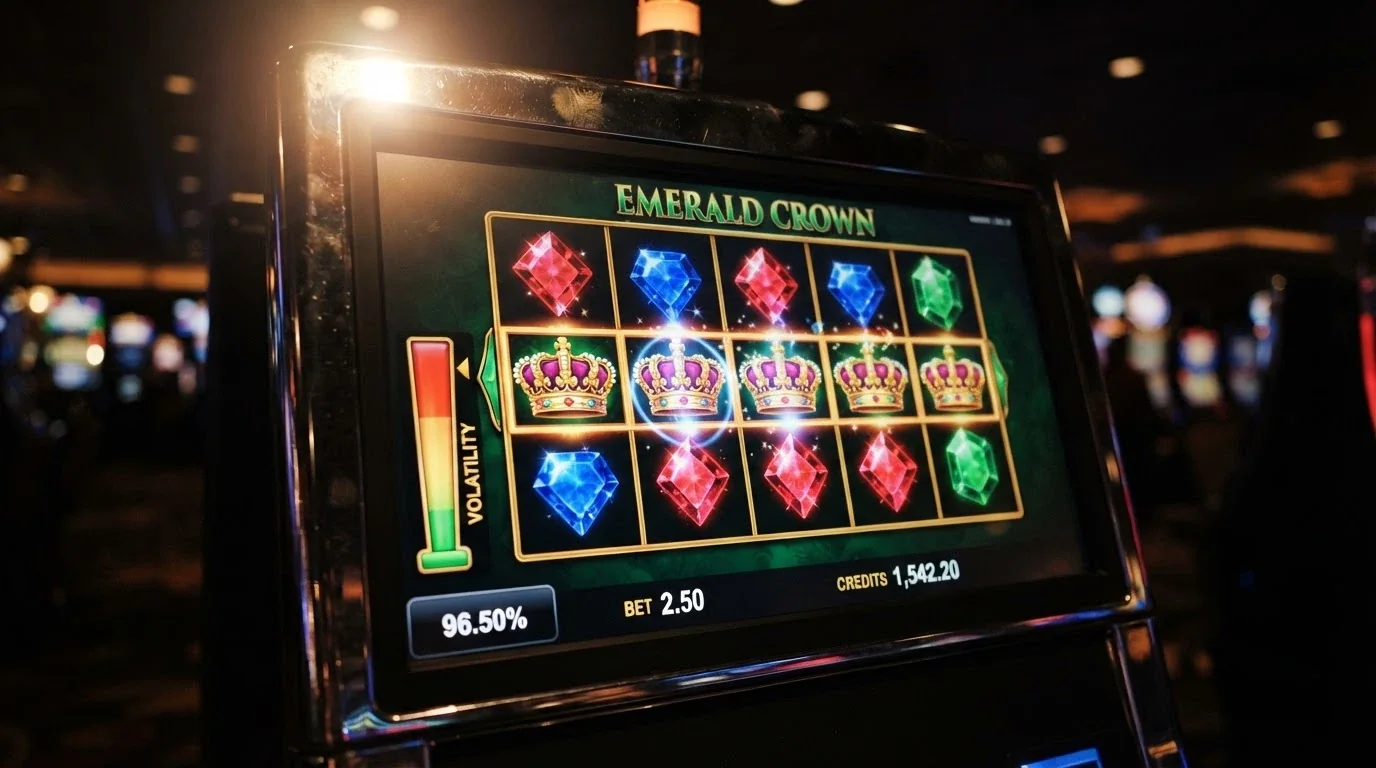
Seven titles dominate the crypto-pokies conversation, and the verified RTP, volatility and provider data is below.
| Slot title | RTP | Volatility | Provider |
|---|---|---|---|
| Gates of Olympus | 96.50% | Very High | Pragmatic Play |
| Sweet Bonanza | 96.48–96.51% | High | Pragmatic Play |
| The Dog House Megaways | 96.55% | Very High | Pragmatic Play |
| Sugar Rush 1000 | 96.53% | Very High | Pragmatic Play |
| Big Bass Bonanza | 96.71% | High | Pragmatic Play |
| Book of Dead | 96.21% | High | Play’n GO |
| Wolf Gold | 96.01% | Medium | Pragmatic Play |
The first thing to read from this table is the RTP spread: 96.01% at Wolf Gold to 96.71% at Big Bass Bonanza, with most of the cluster between 96.4% and 96.6%. On the surface, that is a tight band — 70 basis points — and the practical difference between 96.0% and 96.7% over A$10,000 in turnover is A$70 in expected house take. It matters less than it looks at the session level and more than it looks over thousands of spins.
The second thing to read is the Pragmatic Play share. Six of the seven titles are Pragmatic Play. That concentration is real across the crypto casino landscape, and it carries a structural implication the marketing will not tell you: Pragmatic Play slots ship with multiple selectable RTP configurations, from 96.5% down to 94.5% or lower, and the operator selects which configuration to deploy. Two casinos running Gates of Olympus can be running the same title at different RTP levels without the player ever knowing. The “RTP 96.50%” figure on a slot info page is the configuration that operator chose to publish. A player at one casino can be playing a 96.5% game while a player at another casino plays the same title at 94.5%, and the only place that difference shows up is in the long-run return.
The volatility column tells a different story. Gates of Olympus, The Dog House Megaways and Sugar Rush 1000 are all rated Very High — which means long dry patches punctuated by occasional large hits. Sweet Bonanza, Big Bass Bonanza and Book of Dead are High. Wolf Gold is the only Medium-volatility title in the set. A player who wants a slower burn and more frequent small wins gets Wolf Gold; a player who wants the chance at a max-win figure of 21,100x on Sweet Bonanza or 25,000x on Sugar Rush 1000 pays for that chance in dry sessions.
The max-win column is where the headline-grabbing figures live. Sweet Bonanza’s 21,100x and Sugar Rush 1000’s 25,000x are the upper ends of the cluster. The Dog House Megaways’s 12,305x and Gates of Olympus’s 5,000x sit lower. None of these max-win figures is a probability statement — they are the ceiling of what the math permits on a single spin, not what a player should expect from a session.
Real-Money Crypto Pokies vs Free-Play Demos: Where to Start
Demo mode is the cheapest way to learn a slot’s volatility and feature rhythm, and most operators in this ranking run demos on at least the major titles without requiring a deposit. A player who has not played Gates of Olympus or Sugar Rush 1000 before committing real money gets more useful information from 200 free-play spins than from any review or paytable.
What demo mode teaches that a paytable cannot is the gap between spins in the base game and the bonus round. Very-high-volatility Pragmatic Play titles run long base-game stretches with small returns and concentrate the payout mass in the bonus feature. A player who experiences that rhythm in demo mode goes into real-money play with a calibrated expectation. A player who has only read the paytable expects something closer to a steady drip and is surprised by the dry patches.
The transition from demo to real-money play changes three things. The first is the house edge, which is the same in both modes — the RNG does not know which mode it is running. The second is the bankroll exposure, which is real in real-money mode and notional in demo. The third is the bonus terms, which apply only once a deposit has been made and a bonus has been claimed. A player who demos a slot, then claims a bonus with 40x wagering and plays that slot to clear it, is running an experiment the demo did not prepare them for.
How Crypto Volatility Compounds Your Pokies Risk
The risk profile on a crypto-casino pokies session has two layers, and the second layer is invisible until it bites. The first is slot variance — the dry-patch-versus-big-hit distribution the volatility rating describes. The second is coin-price variance on the bankroll. A player who deposits 0.1 BTC at A$100,000 a coin is playing with a A$10,000 bankroll. If BTC drops to A$92,000 during the session, the bankroll is A$9,200 before the house edge has been applied to a single spin. Slot variance runs on top of that. A losing session compounded by a falling coin price is a worse outcome than either risk alone, and a player who bankrolls in BTC rather than USDT is exposed to both at once.
USDT and USDC remove the coin-price leg of the risk. A USDT bankroll is a US-dollar bankroll at every moment of the session, regardless of what BTC is doing. That is why experienced players bankroll in stablecoins and treat BTC as the settlement coin on the way in and the way out. The 8% BTC drop that wipes 8% off a BTC bankroll leaves a USDT bankroll untouched.
The Pragmatic Play multi-RTP layer compounds the second layer still further. A player at one casino playing Gates of Olympus at 96.50% and a player at another casino playing the same title at 94.5% are running different house edges — 3.50% versus 5.50% — on the same game. The lower-RTP configuration drains the bankroll faster by 2 percentage points of turnover, which compounds across the wagering requirement on any bonus. Two casinos running the same Pragmatic Play title at different RTP configurations are not offering the same game at the same price.
No-KYC Crypto Casinos: The Promise and the Reality for Australian Players
“No KYC” is the marketing line the offshore crypto casino leans on hardest, and it is the line that breaks first when a player tries to cash out. Above USD$2,000–3,000 in cumulative withdrawals, almost every operator in this ranking triggers identity verification — a driver’s licence, a proof of address, sometimes a source-of-funds check. The “no KYC” claim refers to the deposit and the small-win withdrawal. The reality is that a meaningful withdrawal will require documents, will take days to clear and will expose the player’s identity data to an operator with no Australian privacy-law obligation.

The threshold is consistent across the operators reviewed. The same cumulative-cashout figure — USD$2,000 to USD$3,000 — was the trigger point at almost every brand. A player who plans to withdraw less than that over the life of the account will not hit the KYC wall. A player who wins a four-figure session and tries to cash it out will.
The marketing claim is not a lie. It is a misdirection. “No KYC” describes the first stage of the relationship. The second stage — when the player has won and wants the money — runs through the same KYC process a licensed Australian operator would apply, with one critical difference: the offshore operator has no obligation under Australian privacy law to protect the data they collect. The documents sit on a server outside Australia, governed by whatever privacy regime applies in the operator’s home jurisdiction.
What Happens When KYC Triggers: The Documents, the Delay and the Risk
KYC at an offshore crypto casino typically requests a government-issued photo ID — driver’s licence or passport — plus a proof of address issued within the last three months — a utility bill, a bank statement. Some operators add a source-of-funds check at higher withdrawal thresholds or for players whose deposit pattern flags as unusual. The document submission is digital, usually through a portal on the operator’s site, and the verification window runs from a few hours at the fast end to several business days at the slow end.
The data-privacy implication is the part of KYC the marketing does not lead with. The documents an Australian player submits to an offshore operator sit on infrastructure governed by the operator’s home-jurisdiction privacy regime rather than the Privacy Act 1988. The Australian Privacy Principles do not apply. The Office of the Australian Information Commissioner has no jurisdiction. If the operator is breached, or if the data is sold or shared with an affiliate, the player’s recourse is whatever the operator’s home jurisdiction provides — which is typically less than what Australian law provides.
If KYC verification stalls or is rejected, the realistic options are limited. The operator’s complaints process is the first step; the licence complaint to Curaçao or Kahnawake is the second; a chargeback through the player’s bank is the third — and the third option depends on whether a card was involved, which is itself restricted under Australian rules. A player who has reached the KYC threshold and is hitting a wall at verification is, in practical terms, negotiating with an offshore entity under an offshore legal regime. That is the consumer-protection reality underneath the “no KYC” marketing.
Crypto Casinos on Mobile: Playing Pokies From Your Phone in 2026
Most crypto casinos run on a mobile-optimised browser interface rather than a dedicated app, and the practical experience from a phone is functionally identical to the desktop experience for depositing, playing and withdrawing. Stake, Rocket Play, Skycrown, Royal Reels, Fair Go, Bizzo, Rainbet, WinSpirit and BitStarz all operate through the mobile browser. The few operators that ship a dedicated app distribute it through direct download from the operator’s site rather than through the Australian App Store or Google Play, because the ACMA’s blocking regime applies to the app as well as to the domain.
Game compatibility on Australian mobile networks is not the friction point it was five years ago. The major studio libraries — Pragmatic Play, Evolution, NetEnt, BGaming, Play’n GO — render cleanly on modern smartphone browsers, and live dealer tables from Evolution stream at the bandwidth a 4G or 5G Australian mobile connection handles comfortably. The screen-size constraint on pokies is real but mild: cluster-pays grids like Gates of Olympus and Sugar Rush 1000 scale down well, and the spin controls remain legible at standard phone resolutions.
The practical experience from a phone — open the browser, log in, deposit via USDT on TRC-20 from the player’s wallet, claim the bonus, play, withdraw — runs end-to-end without a desktop session. The phone is not a constrained version of the casino. For most players in 2026 it is the casino.
How We Chose and Ranked These Crypto Casinos
Three sources fed this review. The first was the operator’s own terms and conditions pages, read for the bonus structure, the wagering multiple, the maximum bet during wagering, the bonus validity window and the max cashout from the offer. The second was the relevant regulator’s register — the Curaçao Gaming Authority verification page, the Kahnawake Gaming Commission register — for licence verification. The third was independent third-party withdrawal testing, available in patchy form for a subset of the operators.
Every operator was checked against the ACMA register of blocked services, which is the Australian-side context this ranking operates within. 1,518 illegal gambling and affiliate websites have been blocked since November 2019, and the blocks continue at a quarterly cadence. The ACMA’s own description of the consumer-protection gap — illegal operators let you deposit, then block access to winnings — is the operational reality underneath the licence numbers and the bonus headlines.
The criteria that ordered the ranking were licence transparency, bonus-term fairness, withdrawal-speed evidence and game-provider quality. Where independent data was thin, the gap is shown rather than smoothed. No operator paid for placement. No weighting was invented to fit a preferred order. The ranking is an editorial read of the available evidence, and the evidence varies in depth across the ten operators named.
The competitor landscape the page sits inside is dominated by affiliate listicles testing offshore crypto casinos — Pokiesaustralia.com, Australiangamblers.com, Payoutverdict.com, Bitcoincasinoz.net, Casipto.com — most of which lead with bonus headline and skip past the IGA prohibition, the ACMA blocking record, the BetStop coverage gap and the harm context. This page sits closer to the ACMA register than to the affiliate listicle. That is a deliberate choice, and the choices in the ranking follow from it.
The Bottom Line: What Every Australian Crypto Player Needs to Know Before Depositing
The honest trade-off at an offshore crypto casino is a clean one. The player gets speed, game variety and crypto-native features — wallet-to-wallet deposits, sub-hour crypto withdrawals on the fastest operators, 3,000-to-4,000 game libraries, provably fair mechanics on the titles that support them — that licensed Australian wagering does not offer, because licensed Australian wagering does not offer online casino. The player gives up every consumer protection the licensed side provides: no BetStop coverage, no ACMA dispute resolution, no Australian Consumer Law, no Privacy Act protection on the documents the operator collects.
The non-negotiable pre-deposit checklist is four items. Verify the licence number on the regulator’s own register before depositing anything. Read the bonus terms — wagering multiple, max bet, validity window, max cashout — before claiming anything. Test a small withdrawal before committing more than you can afford to lose at that operator. Set a loss limit before the first session and stop at it, because the offshore operator has no deposit ceiling, no session reminder and no exclusion infrastructure the player can lean on.
The smartest Australian crypto player treats every deposit as expendable and every bonus as a liability until cleared. A bonus that costs A$1,120 in expected loss to clear an A$800 headline is not a gift — it is a margin-extraction mechanism dressed as a welcome. The arithmetic that turns the headline into the real cost is the same arithmetic the operator runs in reverse to price the offer. A player who runs it first is harder to extract from.
The harm-awareness bottom line is the part that does not depend on which operator a player picks. The National Gambling Helpline is 1800 858 858, free, confidential and staffed 24 hours a day. Gambling Help Online, at gamblinghelponline.org.au, runs free 24/7 chat and email counselling. BetStop, at betstop.gov.au, is the National Self-Exclusion Register — covering Australian-licensed wagering, not offshore crypto casinos. About 2.1% of Australian adults experience problem gambling; risky-gambling scores climbed from 13.7% in 2024 to 19.4% in 2025; 5.9% of adults reported being harmed by another person’s gambling. Those numbers are the population a crypto casino operates inside, and they are the reason the consumer-protection infrastructure exists on the licensed side. The infrastructure does not travel with the deposit.
Frequently Asked Questions
Which cryptocurrencies can I use at Australian crypto casinos?
BTC, ETH, LTC, USDT and DOGE are the constants across the ranked set — present at every operator that names its supported coins. SOL, TRX, XRP, EOS and BCH appear at a smaller subset. PayID sits alongside crypto on Bizzo for AUD deposits. Most operators list five to ten coins; Bizzo tops the field at twenty-two plus.
Are crypto casino winnings taxable in Australia?
No. Under section 6-5 of the ITAA 1997, gambling winnings are not assessable income for an ordinary punter, and losses are not deductible under section 8-1. The ATO has not assessed casual winnings in any Australian case. The rule holds whether the win is paid in BTC, USDT or AUD — and changes only if gambling is the person’s business.
What can I do if an offshore crypto casino refuses to pay out?
Realistically, very little. The ACMA cannot recover funds from an offshore operator and does not arbitrate disputes. Your avenues are the operator’s own complaints process, a licence complaint to Curaçao or Kahnawake, or a chargeback through your bank if a credit card was involved — itself restricted. The realistic protection is a small test withdrawal before depositing more.
Does BetStop protect me at a crypto casino?
No. BetStop — the National Self-Exclusion Register — covers Australian-licensed wagering only. Offshore crypto casinos are not connected to the register. A self-excluded person can still deposit, play and withdraw at every operator on this page. Self-exclusion at an offshore site must be requested individually and is not enforced across operators.
What is the minimum deposit at Australian crypto casinos?
Minimums sit between A$30 and the C$30 equivalent across the featured set. Rocket Play, Skycrown and Rainbet all start at A$30. Bizzo’s standard welcome opens at A$20 on the first deposit, with the larger free-spin tier requiring A$500. Royal Reels mirrors the A$30 floor. Few operators drop below that level for crypto.
Anonymous Crypto Gambling in Australia: How Far Does It Really Go?
True anonymity at an Australian-facing crypto casino is rare, and the reasons are structural rather than regulatory.
The first reason is the blockchain ledger. Every deposit and every withdrawal is a public transaction tied to a wallet address. The wallet address is pseudonymous, not anonymous, and the bridge to a real-world identity runs through the exchange the player bought the coin at. CoinSpot and Independent Reserve — the two Australian exchanges the cleanest deposit routes run through — hold verified identity on every account. The exchange KYC happens before the player ever reaches the casino, and the casino can request exchange records if a dispute arises.
The second reason is AUSTRAC’s Travel Rule. Reporting kicks in at A$10,000 for crypto transactions, which means any single transfer at or above that threshold triggers exchange-side reporting to AUSTRAC. For a player moving session-bankroll amounts — A$100, A$500, A$2,000 — the Travel Rule does not apply. For a player moving a large win, it does.
The third reason is the casino-side KYC threshold described above. Even where the exchange layer and the Travel Rule would otherwise leave the player pseudonymous, the casino’s own USD$2,000–3,000 cumulative-cashout trigger forces an identity check at the withdrawal stage. A player who manages to stay under that threshold across the life of the account retains more anonymity than a player who does not. A player who wins a meaningful amount does not.
The practical limit on anonymity for an Australian crypto casino player is therefore set by the operator’s KYC threshold and the exchange’s KYC at the funding stage. The blockchain layer is pseudonymous throughout, but pseudonymity is not anonymity, and the bridges to identity are well-instrumented.
Which Crypto Casinos Work Best on an Australian Mobile?
The mobile experience across the ranking is more uniform than the desktop experience, because the underlying software stack is similar and the screen-size constraint flattens some of the differentiation. That said, three operators stand out on specific mobile dimensions.
Stake’s mobile interface is the cleanest in the set, because the operator built crypto-native UX first and adapted it to mobile rather than the other way around. The game grid loads quickly, the wallet-to-deposit flow is short, and the in-play interface on sports — for players who use Stake’s sportsbook alongside the casino — is built for thumb navigation. BitStarz runs close behind, with a mobile interface that handles the 4,000-plus game library through search and filter rather than scrolling. Bizzo’s mobile experience is solid at the bonus-claim and deposit stages, with PayID integration that works well on a phone browser.
Game-loading speed on Australian mobile networks favours the operators with the lightest client overhead. The HTML5-only operators — most of the Pragmatic Play and Evolution-powered lobbies — load faster than operators running heavier client-side frameworks. That difference is small on a fast connection and meaningful on a slow one.
The deposit and withdrawal flow on mobile is where the differences narrow most. USDT on TRC-20 from a phone wallet to an offshore casino is a copy-paste of the deposit address, a confirmation in the wallet app, and a refresh on the casino page. That flow runs identically across the ranking on mobile. The friction sits at the bank-to-exchange leg, which is the same on a phone as on a desktop.
Created by the ”Online Pokies Real Money” editorial team.