
Casinos Not on BetStop in Australia: The 2026 Offshore Casino Review
 Available in AU
If you’ve searched for a “best casino not on BetStop Australia,” you already know what the term promises: a place to play online casino games after asking the licensed Australian market to lock you out. That promise is real, and so is its cost. Every casino on this page sits outside the Interactive Gambling Act 2001. None is licensed in Australia. None connects to BetStop. Every bonus carries conditions the marketing page buries. This guide lays out which casinos took an Australian dollar and which facts stayed unconfirmed, then hands the trade-off to you.

Verified against the ACMA investigations page, BetStop statistics and operator terms pages as of 18 October 2026.
Table of Contents
- What This Guide Actually Ranks — And What It Can’t
- Why Every Casino on This Page Sits Outside the Australian Rulebook
- 10 Offshore Casinos Ranked — What We Could Verify and What Stayed Hidden
- Why Your 2026 Bonus Is Smaller Than the Headline Number
- The Payment Rails That Work at Casinos Not on BetStop — And the One That Is a Red Flag
- Pokies, Live Tables and the Games You Will Actually Find Off-Register
- The Safety Net You Leave Behind When You Step Off BetStop
- How We Selected and Ranked These Casinos
- The Trade-Off No Welcome Bonus Can Settle for You
- Frequently Asked Questions
What This Guide Actually Ranks — And What It Can’t
The phrase “best casino not on BetStop” sounds like a comparison question. It is also a legal one. There is no Australian licence for an online casino — not federally, not in any state or territory, not anywhere in the country. The Interactive Gambling Act 2001 makes providing one an offence. So the only casinos that will accept a self-excluded Australian are the ones that never had to comply with the rule in the first place.
That is the structural fact this page sits on. It does not pick the safest offshore casino for an Australian player because there is not one in the regulatory sense. It compares the operators that took Australian money anyway, on the criteria a reader can actually check. The individual player is not prosecuted under the Act. The casino is. Neither fact gives the player an Australian regulator to complain to if the withdrawal stalls.
What “Best Casino Not on BetStop” Actually Describes
The search belongs to a specific reader. Five million Australians wager each year. About 400,000 of them are high-risk. Roughly 30,000 have an active BetStop exclusion. That gap — 400,000 high-risk and 30,000 self-excluded — is who lands on this page. Some are the registered player looking for a way around their own exclusion. Others are weighing a casino offer against the BetStop option they were never quite ready to take.
Both readers ask the same question: will this casino actually let me play? The answer is almost always yes. That is what “not on BetStop” means in practice: the casino is licensed somewhere offshore, accepts Australian deposits, and has no connection to the Australian register. The legal position is that the casino is providing a prohibited service under the IGA. The player carries no Australian consumer protection, no BetStop coverage, and no recourse if a withdrawal stalls.
This page does not pitch itself as a recommendation. It is a comparison. The ranking here is ordered by how much we could verify about each operator, not by which one we would pick for ourselves. BetStop binds about 150 licensed Australian wagering providers. An offshore casino is not on that list because it was never eligible to join.
How We Weigh the Picks on This Page
Four filters ordered the ten operators below. None of them is “best casino overall” — there is no global answer to that for Australian players, because none of these casinos holds an Australian licence.
- Relevance to Australian players. Some offshore casinos target many markets and treat Australia as one of dozens. The picks on this page are casinos that Australian-facing affiliates actually feature, with AUD support and AU-friendly payment rails.
- Licence transparency. A casino that names its licence jurisdiction and ideally a licence number ranks higher than one that names neither. The Curaçao Gaming Control Board register was the primary verification source.
- ACMA enforcement status. The ACMA’s investigations page and blocked-site list were checked. A finding under section 15(2A) of the IGA is a real-world signal that the regulator considers the operator to be in breach.
- Completeness of verifiable data. Welcome bonus, wagering multiple, free-spin counts, payment methods and withdrawal terms were checked where published. Where the casino’s own terms page did not say, this page does not invent the figure.
The order is not a verdict. It is a ranking of how much the casino was willing to disclose and how much of that disclosure could be checked against an independent register.
Why Every Casino on This Page Sits Outside the Australian Rulebook
The offshore status of these casinos is not a footnote. It is the starting condition.
What “Not on BetStop” Means — And What It Doesn’t
BetStop is a national register, but it is a national register of licensed Australian wagering providers. About 150 of them connect to it. The register launched on 21 August 2023 and had recorded 67,480 registrations by 31 July 2026, with 41,290 active exclusions. A single registration blocks the person from every licensed Australian online and phone wagering service at once.
An offshore casino is not “off BetStop” in the way a licensed bookmaker might be off BetStop — say, a brand the player has not registered with. It is off BetStop because it was never eligible to be on it. BetStop’s reach ends at the Australian border. A Curaçao-licensed casino does not connect to the register because no Australian regulator has authority over its licence.
This is the practical result. Self-excluding through BetStop blocks the player from the licensed Australian market and does nothing about an offshore casino. The casino, meanwhile, has no obligation to honour the Australian exclusion — and no ability to check it. The 1,788 sites the ACMA has blocked since November 2019 are a list of operators the regulator treats as outside the law. Most of the operators on this page appear on it, or on the investigations page that precedes it.
The BetStop Register That Enforces Self-Exclusion — For the Licensed Market Only
BetStop’s mechanics are simple. One online registration. Three-month minimum exclusion. Lifetime maximum. The exclusion covers every licensed wagering provider — online, phone, anywhere they take bets on sport or racing in Australia. Marketing to excluded customers is prohibited.

By mid-2026, the demographic profile of registrants skewed young: 78% under 40, and 38% chose lifetime exclusion. That concentration in younger adults maps onto the awareness gap the regulator faces. Only about a third of Australian wagerers — 33.5% — know BetStop exists. Among all Australian adults, awareness sits at 26.5%. The tool exists. The reach is partial.
From 1 January 2027, the 2026 reform strengthens the register’s surrounding framework. Direct marketing of inducements will be prohibited for three months after a person deregisters from BetStop, and indefinitely for customers identified as at risk of gambling-related harm. The register’s coverage of operators does not change. That is the limit of what BetStop can do.
The Route That Exists Inside the Licensed Australian Market
The Australian framework does not ban gambling. It bans the product this page is about: online casino games, online pokies and in-play sports betting. What remains legal is wagering on sports and racing placed before the event begins, plus lotteries and keno (online keno to be banned from 1 January 2027).
The licensing is state-based. The Northern Territory Racing and Wagering Commission, run through Licensing NT, is the de facto national licensor for online wagering, with terms running up to 20 years. Operators pay point-of-consumption tax where the customer is. The NT charges 5% wagering tax plus a 0.05% racing levy; the states set their own POC tax, typically in the 10–15% range. Wagering companies paid a combined $1.13 billion in state levies and betting taxes in 2023–24.
The licensed market also sets payment rails. From 11 June 2024, credit cards, credit-related products and crypto are banned as payment for online wagering. Penalties for failing to enforce the ban reach $247,500. Legal deposit routes are debit cards, bank transfer, PayID and BPAY. Minimum age for any commercial gambling in Australia is 18.
That payment-method list is the diagnostic tool this page uses downstream. A site asking for a credit card or crypto is signalling — by the rails it accepts — that it sits outside the Australian rulebook. It is the same way a player can tell a building is not a licensed premises from the sign on the door. The internal fittings vary; the regulatory status is on the rails.
New and Mobile Casino Formats Operating Off the Register
The offshore market keeps adding storefronts. Mobile-first casinos, crypto-native brands, hybrid sweepstakes models — they target Australian players through affiliate sites and search ads, the same way the established brands do. The legal status does not change with the format. The IGA prohibition covers online casino regardless of whether the casino is a desktop lobby, a mobile app or a Telegram channel. New does not mean licensed. The amendment strengthening the prohibition in 2017 did not draw a carve-out for newer formats, and neither does the 2026 reform.
10 Offshore Casinos Ranked — What We Could Verify and What Stayed Hidden
The comparison below is not a buyer’s guide. It is the set of operators Australian-facing affiliates feature most often, ranked by how much each one was willing to disclose — and how much of that disclosure could be checked against an independent register.
Comparison at a Glance
| Operator | Licence | ACMA Status | Free Spins | Key Payments |
|---|---|---|---|---|
| RocketPlay | Curaçao (OGL/2024/1307/0748) | — | 100 | PayID, cards, crypto, Skrill, Neteller, Neosurf |
| Skycrown | Curacao | Found in breach (s 15(2A)) | 400 | PayID, cards, crypto |
| Neospin | Curacao | Domains on blocked list (Q4 2025) | 300 + 100 ND | PayID, cards, Neosurf, crypto |
| Royal Reels | — | ISP-blocked July 2023 | — | — |
| WinSpirit | — | Four domains blocked July 2025 | — | — |
| Stake | Curacao | — | — | Crypto-primary |
| Fair Go | — | Found in breach (s 15(2A)); domains blocked | 30 ND | PayID, Neosurf, Bitcoin, cards |
| Bizzo | Curacao | Found in breach (s 15(2A)); site blocked | 150 + 10 ND | PayID, cards, Neosurf, crypto |
| Rainbet | — | — | — | — |
| Scream Casino | — | — | — | — |
The blanks in this table are not typos. They are the gaps that research could not close. An em dash means the operator did not publish the figure in a way that could be checked against an independent register, or did not publish it at all.
RocketPlay: 3,000+ Games and a Verifiable Curaçao Licence
RocketPlay is the most thoroughly documented operator in this set. The licence is specific: Curaçao Gaming Control Board, number OGL/2024/1307/0748, held by Scores55 Tech B.V., registered in Curaçao (registration 162990). That is a number that can be checked against the regulator’s register rather than a vague reference to “Curacao” that cannot.
The welcome offer is also on the record. First deposit: 100% match up to AUD 500 plus 100 free spins. Wagering: 40x the bonus amount. Max bet during wagering: AUD 7.50. PayID deposits have a minimum of AU$20 and process instantly; cards start at AU$10. The minimum withdrawal is EUR 25 (or the AUD equivalent). The game library is large — over 3,000 titles from multiple providers, including Pragmatic Play, NetEnt and Play’n GO — and supports AUD alongside several cryptocurrencies.
The verdict here is straightforward. For a player who cares about being able to verify the basics before depositing, RocketPlay is the most transparent option in the set. The wagering multiple and the max bet during wagering are standard for the offshore market. The legal status in Australia is unchanged.
Skycrown: AUD 8,000 in Bonus Credit — And an ACMA Finding Against It
Skycrown is marketed under the largest headline bonus in the set: a multi-tier welcome package advertised at up to A$8,000 plus 400 free spins. The payment mix is standard for AU-facing offshore brands — PayID, Visa, Mastercard and crypto.
The complication is regulatory. The ACMA has formally found “Sky Crown” to be providing a prohibited interactive gambling service in breach of section 15(2A) of the IGA. The finding is on the regulator’s investigations page. Skycrown operates from a Curaçao licence.
The contradiction sits at the heart of this market. The casino advertises an AUD 8,000 package and the Australian regulator considers the casino to be operating illegally here. Both are true at once. The bonus terms — wagering multiple, validity window, max cashout — were not confirmed for this ranking and should be checked on the operator’s own terms page before any deposit. Where a casino shows the largest bonus on the page, the regulator’s finding tends to sit in the small print at the bottom.
Neospin: A 300% Match and a No-Deposit Offer — With Domains Already on the ACMA Blocked List
Neospin’s welcome package is the largest percentage match in the set: 300% up to A$11,000 plus 300 free spins. On top of that, Neospin advertises a 100 free-spin no-deposit bonus with 40x wagering. Payment methods include PayID, cards, Neosurf and crypto.
The ACMA status is the issue. Neospin’s blocked domains sit on the regulator’s blocked-site list as of the Q4 2025 report. The casino operates from a Curaçao licence, and the mirror-domain pattern is a familiar workaround for Australian players after a primary domain is blocked.
The no-deposit offer is a genuine offer type, but the 40x wagering and the cap on winnings from no-deposit free spins (typically A$50–A$300 across this market) means most of the headline upside does not reach the player. As with Skycrown, the deposit-bonus wagering multiple and other terms should be verified on the operator’s own page before claiming. The 300% headline is real; the cost of clearing it is in the bonus terms.
Bizzo Casino: A Moderate Welcome Package, an ACMA Finding and a Site Already Blocked
Bizzo sits in the middle of the set on bonus size. The advertised welcome package is up to A$450 plus 150 free spins, with a 10 free-spin no-deposit bonus at 40x wagering. The Curaçao licence and PayID, cards, Neosurf and crypto payment mix are familiar.
The ACMA status is not. The regulator has found Bizzo Casino to be providing a prohibited interactive gambling service in breach of section 15(2A) of the IGA, and its website has been blocked. A player in Australia reaches the casino the way players reach any blocked offshore casino: through mirror domains, a VPN, or whatever link was current at the moment of search. That is the everyday reality of an offshore market under active enforcement.
Fair Go Casino: RTG-Exclusive, PayID-Friendly — And Under Formal ACMA Investigation
Fair Go is a different shape from the multi-provider brands above. Its library is RTG — RealTime Gaming — exclusive. The bonus structure leans on a 30 free-spin no-deposit offer on Fu Long Treasures, with a maximum cashout of A$180 and a validity running to 25 August 2026. PayID, Neosurf, Bitcoin and cards are accepted; Australian bank card success rates are lower because of MCC flagging, where the merchant category code routes the transaction through fraud filters that block gambling merchants.
The ACMA has formally found Fair Go to be providing a prohibited interactive gambling service in breach of section 15(2A) of the IGA, and Fair Go’s main site and several mirror domains are blocked. The RTG exclusivity gives Fair Go a recognisable identity among Australian players — the same games, the same visual style — but does not change the legal situation. The brand has Australian players’ trust but not an Australian licence.
Stake: Crypto-First, Fiat-Light — An Offshore Giant With No Confirmed ACMA Action This Run
Stake is the highest-profile crypto-native brand in the set. The Curaçao licence is on the record. The payment model is crypto-primary: Bitcoin, Ethereum, Litecoin and more, with some fiat support. Stake originals sit alongside a multi-provider third-party library.
What this ranking could not confirm this run was the welcome bonus, wagering multiple, free-spin count and any value-per-spin figure for Stake’s Australian-facing promotions. The absence is qualitative rather than a finding — Stake does publish terms, but the specific offers targeting Australian players rotate and were not pinned down to a single verifiable offer. The ACMA did not return a specific blocking finding against Stake this research cycle. That does not mean Stake is licensed in Australia. It is not. The difference matters: the page reports what was found, not what was assumed.
Royal Reels: Blocked by the ACMA in 2023 — And Almost Nothing Else Verified
Royal Reels was blocked by ISPs at the ACMA’s request in July 2023, one of the earlier enforcement actions under the regulator’s blocking regime. That is the only confirmed fact about the brand in this ranking.
Licence jurisdiction, welcome bonus, wagering multiple, free spins, payment methods and any current operational details were not confirmed. The brand may exist under a different licence and a different mirror domain. For a player in Australia, what is verifiable is the blocking order from 2023 — and that the operator was, at that time, providing a prohibited interactive gambling service. The remaining rows of the table stay empty by design.
WinSpirit: Four Domains Blocked by the ACMA in 2025
WinSpirit is the operator with the most aggressive enforcement footprint in this ranking. Four domains — several WinSpirit domains — were blocked by ISPs at the ACMA’s request in July 2025. A single operator cycling through four blocked domains tells a story about how the offshore market reacts to Australian enforcement: when one door closes, another opens under a different URL.
Everything else about WinSpirit is unconfirmed. The licence, the welcome bonus, the wagering, the payment mix — none could be checked against a verifiable source this run. What is verifiable is the blocking pattern and the regulatory status.
Rainbet: An Offshore Name With No Confirmed Data Points This Run
Rainbet is included in this ranking because Australian-facing affiliates feature it. What this run could not confirm is almost everything about it: licence jurisdiction, welcome bonus terms, payment methods and ACMA enforcement status.
A blank profile is itself a finding. The default legal position for any offshore casino targeting Australian players is that it is operating in breach of the Interactive Gambling Act 2001. A casino that does not publish the basics — a licence number, a terms page, a payment list — gives a player nothing to verify before depositing. That is what this ranking records.
Scream Casino: No Confirmed Licence, No Confirmed Terms — The Least Documented Operator in the Set
Scream Casino sits at the bottom of the ranking by default. No licence was confirmed. No bonus terms were confirmed. No payment methods were confirmed. No ACMA status was confirmed. The operator exists in the affiliate listings this page consulted; it does not exist in the verifiable record.
For a player in Australia, Scream Casino represents the lower bound of what the offshore market offers. The ranking is not editorial. It reflects the data that could be checked. The least-disclosed operator gets the lowest placement.
Why Your 2026 Bonus Is Smaller Than the Headline Number
A welcome bonus is a marketing number. It becomes a real number once the wagering multiple, the max bet during wagering and the validity window apply. The arithmetic for the most-disclosed offer in this set — RocketPlay’s 100% up to AUD 500 at 40x wagering — shows the gap.

Assuming only the bonus amount is wagered (no deposit funds, no free-spin winnings), the required turnover is AUD 500 multiplied by 40, which is AUD 20,000. At a realistic per-spin stake of AUD 1 and roughly 12 spins per minute on a five-second interval, that is 20,000 spins, or about 27.8 hours of continuous play at the same title. The operator’s max bet during wagering is capped at AUD 7.50, which lets a player clear the requirement faster but accelerates variance per spin. The conclusion here is about how long, not how much. This is a statistical estimate over many spins at a single title, not a guaranteed outcome for any single player.
No-Deposit Bonuses: Free Money With a Tight Ceiling
No-deposit bonuses are the closest thing to a free lunch the offshore market offers. The typical structure in this segment: 10 to 50 free spins or A$5 to A$25 in bonus credit, with wagering requirements of 35x to 50x and maximum cashout caps of A$50 to A$300.
Per-operator examples confirm the range. Neospin’s 100 free-spin no-deposit carries 40x wagering. Fair Go’s 30 free-spin no-deposit on Fu Long Treasures caps cashout at A$180 (validity through 25 August 2026). Bizzo’s 10 free-spin no-deposit carries 40x wagering.
The ceiling is what kills most of the upside. Hit a 5,000x line on a no-deposit spin — possible on titles like Sweet Bonanza 1000 or Gates of Olympus — and the cashout is still capped at A$300 or less. The wagering has to clear first. By the time a player meets a 40x requirement on 100 free spins at a low per-spin value, the expected value has usually fallen well below the cap. The house almost always keeps the upside. The “free” is in the entry, not the exit.
Free Spins: The Most Common Offer — And the One With the Most Fine Print
Free spins dominate the welcome packages on this page. RocketPlay bundles 100, Skycrown 400, Neospin 300, Bizzo 150, Fair Go 30 (no-deposit only). The fine print varies operator by operator.
What research could not confirm this run is the per-spin value across most of these bundles. A 400 free-spin package at AU$0.10 per spin is AUD 40 of slot turnover before wagering. A 400 free-spin package at AU$1 per spin is AUD 400. The headline spin count hides the actual monetary value, and that gap is where the fine print lives.
Game restrictions matter too. Some free-spin bundles are locked to a single title — Fair Go’s 30 spins on Fu Long Treasures are an example. Others spread across multiple games. The player should check both the per-spin value and the eligible titles on the operator’s terms page before depositing. The spin count is the billboard; the per-spin value is the invoice.
Low-Deposit Thresholds: What the Minimum Buy-In Actually Gets You
A low deposit is not a low-cost proposition by itself. RocketPlay’s AU$20 PayID minimum and AU$10 card minimum open the door, but the withdrawal floor sits at EUR 25 (or AUD equivalent). A player who deposits AU$20, wins, and tries to withdraw EUR 25 has to add funds before the withdrawal clears — or wait for the balance to grow enough to cover the floor.
The structural tension runs through every bonus in this set. A bonus that needs turnover to clear costs more than the deposit; a no-deposit offer caps winnings below what most players would call meaningful. The minimum buy-in is the entry fee. The bonus terms determine whether the player ever sees the upside again.
For operators without confirmed deposit minimums, the advice is the same — check the cashier page before paying. Some offshore casinos set the floor at AU$10. Others set it at AU$30. The market is not standardised, and the floor a player sees at registration may not be the floor a player sees at the cashier.
Bonus-Type Comparison
| Offer Type | Typical Value | Wagering Multiple | Max Cashout Cap | Validity Window |
|---|---|---|---|---|
| No-deposit free spins | 10–50 spins | 35x–50x | A$50–A$300 | Short (days to weeks) |
| No-deposit bonus credit | A$5–A$25 | 35x–50x | A$50–A$300 | Short (days to weeks) |
| First-deposit match | 100%–300% of deposit | 40x (RocketPlay confirmed) | Varies | 7–30 days |
| Multi-tier welcome package | A$450–A$11,000+ | Varies | Varies | Varies |
| Free-spin bundle | 100–400 spins | Varies | Varies | Varies |
The caps and windows across the right-hand columns are where the marketing number meets the wagering requirement. A first-deposit match at 40x is standard for this market; a multi-tier package at the same multiple clears far slower than the headline suggests. The “Varies” cells are not laziness — they are the unconfirmed entries where research did not pin down a specific figure.
The Payment Rails That Work at Casinos Not on BetStop — And the One That Is a Red Flag
Payment methods are where the licensed and unlicensed markets split cleanly. From 11 June 2024, credit cards and crypto are banned for online wagering under the IGA. That ban does not reach offshore casinos. It also does not need to — the offshore casino was never inside the framework to begin with. The ban is a tell. If a site asks for a credit card or crypto, it is operating outside the Australian regulatory perimeter.
PayPal at Offshore Casinos: Why You Almost Certainly Will Not Find It
PayPal does not service unlicensed gambling operators targeting Australian players. The reason is structural: PayPal’s Australian terms require the merchant to hold the regulatory authorisations PayPal’s payment rails depend on. An offshore casino holds a Curaçao licence, not an Australian one. PayPal’s payment processor does not route funds to that merchant.
A casino claiming to accept PayPal at the cashier for Australian players should be treated with caution. Either the PayPal deposit routes through an unrelated merchant account, which means the transaction description on the player’s bank statement will not match the casino’s name. Or the PayPal button does not actually work for Australian players and the site has not been updated to remove it. Either outcome costs the player a deposit attempt.
PayID: The Fastest AUD Rail at Offshore Casinos — But Speed Stops at Verification
PayID is the dominant AUD deposit rail at AU-facing offshore casinos. RocketPlay’s deposit via PayID starts at AU$20 and lands instantly. Skycrown, Neospin, Fair Go and Bizzo all accept PayID.
Deposits are instant. Withdrawals are not — at least, not on the first one. Every offshore casino in this set runs identity verification before the first withdrawal, and that step takes time. Once KYC clears, PayID withdrawals typically land in 15 to 60 minutes. Before KYC clears, they do not land at all.
The speed gap between deposit and withdrawal is the friction a player meets at every offshore casino. The operator that processes PayID withdrawals the fastest is not necessarily the most trustworthy one — but the operator that delays KYC indefinitely is one to leave. The deposit goes in. The withdrawal waits.
Pay-by-Phone and Mobile Billing: A Niche Rail With Thin Confirmation This Run
Mobile billing is marketed to Australian players through affiliate sites as a low-friction deposit method. The player pays through their phone account or prepaid balance. No bank card or PayID needed. Limits are typically low (around A$30–A$50 per day), and fees apply.
This research run did not confirm per-operator availability of mobile billing across the ten casinos reviewed. Mobile billing availability should be verified on each casino’s banking page before registering. The method is real. Its coverage in this set is not pinned down, and a player should not assume the marketing page reflects what the cashier will accept.
Payout Speeds and Withdrawal Limits: What the Fine Print Actually Says
The withdrawal experience at offshore casinos follows a pattern.
- Identity verification comes first. Documents — passport, driver’s licence, proof of address — are uploaded and reviewed. Once cleared, the first withdrawal is processed.
- PayID withdrawals clear in 15 to 60 minutes after KYC. Card withdrawals take longer. Crypto withdrawals vary by chain and network load.
- Minimum withdrawal at RocketPlay is EUR 25 (or AUD equivalent). Other operators did not publish a confirmed minimum in this research run. The general rule is the same across the market — a low minimum exists, but the first withdrawal waits on KYC.
What players cannot check before depositing is the operator’s history of delayed payouts. Some offshore casinos pay within hours. Others delay for weeks, citing bonus terms or source-of-funds reviews. The deposit goes in. The withdrawal is conditional. That is the structure, and a player weighing one operator against another should weight it accordingly.
Pokies, Live Tables and the Games You Will Actually Find Off-Register
The game libraries at offshore casinos are large. The independent data on what is inside them is not.
Slots and Pokies: The Titles With Verified RTP and Volatility
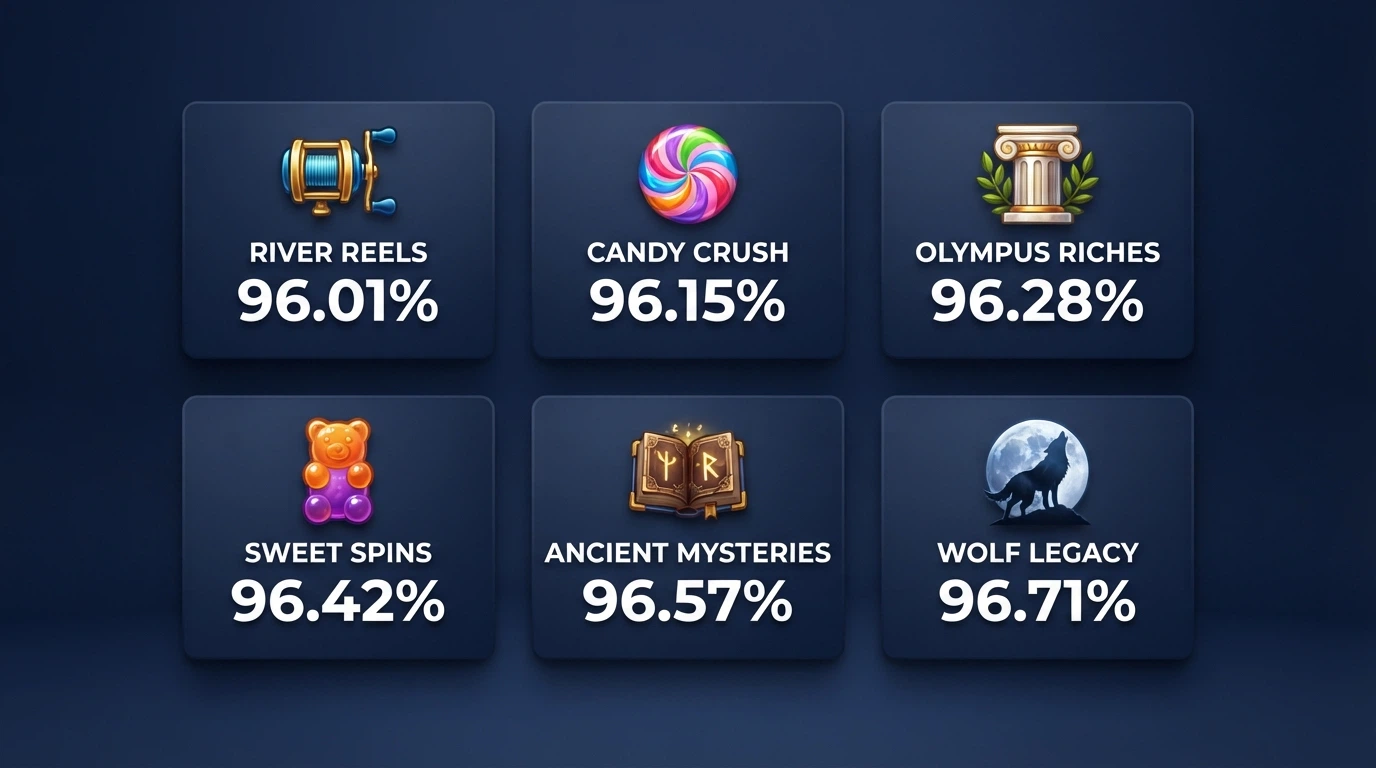
The table below carries every slot title research could verify RTP and volatility for. Six titles, all from Pragmatic Play, Play’n GO and Reel Kingdom. The volatility column is populated only where research confirmed a classification; cells where research did not carry a volatility figure stay empty by design.
| Slot Title | Provider | RTP | Volatility | Max Win |
|---|---|---|---|---|
| Big Bass Bonanza | Pragmatic Play / Reel Kingdom | 96.71% | High (4/5) | 2,100x |
| Sweet Bonanza 1000 | Pragmatic Play | 96.53% | High | 25,000x |
| Gates of Olympus | Pragmatic Play | 96.50% | High | 5,000x |
| Sweet Bonanza | Pragmatic Play | 96.51% | High | 21,000x+ |
| Book of Dead | Play’n GO | 96.21% | — | 5,000x+ |
| Wolf Gold | Pragmatic Play | 96.01% | Medium | — |
Every percentage point below 100% is the house edge. Across a session, the 3.29% house edge on Big Bass Bonanza compounds. A player running 20,000 spins at AUD 1 per spin loses AUD 660 on average — the calculation behind the bonus section’s time estimate. The headline RTP of 96.71% looks generous; the realised return after the wagering requirement is what it actually is.
Volatility is the missing column on most operator game pages. Casinos list thousands of titles. They publish an RTP for a handful. They almost never publish a volatility classification. The player has to check the provider’s spec sheet for each title, where it exists at all.
Casino Games Beyond the Reels: Table Games, Video Poker and the Rest
Offshore casinos carry blackjack, roulette, baccarat and video poker alongside the pokies. European roulette runs at roughly 97.3% RTP. Blackjack with perfect basic strategy runs at roughly 99.5%. Those are the theoretical returns; the house edge of 0.5% on blackjack is the lowest in the casino.
Per-title RTP for table games is rarely published by the operator. The rules are public — the dealer’s hit threshold, the payout on blackjack, the single-zero vs double-zero wheel — and the return follows from the rules. A player who checks the rules before placing a bet knows more than the operator’s published page usually does.
The provider mix at the multi-provider offshore casinos (Pragmatic Play, NetEnt, Play’n GO and others) drives game quality. A NetEnt blackjack variant and a Pragmatic Play blackjack variant use the same rules but render differently, deal at different speeds, and offer different side bets. The game library is real. The granularity of the data is not.
Live Dealer Tables: The Land-Based Feel, Streamed From Offshore Studios
Live casino games bring a human dealer to the screen. Blackjack, roulette, baccarat, game shows — the format is the same as a land-based casino, with the cards dealt by a real person on a real table somewhere offshore. Providers like Evolution and Pragmatic Play Live run the studios behind most multi-provider offshore lobbies.
This research run did not pin down per-operator live-dealer specifics. The format is real. The studio locations, the stream quality, the game-rule variants and the table limits vary by operator and were not verified across the ten casinos in this ranking. A player interested in live casino should check the lobby on the operator’s site directly.
The Safety Net You Leave Behind When You Step Off BetStop
Playing at a licensed Australian wagering operator carries a specific set of protections. Playing at an offshore casino carries almost none of them. This section names what is lost.
BetStop Self-Exclusion: What It Does Inside the Fence — And Why It Cannot Reach Offshore
BetStop’s coverage is real and meaningful — for the licensed market. One registration blocks a person from every Australian-licensed wagering service at once. The minimum period is three months. The maximum is lifetime. Marketing to an excluded customer is prohibited. The register’s mechanics are independent of any single operator; a casino cannot decide to honour a BetStop exclusion on Monday and route around it on Tuesday.
What BetStop cannot do is reach an offshore casino. The register’s authority is Australian; the operator’s licence is Curaçao. The two do not connect. A player who self-excludes through BetStop and then opens an account at an offshore casino has not defeated their own exclusion — they have chosen a different product that the exclusion does not cover. That distinction matters when the same player decides to seek help.
Deposit Limits, Activity Statements and the Tools You Lose Offshore
Licensed Australian wagering operators must offer customer-set deposit limits and activity statements. A player sets a weekly deposit ceiling of AU$200; the operator enforces it. The operator sends a quarterly activity statement; the player sees what they wagered and what they lost. State and territory regulators back both requirements.
Offshore casinos may offer similar tools — site-level deposit caps, cool-off periods, time-out buttons. Whether they enforce them is not independently verifiable. The regulator enforcing the tool does not exist. The casino polices itself. A self-exclusion set on a Curaçao-licensed casino is enforceable only to the extent the same operator chooses to enforce it tomorrow.
The credit card and crypto ban does not apply offshore. A player who would hit a credit card block at a licensed Australian operator can deposit with a credit card at an offshore casino. That is the choice the offshore market offers — and the choice the licensed market does not.
Self-Exclusion and Time-Out Tools at Offshore Casinos: What Exists and What Cannot Be Trusted
Most offshore casinos offer a self-exclusion or time-out button. The structural conflict is that the operator offering the exclusion is also the operator enforcing it. The casino does not call an independent registry to honour the exclusion. It records the exclusion in its own database.
This works for players who use the tool and stay excluded. It does not work the way BetStop works — where a single registration blocks every licensed operator at once. There is no cross-operator registry offshore. There is no regulator checking that the casino enforces its own exclusion list. The tool exists. The audit trail does not.
The practical advice: use the offshore tools where they exist. Do not rely on them as a substitute for BetStop. The National Gambling Helpline runs 24 hours a day at 1800 858 858 and offers online chat through Gambling Help Online (gamblinghelponline.org.au). Those services work regardless of where the player is gambling, and they work whether the player is at a licensed Australian operator, an offshore casino or trying to stop entirely.
The numbers behind the safety net are real. About 2.1% of Australian adults — roughly 430,000 people — experience problem gambling. Among Aboriginal and Torres Strait Islander peoples, the rate of those at risk of gambling harm sits at 27.1%, against 14.6% for non-Indigenous Australians. The harm is unevenly distributed. The tools available to address it are unevenly accessible. As the ACMA reminds consumers, even a service that looks legitimate is unlikely to carry important customer protections.
How We Selected and Ranked These Casinos
The methodology behind this ranking is explicit so the reader can weigh it.
Sources consulted: the ACMA investigations page and blocked-site list for enforcement status; the Curaçao Gaming Control Board’s published register for licence verification where the operator disclosed a number; the operator’s own terms and bonus pages for welcome terms, wagering multiples, payment methods and withdrawal limits; affiliate sites with Australian-facing content for bonus terms not published on the operator’s own pages.
Criteria that ordered the ranking: relevance to Australian players (not global market share — a brand that targets Australia ranks higher than a brand that does not); licence transparency (a specific licence number ranks higher than a vague reference to “Curacao”); ACMA enforcement status (a clean profile ranks higher than a finding under section 15(2A) of the IGA, all else equal); completeness of verifiable data (an operator that publishes its terms ranks higher than one that does not).
Limits of the evaluation: bonus terms, payment methods and game libraries change between research runs. A casino advertising a 300% match this month may run a 100% match next month. The free-spin count may rotate. The PayID minimum may shift. The player should verify each figure on the operator’s own terms page before depositing. This ranking records what was verifiable at the time of the 2026 research pass; it does not guarantee that those figures remain current, and it does not claim completeness where the operator did not publish.
The Trade-Off No Welcome Bonus Can Settle for You
The decision to play at an offshore casino is not about which bonus is biggest. It is about what the player forfeits for the right to play. This page has laid out both sides so the reader can make the call with their eyes open.
What the player gains: access to online casino games — pokies, blackjack, roulette, live dealers — that are otherwise prohibited under Australian law. Bonus packages that exceed anything a licensed wagering operator can offer. A choice of payment rails, including crypto, that the licensed Australian market does not allow.
What the player gives up: Australian consumer protection. BetStop coverage. Recourse through the ACMA on a complaint. Dispute resolution through an Australian regulator. The guarantee that the site will not be blocked at ISP level while a balance sits on it. The right to complain to a state or territory regulator if a withdrawal stalls. The default protection the licensed market provides — that the operator behind the bonus has been vetted, audited and held to a standard.
The legal position is unchanged. The player is not prosecuted under the IGA — the Act targets the provider. The casino is. The structural cost of playing offshore is permanent, not a one-time bonus term. The reader alone can weigh that cost against their own reasons for searching this term.
The 2026 reform tightens the licensed market. From 1 January 2027, banks and payment providers gain express authority to block transactions to illegal gambling operators. Ad caps and inducement restrictions apply to licensed wagering. Online keno is banned. The licensed market becomes more constrained, and the offshore market becomes harder to fund from an Australian bank account. The trade-off this page describes does not soften.
Frequently Asked Questions
Is it legal to play at an online casino that is not on BetStop in Australia?
Playing at an offshore casino is not a criminal offence. The Interactive Gambling Act 2001 targets the provider, not the customer. Providing online casino games to a person in Australia is prohibited, and the ACMA has blocked 1,788 such services since November 2019. The player carries the consumer-protection risks of an unlicensed operator; prosecution is not on the table.
Why doesn’t BetStop cover online casinos — only wagering services?
BetStop is the National Self-Exclusion Register for Australian-licensed wagering providers — about 150 of them connect to it. The register cannot include online casinos because no Australian licence for online casino exists. The Interactive Gambling Act 2001 prohibits providing one. An offshore casino has no Australian licence and no path into BetStop.
What protections do I lose by playing at an offshore casino not connected to BetStop?
An offshore casino offers no Australian consumer protection. There is no ACMA complaints recovery, no state or territory regulator to escalate to, no BetStop coverage and no guaranteed dispute resolution on a stalled withdrawal. The site can be blocked at ISP level with a balance still on the account.
How does the ACMA block illegal gambling sites, and can a blocked casino still be accessed?
The ACMA directs Australian ISPs to block illegal gambling and affiliate websites at the DNS level. Since November 2019, the regulator has ordered 1,788 such blocks. A blocked site is not reachable through a normal Australian internet connection. Workarounds exist — mirror domains, VPNs — but the block itself is real and ongoing.
Are my winnings from a non-BetStop casino taxable in Australia?
Betting and gambling winnings are not assessable income for the ordinary Australian player under section 6-5 of the ITAA 1997, and losses are not deductible under section 8-1. The position changes only for someone running a betting business. The offshore status of the operator does not change the Australian tax position of the player.
Will the 2026 gambling reform bill affect casinos not on BetStop?
The Interactive Gambling Amendment (Gambling Reform) Bill 2026 passed Parliament on 19 August 2026, with most measures commencing 1 January 2027. The reform tightens the licensed market and gives banks and payment providers express authority to block transactions to illegal gambling operators. The reform does not legalise offshore casinos. It restricts the funding routes into them.
Created by the ”Online Pokies Real Money” editorial team.