
Online Pokies No-Deposit Bonus Free Spins in Australia — Read the Bonus Before You Spin
Data current as of 29 October 2026, checked against the ACMA register and the Interactive Gambling Act 2001.

A “no-deposit free spins” offer on an Australian-facing online pokies site looks, on the surface, like a free swing at someone else’s reels. No card needed. No PayID push. Sign up, verify an email or a phone number, accept the spins, watch them land. The marketing calls it a gift. The terms call it something else.
Across the Australian-facing offshore market in 2026, the typical no-deposit bonus headline sits somewhere between A$50 and A$200 in face value, with the headline being either a fixed bundle of spins (commonly 10, 25, 50, 80 or 100) or a small free chip. The headline is the smallest number anyone quotes. The actual cost — to the player, and the actual walkaway cash — sits somewhere quite different, and the gap between the two is the subject of this page.
What follows is a working guide to how no-deposit free spins on online pokies actually work for Australian players in 2026: the two formats the offer takes, the wagering requirement that turns winnings into locked funds, the cashout cap that quietly shrinks the headline, the offshore reality behind every “AU-friendly” banner, and the player-protection tools that exist for Australians who want to step away. It is a sceptical read of the offer, not a sales pitch for one.
Table of Contents
- What No-Deposit Free Spins Actually Mean on Australian Pokies
- Why Your 2026 No-Deposit Bonus Is Smaller Than It Looks
- The No-Deposit Free Spins Landscape — Who Delivers and Who Doesn’t
- Playing Offshore — What Australian Law Actually Says
- Staying in Control — Tools That Work for Australian Players
- How We Evaluated These Operators
- Your Move — What the Numbers Say You Should Do
- Frequently Asked Questions
What No-Deposit Free Spins Actually Mean on Australian Pokies
The No-Deposit Model — Free, But Not a Gift
“No deposit” means exactly what it says: the player does not have to fund an account with a debit card, a bank transfer or a crypto wallet before the spins land. Registration opens the door. Email verification, sometimes phone verification, sometimes a single one-cent SMS code — that is the full gate.
What “no deposit” does not mean is “no obligation”. A no-deposit free-spin offer is a transactional product. The operator takes a real cost in funding the bonus and recovers it from one of two places: the small percentage of new registrants who go on to make a cash deposit, or — and this is the part the marketing does not lead with — the player who never deposits but is required to play through the winnings many times over before any cash can be withdrawn. The “free” is genuinely free on the entry side. The exit side is where the math lives.
Wagering on no-deposit free-spin winnings at Australian-facing offshore casinos in 2026 typically runs 30× to 50× the bonus winnings. At 50× on a small win from 20 free spins, a player may need to spin through hundreds of dollars in volume before anything is withdrawable. The maths is the point. The operator is not running a charity; it is running a funnel that converts a fraction of one percent of claimants into depositing customers, and the wagering is what funds the conversion cost for everyone else.
The model is not a scam. It is a known shape of the market and the Australian offshore casinos that offer it are not concealing anything. What is concealed, often, is the implication: that “free” describes only the entry, and that a player who reads no further than the headline number is going to be surprised by how far that headline has to travel before it becomes walkaway cash.
Free Spins vs Free Chips — What You’re Actually Getting
Two formats dominate the no-deposit space in 2026, and they are not interchangeable.
Free spins are the most common shape. The operator hands the player a fixed number of spins on a specific pokies title or a small set of titles, usually at a fixed coin value (often around A$0.10 to A$0.25 per spin depending on the title and the operator). The player runs the spins, the winnings are credited as bonus funds, and the wagering requirement applies to those winnings. A typical BitStarz-style benchmark — used here only because research confirms the terms — is 50 no-deposit free spins on registration with 40× wagering on bonus winnings and an A$100 maximum cashout. The headline of “50 free spins” is real; the A$100 ceiling is what most readers miss.
Free chips work differently. The operator credits a small cash balance — commonly A$10 to A$20 at the Australian-facing offshore end of the market — that the player can deploy across a broader selection of pokies titles. FairGO’s rotating no-deposit chip lineup (A$10, A$15, A$20 chips, coupon-driven, regularly cycled) is the Australian-facing example that research confirms. A LuckyDreams-style benchmark — an A$50 free chip across 1,200+ eligible pokies with 50× wagering and a hard A$50 max cashout — illustrates the chip variant at the larger end.
The trade is direct. Free spins lock the player to specific titles and usually come with a lower face value; free chips give game choice and can come with a higher nominal face value but typically a steeper wagering multiple and a tighter cashout cap. Neither is “better” in the abstract. They are different products for slightly different uses, and a player who knows which they are picking before they sign up avoids a category of surprise.
Why Your 2026 No-Deposit Bonus Is Smaller Than It Looks
The expected cost of a “free” offer, in numbers rather than in marketing, is worth seeing once.
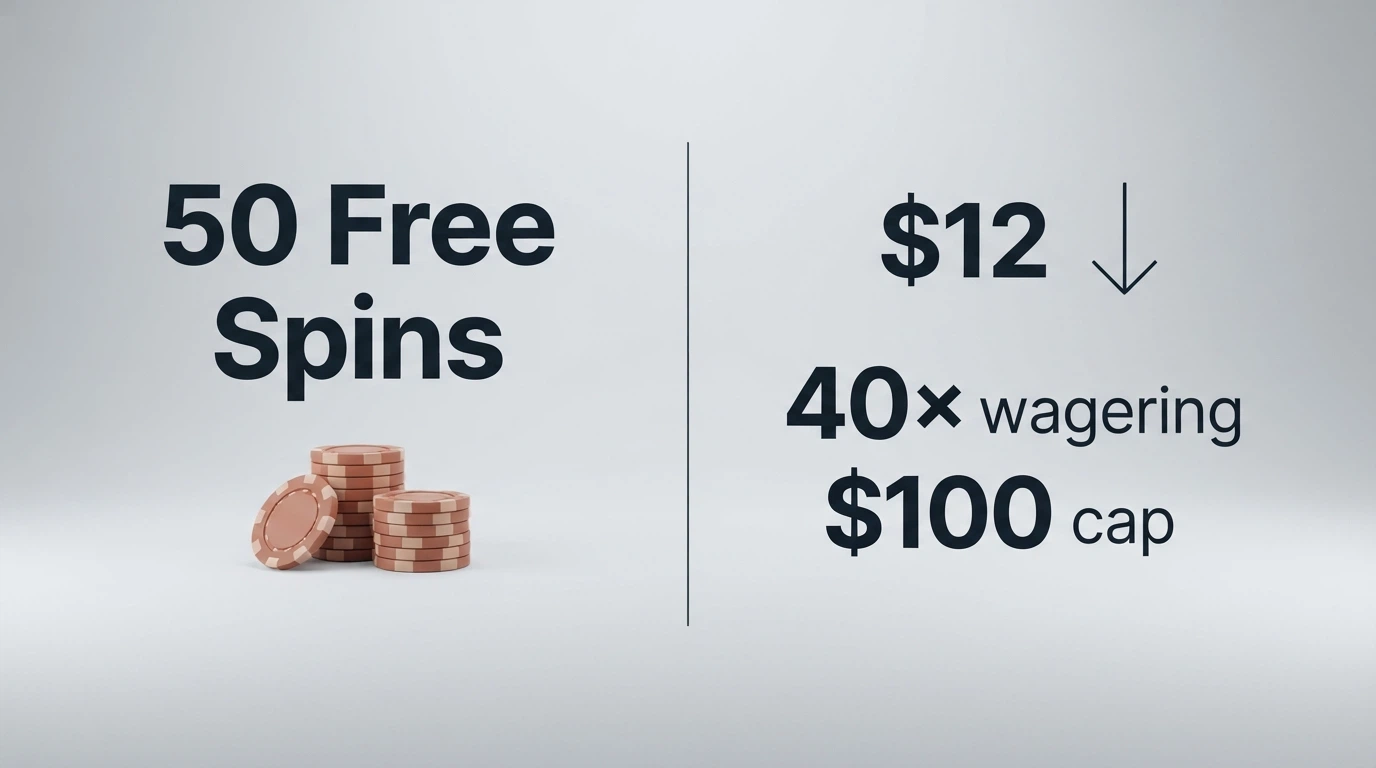
Take Big Bass Bonanza — a Pragmatic Play / Reel Kingdom title with a 96.71% return-to-player figure, medium-high volatility, and a 2,100× max win — as a representative pokies game for the calculation. A 96.71% return means the house edge on this title is 3.29%. A no-deposit free-spin offer worth, say, A$125 face value with a 40× wagering requirement on winnings generates about A$5,000 in required turnover. Across that volume, the statistical expected loss to the player sits at roughly A$165. The bonus face value and the expected cost are not the same number, and the gap widens with both the wagering multiplier and the bonus size.
Walk the bounds. The cheapest plausible offer in the 2026 set — a small free-spin bundle at A$50 with 30× wagering — implies A$1,500 in required turnover and roughly A$49 in expected loss. The heaviest plausible offer — a larger free chip at A$200 with 50× wagering — implies A$10,000 in turnover and roughly A$329 in expected loss. Those numbers are statistical averages across many spins under the stated assumptions. They are not guarantees for any individual session; a player can walk away with a small profit on a lucky run, or with nothing on a long one. They are what the average looks like, repeated enough times to flatten out.
The max-cashout cap sits on top of all of this. If the same A$125 / 40× hypothetical carries an A$100 max cashout, then anything above A$100 in winnings that survives wagering simply does not pay out. Expected loss is not affected by the cap, but expected value is — a portion of the lucky-run upside never reaches the player. The cap is, in practical terms, a way for the operator to keep the headline number (A$125) while ensuring the realistic worst case (for them) is bounded.
This is the math the marketing copy does not run, and the reason the next several subsections walk through every layer that sits between the headline and the cash.
No-Deposit Free Spins — The Headline Offer
The headline numbers in 2026 across the Australian-facing offshore market are remarkably consistent in shape: between 10 and 50 free spins for the small-NDB end, with a handful of operators offering 80 or 100-spin headline bundles that are usually deposit-gated once you look closely. The 50-free-spins offer is the benchmark and appears, with small variations in terms, across multiple operators. The 20-free-spin offer (Rocket Play’s verified-review incentive, 40× wagering, ~A$85 max winnings cap) is the smaller mid-market benchmark. The 10-free-spin offer (Bizzo’s app-download incentive, 40× wagering, 7-day expiry) is the entry-level floor.
What “no deposit” really requires, on the operator side, is almost always verification rather than cash. Email verification is universal. Phone verification is common. One small Australian-facing operator requires the player to install the mobile app to claim the spins, which is more friction than a straight sign-up but not cash. The wording matters: a player who reads “no deposit” and assumes the only obstacle is an email address may miss a phone-verification step, an app install, or a coupon code field that gates the spins until filled in.
The titles the spins land on are usually a small set of well-known games. Rocket Play’s 20 NDB spins land on Book of Pyramids (BGaming). VegasNow’s 50 NDB spins land on Big Bass Splash (Pragmatic Play). Slots Gallery’s 20 NDB spins land on Zeus the Thunderer. The choice is the operator’s, not the player’s, and the wagering usually runs on the winnings at 40× as the modal value across the set.
Free Spins on Sign-Up — What Registration Unlocks
“Sign-up free spins” and “no-deposit free spins” are almost the same thing in practice. The trigger is registration; the spins land at the same moment. The WinSpirit 35-spin NDB, the BitStarz 50-spin NDB (used here as a benchmark, not a featured operator) and the Rocket Play 20-spin NDB are all sign-up-gated: open the account, verify, claim, spin.
What sign-up triggers vary, in detail, is the verification depth. Some operators require only email. Some require both email and phone, with a one-time SMS code to an Australian mobile. Some require the player to upload a document — passport, driver’s licence, proof of address — before the spins are credited, although this is more common on the withdrawal side than the bonus-trigger side. The friction is small relative to the friction of being asked to fund a deposit, and it is the friction the no-deposit model sells itself against.
There is also a subtle distinction between “on registration” and “on first login”. A handful of operators credit the spins at the moment the account is opened; others hold the spins until the player makes a first visit to the lobby. The end state is similar, but a player who registers, walks away, and returns days later may find the spins waiting, expired, or, in some cases, forfeited. Reading the terms at the moment of registration, before the clock starts, is the only defence.
Real-Money Free Spins — When the Reels Pay Actual Cash
“Real money” on a free-spin bonus means the winnings are credited as cash — not as bonus funds — and the cash is at least nominally withdrawable. The qualifier is the wagering requirement. A “real money free spin” offer at a 30× wagering multiple still requires the player to turn over the winnings thirty times before withdrawal is unlocked, and the volume required can be hundreds of dollars on a small win.
The contrast is with fun-mode spins. Fun-mode spins, also called demo spins or play-money spins, pay nothing at all. They cost the player nothing and they return nothing. They are a try-before-you-buy mechanism rather than a bonus. A player who runs Big Bass Bonanza in demo mode for an hour and then runs it for real on a free-spin bonus is in two different products. The maths is not the same. The “free” in fun-mode is absolute; the “free” in a real-money free-spin bonus is conditional.
The wagering catch is the one that turns “real money” from a category into a state. Until the turnover requirement is met, the winnings are not real money in the pocket — they are real money on the platform, locked. A player who clears wagering sees the funds move from bonus to cash balance and from cash balance to withdrawable. A player who does not clear wagering sees the funds revert. The marketing line “real money free spins” is technically accurate at the moment the spin lands. It stops being accurate the moment the wagering clock starts.
AU-Focused Free Spin Deals — What Localised Offers Look Like
The Australian-facing offshore market in 2026 is, on its surface, a localised one. PayID and Osko badges appear on deposit pages. AUD is the default currency. State-level marketing angles — NSW targeting, Queensland-friendly hours, Victorian-language copy — appear in promotional emails. The branding signals that the operator has decided to court Australian players specifically.
The localisation is real. The legal status is not changed by it. An AUD-denominated account at an offshore Curacao-licensed casino remains an offshore product under Australian law. The PayID rail that makes the deposit instant is a fast bank-transfer technology operated by Australian institutions; it does not change who holds the licence on the other end. A player who reads “AUD” and “PayID” and concludes that the product is licensed in Australia is being led by the marketing rather than the statute. The Interactive Gambling Act 2001 prohibits the supply of online casino games to a person physically in Australia; that prohibition does not lift because the deposit rail is domestic.
What localised offers do well is reduce friction. An AUD account removes the FX cost. A PayID deposit removes the card-entry friction. A local-language welcome email is friendlier than a templated English one. None of this changes the wagering, the cashout cap, the offshore licence or the absence of an Australian complaints body. It is branding, not licensing.
Fixed Bundle Tiers — 25, 50, 80 and 100 Free Spins
The fixed-spin bundle has become the standard shape of the Australian-facing NDB offer in 2026. Twenty-five spins is the entry-level bundle, usually associated with smaller, less-trafficked operators and lower face value per spin. Fifty spins is the modal bundle across the set, common enough to function as the de facto market benchmark (BitStarz 50, VegasNow 50). Eighty and 100-spin bundles exist but are more often attached to deposit-gated welcome packages than to true no-deposit offers — Rocket Play’s 100-spin welcome package, for instance, requires the A$30 minimum deposit to trigger.
The wagering scales with the bundle size, but not proportionally. A 25-spin bundle at 40× on winnings produces a smaller absolute turnover requirement than a 100-spin bundle at the same multiple, but the per-spin value also tends to be lower on the smaller bundles. The headline number, in other words, is doing more work than the comparison suggests. A 100-spin bundle at A$0.10 per spin with 40× wagering on winnings can generate the same expected loss as a 25-spin bundle at A$0.25 per spin with the same multiple — because the volume and the wagering both move together.
The pattern that matters: bigger bundle, more spins, usually means more total turnover and a higher expected loss in absolute terms — even though the headline looks bigger. A player picking on headline count alone is picking on the wrong axis.
PayID-Boosted Pokies — Free Spins With Faster Banking
PayID and Osko are Australia’s instant-bank-transfer rails. PayID links a bank account to a memorable identifier — typically a phone number or an email — and Osko is the underlying payments infrastructure that moves the funds between participating banks in near real time. Both are operated by Australian financial institutions; both are legal deposit routes for licensed Australian wagering (alongside debit card, bank transfer and BPAY).
The relevance to no-deposit free spins is narrower than the marketing implies. The spins themselves are no-deposit — no PayID transaction is needed to trigger the offer. PayID enters when the player moves from claiming the bonus to funding an account for ongoing play, and at that point the AU-domestic rail does what it does well: instant, low-friction, no card details typed into the casino cashier.
The 2027 payment-block reform changes this. From 1 January 2027, banks and payment providers gain express authority to block transactions to illegal gambling operators. PayID and Osko are domestic rails, and it is not yet settled how the block will be implemented in practice — at the bank level, at the PayID identifier level, or somewhere else. What is settled is that the deposit friction will rise, not fall, in the twelve months after this page’s publication. A reader who has spent 2026 getting used to instant PayID deposits at an offshore casino is buying into a payment experience that is on a regulatory clock.
It is also worth remembering that credit card and crypto have been banned as payment for online wagering since 11 June 2024 — a rule the licensed Australian market respects and the offshore market mostly sidesteps. The fact that a casino accepts PayID does not mean it has stopped accepting the payment methods Australian law has banned; the offshore operator is outside the jurisdiction.
Free-Play and No-Download Spins — Try Before You Sign
The lowest-friction entry point is also the least valuable. Free-play and no-download pokies run in a browser tab, in demo mode, and cost the player nothing. The reels spin, the bonus rounds trigger, the balance moves up and down — all in fun-money that pays nothing real. The operator’s purpose is to show the player the game well enough to register and deposit.
This is not the same product as a no-deposit free-spin bonus, and the difference matters. A demo spin costs nothing and pays nothing; a no-deposit spin costs the operator money (the bonus) and pays the player something (the winnings, subject to wagering). A player who treats demo mode as a substitute for trying a real NDB offer is skipping the part where the bonus terms actually live.
The contrast that research confirms is the app-download gate. Bizzo’s 10-spin NDB requires the player to download the casino’s mobile app to claim the spins — a friction layer that demo mode avoids but that the bonus does not. The point of the app download, from the operator’s side, is to convert the player from a browser visitor to an installed-app user with push notification access. The 10 free spins are the price of that conversion. A player who has no intention of using the app after the spins are spent has paid for a product they will not use.
The No-Deposit Free Spins Landscape — Who Delivers and Who Doesn’t
A side-by-side of the ten highest-traffic Australian-facing offshore casinos in 2026, ranked by whether their no-deposit free-spin offer was confirmed by independent sources this run, and how much of the AU traffic they capture.
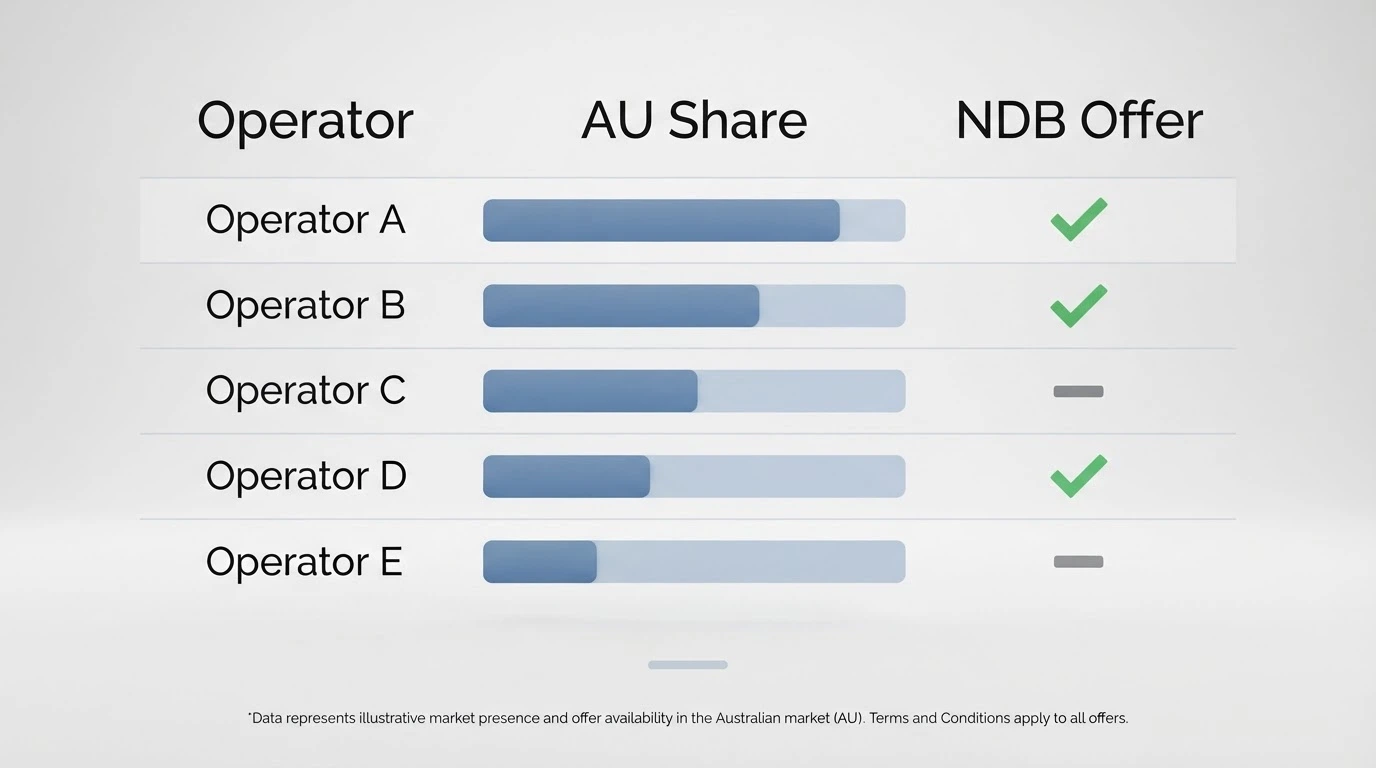
| Casino | AU Market Share | No-Deposit Free Spins Offer |
|---|---|---|
| Rocket Play | 9.4% | 20 NDB FS on Book of Pyramids (verified-review), 40×, ~A$85 cap |
| Skycrown | 8.55% | — |
| Royal Reels | 2.51% | — |
| Stake | 1.28% | — |
| WinSpirit | 1.55% | 35 NDB FS on registration, 7-day rollover, hundreds of games |
| FairGO | 0.80% | A$10 / A$15 / A$20 NDB chips, 60×, A$150–A$180 cap (coupon-driven) |
| Bizzo Casino | 0.57% | 10 NDB FS for mobile app download, 40×, 7-day |
| Rocket Casino | 0.57% | Deposit-gated (A$30 prior deposit required) — not a true NDB |
| Scream Casino | 0.99% | — |
| Rainbet | 1.28% | — |
Five of the ten carried a confirmed no-deposit offer. Five did not. That split is the headline.
How We Separated the Real No-Deposit Offers From the Noise
The line between a true NDB and a deposit-gated “free spin” offer is, on the surface, often blurred. Operators use the same vocabulary — “free spins”, “no deposit bonus”, “registration offer” — for products that are not the same. The filtering rule this page applied was a strict one: the spins must trigger without any prior cash deposit. A player who has funded an account previously — even once, even for A$30 — is no longer in the NDB category, no matter what the offer’s marketing calls it.
Rocket Casino’s missions-based free spins are the worked example. The operator offers up to 120 free spins via missions (app download, notification opt-in, and similar), but the missions require at least one prior A$30 deposit. The result is a product with free-spin mechanics and 45× wagering, but it is deposit-gated, not no-deposit. The page treats it as the contrast it is.
The four operators with confirmed NDB terms — Rocket Play, WinSpirit, FairGO, Bizzo — each had at least one no-deposit offer verified by an independent affiliate source this run. Skycrown, Royal Reels, Stake, Scream Casino and Rainbet had terms that could not be verified this run, and the table reflects that with the no-data marker rather than a guess.
What the Top Operators Have in Common — and Where They Split
Every operator on the ranking is offshore and unlicensed in Australia. That is the first common feature and the most important one: there is no Australian licence available for the product any of them offers, so the entire set sits outside the Australian regulatory framework. The Interactive Gambling Act 2001 makes the supply of online casino games to a person in Australia an offence; the player is not the target of that offence, but the product is illegal at the point of supply.
Curacao is the modal licence across the set. Rocket Play’s Curacao licence is the operator-side example that research confirms; WinSpirit and Stake also operate under Curacao. Several operators in the top ten — Skycrown, Royal Reels, FairGO, Bizzo, Rocket Casino, Scream Casino, Rainbet — could not have their licence verified this run, and the page does not claim what could not be confirmed. The Curacao Gaming Control Board is a real regulator, but the licence it grants is not equivalent to an Australian licence and confers no Australian consumer protection.
The traffic concentration is the other shared feature. Rocket Play at 9.4% and Skycrown at 8.55% together account for roughly 18% of the AU-facing offshore market between them. The remaining eight operators split the other 82%, mostly in the low-single-digit percentages. What the concentration means in practice: half the AU traffic is going to two operators, both offshore, neither licensed in Australia. The market the player is comparing options across is smaller than the table makes it look.
Rocket Play
Rocket Play is the AU traffic leader of the offshore set, with 9.4% market share and a Curacao licence. The headline number a new AU registrant sees is the welcome package — 100% up to A$1,000 plus 100 free spins on Aztec Magic (BGaming), with a 40× wagering requirement, an A$7.50 maximum bet while the bonus is active, and a 5-day bonus validity. The 100 free spins arrive as 20 immediately plus 80 over four daily batches of 20, which spreads the wagering load across the validity window.
The no-deposit product is separate from the welcome package. Rocket Play offers 20 free spins on Book of Pyramids (BGaming) for writing a verified review of the casino, with 40× wagering on bonus winnings and a maximum winnings cap of around A$85 (50 EUR equivalent). The trigger is unusual — most NDB offers trigger on registration, not on a review-writing action — and the cap is the tightest among the confirmed NDB offers in the set.
The high-roller offer sits above the welcome bonus: a 50% match up to A$2,500 for deposits of A$300 or more, with the same A$7.50 max-bet rule. The product shape is conventional offshore — Curacao-licensed, BGaming and Pragmatic Play providers, AUD-denominated, A$30 minimum deposit on the welcome offer. For an AU player with a moderate bankroll, the welcome package is the centre of the offer; the 20 NDB spins are a small side product with an unusually low cap.
The verdict: Rocket Play is the largest AU-facing offshore brand in the set and the one whose NDB terms research could verify with the most specificity. The 20 NDB spins are a real offer with a hard cap, not a vague “up to” headline; the welcome package is competitive against the rest of the offshore market.
Skycrown
Skycrown is the second-largest AU-facing offshore brand by traffic, with 8.55% market share — close behind Rocket Play and well ahead of every other operator in the set. That is the extent of what this page can confirm about the brand this run. The licence status, the welcome bonus terms, the free-spin offer (if any), the wagering multiplier, the bonus validity, and the max cashout from any no-deposit offer were all unable to be verified through the affiliate and operator sources consulted.
That absence is information, not nothing. The verification gap means a player comparing Skycrown to Rocket Play cannot, on the evidence this page has, match the two on terms. The market-share number is a real proxy for traffic and brand recognition; it is not a proxy for the size or quality of the no-deposit offer. Skycrown may well run a competitive NDB; it may not. This page cannot tell the reader, and inventing a guess would be exactly the error the editorial standard forbids.
The verdict: Skycrown is the second-largest AU-facing offshore brand by traffic and the second-largest information gap in the ranking. The volume of AU players the brand attracts is real; the bonus terms behind the door could not be verified at review time.
Royal Reels
Royal Reels sits at 2.51% AU market share — about a quarter of Skycrown’s volume, but still inside the top five of the offshore set. The same verification gap applies: licence status could not be confirmed, and bonus terms — welcome, no-deposit, wagering, cashout, validity — were not verifiable through the sources consulted this run.
A player landing on Royal Reels via a comparison page should expect an offshore product in the same shape as the rest of the set, but should not assume the specific terms are the same. The 2.51% market share is a real signal of brand presence; it is not a signal that the no-deposit offer is comparable to Rocket Play’s 20-spin Book of Pyramids bonus or WinSpirit’s 35-spin registration offer. It is a signal that Royal Reels has enough AU traffic to be worth the operator’s continued marketing spend in this market.
The verdict: Royal Reels is a real AU-facing offshore brand with measurable traffic and unconfirmed bonus terms. The comparison to the confirmed-NDB operators in the set cannot be completed on the evidence available.
Stake
Stake is the global-name brand in the set, with 1.28% AU market share and a Curacao licence. The provider lineup is the differentiator — Pragmatic Play, Evolution, Hacksaw and others — and signals a casino positioned at the higher-volume, higher-quality end of the offshore market rather than the bonus-aggressive end. Stake’s brand reputation in the global crypto-casino space does not, by itself, translate into a no-deposit free-spin offer for the AU market; the NDB product is what the marketing says it is, not what the brand is known for.
No no-deposit bonus is currently available at Stake. While the platform offers a significant range of pokies and providers, readers searching specifically for the no-deposit free spins described in this guide will not find that offer here. Stake focuses its bonus structure elsewhere, prioritising its high-volume game library over registration-only free spins.
The verdict: Stake is a Curacao-licensed global brand with measurable AU traffic and a strong provider lineup, and no confirmed no-deposit free-spin offer for the Australian market in 2026.
WinSpirit
WinSpirit sits at 1.55% AU market share with a Curacao licence, and is one of the four confirmed-NDB operators in the set. The offer is 35 no-deposit free spins credited on registration, with a 7-day rollover window and applicability across hundreds of games. The wagering multiplier on the winnings could not be confirmed this run; the 7-day validity is the tightest in the confirmed set and the most consequential number on the offer.
A 7-day rollover on 35 free spins is workable but not generous. A player who registers, claims the spins, and gets pulled away for two days returns to a clock that has already burned a third of its time. The win that survives wagering has to clear the turnover within five remaining days, and the volume required at a typical 30× to 50× multiplier is non-trivial. WinSpirit is the operator in the set where the time pressure is the dominant term, and a player who treats the bonus as something to come back to next week has already lost most of the value.
The verdict: WinSpirit is the operator in the set with the tightest rollover clock on its confirmed no-deposit offer. Success requires strict attention to the 7-day rollover window; those who register and claim the spins without intending to play immediately will likely see the bonus expire before the turnover requirements are met. It is an offer best suited to players who have the time to clear the requirements within the week.
FairGO
FairGO is the small-market-share, single-provider outlier in the set, with 0.80% AU share and an RTG (RealTime Gaming) platform. The operator’s no-deposit product is chips rather than spins, in A$10, A$15 and A$20 denominations, each carrying 60× wagering and an A$150 to A$180 max cashout depending on the coupon. The chips rotate on a coupon schedule, and a player who wants the offer has to claim the current coupon at the current value rather than picking a denomination from a static list.
The 60× wagering is the headline number for FairGO, and it sits well above the ~35× industry average the other operators in the set run on. The mathematics translate directly: a player with an A$18 win from an A$15 chip at 60× has to turnover roughly A$1,080 before the A$180 cashout cap is reachable. The expected loss on that volume at a representative 96.71% RTP is around A$35 — about double the A$15 face value of the chip itself. The cap saves the player from the worst-case upside of the bonus; it does not save the player from the worst-case cost of clearing it.
FairGO’s RTG-only platform is also worth flagging. A single-provider casino is a narrower game library than the multi-provider operators in the set — Rocket Play, Bizzo, Stake all run several providers. The narrower library is not a problem on its own; RTG has a long-standing catalogue of pokies titles and FairGO has been operating on it for years. It is a problem only for the player who wants to play a specific non-RTG title while the bonus is active, because the wagering volume will not count on games outside the platform.
The verdict: FairGO is the operator in the set with the steepest no-deposit wagering and the most coupon-driven offer shape. A player who can clear 60× on a small chip inside the validity window gets a real bonus; a player who cannot should pass on the offer rather than push through it.
Bizzo Casino
Bizzo is the small-share, multi-provider operator in the set, with 0.57% AU market share and a provider lineup of BGaming, Mascot, Spinomenal and Betsoft. The no-deposit product is 10 free spins for downloading the Bizzo mobile app, with 40× wagering on bonus winnings and a 7-day expiry — the smallest confirmed NDB in the set by spin count, and the one with the highest friction per spin.
The app-download gate is the differentiator. A player who installs the app, enables notifications, and claims the spins gets 10 spins at whatever per-spin value Bizzo assigns; a player who registers without installing the app sees no spins. The gate exists to convert a browser visitor into an installed-app user, and a player who does not intend to keep the app on the phone after the spins are spent has paid the friction without using the bonus.
The deposit-side offer behind the NDB is the largest in the set by total face value: up to A$7,250 plus 175 free spins plus a bonus game across the welcome package, available to players who fund an account. The welcome package is the operator’s main product; the 10 NDB spins are the on-ramp to it.
The verdict: Bizzo’s 10 NDB spins are the smallest confirmed no-deposit offer in the set, gated by an app download. The bonus behind the gate is competitive against the offshore market; the gate itself is the deciding factor for a player who has no use for the app.
Rocket Casino
Rocket Casino is the deposit-gated contrast in the set, with 0.57% AU market share and a free-spin product that requires at least one prior A$30 deposit to trigger. The mechanics are mission-based: app download earns 20 free spins, enabling notifications earns another 20, and similar missions build toward an up-to-120-spin total. The wagering on the bonus winnings is 45×, and the maximum winnings cap is A$75.
The 45× wagering is on the steep side of the set. The A$75 cap is the tightest max-cashout figure among the confirmed-NDB operators. Together they produce a product where the player has to turnover roughly A$3,375 on a maximum win to reach the A$75 ceiling — a ratio of 45:1 between volume and ceiling that leaves very little room for the player to come out ahead. The mission structure is also the giveaway: an operator that has to incentivise the player to download an app and enable notifications is not running a generous bonus; it is buying a player profile.
The verdict: Rocket Casino’s missions-based free spins look like an NDB in the marketing but require a deposit to trigger. Rocket Casino’s bonus structure is built for existing players rather than new registrants seeking a true no-deposit offer. Those looking for an immediate free-spins boost upon sign-up will not find it here, as the missions-based rewards only unlock for players who have already committed to a deposit.
Scream Casino
Scream Casino sits at 0.99% AU market share — small enough to be in the long tail, large enough to register on the traffic analysis. The licence status could not be verified this run, the bonus terms could not be verified this run, and the only number the page can confirm with confidence is the market share itself.
A player evaluating Scream Casino on this page is, in effect, evaluating the absence of information. The brand has AU traffic; the brand has a casino product; the brand has terms that exist somewhere on its own site but could not be cross-referenced through the independent affiliate sources consulted this run. The honest read is that Scream Casino is a real AU-facing offshore brand with an information gap, not a brand that this page has decided to under-rate.
The verdict: Scream Casino is an AU-facing offshore brand with measurable traffic and unverified bonus terms. A player comparing it to the confirmed-NDB operators in the set has nothing to compare against on the evidence available.
Rainbet
Rainbet sits at 1.28% AU market share — the same traffic tier as Stake — and, like Stake, has terms that could not be verified this run. The licence is unconfirmed; the welcome bonus is unconfirmed; the free-spin offer (if any) is unconfirmed; the wagering and cashout figures are unconfirmed.
The parallel with Stake is worth noting. Both operators sit at the same AU share; both have unverified bonus terms; both have real traffic. The difference is the brand profile — Stake is a global name with a recognised provider lineup, Rainbet is a smaller and less-distributed brand. Neither advantage tells the reader anything about the size or quality of a no-deposit free-spin offer, because neither operator’s NDB terms are on the page.
The verdict: Rainbet is an AU-facing offshore brand with measurable traffic and unverified bonus terms. A comparison to the confirmed-NDB operators cannot be completed on the evidence available, and a reader interested in Rainbet specifically should check the operator’s own terms page before assuming the offer matches the rest of the set.
Playing Offshore — What Australian Law Actually Says
The IGA Prohibition — No Online Casino Licence Exists in Australia
The Interactive Gambling Act 2001 prohibits the supply of online casino games — including online pokies — and in-play sports betting to a person physically in Australia. There is no licence for these products anywhere in the country. Not federally, not in any state, not in any territory. A page about “the best licensed online casinos in Australia” is describing something that does not exist, and writing one produces a factual lie on every screen.
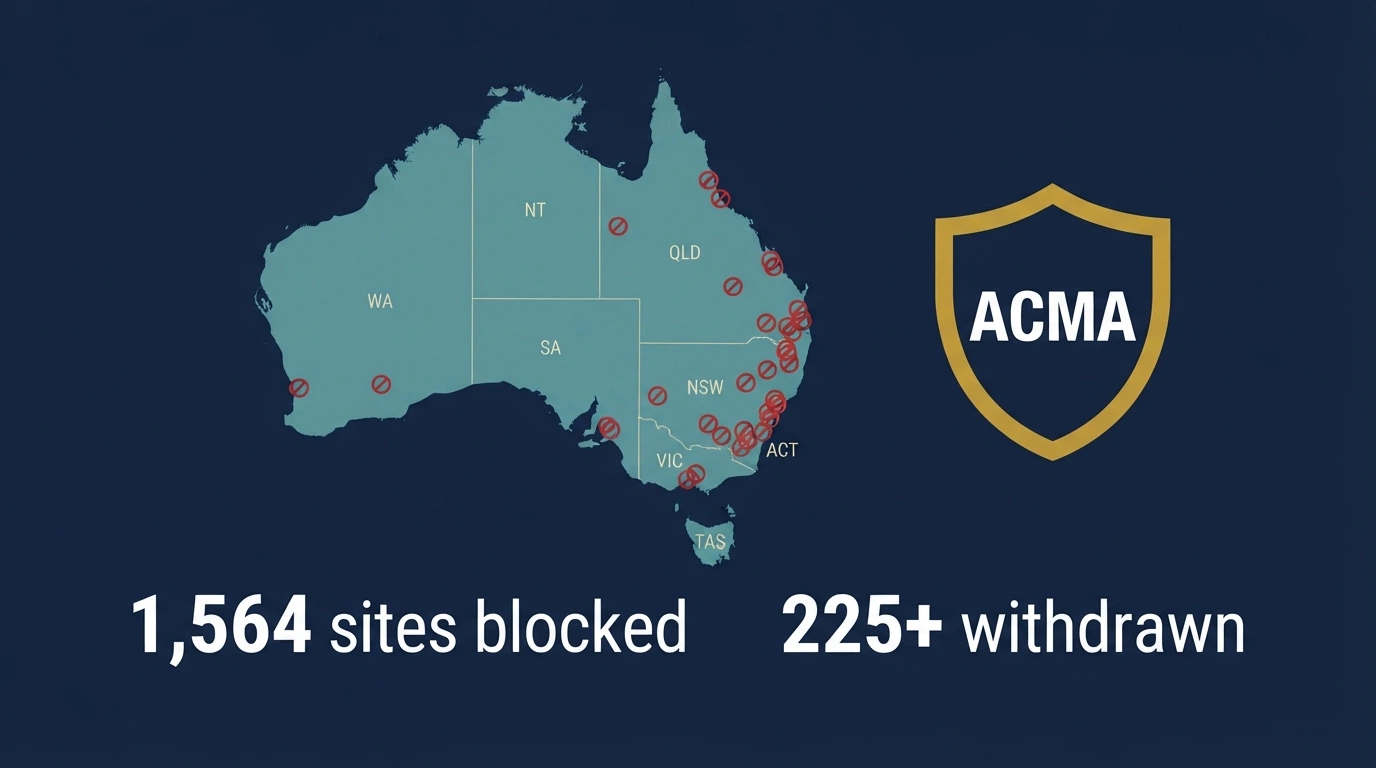
The Interactive Gambling Amendment Act 2017 strengthened the prohibition. The ACMA — the Australian Communications and Media Authority — is the federal regulator that enforces it. The ACMA investigates complaints, issues formal warnings, runs civil penalty proceedings, and directs Australian ISPs to block illegal sites at the DNS level. Since the first blocking request in November 2019, the ACMA has had 1,564 illegal gambling and affiliate websites blocked, as at March 2026. More than 225 illegal services have withdrawn from the Australian market entirely since enforcement was strengthened in 2017.
What is licensable in Australia is narrower than the marketing suggests. Wagering on races and sport placed before the event begins is licensable, through operators licensed by a state or territory — SportsBet, Bet365, Ladbrokes, the licensed bookies. Lotteries and keno are licensable. Online casino games, online pokies and in-play betting are not licensable, and the offshore operators offering them are operating outside the Australian framework by definition.
The player is not prosecuted. The IGA targets the provider, not the individual punter. But the player receives no Australian consumer protection as a result — which is the section that follows.
What You Give Up When You Play Offshore
A player signing up at an offshore online casino leaves the Australian regulatory framework behind, and the things they give up are concrete rather than abstract.
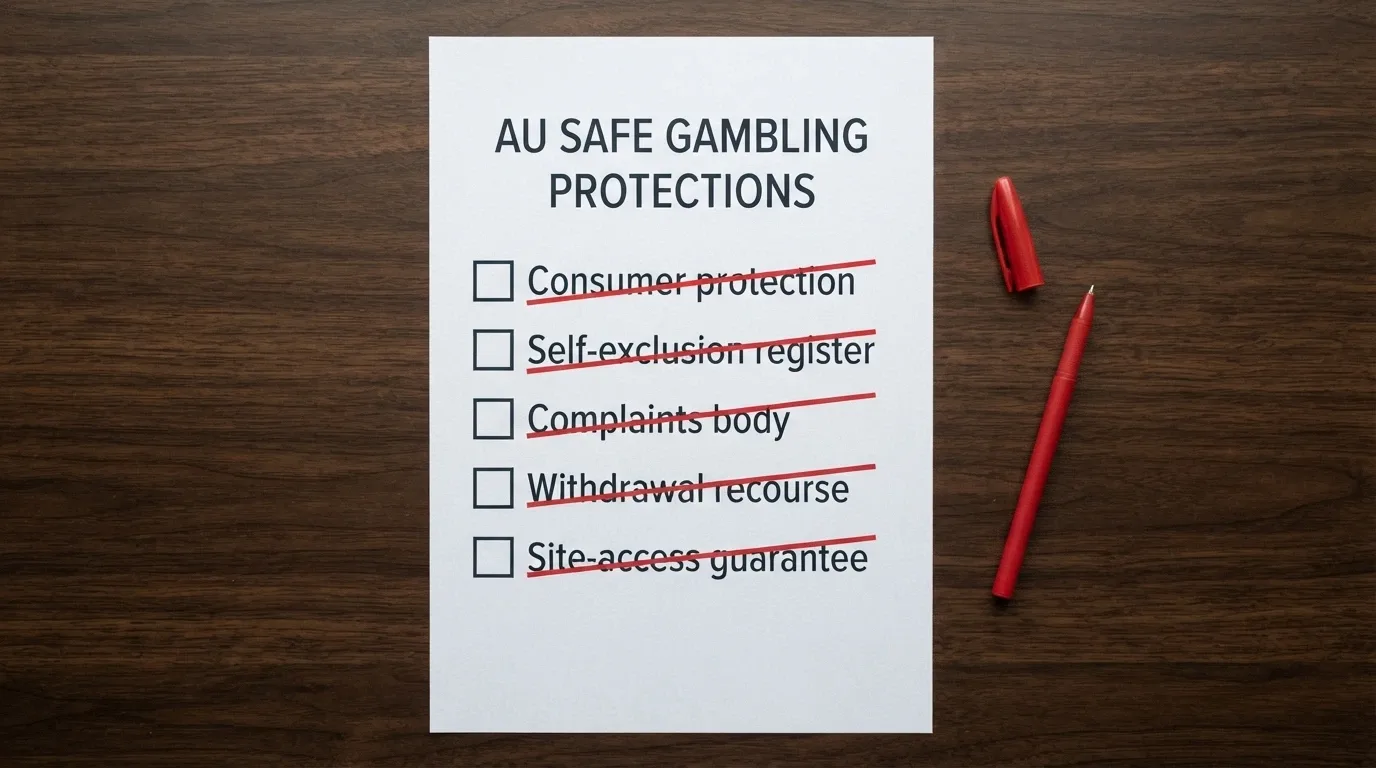
- No Australian consumer protection. The Australian Consumer Law (under the Competition and Consumer Act 2010) does not apply to the offshore operator’s treatment of an Australian player. Misleading conduct, unfair contract terms, unconscionable conduct — the protections a player takes for granted when buying anything else in Australia — do not travel with them across the border.
- No Australian complaints body. The ACMA can investigate and can pursue the operator, but it cannot recover money for an individual player. There is no AU equivalent of a gambling-ombudsman function that can compel a payout, and the state-based gambling regulators have no jurisdiction over an offshore operator.
- No BetStop coverage. BetStop — the National Self-Exclusion Register, discussed in detail in the section below — binds Australian-licensed wagering services only. A player who has self-excluded through BetStop can still deposit, play and lose at an offshore casino. The exclusion the player thought they had does not reach the offshore product.
- No withdrawal-dispute recourse. If an offshore operator refuses a withdrawal, voids a win, or closes the account, the player has no Australian forum to take the complaint to. Chargebacks through the player’s bank are sometimes available but unreliable; litigation in the operator’s home jurisdiction is impractical for a small claim.
- No site-access guarantee. The ACMA can direct Australian ISPs to block an offshore casino at any time, including with a balance still sitting on the site. DNS-level blocking does not return the player’s money.
The 2027 reform adds a payment-side risk on top of all of this. From 1 January 2027, banks and payment providers gain express authority to block transactions to illegal gambling operators, and the practical effect on the player’s ability to deposit and — critically — to withdraw is unsettled. What is settled is that the friction goes up, not down.
The 2026 Reform — Payment Blocks and Marketing Bans From 2027
The Interactive Gambling Amendment (Gambling Reform) Bill 2026 passed Parliament on 19 August 2026. Its measures commence on 1 January 2027. The reform is not aimed at offshore operators directly — it is aimed at the licensed Australian wagering market and at the payment and marketing infrastructure that surrounds it — but the second-order effects on the offshore market are large.
The payment-block provision is the one that matters most for a player at an offshore casino. From 1 January 2027, banks and payment providers gain express authority to block transactions to illegal gambling operators. PayID, Osko, BPAY and direct bank transfers are all in scope in principle; the operational detail — at the bank level, at the payment-system level, or both — is still being finalised. What is clear is that the path between an Australian bank account and an offshore casino cashier will not be the same open corridor it has been in 2026.
The inducement-marketing provisions constrain the licensed market. From 1 January 2027, direct marketing of inducements is banned for 14 days after a customer signs up with a licensed wagering provider, for three months after a person deregisters from BetStop, and indefinitely for customers identified as being at risk of gambling-related harm. Part 7D of the IGA takes a targeted approach rather than a blanket prohibition: providers must identify at-risk customers and stop sending them inducements, with the line between a permissible promotional message and an impermissible inducement defined in the statute.
The broadcasting restrictions apply across the licensed market and the broader media environment. No more than three wagering ads per hour between 6:00 am and 8:30 pm. A live-sport blackout from 15 minutes before until 5 minutes after a live event. Radio ads barred during school drop-off and pick-up. Broadcasting sporting odds banned outright. Online wagering ads restricted to logged-in, age-verified users who have not opted out. No wagering advertising inside sports venues or on player or official uniforms. Athletes, celebrities and influencers barred from promoting wagering products. And a new national register — AdStop — for Australians who want to opt out of wagering advertising entirely, administered by the ACMA and funded by a cost-recovery levy on licensed wagering providers.
None of this directly legalises or de-legalises the offshore product. What it does is make the licensed product more constrained, the offshore product harder to pay for, and the broader Australian gambling market a more regulated environment for licensed operators specifically.
Staying in Control — Tools That Work for Australian Players
BetStop and Self-Exclusion — What It Covers (and What It Doesn’t)
BetStop is the National Self-Exclusion Register, live since August 2023 and administered by the ACMA. As at 31 July 2026, the register had 67,480 registrations, of which 41,290 exclusions were still active — more than 60% of everyone who has registered. The minimum exclusion period is three months; the maximum is lifetime. Across the licensed wagering market, BetStop binds approximately 150 Australian-licensed wagering providers. One registration, one exclusion, coverage across the licensed set.
The demographic of the register is worth knowing. 78% of BetStop registrants are under 40. 38% have chosen lifetime exclusion — a number that tells a story about how seriously the people who reach for this tool take the decision to step away. The register is not a casual signup; it is a deliberate act by people who have decided, often after a long process, that they need the friction.
The offshore gap is the limit. BetStop binds Australian-licensed wagering services only. An offshore casino is not connected to the register, and an Australian player who has self-excluded through BetStop can still register, deposit and play at an offshore casino. The exclusion the player thought they had does not extend to the offshore product. This is the single most important fact for a self-excluded Australian to know: the protection ends at the border.
What does work at the offshore end is the player’s own discipline. Some offshore operators run their own self-exclusion and cooling-off mechanisms, but they are not Australian mechanisms and they are not under ACMA oversight. A player who wants the offshore product to enforce a break has to do the work themselves, and the only Australian tool that supports that is the player’s own decision.
Help Resources and the Real Numbers on Problem Gambling in Australia
The National Gambling Helpline is 1800 858 858 — free, confidential, staffed 24/7. Gambling Help Online (gamblinghelponline.org.au) provides online chat and counselling. Gambler’s Help services run state-based, with face-to-face and phone support, self-exclusion support, and financial counselling. The helpline and the online service are the front door for anyone who has decided that the gambling has become a problem, whether the gambling is at a licensed Australian operator, an offshore casino, a TAB, or a pub pokies room.
The prevalence numbers are real and worth facing. About 2.1% of Australian adults — roughly 430,000 people — experience problem gambling. The Australian Institute of Health and Welfare put high-risk gambling at 1.8% in 2022. These are not numbers from a marketing deck; they are prevalence data from the AIHW and the national health infrastructure, and they describe a population in which hundreds of thousands of Australians are currently experiencing harm. The 2.1% figure does not stratify by gambling channel — pub pokies, licensed wagering, offshore casino — but the harm is the same regardless of where it manifests.
The path from harm to help is short. A phone call to 1800 858 858, a chat session on gamblinghelponline.org.au, a referral to a state-based Gambler’s Help service. None of these tools require the player to stop gambling before they reach out. None of them require the player to identify which operator they have been using. The help is at the end of the number, and the number is free.
How We Evaluated These Operators
The operators on this page were selected from the highest-traffic Australian-facing offshore casino brands identified through independent traffic analysis (BLASK BRANDS AU market-share figures for 2026). The selected set is not a ranking by offer quality — it is a ranking by AU traffic and confirmed no-deposit availability. The traffic analysis is what determines inclusion; the offer verification is what determines the no-deposit column in the comparison table.
The bonus terms were sourced from operator sites where directly accessible, and from independent affiliate audits where the operator’s own pages could not be cross-referenced this run. The affiliate sources consulted were Pokiesaustralia.com, Thecasinowizard.com, Vegaspokie.com, Australiangamblers.com, Slotspeak.net, and Casinoa.org. Each operator’s no-deposit status was verified against the question of whether a cash deposit is required to trigger the offer — the strict definition this page uses throughout. Operators whose offers required any prior deposit were excluded from the NDB category, regardless of how the offer was marketed.
The legal and regulatory figures were cross-checked against the Interactive Gambling Act 2001, the ACMA register, and BetStop’s published statistics. The 2026 reform details were sourced from the relevant Bills and from the ACMA’s reform communications. The problem-gambling prevalence figures came from the AIHW. The helpline number and the Gambling Help Online URL were verified against the DSS and ACMA published resources.
What this evaluation is not: it is not a buying recommendation, it is not a quality ranking, and it is not a guarantee that any offer is available at the moment of reading. Operators change terms. Affiliates update pages. The numbers on this page are correct as of 2026 but the comparison is only useful if the reader checks the operator’s current terms before claiming.
Your Move — What the Numbers Say You Should Do
The no-deposit free-spin offer that exists for an Australian pokies player in 2026 comes, almost without exception, from an offshore operator that holds no Australian licence and offers an unlicensed product in this market. The headline is real. The 30× to 50× wagering is real. The A$50 to A$100 max cashout is real. The 7-day rollover windows, the 5-day welcome-package validity, the 60× FairGO multiplier, the 40-spin benchmarks — all real. What is also real is that the player claiming any of these offers is doing so outside the Australian regulatory framework, and the framework does not follow them across the border.

The wagering and the cashout caps turn the headline into a fraction of the headline in walkaway cash. The expected loss calculation earlier in this page sets the realistic cost — a statistical average that runs, at the A$125 / 40× midpoint, around A$165 across the volume of play required. At the heavier end (A$200 / 50×) the expected loss crosses A$300. The cost is real, even when the headline number is small.
The 2027 payment-block provisions will, from 1 January, raise the friction on every transaction between an Australian bank account and an offshore casino cashier. A player who has built a habit around instant PayID deposits in 2026 is buying into a payment experience that is on a regulatory clock. The deposits will get slower. The withdrawals will get slower. The risk that a withdrawal fails entirely rises with every month that passes from the 2027 commencement date.
BetStop does not reach any of the operators on this page. The self-exclusion that 67,480 Australians have signed up for binds Australian-licensed wagering services only. The ACMA cannot recover money for an individual player. There is no AU complaints body that can compel a payout from an offshore operator. There is no DNS-level guarantee that the casino the player has an account with today will be reachable tomorrow.
The cost of “free” spins, in the data this page carries, is the protections the player leaves behind. The choice between the headline and the protections is the choice the page asks the reader to make. It is not the page’s job to make it for them.
Frequently Asked Questions
Are online pokies with free spins legal in Australia?
No. The Interactive Gambling Act 2001 prohibits the supply of online casino games — including online pokies — to a person in Australia. No licence for the product exists anywhere in the country. Offshore casinos offering free spins to Australian players are operating outside the Australian framework; the player is not prosecuted, but the operator is.
What wagering requirements apply to no-deposit free spins in Australia?
No-deposit free-spin wagering at Australian-facing offshore casinos typically runs 30× to 50× on bonus winnings. Anything above 50× on NDB winnings is unusually steep and makes the offer practically unclearable for most players. FairGO’s 60× is the outlier in the set and well above the modal range.
How much can I cash out from no-deposit free spins at Australian online casinos?
Typical max cashout from no-deposit free spins at Australian-facing offshore casinos is A$50 to A$100, with some operators capping lower (Rocket Casino’s missions-based A$75) or higher (FairGO’s chip-based A$150 to A$180). The cap sits on top of the wagering requirement and limits the walkaway cash independently of how the spins performed.
Can I use PayID to deposit at online pokies sites in Australia?
PayID and Osko are legal deposit routes for licensed Australian wagering, alongside debit card, bank transfer and BPAY. They are also accepted by some offshore casinos for deposits. The deposit rail is legal; the offshore casino on the other end is not. From 1 January 2027, banks gain authority to block transactions to illegal gambling operators, which will affect PayID deposits at offshore casinos.
What happens to my money if an offshore casino blocks Australian players?
The ACMA can direct Australian ISPs to block an offshore casino at the DNS level at any time. The block cuts access but does not return the player’s balance. The player has no Australian forum to recover the funds, and the offshore operator has no obligation under Australian law to release them. This is one of the protections that disappears at the border.
Is BetStop connected to offshore online casinos?
No. BetStop — the National Self-Exclusion Register — binds Australian-licensed wagering services only. Approximately 150 licensed providers are connected. Offshore casinos are not connected, and a self-excluded Australian can still register, deposit and play at an offshore casino. The exclusion does not extend to the offshore product.