
Highest Payout Online Casino Australia: What the Percentage Actually Costs You
Australian players searching for the highest payout online casino find themselves comparing offshore operators ranked by return-to-player percentage and withdrawal speed. Every brand on those lists operates without an Australian licence. Online casino games and online pokies are prohibited in Australia under the Interactive Gambling Act 2001; no Australian licence for the product exists, and none can — the product itself is the thing the Act outlaws. What a player is comparing, then, is a set of offshore operators against one another, not against the licensed benchmark the market does not provide.

Current as of 22 November 2026 · verified against the ACMA enforcement register and the Interactive Gambling Act 2001.
That landing line carries two things at once. It tells the reader when the figures on this page were current, and it names the regulator and the statute that decide which operators can legally take their money. The first fact is what the comparison rests on. The second is the frame the comparison sits inside. Both belong at the top because the comparison without the frame is a number with nothing to anchor it, and the frame without the comparison is a regulatory lecture nobody came for.
Table of Contents
- Why “Highest Payout Casino” Means Less Than You Think
- The Pokies That Pay the Most — And the Asterisks You Cannot Ignore
- The Operators Australians Actually Play At — Ranked by What They Pay
- Online Casino Is Illegal in Australia — Here Is What the Law Actually Says
- When the Payout Promise Pulls Too Hard — Responsible Play in a High-Stakes Market
- How We Evaluated These Operators
- What the Highest-Payout Search Means for Your Next Session
- Frequently Asked Questions
Why “Highest Payout Casino” Means Less Than You Think
A payout percentage is not what most players think it is. The figure attached to a pokie — 96%, 98%, 99% — describes a long-run theoretical return averaged across millions of spins. It does not describe a session. It does not describe a week. It does not describe what happens when you sit down at the computer on a Tuesday night with A$200 in your account. The term the marketing arm of the industry reaches for is “payout,” which sounds like money heading back to the player. The mathematical term is return to player, and what it measures is the inverse of the operator’s margin, sampled across a sample size no individual player will ever reach.
Across thirty-eight operators measured for platform-wide RTP in 2026, the industry average sat at 95.81%. Every casino on the tested list cleared 96%. The headline reads as though 96% is the floor and 98% is the ceiling; in practice the spread between operators is narrower than the spread between games inside any one of them. The number that matters more is the one attached to the specific title you load, because the casino average is a weighted mean of everything from blackjack to scratch cards, and the game in front of you is one slice of that mean.
The deeper problem is that the figure is self-reported. Of twelve operators tested in a 2026 audit, only eight published monthly audited RTP reports. The remaining four relied on provider-stated figures, which is the same as saying the casino published what the game studio told them to publish. None of this happens under Australian oversight. There is no regulator examining the numbers, no auditor’s stamp on the page, and no penalty for publishing a return rate that turns out to be wishful thinking. The “highest payout” claim is, in nearly every case, a marketing line with a number beside it and no one checking the number.
RTP Explained — The Gap Between a Percentage and Your Session
RTP, in plain terms, is the share of every dollar wagered that the game returns to players over time. A 97% RTP pokie keeps three cents of every dollar as gross margin and returns ninety-seven cents as winnings, on average, across an enormous sample. The sample is the part players miss. The maths only works over millions of spins. A single session of a few hundred spins is a single draw from a distribution whose mean is 97% and whose variance is set by volatility. That draw can land at 60% or 180% and still be entirely consistent with the headline figure.
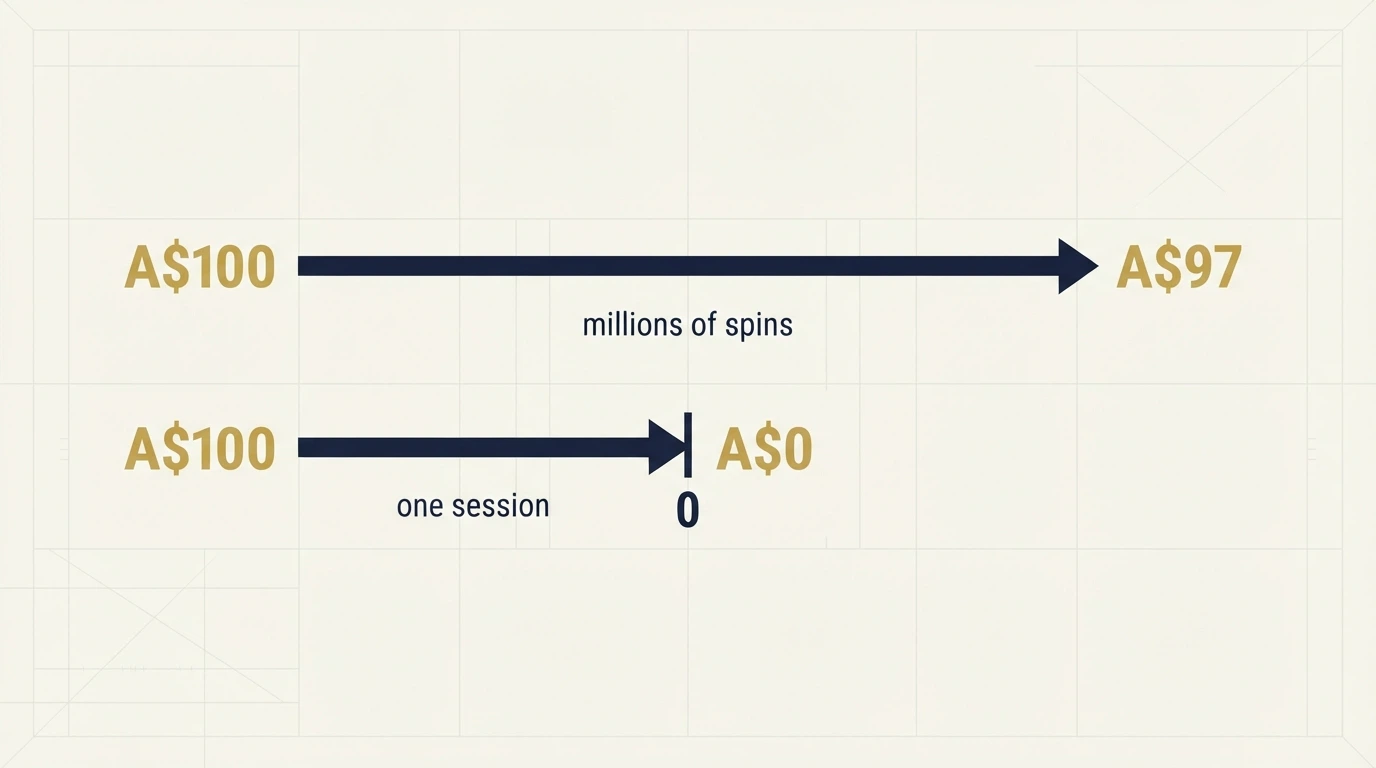
The house edge is the same number viewed from the other side. A 97% RTP game carries a 3% house edge; a 95% game carries a 5% house edge. The edge is what the operator keeps, on average, across every dollar wagered. It does not mean the operator wins every session. It means the operator wins 3% of all dollars wagered, distributed across millions of outcomes, with the per-session results scattered around that mean. A player who walks away ahead after an hour of play has not “beaten” the house edge. They have drawn the right side of the distribution once, and the next draw is unaffected by the last one.
The trap is the word “return.” It sounds like a guarantee, as though the machine owes you A$97 for every A$100 you put through it. It does not. The 97% is what a hundred players collectively receive over a million spins, which is a sample large enough that the variance shrinks to near zero and the mean becomes the actual outcome. Any individual player’s experience can be wildly different. Some sessions end at zero. Some end at three or four times the deposit. The 97% sits in the middle of all those outcomes, and the player sits somewhere inside that distribution, not at its centre.
Platform RTP vs Game RTP — One Number Cannot Tell the Whole Story
A casino advertising a 97% platform RTP is averaging every game on its shelf, and that shelf contains hundreds or thousands of titles at different return rates. The Pokies you actually load may return 92% or 99%. The platform figure tells you nothing about which one sits in front of you. It is, at best, a directional statement: this operator’s library skews higher than that operator’s library. It is not a guarantee about the title you will play tomorrow night.
This is where the operator’s incentive lies. Stocking a shelf full of high-RTP titles pulls the platform average up, which helps the marketing claim. Loading lower-RTP configurations of the popular titles leaves the headline intact while reducing the actual return on what most players actually play. Sweet Bonanza is the cleanest example. The title ships in at least four RTP versions — 96.51%, 95.45%, 94.51%, and 91.51% — and the casino operator, not the provider, decides which version loads for an Australian player who opens the game. The operator is not obliged to disclose the version, and most operators do not.
Across twelve Australian-facing operators tested in 2026, Pokies averaged 95.2% RTP, while individual titles ranged from 92% to 99.5%. The average and the range are both correct, and they tell very different stories. A player picking a pokie at random is somewhere in the middle of that range, not at the top. The platform number flatters the operator; the game number flatters the title. A page that quotes only the platform number is selling the operator. A page that quotes the game number, where research carries it, is closer to what the player actually plays.
Providers with a consistent record help. NetEnt, Play’n GO, and Pragmatic Play all release Pokies above 96% as a matter of course, with several pushing past 98%. The provider track record is one of the few external signals a player has, because the casino does not publish per-game RTP as standard. The signal is partial. A provider known for high-RTP titles can still ship a 94% game in any given month. But the average tendency over a studio’s catalogue is more informative than a casino’s platform average, which is set by choices the casino itself makes.
Payout Rate, Payout Speed, and House Edge — Three Different Things
The single most expensive category error a player can make when comparing operators is conflating payout rate with payout speed. A casino that pays withdrawals in nine minutes is not paying out at 99%; it is paying withdrawals quickly on whatever return rate its games actually run at. Speed and rate are independent dimensions, and a player who treats them as the same number is comparing two unrelated things and calling one of them the answer.
The house edge is what neither figure prices in. A 3% edge on a game run at A$100,000 of turnover costs the player A$3,000 in expected losses. A 1% edge on the same turnover costs A$1,000. The casino can pay that A$3,000 loss back in nine minutes via PayID and still be ahead by A$1,000 over a casino that pays in three days at a 2% edge. Speed is the player’s experience. The edge is the player’s actual cost. Confusing them is the mistake that turns a comparison into a marketing message.
A concrete example makes the cost concrete. Take SkyCrown’s welcome bonus — A$2,000 matched at 35x wagering on the bonus. The required turnover before any winnings can be withdrawn is A$2,000 multiplied by 35, which is A$70,000. That A$70,000 is what the player must put through the games before the bonus clears. The expected loss on that turnover, assuming the bonus amount is the only thing wagered and the games are played at SkyCrown’s measured 96.42% platform RTP, is A$70,000 multiplied by the 3.58% house edge. The arithmetic works out to roughly A$2,506 in expected losses on a A$2,000 bonus. The “free” money costs the player more than its face value before a cent is withdrawn.
Run the same calculation against the industry average of 95.81%, and the expected loss climbs to roughly A$2,933. Run it against a hypothetical 97% RTP and the expected loss drops to A$2,100. The gap between the worst of those three and the best is more than A$800 — a single percentage point of RTP, on a A$70,000 turnover, is worth hundreds of dollars to the player. The headline payout rate is not window dressing. It is the single biggest variable in the cost of clearing a bonus, and it is the variable most operators choose not to publish per game.
This is also why the platform RTP, where it is measured rather than self-reported, deserves more weight than the welcome bonus headline. The bonus tells you how generous the operator’s first impression is. The RTP tells you what every dollar you actually risk is worth. The first impression can be enormous and still be a worse deal than a smaller bonus at a higher return rate, because the bonus is paid for in turnover, and turnover is paid for in expected losses.
The Pokies That Pay the Most — And the Asterisks You Cannot Ignore
The pokies with the highest published return rates sit in a narrow band at the top of the market. Ugga Bugga leads at 99.07%. Mega Joker and Book of 99 share second place at 99.00%, though one of them gets there only under a condition most players miss. Jackpot 6000 follows in the high 98s, with 1429 Uncharted Seas close behind at 98.60%. Blood Suckers holds 98.00% with no conditions attached. White Rabbit Megaways and Medusa Megaways sit in the 97.6–97.7% range at higher volatility. Ooh Aah Dracula reaches up to 99% on its higher-stake configuration.
The Highest-RTP Pokies Australian Players Can Access
| Slot | RTP | Provider | Volatility | Max Win |
|---|---|---|---|---|
| Ugga Bugga | 99.07% | Playtech | — | — |
| Mega Joker | 99.00% | NetEnt | High | 2,000x |
| Book of 99 | 99.00% | Relax Gaming | High | 12,075x |
| Jackpot 6000 | 98.86%–98.90% | NetEnt | Medium | 6,000x |
| 1429 Uncharted Seas | 98.60% | Thunderkick | Low–Medium | ~670x |
| Blood Suckers | 98.00% | NetEnt | — | — |
| White Rabbit Megaways | 97.72% | Big Time Gaming | Very High | 13,000x |
| Medusa Megaways | 97.63% | NextGen | High | — |
| Ooh Aah Dracula | up to 99% | Barcrest | Medium–High | ~5,000x |
The table shows published figures. The columns a player cannot read off the page are the ones that change everything: the conditions under which a 99% title actually pays 99%, and the volatility that determines whether the player ever sees the long-run return.

The Mega Joker Problem — When 99% RTP Needs a Condition Most Players Miss
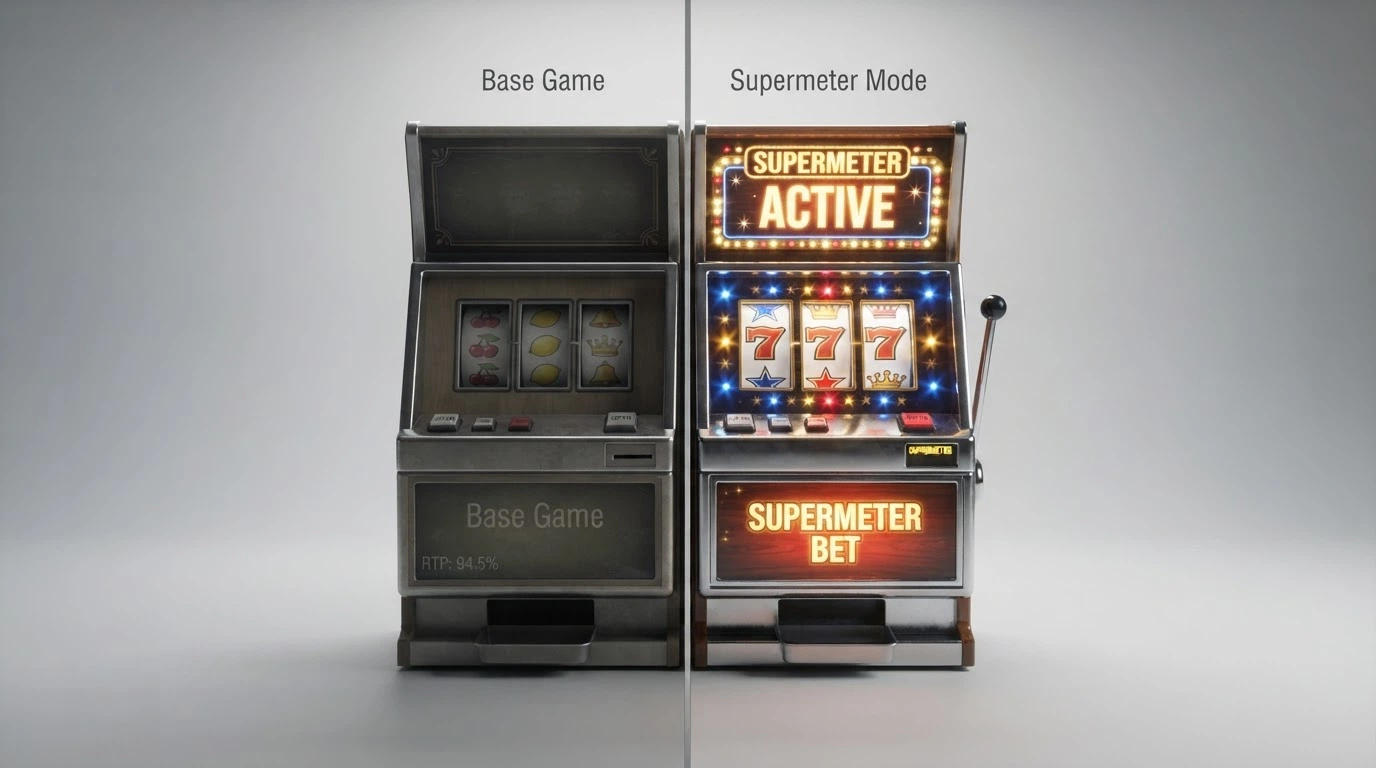
Mega Joker’s 99% RTP only activates in Supermeter mode at maximum stake. At the base level, the same machine returns somewhere between 76% and 85% — a gap of fourteen to twenty-three percentage points from the advertised figure. A player who picks the game because of its headline RTP and plays it at a lower stake is, in effect, playing a different machine than the one they think they chose. The published number is true. The number behind the player’s session is something else entirely.
Compare that to Blood Suckers at 98.00%. The figure holds at every bet level, with no mode to enter and no stake to maximise. A player who loads Blood Suckers and plays at any denomination they like is playing the game the RTP describes. The conditional 99% on Mega Joker is more attractive on paper and worse in practice for most players, because most players never realise the Supermeter condition is the one that unlocks the headline number. The marketing term for that is “up to 99%.” The plain-English version is “less, unless you play exactly this way.”
One Pokie, Four RTP Versions — How a Casino Loads a Weaker Game
Sweet Bonanza ships with four RTP configurations — 96.51%, 95.45%, 94.51%, and 91.51% — and the casino selects which one a player loads. The provider built the game in multiple versions so operators could choose the configuration that suits their margin. The player who opens Sweet Bonanza on one site may be playing a 96.51% title; on another, the same game may be returning 91.51%, a difference of five percentage points on every dollar wagered. The casino is not obliged to tell the player which version is loaded. Most do not.
This is the deeper failure inside the “platform RTP” claim. A casino can publish a 96.5% platform average while loading the lower-RTP version of the most-played title on its shelf. The headline survives. The per-game experience does not match it. A player comparing operators by platform RTP alone is comparing a number that, in part, reflects the operator’s choice to deploy weaker versions of the same games the better operator deploys at full strength. The signal is contaminated at the source.
The practical upshot is that per-game RTP matters more than platform RTP, and per-game RTP is the figure most operators do not publish. Providers with consistent track records — NetEnt, Play’n GO, Pragmatic Play — help because their catalogue averages higher, but the player cannot verify which version of a specific title is loaded at a specific casino without asking, and the answer is often silence.
Pokies vs Table Games — Where the Real Return Sits
The highest-RTP pokie still trails a basic-strategy blackjack hand. Blackjack on a single deck returns 99.5% with optimal play. Jacks or Better video poker, full-pay, returns 99.54%. Baccarat banker bets return 98.94%. European roulette returns 97.3%. Every one of those figures beats the 95.2% Pokies average, and several beat the highest published pokie RTP. The “highest payout” framing the search term implies hides a category gap that Pokies-first players never see.
The reason this gap matters is that a player comparing Pokies by RTP is comparing within the wrong category. A single-deck blackjack hand at 99.5% sits at the same return rate as a 99.5% pokie, and the blackjack game requires no scrolling through a thousand titles to find. The Pokies offer theme, narrative, free-spin features and progressive jackpots. Table games offer return. A player who actually wants the highest return available — which is the literal meaning of the search term — will find it at the table, not on the reels.
That does not make Pokies a bad choice. A player who plays for the experience rather than the return is making a different decision, and Pokies are where that decision lives. But the page the search returns should name the gap, because the gap is real, and a player chasing a 99% headline is one browser tab from a 99.5% game that requires no optimisation to reach.
The Operators Australians Actually Play At — Ranked by What They Pay
Every operator an Australian player can actually reach is offshore and unlicensed in Australia. There is no Australian licence for online casino. The comparison that follows ranks ten operators by the payout-relevant data that exists, and labels honestly what is measured, what is self-reported, and what is unknown. Some rows are thin. The thinness is the finding.
| Operator | Welcome Bonus | Wagering Requirement |
|---|---|---|
| SkyCrown | 100% up to A$2,000 + 100 free spins | 35x bonus |
| Rocket Play | 100% up to A$1,000 + 100 FS first deposit; multi-deposit to A$6,000 + 300 FS | 40x bonus |
| Royal Reels | 100% up to A$500 + 50 FS first deposit; 3-deposit pack to A$2,500 + 50 spins | 35x bonus |
| WinSpirit | A$2,000 + 350 free spins | — |
| FairGO | 100% up to A$200, redeemable 5× (total A$1,000) | 30x deposit + bonus |
| Stake | — | — |
| Rainbet | 250% up to $1,750 across 3 deposits + 60 FS | 40x bonus (or no-wager gradual release) |
| Bizzo Casino | 10–25 free spins (no deposit) | 40x spin winnings |
| Scream Casino | — | — |
| Rocket Casino | — | — |
The empty cells in this table are not an oversight. They are the honest representation of what the operator’s published materials surfaced this run. A cell with a dash says the field is unknown. A cell with a figure says the figure is published; whether it has been independently verified is a separate matter, addressed in each write-up.
SkyCrown — The Highest Measured RTP With a 9-Minute PayID Window
SkyCrown posted a 96.42% RTP across fifty sampled Pokies, the highest measured — not self-reported — figure in the operator set. PayID withdrawals averaged nine minutes across fourteen tests. Crypto withdrawals on USDT-TRC20 averaged four minutes across twelve tests. The library holds more than 4,200 games, with Pragmatic Play, Hacksaw Gaming, and Play’n GO among the providers. The welcome bonus is 100% up to A$2,000 plus 100 free spins at 35x bonus-only wagering, with the free-spin winnings carrying a 30x multiplier of their own. The bonus has a 14-day validity. The minimum deposit is A$20, and the maximum weekly withdrawal is A$10,000. The licence is Curaçao.
The 35x bonus-only structure is the cheaper of the two common models. A A$2,000 bonus requires A$70,000 in turnover before withdrawal — the figure used in the calculation earlier in this page. The fact that turnover applies to the bonus alone, rather than to deposit plus bonus, saves the player the doubled cost that FairGO’s structure imposes. The 14-day window is short by industry standards; players who clear the bonus in nine days pay the same expected loss as players who clear it in twelve, but the time pressure is real.
The withdrawal ceiling is the limit that matters at scale. A$10,000 a week is generous by comparison with most of the operators in this set, but it remains a ceiling. A player who wins A$50,000 on a single spin of a high-volatility title like Book of 99 waits five weeks to be paid in full. That is the practical cost of the A$10,000 ceiling, and it is a cost that does not appear in the platform RTP figure.
For a player who values measured data over headline numbers, SkyCrown is the most defensible name on the list. The PayID speed, the audited RTP, and the bonus-only wagering combine into the cleanest offer in the set. The Curaçao licence is the same one every other Curaçao-licensed operator carries; it does not make SkyCrown safer than its peers, only more transparent about the data it publishes.
Rocket Play — A Self-Reported 98% RTP and a A$15,000 Weekly Cap
Rocket Play claims a 98% platform RTP, the highest figure on the list, but the figure is self-reported and unaudited. The library holds more than 3,000 games. The welcome bonus is 100% up to A$1,000 plus 100 free spins on the first deposit, with a multi-deposit structure that stretches to A$6,000 plus 300 free spins across the package. Wagering is 40x on the bonus, and the bonus has a 5-day validity. The maximum cashout from the welcome bonus is A$5,000. The maximum weekly withdrawal is A$15,000; monthly is A$30,000. The minimum deposit is A$30 on the first-deposit bonus and A$25 elsewhere. The licence was not confirmed this run.
The 98% RTP is the single most attractive number on the page. It is also the figure a player should treat with the most caution, because it carries no audit stamp. Compare it to SkyCrown’s 96.42%, which is the highest measured figure. The gap is 1.58 percentage points. On a A$40,000 turnover — Rocket Play’s A$1,000 bonus at 40x wagering — that gap is worth roughly A$632 in expected losses. The unaudited 98% may be accurate; it may also be the 95% the operator actually runs at, dressed in marketing-friendly clothes.
The 5-day bonus validity is a tighter constraint than any of its peers. A player who clears 40x on a A$1,000 bonus has to put A$40,000 through the games in five days. That is roughly A$8,000 a day on average. For a player with a small bankroll, that pace is impossible to maintain without exceeding sensible bet sizes. The 5-day window is not a player-friendly feature. It is a constraint that protects the operator’s bonus margin.
The verdict: the headline RTP is appealing and the supporting terms undermine it. The 5-day validity and the A$5,000 bonus cashout cap both shrink the value of the welcome offer faster than the headline suggests. Rocket Play is worth treating as a curiosity on the 98% claim, not as a destination.
Royal Reels — A A$10 No-Deposit Chip and a Three-Tier Welcome Pack
Royal Reels offers one of the few no-deposit entry points in the set — a A$10 free chip at 30x wagering with a cashout cap shown at activation. The first-deposit bonus is 100% up to A$500 plus 50 free spins, and a three-deposit welcome pack stretches to A$2,500 plus 50 spins in total. Wagering is 35x on the bonus. The maximum bet during the bonus is A$5. The free spins play at A$0.20 per spin, for a total headline value of A$10. The minimum deposit is A$30. The licence was not confirmed this run.
The no-deposit chip is the standout feature. It lets a player try the platform without committing funds, and the 30x wagering is lower than Rocket Play’s 40x. The cashout cap on the chip is the real limit, and the cap is shown only when the bonus is activated, not in the headline. A player who treats the chip as free money without checking the cap can find the cap as a surprise at withdrawal.
The free spins at A$0.20 are a separate arithmetic. Fifty free spins at A$0.20 each is A$10 in nominal wagering value, before any RTP calculation. At a 96% return rate, the expected return on those spins is A$9.60, less than the headline value. The headline reads “50 free spins” the way the A$10 no-deposit chip reads as “A$10 free.” Both are smaller than they look once the maths is done.
The bonus is otherwise unremarkable: 35x wagering on a A$500 first deposit means A$17,500 in turnover, comparable to the lower-cost offers in the set. The lack of confirmed licence is a real gap. For a player who wants to try before they deposit, Royal Reels is one of the few names in this set with that option; for a player who wants to compare licence terms, it is not the one to choose.
WinSpirit — A A$2,000 + 350 Free Spin Welcome, Light on Detail
WinSpirit advertises one of the largest welcome bundles in the set at A$2,000 plus 350 free spins. The wagering requirement, bonus validity, minimum deposit, withdrawal caps, game count, providers, platform RTP, and licence jurisdiction are all unconfirmed. A headline figure with no supporting terms is not a comparison point. It is a question mark.
The bundle is competitive on the surface. The 350 free spins lift it above most peers on nominal value. What a player cannot tell from the headline is what the wagering requirement is, how long the bonus is valid, what the maximum withdrawal is, and which games the free spins play on. Each of those figures can change the offer’s value by an order of magnitude. A 40x wagering requirement on a A$2,000 bonus means A$80,000 in turnover; a 20x requirement means A$40,000. The expected loss on the higher turnover is roughly twice the lower.
This is the section of the comparison where the data runs out. WinSpirit is in the set because the headline reaches the searcher, not because the underlying offer is verified. The honest verdict is that the bundle is worth a second look once the terms are visible, and the terms are not visible this run.
FairGO — A Single-Provider Shop With a 30x Deposit+Bonus Clear
FairGO runs on a single provider — Spin Logic / RTG — with around 280 titles including Pokies, table games, and video poker. The welcome bonus is 100% up to A$200 redeemable five times, for a total of A$1,000. The wagering requirement is 30x deposit plus bonus, a structure that doubles the effective turnover compared to bonus-only wagering. The maximum bet during the bonus is A$10. The no-deposit offer is a A$10 to A$30 free chip at 60x wagering with a A$180 maximum cashout. The weekly withdrawal cap is A$7,500. There is no maximum cashout on deposit bonuses. The minimum deposit is A$5 on Lightning Bitcoin and A$20 standard. The casino was founded in 2017. The licence was not confirmed this run.
The 30x deposit-plus-bonus structure is the costly line in the offer. A player who deposits A$200 and claims the A$200 bonus must wager 30 times the combined A$400, which is A$12,000 in turnover. On a bonus-only structure, the same wagering would require A$6,000. The deposit-plus-bonus structure doubles the cost of clearing for a bonus that is half the headline value of SkyCrown’s. The arithmetic favours bonus-only every time it is offered.
The single-provider catalogue cuts both ways. The library is small at 280 titles, and it lacks the studio diversity of larger operators. What it gains is consistency: every title on the shelf runs on the same provider’s math model, and Spin Logic / RTG has shipped a long enough catalogue that the platform’s behaviour is at least partly predictable. For a player who values that predictability over breadth, FairGO is one of the few operators in this set where the choice is conscious.
The A$5 Lightning Bitcoin minimum deposit is the lowest entry point in the set. For a player who wants to test an offshore casino with the smallest possible commitment, FairGO offers the lowest cost of trying. The A$7,500 weekly cap is below SkyCrown’s A$10,000 and well below Rocket Play’s A$15,000; it is the constraint that defines who the casino is built for.
Stake — A Curaçao-Licensed Platform With No Confirmed Welcome Bonus
Stake holds a Curaçao licence and is one of the most recognised names in the offshore space. This run did not confirm a welcome bonus, platform RTP, game count, minimum deposit, withdrawal caps, or providers for Australian players. The brand recognition exceeds the available data, and the comparison stops where the data stops.
A Curaçao licence is the same licence every other Curaçao-licensed operator on this page carries. It does not bind Stake to Australian consumer protection, BetStop, or ACMA complaint processes. It signals a registration with a regulator that issues licences to operators who apply for them, with limited ongoing oversight of payout data.
For a player who chooses on brand recognition alone, Stake is a defensible name. For a player who chooses on the data this page compares, Stake is a thin row in the table — present, but empty where the comparison happens. The verdict is that brand alone is not the basis on which to pick an offshore casino in Australia.
Rainbet — 7,000+ Games, 25 Crypto Tokens, and a No-Wager Bonus Option
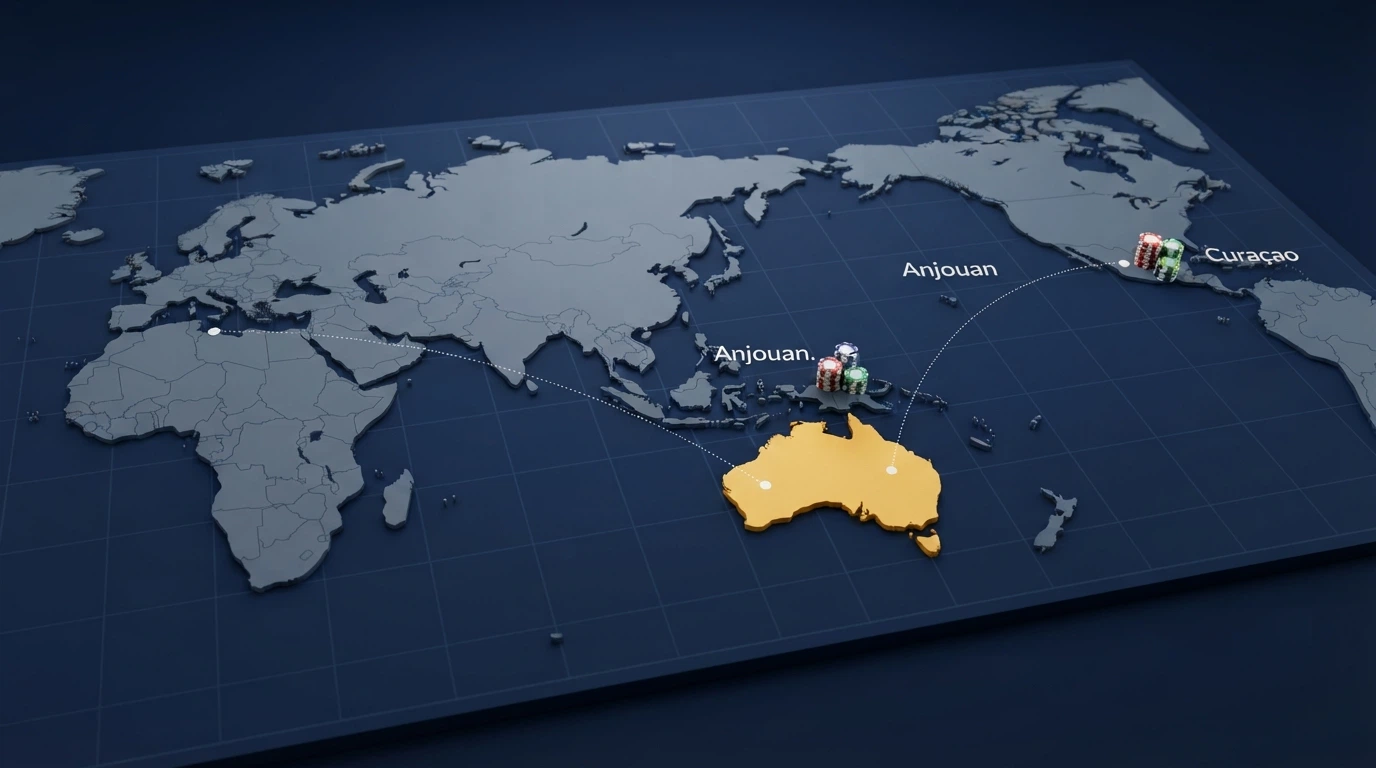
Rainbet offers the largest game library in the set at 7,000+ titles, including 14 provably fair Originals with demo mode. It supports 25 cryptocurrencies. The welcome bonus is 250% up to A$1,750 across three deposits plus 60 free spins (20 per stage). The bonus has two tracks: a 40x wager-locked option or a no-wager gradual release. The bonus validity is seven days from activation. The minimum deposit is around A$46. There is no maximum withdrawal at Level 1 KYC. The minimum withdrawal is around A$23. Crypto withdrawals are instant to ten minutes; fiat is one to five business days. The licence is Anjouan.
The dual-track bonus is the standout feature. The 40x option matches the wagering cost of Rocket Play and Bizzo; the no-wager gradual release removes the turnover requirement entirely at the cost of slower access to the bonus funds. For a player who plans to deposit and play through the bonus once, the 40x option delivers the full bonus on completion. For a player who plans smaller deposits and longer play, the no-wager path removes the principal cost of bonus play. Either track is defensible; which is better depends on the player’s bankroll and patience.
The crypto-heavy payout structure makes Rainbet a clean fit for players who already hold and use cryptocurrency. The instant-to-ten-minute window on USDT-TRC20 and similar tokens is faster than PayID at most operators, and the absence of a withdrawal ceiling at Level 1 KYC is a real advantage over the weekly caps that constrain every other operator in the set. The fiat alternative, at one to five business days, is comparable to industry standards.
The Anjouan licence is the same jurisdictional category as Curaçao for the purposes of Australian consumer protection. It does not bind the operator to BetStop, to ACMA complaint processes, or to the credit-card-and-crypto payment ban that applies to Australian-licensed wagering. Rainbet’s acceptance of crypto is the signal that it sits outside the licensed frame.
The verdict: Rainbet is the strongest fit in the set for a crypto-first player who wants the largest library and a bonus structure that does not punish smaller deposits. The trade-off is the licence jurisdiction, which offers no Australian recourse if a withdrawal stalls.
Bizzo Casino — Free Spins Without a Deposit, 40x on the Winnings
Bizzo Casino’s entry point is 10–25 free spins with no deposit required. The 40x wagering applies to spin winnings, not to the spins themselves. The operator runs a multi-provider aggregator model, with crypto, PayID, and e-wallets as primary payout methods. The platform RTP, game count, bonus validity, minimum deposit, and withdrawal caps were not available from the operator’s published materials at review time. The licence was not confirmed this run.
The no-deposit free spins are the cleanest entry in the set for a player who wants to test an offshore casino without funding an account. The 40x wagering on winnings is the cost: a player who wins A$5 from the spins has to wager A$200 before the winnings can be withdrawn. At a 96% RTP, the expected loss on that A$200 is A$8, against A$5 of winnings. The arithmetic does not favour the player; the offer favours the player who treats it as a way to see the platform, not as a profit centre.
The multi-provider aggregator model means the game library spans multiple suppliers without a single headline count. The player gets variety; the player also gets the absence of a consistent provider track record as a quality signal. The lack of confirmed RTP figures makes per-game comparison impossible at the platform level, which is a constraint this page cannot resolve.
The verdict: Bizzo Casino is worth a try at the no-deposit entry, and the 40x spin-winnings wagering is the price of that try. Beyond the free spins, the absence of confirmed payout data is a real limit on the comparison this page can offer.
Rocket Casino
Rocket Casino appears in the featured set as an offshore operator with no Australian licence. None of the payout-relevant fields — platform RTP, bonus terms, game count, withdrawal caps, providers, licence jurisdiction — were confirmed this run. Specific payout data, bonus terms, game-library details, withdrawal caps, and licence jurisdiction were not available from the operator’s published materials at the time of review.
A row in the comparison with every cell empty is not a recommendation. It is the honest record of what the search returned. The operator exists and accepts Australian players; beyond that, the page cannot say what it pays, how fast it pays, or under whose rules it operates.
The verdict: Rocket Casino is in the set because the brand surfaces for the search; it is not in the set because the data supports a comparison. A player who reaches Rocket Casino through a different channel is making a decision outside the bounds of what this page can verify.
Scream Casino
Scream Casino rounds out the featured set as an offshore operator with no Australian licence and no confirmed payout-relevant data this run. Specific payout data, bonus terms, game-library details, withdrawal caps, and licence jurisdiction were not available from the operator’s published materials at the time of review. The operator exists and accepts Australian players, but the comparison stops at the name.
The same caveat applies as for Rocket Casino: a row with no data is a row that does not help a player decide. The fact that the brand appears in search results is what brought it into the set. The absence of published terms is what keeps it at the bottom of the ranking.
The verdict: Scream Casino, like Rocket Casino, is in the set as a representative of the longer tail of offshore brands an Australian player can reach. The data this page can compare does not include it. A player who chooses on data will pass it by; a player who chooses on brand recognition is operating outside what this page covers.
Online Casino Is Illegal in Australia — Here Is What the Law Actually Says
Online casino games, online Pokies, and in-play sports betting are prohibited in Australia under the Interactive Gambling Act 2001. The prohibition targets the provider, not the player, but the player loses the protections that come with a licensed frame. No Australian licence for online casino exists. The licensed alternative is wagering on races and sport placed before the event begins, plus lotteries and keno, under state and territory licences — primarily the Northern Territory. The minimum age for any commercial gambling is 18.
This is the legal frame that every comparison on this page sits inside. The frame does not make offshore play legal. It does make offshore play unprotected. The difference between the two is the difference between a number on a page and a number a regulator has audited, and the difference is what the rest of this section is about.
The Interactive Gambling Act 2001 and What It Prohibits
The Interactive Gambling Act 2001, strengthened by the Interactive Gambling Amendment Act 2017 which closed the loopholes offshore operators used to reach Australian customers, prohibits the provision of online casino games, online Pokies, and in-play sports betting to a person in Australia. What remains permitted is wagering on races and sport placed before the event begins, lotteries, and keno, through operators licensed by a state or territory — primarily the Northern Territory Racing and Wagering Commission and Licensing NT.
The player is not the target of prosecution. The Act targets the provider of the prohibited service, and the enforcement machinery described in the next section operates against operators, not against individual users. That fact should not be read as a green light. It means the law is built to remove the supply side; it does not mean the demand side is treated as legitimate. An Australian user of an offshore casino is using an illegal service, even if using it carries no personal penalty.
The minimum age for any commercial gambling in Australia is 18. Offshore operators set their own age policies, which may or may not align with Australian requirements. A site that does not verify age is signalling that it operates outside the frame a regulated market provides. The signal is consistent across every operator in this page’s comparison.
1,564 Sites Blocked and Counting — How the ACMA Enforces the Ban
The Australian Communications and Media Authority has directed Australian ISPs to block more than 1,564 illegal gambling and affiliate websites since its first blocking request in November 2019. More than 225 illegal services have withdrawn from the Australian market since enforcement was strengthened in 2017. The blocking is real, it is ongoing, and it operates at the DNS level — meaning a site that is reachable today can be unreachable tomorrow, with no warning to the player who has an active balance on it.
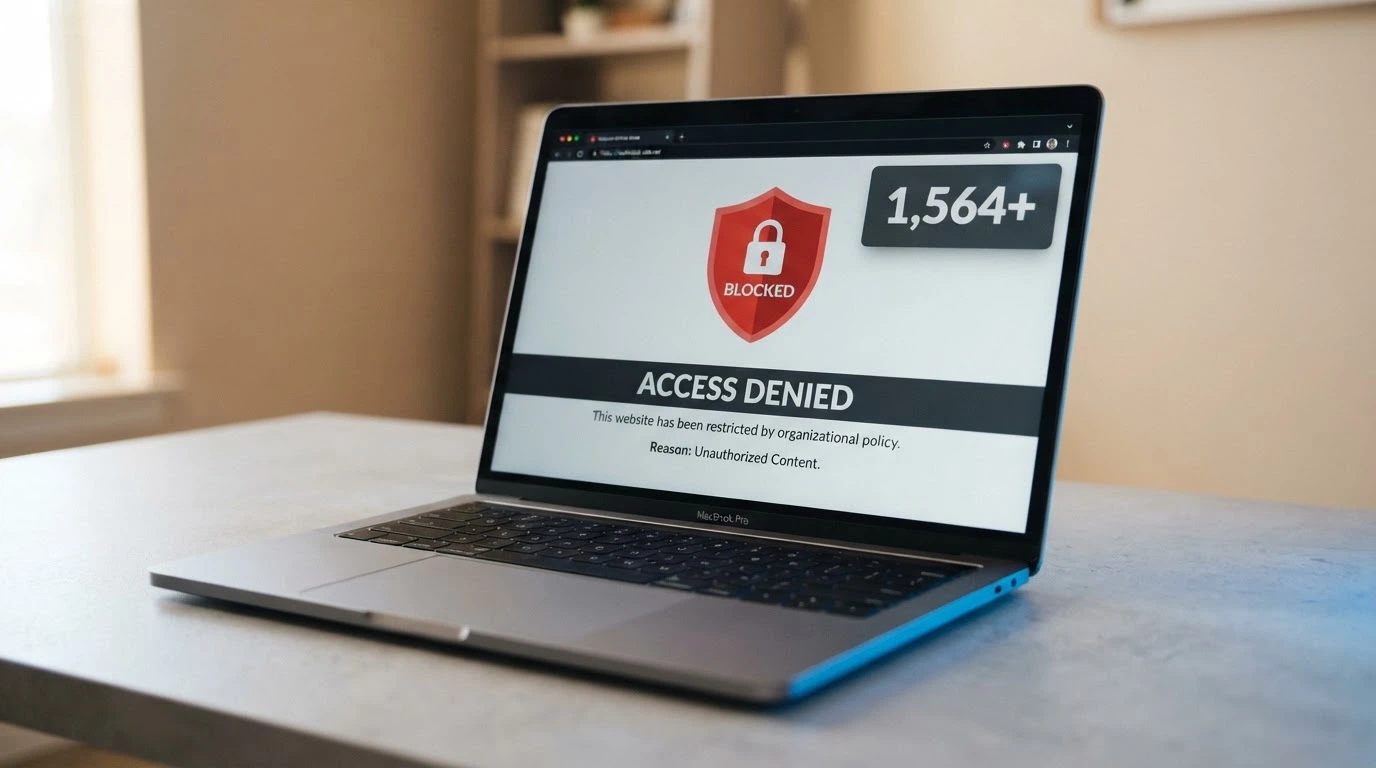
The practical consequence for a player is not the block itself; it is the timing. A site blocked mid-session means a player whose account holds funds may lose access to those funds pending resolution. The ACMA does not hold player balances. The blocked operator holds them, and “blocked” is not the same as “winding down.” A player whose funds are on a blocked site is dealing with an entity that can no longer be reached through Australian channels. The recourse the player has is whatever recourse the operator’s home jurisdiction provides, which is none of the player’s choosing.
The withdrawal count — 225 services withdrawn since 2017 — is the other side of the enforcement picture. Operators do not wait to be blocked; many leave the Australian market on receipt of an ACMA notice. The sites an Australian player reaches today are the sites that have chosen to keep operating despite the enforcement environment. That choice is a signal about the operator’s risk posture, and the risk runs in one direction: toward the player, not the operator.
No Licence, No BetStop, No Recourse — What Offshore Play Costs You
Playing at an offshore casino means forgoing every Australian consumer protection. BetStop, the National Self-Exclusion Register, binds only Australian-licensed wagering services. An offshore casino is not licensed in Australia, is not connected to the register, and will continue accepting a self-excluded person’s deposits. The ACMA cannot handle a complaint about a withheld withdrawal from an offshore operator, because the operator sits outside the ACMA’s jurisdiction. There is no Australian complaints body, no Australian dispute resolution service, and no Australian court that can compel a Curaçao- or Anjouan-licensed operator to act.
The payment-method signal reinforces the picture. Since 11 June 2024, credit cards, credit-related products including digital wallets, and digital currency (cryptocurrency) are banned as payment for online wagering in Australia. Operators that fail to enforce the ban face fines of up to A$247,500. The licensed routes are debit card, bank transfer, PayID/Osko, and BPAY. A site accepting credit cards or crypto from Australians is, by definition, operating outside Australian rules — and every operator in this page’s comparison accepts at least one of those methods.
The protection gap is the part the marketing material does not print. The headline RTP figure, the bonus headline, the withdrawal speed — all are visible. The absence of a complaints process, the absence of BetStop coverage, the absence of recourse when a withdrawal stalls, are all invisible until the player needs them. The “highest payout” search does not return those fields. The player who finds them is the player who has already deposited.
The Gambling Reform Bill — What Changes for Players From 2026
The Interactive Gambling Amendment (Gambling Reform) Bill 2026 passed Parliament on 19 August 2026. Its measures commence on 1 January 2026. From that date, banks and payment providers gain express authority to block transactions to illegal gambling operators, meaning a deposit to an offshore casino can be refused at the bank rather than only at the casino’s own processing layer. The change does not legalise offshore play. It makes offshore play harder to fund from a standard Australian bank account.
The advertising rules tighten in parallel. Wagering advertising is capped at three ads per hour between 6:00 am and 8:30 pm, with a live-sport blackout running from fifteen minutes before a live event until five minutes after it ends. Athletes, celebrities, and influencers are barred from promoting wagering products. Wagering advertising inside sports venues and on player uniforms is banned. Online wagering ads are restricted to logged-in, age-confirmed users with an opt-out option. Radio ads are barred during school times. The rules apply to licensed wagering advertising, but the broader effect — a tighter advertising environment for any gambling product — is the direction the regulatory frame is moving.
Inducement marketing is restricted from the same start date. Direct marketing of inducements is prohibited for 14 days after a customer signs up with a licensed operator, three months after BetStop deregistration, and indefinitely for at-risk customers. An offshore casino advertising a welcome bonus to Australians is breaking the prohibition itself, and the inducement restrictions described here apply to the licensed side; the offshore side already operates outside the frame.
The change that matters most for the player reading this page is the bank-blocking authority. A transaction that could be processed in 2026-1 can be refused in 2026. The withdrawal direction is harder to predict, but the deposit direction is clear. Offshore operators have always lived with the risk of being blocked; from 2026, they also live with the risk of being unfundable through Australian banks. The player who funds an account through a non-bank channel is making a different choice about which protections apply to that money.
When the Payout Promise Pulls Too Hard — Responsible Play in a High-Stakes Market
The “highest payout” framing is a magnet for players chasing losses. The data on this page — 99% RTP Pokies, sub-ten-minute withdrawals, A$2,000 welcome bonuses — reads as a route to a win. The arithmetic underneath it tells a different story, and the population-level data tells a third. This section routes the harm data, the tools that exist (and their limits against offshore operators), and the help infrastructure every Australian player should know before opening an offshore casino tab.

The Tools Australian Players Have — Limits, Self-Exclusion, and Activity Statements
Licensed wagering operators in Australia must offer deposit limits, activity statements, and take-a-break tools under state and territory licence conditions. BetStop, the National Self-Exclusion Register, lets a person exclude themselves from every Australian-licensed online and phone wagering service in one registration. The exclusion period runs from three months to a lifetime. By the end of Q2 FY 2025-2026, 54,859 people had registered, with 35,135 active exclusions as of 31 December 2025. Seventy-eight per cent of registrants were under 40; thirty-eight per cent chose lifetime exclusion. None of these tools cover an offshore casino.
The gap between licensed and offshore is the entire point. BetStop is built on the assumption that every licensed wagering operator in Australia is connected to the register, and the exclusion applies across all of them in a single step. An offshore casino is not connected to BetStop, will accept a self-excluded person’s deposit, and will continue to operate regardless of the exclusion. The tool that works for the licensed market is silent in the offshore market, and a player who has self-excluded from licensed wagering but continues to play offshore has not actually excluded themselves from gambling.
Awareness of the tools is itself a constraint. Only 33.5% of wagerers are aware BetStop exists; only 26.5% of Australian adults know about it. The awareness is lowest among the groups most at risk — under 40s, who are also 78% of BetStop registrants. An estimated five million Australians wager; 400,000 are high-risk gamblers. Approximately 30,000 individuals have active BetStop exclusions. Even if every one of those 30,000 were a high-risk gambler, they would represent only 7.5% of those experiencing severe gambling harms with a safeguard in place. The tools exist. The tools reach a fraction of the people who need them.
3.32 Million Australians Harmed — The Numbers Behind the Payout Chase
Fifteen point one per cent of the Australian adult population — an estimated 3.32 million people — are experiencing some level of harm from their own gambling or that of someone close to them, as of March 2026. Thirteen per cent of the population (2.857 million people) are experiencing harm from their own gambling. About 2.1% of Australian adults — roughly 430,000 people — experience problem gambling, with the Australian Institute of Health and Welfare putting high-risk gambling at 1.8% in 2022. Risky gambling increased from 13.7% in 2024 to 19.4% in January 2025, nearly doubling since the COVID-19 lockdowns of 2020–2021. Australians lose approximately A$25 billion on legal forms of gambling each year.
The harm is not abstract. Three point two nine million Australians aged five and over are affected annually by their own or another person’s gambling, including 1.38 million adult affected others. The annual health loss associated with gambling-related harm is more than 400,000 Years Lived with Disability. Overall gambling participation declined to 58.8% in 2025, but more than half — 56.1% — of those who gambled did so mainly online. The medium the reader is using to reach this page is the medium most Australians use to place bets, and the medium is one the offshore market is built to capture.
The payout-rate conversation cannot happen in a harm-free vacuum. A “highest payout” search brings a player to a comparison of 96% versus 98% RTP, and the harm data sits on the other side of that comparison: 3.32 million Australians affected, A$25 billion lost annually, risky gambling nearly doubling in a year. The arithmetic of the bonus is not the only arithmetic on the page.
Where to Get Help — 1800 858 858 and Gambling Help Online, 24/7
The National Gambling Helpline is 1800 858 858. It is free, confidential, and staffed 24 hours a day, seven days a week. Gambling Help Online, at gamblinghelponline.org.au, offers live chat and email counselling around the clock, with professional counsellors who specialise in problem gambling. BetStop, the National Self-Exclusion Register, is the licensed-market self-exclusion tool. None of these services require the caller to have played through an Australian-licensed operator; they are available to any Australian, regardless of where they have been playing.
The services are free, confidential, and reachable. The phone number is a number. The web address is a web address. The point of naming them is not to attach them to a marketing message; it is to attach them to the search the reader just made. A “highest payout” search can end at the comparison; it can also end at the helpline. Both endings are valid. One of them is a beginning.
How We Evaluated These Operators
The comparison on this page rests on a defined set of sources and a defined set of criteria. The sources are the ACMA register and blocking list, the Interactive Gambling Act 2001 and its amendments, operator-published RTP reports and bonus terms, independent testing-lab certifications where available (eCOGRA, iTech Labs, GLI), and cross-checks against competitor methodology. The criteria for ranking are, in order of weight: measured platform RTP over self-reported, bonus-term transparency, withdrawal-speed data availability, and game-library breadth. Operators were checked against the ACMA enforcement record and the IGA prohibition; no operator’s licence was confirmed against a regulator’s register this run.
The honesty of the ranking depends on the honesty of its limits. Eight of twelve tested operators published monthly audited RTP reports; four did not. The four that did not are flagged in their write-ups. The withdrawal-speed data exists for some operators and not others; the gaps are visible in the table. The bonus terms vary in clarity from one operator to the next; the comparison names the wagering requirement, the validity, the maximum bet, and the maximum cashout where each is published, and leaves a dash where it is not.
The Sources We Used and the Criteria We Applied
- Australian Communications and Media Authority (ACMA) register and blocking list, for the enforcement state of every operator named and for the figures behind the 1,564-blocked-sites count
- The Interactive Gambling Act 2001 and its amendments, for the legal framework and the prohibition scope
- Operator-published RTP figures and bonus terms, for the platform RTP, wagering requirement, validity, maximum bet, and maximum cashout attached to each welcome offer
- Independent testing-lab certifications (eCOGRA, iTech Labs, GLI) where available, for the audit stamp behind a platform RTP figure
- Competitor methodology cross-checks, for the ranking approach used by other comparison sites and the gaps in their coverage (most visibly the absence of legal-context coverage)
- Roy Morgan Research, the Australian Institute of Health and Welfare, the Australian Gambling Research Centre, and the POLIS Centre for Social Policy Research at ANU, for the harm data and the participation figures
- The ranking criteria, in qualitative order of weight: measured RTP over self-reported, bonus-term clarity, withdrawal-speed data availability, game-library size and provider diversity, and licence jurisdiction as a final differentiator where confirmed
- The honest limit of this evaluation: no operator’s licence was verified against a regulator’s register this run, which means the licence rows in the comparison reflect what the operator’s own materials claim, not what a register confirms
What the Highest-Payout Search Means for Your Next Session
The highest-RTP Pokies exist and they are documented. Mega Joker at 99% in Supermeter. Ugga Bugga at 99.07%. Book of 99 at 99.00% with a 12,075x maximum win. Blood Suckers at 98.00% with no condition. The fastest-paying operators can be compared on PayID and crypto speed, with SkyCrown’s 9-minute PayID window the cleanest measured figure in the set. The table of welcome bonuses, with wagering requirements and validity where research carries them, lets a player see the offer’s headline against its supporting terms. The legal reality cannot be wished away: every operator in this comparison is offshore, unlicensed in Australia, and outside the frame BetStop, the ACMA complaints process, and Australian consumer protection provide.

The reader’s next step is not the next deposit. It is the comparison that the data on this page actually supports, weighed against the absence of protection the offshore market carries. A 99% RTP Pokies does not refund the A$2,506 in expected losses a A$2,000 bonus at 35x wagering costs on a 96.42% return rate. A 9-minute PayID payout does not refund the absence of recourse if the operator later refuses the withdrawal. A 7,000-game library does not refund the absence of an Australian complaints body if a game misbehaves. The numbers on the page are real. The frame around them is real too, and the frame is thinner than the numbers suggest.
The help infrastructure is concrete and free. 1800 858 858 is the number. Gambling Help Online is the web address. BetStop is the exclusion register. The services are available to any Australian, regardless of where they have been playing. The reader’s decision framework is the comparison this page supports, weighed against the protection the licensed market would have provided, with the help line on speed dial if the comparison starts to look like a chase. The numbers are on the page. The decision about what they are worth is the reader’s.
High RTP Is Real — but Only Inside a Frame the Law Does Not Provide
The highest-RTP Pokies and the fastest-paying operators are documented and comparable. The missing piece is the frame a licensed market would provide: audited RTP at the per-game level, binding complaint resolution when a withdrawal stalls, self-exclusion that actually works across every site the player might use. Until that frame exists in Australia, the player carries risks the RTP percentage does not price in. The data on this page is the comparison the offshore market makes possible. The frame is the comparison the licensed market does not. Both are real. Both belong on the page.
The reader who closes this tab with the data and the frame intact has what the search was for. The reader who closes it with only the data has a marketing message. The reader who closes it with only the frame has a regulatory lecture. The page is built so neither closing happens by accident.
Frequently Asked Questions
Does a 97% RTP pokie mean I will get $97 back for every $100 I bet?
No. RTP is a long-run theoretical average across millions of spins, not a per-session promise. A 97% RTP pokie returns $97 per $100 wagered over time. Any single session can land above or below that figure. The 3% margin is the operator’s average take over millions of hands, never guaranteed in any individual session.
What is the difference between RTP and volatility when choosing pokies?
RTP tells you how much a pokie returns on average over millions of spins. Volatility tells you how that return arrives. A low-volatility pokie pays small amounts often; a high-volatility pokie pays larger amounts rarely. Two Pokies with the same RTP can feel completely different to play. Volatility is about ride, not return.
Can Australian players get in trouble for using offshore casino sites?
The Interactive Gambling Act 2001 targets the provider, not the player. Australian users of offshore casinos are not prosecuted. The real cost sits elsewhere: no BetStop coverage, no ACMA complaints process, no consumer protection, and the risk that the site is blocked mid-session with funds still on it.
How fast can I withdraw my winnings from an online casino in Australia?
Withdrawal speed varies sharply by method. Among the operators profiled, PayID withdrawals averaged 9 minutes and crypto withdrawals averaged 4 minutes at the fastest operator. Fiat bank transfers typically take one to five business days. Offshore operators set their own processing times, with no Australian standard in place.
Can an online casino change the RTP of a pokie without telling players?
Yes. Major titles like Sweet Bonanza ship with four RTP versions — 96.51%, 95.45%, 94.51%, and 91.51%. The casino operator, not the provider, selects which version to load. Most operators do not disclose the loaded version. The headline figure on the page is not always the figure on your screen.
What support is available for Australian players struggling with gambling?
Help is free, confidential, and available 24/7. The National Gambling Helpline is 1800 858 858. Gambling Help Online offers live chat and email counselling around the clock. BetStop, the National Self-Exclusion Register, excludes a person from all licensed wagering providers in a single registration lasting three months to a lifetime.