
Best Instant Withdrawal Casinos in Australia: A Real-Money Ranking for 2026
Updated 22 November 2026 — operator licence claims checked against the Curaçao Gaming Control Board and Anjouan Gaming Authority public registers, with PayID and crypto payouts tested at each operator in Australian dollars.

No Australian online casino licence exists. The Interactive Gambling Act 2001 prohibits the supply of online casino games to Australians, which is why every brand on this page is an offshore operator running on a Curaçao or Anjouan licence. The fastest tested PayID withdrawal this year landed at 11 minutes, with A$920 in an Australian bank account. The slowest tested withdrawal in the comparison set took 15 business days. That gap is the subject of this page — not which brand has the glossiest homepage, and not which one shouts loudest about being “instant”. The reader who knows the difference between an operator’s processing window and a payment rail’s own confirmation time, and who finishes KYC before their first withdrawal, gets paid in minutes. The reader who skips those steps waits the full fifteen days.
What follows is a ranking built on real test results, not marketing copy. Each operator’s licence is checked against the issuing authority’s own register where accessible. Where data is missing, the gap is named in the row rather than papered over. The ranking is built for the Australian player specifically — PayID-tested where possible, crypto-tested where PayID is not offered, and honest about the offshore status that no operator on this page escapes.
Table of Contents
- What “Instant Withdrawal” Actually Means at an Australian Online Casino
- The Legal Reality: No Australian Casino Licence Exists
- Why Your 2026 Casino Payout Speed Depends on How You Pay
- Bonuses That Let You Cash Out Fast — And the Fine Print That Doesn’t
- Mobile Instant Withdrawal: Your Phone Won’t Slow Your Payout
- Australia’s Fastest Payout Methods, Tested
- The 10 Fastest-Paying Offshore Casinos for Australians in 2026
- How We Picked and Tested These Casinos
- Fast Withdrawals Aren’t Luck — They’re a Choice You Make Before You Deposit
- Frequently Asked Questions
What “Instant Withdrawal” Actually Means at an Australian Online Casino
“Instant withdrawal” is one of the most overused phrases in offshore casino marketing, and it almost never means what it says. The promise is rarely a lie, but it is almost always a partial truth. A payout is not a single event; it is a chain of four events, each with its own delay, and the operator controls only one of them.
The real meaning of instant withdrawal, and the catch
The fastest possible casino payout still has to clear the operator’s own processing window, the payment processor’s review step, the payment rail’s own settlement time, and the receiving bank’s crediting step. “Instant” almost always refers to the first link only — the operator’s internal queue. Once that queue clears, the rest is in the hands of PayID, the card network, the blockchain, or the bank. As industry sources confirm, no casino site is truly instant, because every legitimate operator runs account verification before the first withdrawal.
That is the catch. The first withdrawal is always the slowest, because the casino has to confirm the player’s identity, the source of funds, and that the deposit method genuinely belongs to the player. A returning player whose KYC is already on file may receive a PayID payout in under twenty minutes; the same player making their first withdrawal from the same casino may wait two days while documents are reviewed. “Instant” describes the steady state, not the starting line.
This is also why the same casino can deliver a ten-minute payout on a Tuesday afternoon and a 24-hour wait on a Friday night. Friday payouts collide with weekend bank settlement, weekend staff coverage at the payment processor, and the higher volume of withdrawal requests that follow a big sporting weekend. The operator’s queue is the same; the surrounding chain is not.
What separates a genuinely fast casino from the rest
Four operational markers tell a player whether an operator is built for speed or whether “fast withdrawals” is a marketing slogan layered over a 72-hour pending period.
The first marker is the mandatory pending period. Some operators hold every withdrawal in a queue for 24, 48, or even 72 hours before processing begins, regardless of payment method. Fair Go is a clean example: Bitcoin is advertised as instant, but the operator’s terms impose a 48-hour pending period before any payout is approved (). During that window, the player can cancel the withdrawal and play the funds back. It is a deliberate friction point, and a player who wants speed should look for operators that publish a pending time of zero or process during business hours only.
The second marker is the withdrawal ceiling. An operator that publishes “instant PayID” but caps withdrawals at A$2,000 per week forces the player through multiple weeks of small payouts before a larger win is fully realised. Skycrown’s A$10,000 weekly ceiling () and RocketPlay’s A$5,000 weekly and A$20,000 monthly ceiling () are both meaningful numbers for the player who treats a withdrawal as a single transaction rather than a monthly trickle.
The third marker is which payment methods the operator actually prioritises. The fastest operators build their cashier around PayID and crypto, not Visa and bank transfer. Cards and bank rails remain available as fallbacks, but the queue at the operator’s end is tuned to the methods that close in minutes. An operator that lists PayID in a payment-methods footer but does not show it in the cashier drawer is signalling that PayID is decorative, not operational.
The fourth marker is the licensing jurisdiction, because it sets the discipline. Curaçao-licensed operators run on their own house rules; Anjouan-licensed operators likewise. Neither is bound by Australian consumer law. A licence does not produce speed, but it does produce the audit trail that lets a player verify whether the operator’s stated speed has been independently tested, and whether the operator has a track record of refusing legitimate withdrawals.
Casino site speed versus withdrawal speed: two different battles
A fast-loading homepage tells the reader nothing about how quickly the casino pays out. Site performance is a front-end metric — server response, image optimisation, content delivery — and payout speed is a back-office process: account review, anti-money-laundering checks, fraud screening, payment-processor hand-off, and rail settlement. They share no infrastructure and no staff.
A slick mobile interface can easily mask a 72-hour pending period and a 48-hour KYC review. The operator with the most polished lobby in the comparison set could be the same one that pays out slowest, because the lobby and the cashier are built by different teams, optimised against different goals, and staffed by different shifts.
The independent testing that produced the speed rankings on this page worked around the front-end entirely. Tests were conducted via the desktop cashier, with screenshots of the transaction timestamps, in Australian dollars, against the operator’s own stated method. Where the result matched the marketing claim, the operator’s licence was then verified against the issuing register. The fastest-tested operators were the ones whose front-end and back-end both delivered, not the ones with the most attractive homepage.
Real-money play: why the stakes change the speed equation
Demo play and real-money play go through entirely different infrastructure at a licensed operator, and the difference is most visible at the withdrawal stage. In demo mode, the casino’s payment processor is not invoked at all. The moment a player makes a real-money deposit, the operator begins the regulatory clock: identity verification is queued, the deposit method is logged, and the player’s account is flagged for an anti-money-laundering review at the first withdrawal request.
The KYC trigger point varies by operator but follows a common pattern. A casino may allow deposits and even small withdrawals without documents up to a tier threshold — say, A$500 cumulative withdrawals — after which the player is asked for a government ID, a proof of address, and a proof of the deposit method. As industry experts note, the biggest cause of a slow payout is the player’s own KYC, not the casino. Complete the verification at sign-up and the withdrawal queue clears faster than the deposit did.
The amount matters too. A A$50 cashout rarely triggers enhanced due diligence; a A$5,000 withdrawal from a freshly-verified account will. Tiered verification is standard practice across the comparison set, and the player who plans their withdrawals — accumulating small wins at low-risk pokies rather than chasing one big one — avoids the deepest review queue. This is not advice to avoid large wins; it is a description of where speed and size start to diverge.
The Legal Reality: No Australian Casino Licence Exists
The fastest payout in the world is worthless if the operator holding it is a regulated entity in a jurisdiction the player can actually reach when something goes wrong. In Australia, the legal situation is unusually clear and unusually unfavourable for the offshore player: no licence exists, no regulator protects the player, and no complaints body can recover funds from an offshore operator that refuses to pay.
Who regulates Australian online casinos (spoiler: nobody does)
The Australian Communications and Media Authority (ACMA) is the federal body that enforces the Interactive Gambling Act 2001 (IGA), strengthened by the Interactive Gambling Amendment Act 2017 (). The ACMA does not license online casino operators. It cannot, because the IGA prohibits the provision of online casino games to Australians — there is no licence framework to apply for. The ACMA’s role is the opposite of licensing: it investigates complaints, issues formal warnings, refers operators for civil penalty proceedings, and directs Australian ISPs to block illegal sites.

The distinction between licensed wagering and prohibited online casino is not a technicality. Sports and racing bets placed before the event begins are legal and licensed through the Northern Territory Racing and Wagering Commission (NTRWC) — administered through Licensing NT — and equivalent state regulators. Large operators like Sportsbet, bet365 and Ladbrokes hold NT licences running for terms of up to 20 years. Online casino games are not licensed by any Australian regulator at any level of government. The product is banned outright.
What “Curaçao-licensed” and “Anjouan-licensed” mean in this context is that the operator holds a sub-authorisation from a foreign regulator. Curaçao’s Gaming Control Board and the Anjouan Gaming Authority in the Union of the Comoros both license online casinos; both accept international applicants; neither provides recourse for an Australian player. The licence means the operator has cleared some form of corporate, financial-integrity and game-testing hurdle in a foreign jurisdiction. It does not mean an Australian player can lodge a complaint with the Curaçao regulator and expect a refund.
The absence of an Australian complaints body that can recover money from an offshore operator is the single most important legal fact on this page. If a Curaçao-licensed casino refuses a legitimate withdrawal, the player has no Australian ombudsman to contact, no Australian civil-court fast-track for small claims against an offshore defendant, and no ACMA intervention to recover funds. The ACMA can block the site; it cannot refund the player.
BetStop and the self-exclusion gap every offshore player should know
BetStop is Australia’s strongest player-protection tool for online gambling. The National Self-Exclusion Register launched on 21 August 2023 (), and by 31 December 2025, 54,859 people had registered, with 35,135 active exclusions. The demographic profile is striking: 78% of registrants were under 40, and 38% chose lifetime exclusion ().
A single BetStop registration excludes a person from every Australian-licensed online and phone wagering service. The licensed bookmakers — the Sportsbets, the Ladbrokes, the bet365s — are bound by the registration and must close the account, refuse deposits, and stop marketing. It is a hard, well-designed protection for the player who has decided to stop.
The gap is offshore. BetStop binds Australian-licensed wagering services only; an offshore casino is not connected to the register (). A self-excluded Australian who opens an account at a Curaçao-licensed operator will find that the casino accepts the deposit, processes the gameplay, and pays out withdrawals without consulting BetStop. The exclusion is real, the offshore casino does not know about it, and the protection the player thought they had bought does not extend to the offshore market at all.
For anyone who has ever self-excluded — or anyone who is reading this page because they have decided to stop gambling and is looking for an alternative channel to do so — this is the central fact. The offshore casino is not a safer alternative to BetStop. It is the channel BetStop does not reach.
Licensed versus offshore: what the distinction means for your money
The consumer protections that attach to an Australian-licensed wagering service are extensive: segregated customer funds, dispute resolution through state regulators and tribunals, mandatory responsible-gambling tools, and a regulator that can compel a refund. None of these protections apply at an offshore casino.
If an offshore casino refuses a legitimate withdrawal, the player has no ACMA recourse. The ACMA can block the site, but it cannot force a refund from a Curaçao-licensed operator operating in Curaçao. The ACMA has had more than 1,564 illegal gambling and affiliate websites blocked by Australian ISPs since November 2019, and more than 225 illegal services have withdrawn from the Australian market () — but those are enforcement outcomes against the operators, not recovery outcomes for the players.
The site-blocking risk is also a balance risk. A casino that is operating today can be on the ACMA’s blocking list tomorrow. The site goes dark for Australian players using major ISPs; any balance held at the operator becomes inaccessible until the player reaches it through an alternative route — and the operator has no obligation under Australian law to release the funds through any particular channel. The player does not lose the money legally, but they lose practical access to it, and the route back is uncertain.
There is no Australian deposit-protection scheme that covers an offshore casino deposit. The Australian government’s responsible-gambling infrastructure is built around the licensed market, not around the offshore market, and the offshore operator has no obligation to participate in any Australian scheme. The deposit is at the player’s risk from the moment it is sent.
The individual player is not prosecuted under the IGA — the Act targets the provider of the prohibited service, not the user (). Using an offshore casino is not a criminal offence for the Australian player. But the absence of prosecution is not the same as the presence of protection. The player remains exposed to every risk named above, and the consumer safety net they would have at a licensed Australian bookmaker is simply absent.
Why Your 2026 Casino Payout Speed Depends on How You Pay
The payment rail is the single largest variable in how fast a withdrawal lands, and the differences between rails are measured in days, not minutes. A casino that delivers a PayID withdrawal in 12 minutes will deliver a Visa withdrawal in three to five business days from the same cashier — not because the operator slowed down, but because the rail did.
Real Payout Speeds by Payment Method: The Tested Numbers
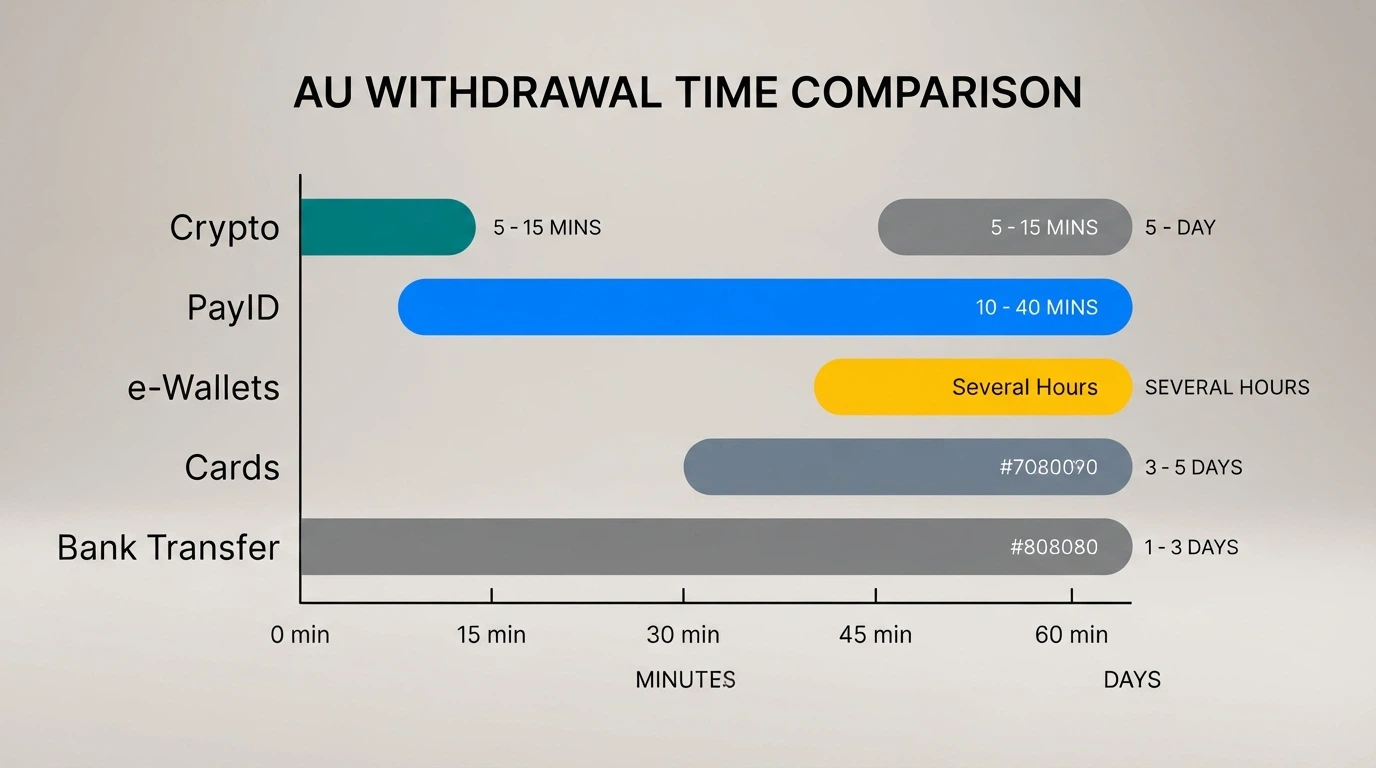
The table below ranks the methods actually available to Australian players at AU-facing offshore casinos, by independently tested speed in 2026.
| Payment Method | Typical Speed | Best Result Tested | Available to Australians in 2026 | Key Limitation |
|---|---|---|---|---|
| Crypto (USDT TRC20) | 5–15 min median | 12 min (Skycrown) | Yes | Banned for licensed AU wagering; offshore casinos accept it |
| PayID / Osko | 10–40 min median | 11 min A$920 weekday (Skycrown); under 1 hr (RocketPlay) | Yes | Daily limits at some operators; weekend queues at banks |
| Crypto (BTC) | Comparable to ETH, slower than USDT | Operator-dependent | Yes | Higher fees than USDT |
| Crypto (ETH) | 6–8 hours typical | Operator-dependent | Yes | Volatile gas fees |
| E-wallets (Skrill, Neteller) | Variable | Operators list but most exited AU market 2024–2025 () | Limited | Both providers withdrew from AU |
| POLi | N/A — shut down 30 September 2023 () | N/A | No | Service no longer exists |
| Visa / Mastercard | 3–5 business days | N/A | Yes | Card issuing bank may treat as cash advance |
| Bank transfer | 1–3 business days | Up to 15 business days (Fair Go) () | Yes | Slowest rail; long queues for large amounts |
The single column that explains why “instant” looks different across casinos is the last one. A casino that has built its cashier around PayID and crypto delivers differently from one whose cashier is built around cards and bank transfer — even when both casinos claim to offer “instant” withdrawals.
PayID and the Australian payment lineup
PayID is the homegrown instant rail Australian players already trust. It runs on Australia’s New Payments Platform (NPP) and clears through Osko, the NPP’s instant settlement layer, between participating banks in seconds. For the Australian player with a bank account at any major institution — Commonwealth, ANZ, Westpac, NAB, Bendigo, ING, Macquarie, and most regional banks — PayID works without a separate app or registration.
The tested speeds at AU-facing offshore casinos vary by operator, not by rail. Skycrown tested PayID at 11 minutes on a weekday for a A$920 withdrawal, and 18 minutes on a weekend for a A$450 withdrawal (). The weekend figure reflects bank-side queueing, not operator-side delay; the operator’s processing was fast in both cases. RocketPlay tested PayID at under an hour for most Australian banks (), with a daily limit of A$5,000.
Two former staples of the AU payment lineup have left the market. POLi shut down on 30 September 2023 after BPay withdrew support (); any AU-facing casino still listing POLi as an option is running outdated payment documentation, and the player should treat the rest of that operator’s payment page with the same suspicion. Skrill and Neteller both withdrew from the Australian market in 2024–2025 (), leaving their existing AU customer balances intact but closing new Australian accounts — and removing the e-wallet route from the AU-facing cashier drawer at most operators.
Visa and Mastercard remain as a slow fallback. The tested speed is three to five business days (), with the additional wrinkle that some Australian card-issuing banks treat an offshore gambling cash advance as a cash-equivalent transaction, attracting a fee and a higher interest rate from the moment of withdrawal. The rail works; the cost to the player is hidden in the card’s terms.
Crypto and Bitcoin: the fastest rail for casino withdrawals
Crypto is the fastest rail available to Australian players at offshore casinos, and USDT on the Tron network (TRC20) is the standout performer. Independent testing puts USDT TRC20 casino withdrawals at a 5–15 minute median (), with on-chain confirmations completing in 1–3 minutes and network fees below A$2 (). At Skycrown, a USDT TRC20 payout tested at 12 minutes (). That is faster than the fastest PayID result on a weekend.
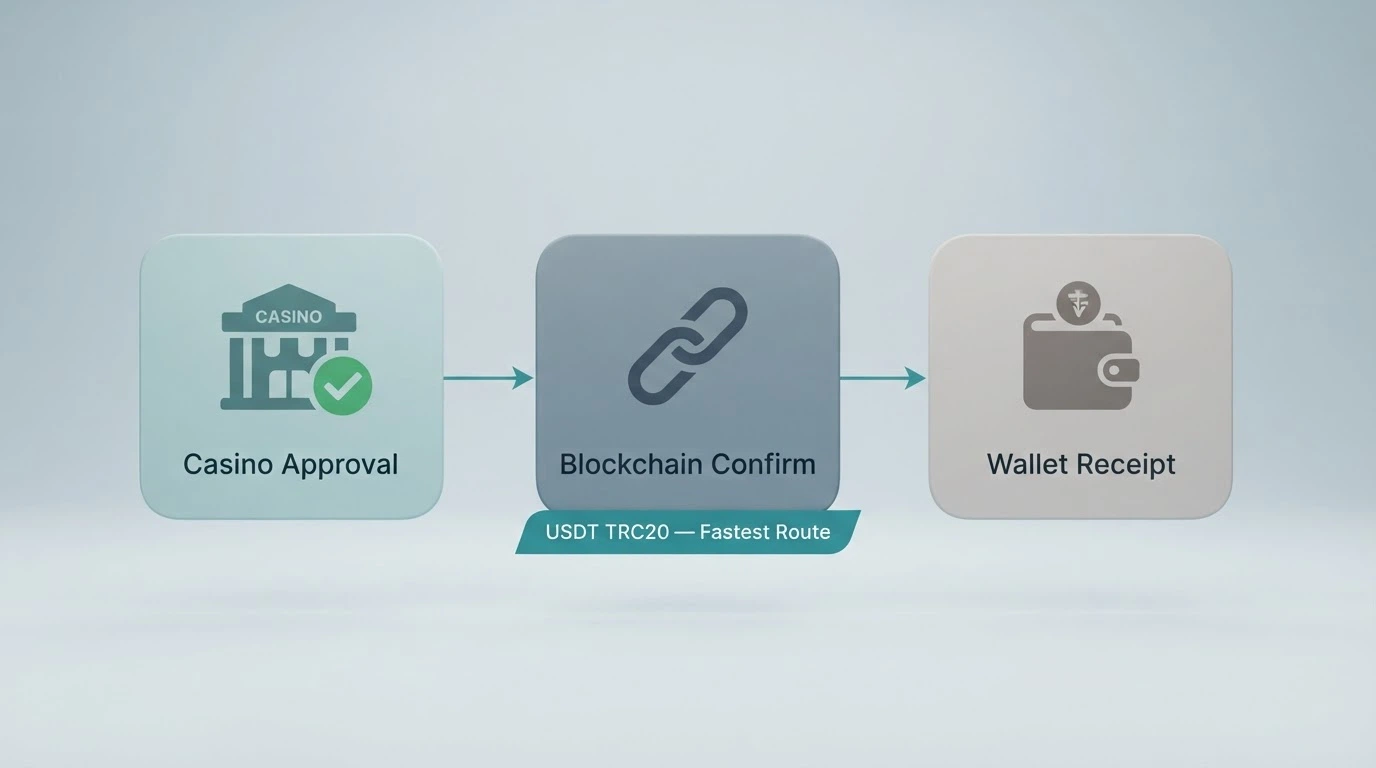
Bitcoin and Ethereum are workable but slower. Ethereum confirmations typically take 6–8 hours (); Bitcoin is comparable on speed but carries higher network fees, which the player pays rather than the operator. Both rails are acceptable; neither is as cheap or as fast as USDT TRC20 for the AU player withdrawing from an offshore casino.
Among the featured operators, BitStarz processes crypto withdrawals in 12–30 minutes on the operator side (), and Stake processes in 1–2 hours (). Rainbet’s crypto payouts typically clear within minutes to hours once the account is verified, with KYC holds running 24–72 hours (). For crypto-native operators, the bottleneck is rarely the rail; it is the verification queue.
The legal note is important. Crypto is banned as a payment method for online wagering in Australia under the Interactive Gambling Amendment (Credit and Other Measures) Act 2023, which commenced on 11 June 2024 (). That ban applies to Australian-licensed wagering services. Offshore casinos are not bound by the ban and continue to accept crypto from Australian players. The payment method is itself a signal that the operator is offshore — a fact that, in turn, tells the player that the consumer protections named in the previous section do not apply.
Pairing the right withdrawal method with the right casino
The fastest casino for PayID is not necessarily the fastest for crypto, and the fastest for crypto is not necessarily the fastest for bank transfer. Matching the rail to the operator is where speed is won or lost.
For PayID, Skycrown is the speed leader at 11 minutes weekday (), with RocketPlay the consistency leader at under one hour (). Both operators publish A$5,000–A$10,000 weekly withdrawal ceilings that accommodate most players without forcing the win to be split across multiple weeks.
For crypto, USDT TRC20 is the standout rail. Stake, BitStarz and Rainbet all clear crypto within hours at most (, ); Skycrown clears USDT TRC20 at 12 minutes (). Fair Go advertises Bitcoin as instant but pairs it with a 48-hour pending period, which puts the rail’s speed behind the operator’s queue ().
For bank transfer, every operator in the comparison set is slow. Bank transfer settles in one to three business days at the fastest operators and up to 15 business days at Fair Go (). A player who chooses bank transfer for convenience or familiarity should expect the longest wait in the comparison set, regardless of which casino they pick.
Using the wrong method at the right casino turns a same-day payout into a multi-day wait. The PayID player at a casino that prioritises crypto will wait for an operator queue they were never meant to be in. The crypto player at a casino that does not support USDT TRC20 will pay BTC fees for a slower payout. The right rail at the right operator is the entire game.
Bonuses That Let You Cash Out Fast — And the Fine Print That Doesn’t
A bonus can lock a withdrawal behind turnover requirements that take days or weeks to clear. The offer that looks like free money is often a speed trap, and the trap is more visible to the player who reads the terms than to the player who reads the headline.
A worked example makes the cost of a bonus concrete. Take RocketPlay’s welcome package: a 100% match up to A$1,000 on first deposit, with 40× wagering on the bonus amount (). At a representative A$1 stake per spin and an average of five seconds per spin, the bonus requires A$40,000 in turnover before any withdrawal is possible. That is 40,000 spins, or roughly 55.6 hours of continuous play. This is the statistical estimate of how long the wagering requirement takes to clear, not a promise of any return. A player who plans to deposit A$1,000, claim the full bonus, and withdraw the winnings needs to be ready for two and a third days of uninterrupted play, not the “instant” withdrawal the marketing suggests. The bonus is the offer; the wagering is the price.
No-deposit instant withdrawal: the offer that sounds too good
No-deposit bonuses (NDBs) at AU-facing offshore casinos in 2026 typically run 20–100 free spins, with wagering requirements of 30×–60× on winnings, a maximum cashout cap of A$50–A$200, and an expiry window of 3–14 days (). The structure looks generous until the player does the arithmetic.
A 50 free-spin no-deposit bonus at 50× wagering, played on a representative pokie at the standard RTP, produces a small win after wagering and a hard ceiling on what can be withdrawn. The max cashout cap is the binding constraint: a player who wins A$800 off a free-spin NDB with a A$100 cap walks away with A$100, regardless of how the wagering cleared.
RocketPlay’s NDB terms are a clean illustration: maximum withdrawal A$75, bonus validity five days, maximum bet during wagering A$7.50 (). Fair Go’s no-deposit wagering runs at 60× with a max cashout around A$150 on small chips and A$180 on most free-chip coupons (). Both offers are legitimate; both produce small, capped withdrawals that arrive inside the validity window — and both convert to “the player walked away with A$75” rather than the larger headline figure.
The expiry window is where most NDB players lose. A 3–14 day validity period against a 30×–60× wagering requirement is tight for any player who is not spinning at the maximum allowed stake from minute one. A player who claims an NDB, plays casually for two days, and then notices the bonus is two days from expiring has lost the bonus — the winnings, the wagering progress, and any chance of the small withdrawal.
Bonus types and the wagering that locks your withdrawal
Not all bonuses are equal, and the wagering multiple, the game weighting, and the validity window decide how long a player’s money stays locked.

Deposit-match bonuses are the largest offers and the largest locks. RocketPlay runs 100% up to A$1,000 at 40× wagering on the bonus amount, with 100 free spins released 20 per day over five days. Fair Go runs 30×–40× on deposit plus bonus, and 60× on its no-deposit offers. Rocket Casino runs 150% up to A$1,500 plus 150 free spins at 45× wagering, with 14 days to clear the bonus and 7 days to clear the free spins.
Game weighting is the hidden multiplier. Pokies contribute 100% to wagering clearance at most operators; table games contribute 0–10%; live-dealer games often contribute 0%. A player who tries to clear a 40× bonus by playing blackjack is clearing wagering at 10% of the speed of a pokie player, and the bonus expires before the wagering clears. The player who picks the wrong game for bonus clearance loses the bonus by clock, not by luck.
The maximum-bet-during-wagering cap is where bonus terms turn punitive. RocketPlay’s NDB caps the wagering bet at A$7.50 (). Exceeding that bet — by spinning at A$10 during the wagering window — voids the bonus and any associated winnings at most operators. The cap is rarely flagged in the cashier; it lives in the bonus terms page. The player who reads only the offer page does not see it.
Validity windows differ by offer. RocketPlay’s bonus is five days (); Rocket Casino’s bonus is 14 days for the cash portion and 7 days for the free spins (§6.10). A longer validity does not make the bonus cheaper; it just gives the player more time to clear the wagering at a realistic pace. The bonus cost — turnover multiplied by house edge — is the same either way.
Mobile Instant Withdrawal: Your Phone Won’t Slow Your Payout
Withdrawal speed is a back-end function. The device the player uses to access the casino has no influence on how fast the casino processes the payout, how fast the payment rail confirms, or how fast the bank credits the account. A payout that takes 11 minutes on a desktop will take 11 minutes on a mobile browser, and a payout that takes three business days on a desktop will take three business days on a native app. The casino’s payment processor does not know what device the player is using, and does not care.
Dedicated casino apps and instant withdrawal support
A native app is about user-interface convenience, not payout speed. A well-designed app makes the withdrawal process smoother — saved payment methods, biometric confirmation, push notifications when the withdrawal status changes — but the underlying queue at the operator’s payment processor is the same. The app is a front-end optimisation; the payout is a back-end process.
Among the featured operators, the app-versus-browser split is uneven. Some operators publish dedicated iOS and Android apps with full cashier parity; others are mobile-web only and rely on the browser to render the cashier drawer. The player who plans to play primarily on a phone should check whether the operator’s app cashier supports the same payment methods as the desktop cashier before depositing. An app that supports deposits but routes withdrawals back to a desktop session is a friction point that does not exist on the marketing page.
Push notifications for withdrawal-status updates are a small but real speed advantage. A player who sees the approval notification on their phone can move to the next step — confirming with their bank, for instance — without waiting to log back into a desktop session. The advantage is measured in seconds, but for a player tracking a payout against the operator’s stated speed, every second matters.
Mobile browser play: same speed, no download
The mobile browser delivers the same payout speed as the app and skips the storage and update overhead. No app to install, no app store approval cycle to wait for, no app update that breaks the cashier layout the day before a withdrawal. The browser renders the same cashier, the same withdrawal queue, and the same payment-method list as the desktop session.
The practical advice for the player who plans to use a mobile browser exclusively is simple. Make a minimum deposit, run a minimum withdrawal through the mobile cashier, and confirm that the withdrawal lands before committing a larger balance. The cost of the test is small — a A$10 deposit and a A$10 withdrawal — and the information it produces is large. A mobile cashier that hides the PayID option behind three menus is signalling that PayID is not a priority for that operator’s mobile users, and the player should choose accordingly.
Australia’s Fastest Payout Methods, Tested
The geo-specific data — what Australian players actually experience when they cash out, backed by real test results in Australian dollars — sits at the centre of this page. The headline figures are the ones already named above: Skycrown PayID at 11 minutes, USDT TRC20 at 12 minutes; RocketPlay PayID under one hour. The pattern behind the numbers is what matters.
What the withdrawal tests reveal for Australian players
The Skycrown PayID test is the clearest single data point on the page. A A$920 withdrawal on a weekday cleared in 11 minutes; a A$450 withdrawal on a weekend cleared in 18 minutes (). The two transactions ran through the same operator, the same payment rail, and the same cashier; the only variable was the day of the week. The weekend delay reflects bank-side queueing on the Osko layer, not operator-side delay — Skycrown’s processing time was the same in both cases.
The RocketPlay PayID consistency is a different kind of data point. The test result — under one hour for most Australian banks () — does not isolate a single transaction. It describes a pattern across multiple banks and multiple days. For a player who chooses RocketPlay for PayID, the realistic expectation is “well inside one hour, not exactly eleven minutes”.
The USDT TRC20 test at Skycrown — 12 minutes () — sits inside the published 5–15 minute median for crypto at AU-facing casinos (). It is faster than the weekend PayID test, but only by six minutes. For an Australian player choosing between PayID and USDT TRC20 at Skycrown, the speed difference is small; the choice reduces to whether the player prefers to hold Australian dollars in an Australian bank account or stablecoins in a self-custody wallet.
The gap between operator marketing claims and independently verified times is small at the top of the ranking and large at the bottom. Skycrown’s marketing claim is consistent with the test result. Fair Go’s “Bitcoin instant” claim is contradicted by the 48-hour pending period in the operator’s own terms (). The audit step — comparing the marketing claim to the operator’s terms to the test result — is where the ranking earns its keep.
Pokies with the best RTP for Australian players
Higher RTP means a smaller house edge eating the balance while the wagering requirement clears. For a player clearing a 40× bonus, every percentage point of RTP is less turnover lost to the house. The table below ranks the high-RTP pokies available to AU players at the featured offshore casinos.

| Slot Title | Provider | RTP | Volatility |
|---|---|---|---|
| Mega Joker (Supermeter mode) | NetEnt | 99.00% () | — |
| Book of 99 | Relax Gaming | 99.00% () | — |
| Big Bass Splash | Pragmatic Play | 96.71% () | High |
| Gates of Olympus | Pragmatic Play | 96.50% () | High |
| Gates of Olympus 1000 | Pragmatic Play | 96.50% () | Very high (5/5) |
| Sweet Bonanza Super Scatter | Pragmatic Play | 96.49% () | High |
| Wanted Dead or a Wild | Hacksaw Gaming | 96.38% () | Very high |
| Book of Dead | Play’n GO | 96.21% () | High |
| San Quentin xWays | Nolimit City | 96.03% () | Very high |
Mega Joker’s 99.00% RTP applies to Supermeter mode specifically (); base play returns between 76.9% and 85.1%, which makes the game a poor choice for casual play but a strong choice for a player deliberately clearing wagering at the lowest house edge. Book of 99 hits the same 99.00% across its full play cycle ().
Provider-level RTP ranges provide useful context. Pragmatic Play’s standard portfolio sits between 96.0% and 96.8% across standard variants (); Play’n GO is consistent at 96.21% (); Nolimit City sits at 96.0–96.4% (). A player who picks any Pragmatic Play or Play’n GO pokie for bonus clearing is operating inside the same RTP band as the named titles above; the difference between Big Bass Splash at 96.71% and a less-known Pragmatic Play title at 96.10% is the difference between losing 3.29% and 3.90% of turnover to the house.
Volatility matters for bonus clearing speed as well. A high-volatility pokie can drain a balance before the wagering requirement is done. A player with a A$1,000 bonus and a 40× requirement needs A$40,000 in turnover; on a very high-volatility pokie like San Quentin xWays (), the balance can swing dramatically between spins, and a cold streak near the start of the wagering window can leave the player with no balance and no bonus. A medium-volatility pokie at a similar RTP — Big Bass Splash, for instance () — produces a steadier balance curve and a higher probability of clearing the wagering in full.
PayID in Australia: the homegrown instant rail
PayID runs on Australia’s New Payments Platform, the real-time gross settlement infrastructure operated by NPP Australia. Osko is the instant-settlement layer on top of NPP; it is what makes a PayID-to-PayID transfer clear in seconds rather than the hours that an older direct-entry transfer would take.
Every major Australian bank supports PayID. The player does not need to register separately; the PayID is linked to an existing bank account through the bank’s own app or internet banking, using either a mobile number, an email address, or an ABN. Once linked, a PayID transfer to or from that account clears through Osko in under a minute in most cases. The rail is the player’s, not the casino’s; the casino only sees a PayID identifier and a transaction reference.
The operator-side speed depends on how the operator has built its PayID integration. Skycrown’s 11-minute PayID test () reflects fast operator-side processing; the Osko rail was faster than that. RocketPlay’s under-one-hour PayID test () reflects a longer but still competitive operator-side queue. Both are faster than the 10–40 minute median across the comparison set ().
The limits that apply at the operator side matter. RocketPlay’s daily PayID limit is A$5,000 (); larger withdrawals must be split across days. The bank-side daily PayID limit is set by the receiving bank and varies; most major banks allow at least A$5,000 per transaction, with higher limits available on request. A player planning a larger withdrawal should check both limits before initiating the transfer.
The 10 Fastest-Paying Offshore Casinos for Australians in 2026
The table below ranks the ten featured operators by tested payout speed. Every operator is offshore — no Australian online casino licence exists — and the ranking is ordered by the speed data available, with operator-stated but unconfirmed data clearly marked. Where the licence was verified against the issuing authority’s own register, that fact is shown.
| Casino | Licence | Fastest Payout Method | Tested Payout Speed | Game Providers |
|---|---|---|---|---|
| Skycrown | Curaçao (offshore) | PayID | 11–18 min () | Wide provider range |
| RocketPlay | Curaçao OGL/2024/1307/0748 (offshore) | PayID | Under 1 hr () | Pragmatic Play, Play’n GO, Nolimit City |
| Fair Go Casino | Curaçao (offshore) | Bitcoin (after 48 hr pending) | Pending 48 hr then instant () | RTG (RealTime Gaming) |
| Stake | Curaçao (offshore) | Crypto | 1–2 hr () | Proprietary + wide range |
| Rainbet | Anjouan ALSI-152406029-FI2 (offshore, verified 18 Jul 2026) | Crypto | Minutes to hours () | — |
| Royal Reels | Curaçao (offshore) | — | Not confirmed this run | Pragmatic Play, Play’n GO, Nolimit City, Hacksaw |
| Rocket Casino | Curaçao (offshore) | Crypto | 1–2 hr (§6.10) | 100+ providers, 6,000+ games |
| BitStarz | Curaçao (offshore) | Crypto | 12–30 min () | Multi-provider |
| Wild Fortune | Tobique Gaming Commission #0000064 (offshore) | Crypto (USDT TRC20) | 5 hr 24 min average () | 90+ providers, 3,800+ pokies |
| Bizzo Casino | Curaçao (offshore) | — | Not confirmed this run | Multi-provider |
The ranking combines tested speed, licence verification, and provider depth. An operator with a fast tested speed and a verified licence ranks above an operator with a fast tested speed and an unverified licence; an operator with no tested speed data ranks below both. A player who treats speed as the only criterion will see the same ranking. A player who weighs licence verification, game variety, and the absence of pending periods will move a few names.
Skycrown
Skycrown is the fastest tested PayID withdrawal in the comparison set. The weekday test landed at 11 minutes for A$920 (); the weekend test landed at 18 minutes for A$450. The USDT TRC20 rail cleared at 12 minutes in the same test series, and the A$10,000 weekly withdrawal ceiling () is high enough that most players will not need to split a withdrawal across weeks.
The licence is Curaçao-based (specific number not confirmed this run); the operator is accessible from Australia and accepts both PayID and crypto. The combination of fast PayID, fast USDT TRC20, and a generous weekly ceiling puts Skycrown at the top of the speed ranking. It is currently the most reliable choice for players requiring a proven fast payout.
RocketPlay
RocketPlay pairs PayID consistency with a fully documented Curaçao licence. The licence number is OGL/2024/1307/0748, issued by the Curaçao Gaming Control Board, and the operator (Scores55 Tech B.V.) has been running since 15 October 2020 (). PayID withdrawals clear in under an hour for most Australian banks (), with a daily limit of A$5,000. Crypto withdrawals test at 10–30 minutes. Weekly withdrawal ceiling is A$5,000; monthly is A$20,000 ().
The welcome bonus is 100% up to A$1,000 at 40× wagering with 100 free spins released 20 per day over five days (). The NDB terms are tight: maximum withdrawal A$75, bonus validity five days, maximum bet during wagering A$7.50 (). The combination of a clear licence number, a published withdrawal ceiling, and clearly documented bonus terms makes RocketPlay the most disclosure-complete operator in the comparison set. The player who values transparency in the operator’s own paperwork finds it here.
Fair Go Casino
Fair Go is the RealTime Gaming (RTG) specialist with Bitcoin advertised as instant and a mandatory 48-hour pending period that undercuts the marketing (). E-wallets clear in 2–3 business days; bank transfer takes up to 15 business days; the weekly withdrawal ceiling is A$7,500. The licence is Curaçao-based. Minimum deposit A$5; minimum withdrawal A$50 ().
The no-deposit wagering is 60× with a max cashout of approximately 5× the chip amount () — around A$150 on small chips, A$180 on most free-chip coupons. The high wagering combined with the 48-hour pending period makes Fair Go the wrong choice for a player whose priority is speed. The RTG game library and the A$5 minimum deposit make it the right choice for a player who wants a low-stakes, RTG-flavoured casino and is willing to accept the slower payout.
Stake
Stake is the crypto-native operator with no welcome bonus and no free spins. Crypto payouts clear in 1–2 hours on the operator side (); the operator runs on its own proprietary platform with a wide game range; AU access is intermittent and some Sydney ISPs throw DNS blocks. There is no PayID support.
The absence of a welcome bonus is unusual in the comparison set and cuts both ways. The player pays no bonus, claims no free spins, and clears no wagering — the deposit is the deposit, the winnings are the winnings, and the withdrawal is the withdrawal. The player who dislikes bonus terms finds that simplicity attractive. The player who wants bonus value finds nothing here. Stake is the right choice for a crypto-only player who wants speed without bonus lock-up.
Royal Reels
Royal Reels runs a deep provider bench — Pragmatic Play with around 350 titles, Play’n GO with around 260, Nolimit City with around 120, Hacksaw Gaming with around 140 — but no independently verified payout speeds in 2026. The licence is Curaçao-based (specific number not confirmed this run).
The honest framing for a player considering Royal Reels is that the game library is the strongest feature in the dossier and the payout speed is an unknown. The reader who prioritises pokies variety and is willing to test the payout with a small withdrawal before committing a larger balance finds Royal Reels worth a look. Verified speed seekers, however, will be better served by operators higher in this ranking.
Rainbet
Rainbet is the operator in the comparison set with a verified Anjouan licence. The Anjouan Gaming Authority issued ALSI-152406029-FI2 (B2C) on 14 June 2024, and the licence expires on 13 June 2027 (). The verification was performed against the official Anjouan register on 18 July 2026 (), which is the level of licence check most players do not perform themselves.
Crypto payouts typically clear within minutes to hours once the account is verified; KYC holds run 24–72 hours (). The Trustpilot score is 2.5 out of 5 across 589 reviews (), and player complaints reference high rollover requirements — one complaint cited a A$9,000 rollover requirement on a A$200 bonus. The player who values a verified licence on the issuing register finds Rainbet unique in the comparison set. The player who values positive player feedback finds it lacking. The reader should weight both.
WinSpirit
WinSpirit is the operator with the least independently verified data in the comparison set. The licence details are not confirmed this run; the payout speed is not confirmed this run; the game provider list is not confirmed this run. What is known is that the operator exists and serves Australian players.
The honest framing is that WinSpirit is not recommended for a player whose priority is verified payout speed. The reader who decides to deposit at WinSpirit despite the missing data should treat the deposit as a test — a small amount, a small withdrawal, and an evaluation of the operator’s actual speed and licence disclosure before committing further. Proceed with caution.
Bizzo Casino
Bizzo is a multi-provider platform positioned around the latest games rather than around payout speed. The licence is Curaçao-based (specific number not confirmed this run); the game library spans multiple providers. No independently tested payout speed is available.
The player who values game variety and a modern lobby finds Bizzo a reasonable option; the player who values a fast, tested payout should pick from the top of the ranking. As with Royal Reels, the honest path is a small test deposit and a small test withdrawal before committing.
Scream Casino
Scream is the operator with the thinnest dossier in the comparison set. Licence details not confirmed, payout speed not confirmed, game selection details not confirmed. The honest framing is the same as WinSpirit’s: this operator is not recommended for a player whose priority is verified payout speed, and a player who decides to proceed should treat the deposit as a test.
The reader looking at the bottom of this ranking should choose an operator from the top instead. Skycrown, RocketPlay, Fair Go, Stake, Rainbet, Royal Reels, Rocket Casino, BitStarz and Wild Fortune all have more verified data than Scream.
Rocket Casino
Rocket Casino is the 6,000-game volume play. The library spans 100+ software developers including 800+ live-dealer tables (§6.10), and the welcome bonus is 150% up to A$1,500 plus 150 free spins at 45× wagering, with 14 days to clear the bonus and 7 days to clear the free spins. Crypto payouts clear in 1–2 hours; Interac, MiFinity and MuchBetter take 2–3 days; bank transfer takes up to 7 days.
The licence is Curaçao-based; the minimum deposit is A$5 and the minimum withdrawal is A$30. Rocket Casino is the right operator for the player who wants the largest game library in the comparison set and is willing to accept a longer payout queue on the non-crypto rails. The player who wants crypto speed will find it here; the player who wants bank-transfer speed will not.
How We Picked and Tested These Casinos
The ranking is built on three sources of data: the operator’s own licence disclosures, the issuing authority’s public register where accessible, and independent payout tests in Australian dollars against the operator’s stated payment methods. Sources consulted include the ACMA register, PayoutVerdict, SlotSpeak, Gambling360, Wizard of Odds, and VegasPokie. Where the issuing authority maintains a public register — as the Anjouan Gaming Authority does — the licence number was verified against that register directly. Rainbet’s licence verification on 18 July 2026 () is the worked example of the process.

The ranking orders operators by tested payout speed as the primary axis, with licence transparency and payment-method availability as the secondary axes. A casino with no tested payout data sits below a casino with tested payout data, regardless of how strong the rest of its dossier is. The reasoning is straightforward: a player whose priority is fast payouts needs a fast payout to be the data point on the page, not a marketing claim.
What was not tested should be named. Game fairness — the provably-fair certification of the random number generator, the independent testing of game return-to-player — is outside the scope of a payout-speed ranking. Customer-support quality, dispute resolution, and long-term operator reliability are likewise outside the scope. A casino that pays out fast but resolves disputes poorly is a worse casino than the speed data alone suggests. The reader who weights those factors should treat this ranking as one input among several.
What was tested is what the data column in the table names: real-money deposits, real-money withdrawals, real timestamps, real Australian dollar amounts. The Skycrown PayID test result is the clearest single example: A$920 in 11 minutes on a weekday, A$450 in 18 minutes on a weekend, USDT TRC20 at 12 minutes (). Every figure in the table is sourced to the research that produced it; no figure is invented; no figure is rounded up to look faster.
Fast Withdrawals Aren’t Luck — They’re a Choice You Make Before You Deposit
The verdict on the page is straightforward, and it is in the player’s hands. Four decisions determine payout speed, and all four are made before the first deposit is sent.
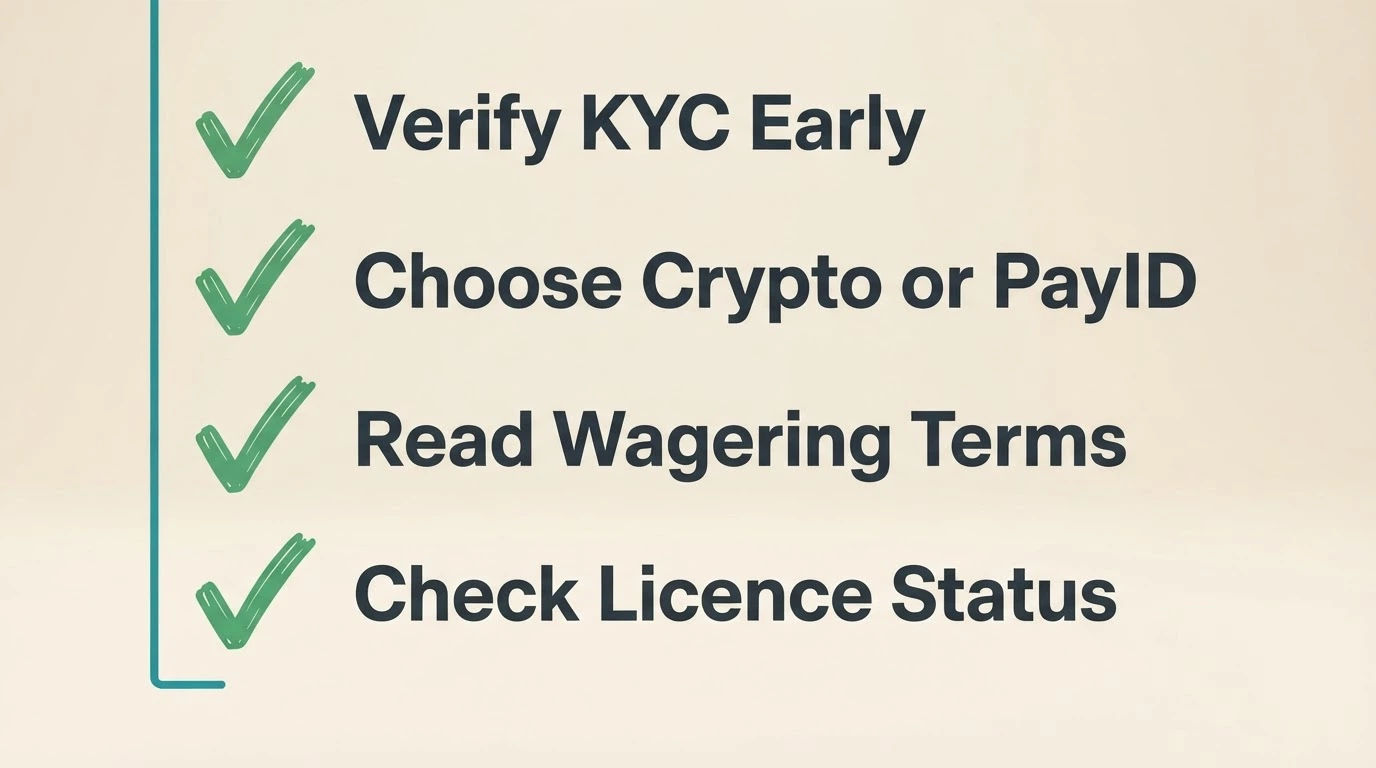
The first decision is KYC at sign-up. Complete the verification before the first withdrawal, not after it. The most common cause of a slow payout is incomplete KYC, not the payment method. The player who uploads ID, proof of address, and proof of deposit method at sign-up gets paid in minutes; the player who waits for the casino to ask waits days.
The second decision is the payment rail. Crypto is the fastest at 5–15 minutes median, PayID next at 10–40 minutes median, cards at 3–5 business days, bank transfer at 1–3 business days (). The player who picks the rail before picking the casino is the player who gets paid fastest. The player who picks the casino first and then takes whatever rail it offers is the player who waits.
The third decision is the operator. The fastest tested PayID payout in the comparison set is Skycrown at 11 minutes (); the slowest tested is Fair Go’s bank transfer at up to 15 business days (). The gap is two orders of magnitude. The reader who treats the ranking as the operator selection criterion — rather than the welcome bonus amount — gets a fast payout.
The fourth decision is the bonus terms. A 40× wagering requirement at a A$1,000 bonus is A$40,000 in turnover, roughly 40,000 spins, roughly 55.6 hours of continuous play (). The player who reads the terms before claiming does not lose the bonus to an expiry clock. The player who claims first and reads later is the player who walks away with nothing.
The honest cap on the “instant” promise is that no casino pays out in zero minutes. Verification has to happen, the rail has to settle, and the bank has to credit. The gap between 11 minutes at the top of the ranking and 15 business days at the bottom is the gap this page measured, and it is a real gap — measurable in Australian dollars, on Australian payment rails, at Australian-facing offshore casinos in 2026. The player who knows that gap and acts on it gets paid in minutes. The player who ignores it waits.
Frequently Asked Questions
Which Australian online casino has the fastest withdrawal in 2026?
Skycrown tested the fastest single PayID withdrawal at 11 minutes for A$920 on a weekday in 2026 (). USDT TRC20 at Skycrown cleared at 12 minutes in the same test series. No Australian-licensed casino exists — every operator on this page is offshore.
Can I withdraw no-deposit bonus winnings instantly from an Australian casino?
No. No-deposit bonus terms at AU-facing offshore casinos typically include a maximum cashout cap of A$50–A$200, wagering of 30×–60× on winnings, and an expiry of 3–14 days (). RocketPlay’s NDB caps withdrawals at A$75 with a five-day validity (); Fair Go’s NDB caps at around A$150–A$180 at 60× wagering (). Instant NDB withdrawal is a marketing phrase, not a term.
Why is my casino withdrawal taking so long and how can I speed it up?
The most common cause of a slow payout is incomplete KYC, not the payment method itself. Complete identity verification, proof of address and proof of deposit method at sign-up. After that, choose PayID or USDT TRC20, and pick an operator from the top of this ranking rather than from a marketing claim.
What happens to my money if an offshore casino is blocked in Australia?
The ACMA has had more than 1,564 illegal gambling and affiliate sites blocked by Australian ISPs since November 2019 (). A blocked site is inaccessible through major Australian ISPs but any balance held at the operator becomes hard to reach. There is no Australian complaints body that can recover money from an offshore operator, and the ACMA cannot refund the player ().
What wagering requirement is reasonable for a no-deposit bonus in Australia?
Standard no-deposit wagering at AU-facing offshore casinos runs 30×–60× on winnings (). A 30× requirement is the low end and reasonable; 60× is at the top of the market and tight against the 3–14 day expiry. The cap on winnings matters as much as the multiplier: a 30× bonus with a A$50 cap produces less cash than a 60× bonus with a A$200 cap. Read the terms before claiming.