
Litecoin Casinos in Australia — What an Offshore Licence Actually Means
Every casino that accepts litecoin and serves Australian players is operating outside Australian law. That is the first fact this page is built on, and it shapes every judgement that follows: which operator is worth a deposit, what a “bonus” actually costs, what protections vanish the moment an LTC transfer clears. There is no licensed litecoin casino in Australia because there is no licensed online casino in Australia, period. The Interactive Gambling Act 2001 makes the provision of online casino games to people in Australia a criminal offence, and the Australian Communications and Media Authority has been enforcing it.

Data current as of 29 October 2026. Licence and operating details verified against the ACMA register, the Curaçao eGaming public licence register, and each operator’s current terms page.
Table of Contents
- Why Your Litecoin Casino Isn’t What You Think It Is
- Australia’s Best Litecoin Casinos Compared — 2026 Ranking
- The Legal Reality — Offshore Litecoin Casinos and Australian Law
- Litecoin Casino Bonuses — What’s Actually Behind the Numbers
- Deposits and Withdrawals — How Fast Litecoin Actually Moves
- Why Most Litecoin Casinos Skip the App Store — Mobile Play Explained
- Anonymity, KYC, and Provably Fair — The Crypto Casino Promise
- The Games Worth Your Litecoin — From High-RTP Pokies to Live Dealer Tables
- Can You Really Play Litecoin Slots for Free? — Demo Mode Explained
- New Litecoin Casinos — Fresh Faces, Same Offshore Reality
- Staying Safe While You Play — Responsible Gambling When the Safety Net Is Missing
- How We Selected and Ranked These Litecoin Casinos
- Should You Play at a Litecoin Casino from Australia?
- Frequently Asked Questions
Why Your Litecoin Casino Isn’t What You Think It Is
The phrase “litecoin casino” suggests a product category with its own legal standing — something different, something new, perhaps something more private. It is not. The crypto label describes the deposit rail, not the operator. Every casino on this page accepts litecoin at the cashier; none of them accept litecoin because Australian law has approved litecoin as a payment method for gambling. They accept it because the operator sits offshore — typically Curaçao — answers to an offshore regulator, and treats the Australian dollar as a converted-balance courtesy rather than a regulated currency.
That changes nothing about how the casino is run, and everything about what a player should expect from it.
Litecoin itself is a credible payment rail. The blockchain has produced a block every 2.5 minutes since 2011 — four times the pace of Bitcoin. A standard transaction costs between $0.01 and $0.05, rarely climbing past $0.10 even when the network is busy. Most crypto casinos set their LTC deposit minimum between $10 and $25 in litecoin value. These are real advantages over a bank transfer, and they explain why LTC has carved out a niche in the offshore casino market.
The advantages stop at the cashier. Once an LTC deposit lands, the game is run by the operator — its payout approval window, its KYC trigger points, the terms on the bonus your deposit activated. That is where litecoin casinos differ from each other, and where this page spends most of its time.
How a Litecoin Casino Actually Works
A litecoin casino is an online casino that accepts litecoin at the deposit screen. The plumbing is simple, and it is the same plumbing the operator uses for Bitcoin, Ethereum, Tether and a dozen other coins.
The cycle starts with a wallet — either a custodial wallet on a crypto exchange or a self-custody wallet where the player holds the private keys. The player buys LTC on the exchange (or transfers LTC they already own), then pastes the casino’s deposit address into their wallet’s send screen, sets the amount, and confirms. The transaction broadcasts to the Litecoin network. The first confirmation arrives in roughly 2.5 minutes; casinos that require two or three confirmations to credit a balance typically finish crediting within seven or eight minutes. A handful of operators credit on zero confirmations after a small internal risk check, which is faster still.
The casino’s internal approval is the variable piece. On a clean first deposit at an instant-payout operator, that approval can take less than a minute. On the same operator under manual review — a flagged IP, a first withdrawal, a large amount — it can stretch to ten or thirty minutes. The blockchain is the easy half; the cashier is where the wait lives.
Withdrawals run the same direction in reverse. The player requests a payout in LTC from the casino’s cashier, the operator’s approval system processes it, and the LTC arrives back in the player’s wallet after the standard confirmation window. The irreversibility works both ways: a deposit cannot be charged back, and a withdrawal that the operator refuses cannot be forced through any consumer-protection pathway, because there is none.
Why LTC Beats Bank Transfers and Card Deposits at the Casino Cashier
For Australian players funding a casino account, three traditional rails are out. Credit cards have been banned for online wagering since June 2024. PayID, BPAY and bank transfers are payment methods for licensed Australian wagering operators — and offshore casinos are not on that list. The methods that still work for an Australian depositing at an offshore casino are crypto, a handful of e-wallets, and the occasional voucher. LTC is the fastest and cheapest of those.
On cost, a card transaction carries roughly 1.5% to 3% in processing fees plus the issuing bank’s foreign-transaction surcharge. A bank transfer is free on the player’s side but slow — same-day at best, often next business day. A Litecoin transfer costs $0.01 to $0.05 in network fees, and a casino that absorbs that fee passes it on; a casino that doesn’t adds it to the player’s bill but typically still charges less than a card surcharge.
On speed, the comparison is brutal. A card deposit posts in seconds but a card withdrawal takes three to five business days, with a chargeback window the operator can dispute. An LTC deposit credits in minutes, an LTC withdrawal arrives in under an hour at the better operators. The bank does not know what the transaction is for, and neither does anyone else.
The trade-off is irreversibility. A chargeback on a stolen card deposit recovers the funds; a chargeback on an LTC deposit does not exist. If the operator is blocked, freezes withdrawals or simply vanishes, the player’s LTC is gone with no recourse. The same speed that makes LTC attractive at deposit makes it permanent at loss. That is the bargain every litecoin casino player accepts, and most do not realise they have accepted it until it matters.
Australia’s Best Litecoin Casinos Compared — 2026 Ranking
The ten offshore operators below accept litecoin and serve Australian players. None holds an Australian licence; none is connected to BetStop or to any Australian consumer-protection framework. What follows is a comparison of what each operator actually delivers in bonus terms, wagering fairness, and game range — not a recommendation to deposit at any of them.
The ranking is built on four criteria: bonus value and the transparency of the terms attached to it, the fairness of the wagering requirement and any caps that limit it, confirmed litecoin support at the cashier, and licence transparency — whether the operator names its regulator and licence number in published terms. Game count and game provider breadth break ties.
How We Compared These Litecoin Casinos
Each operator was checked against the same five columns. Cells left blank reflect data that the operator has not confirmed in publicly available terms.
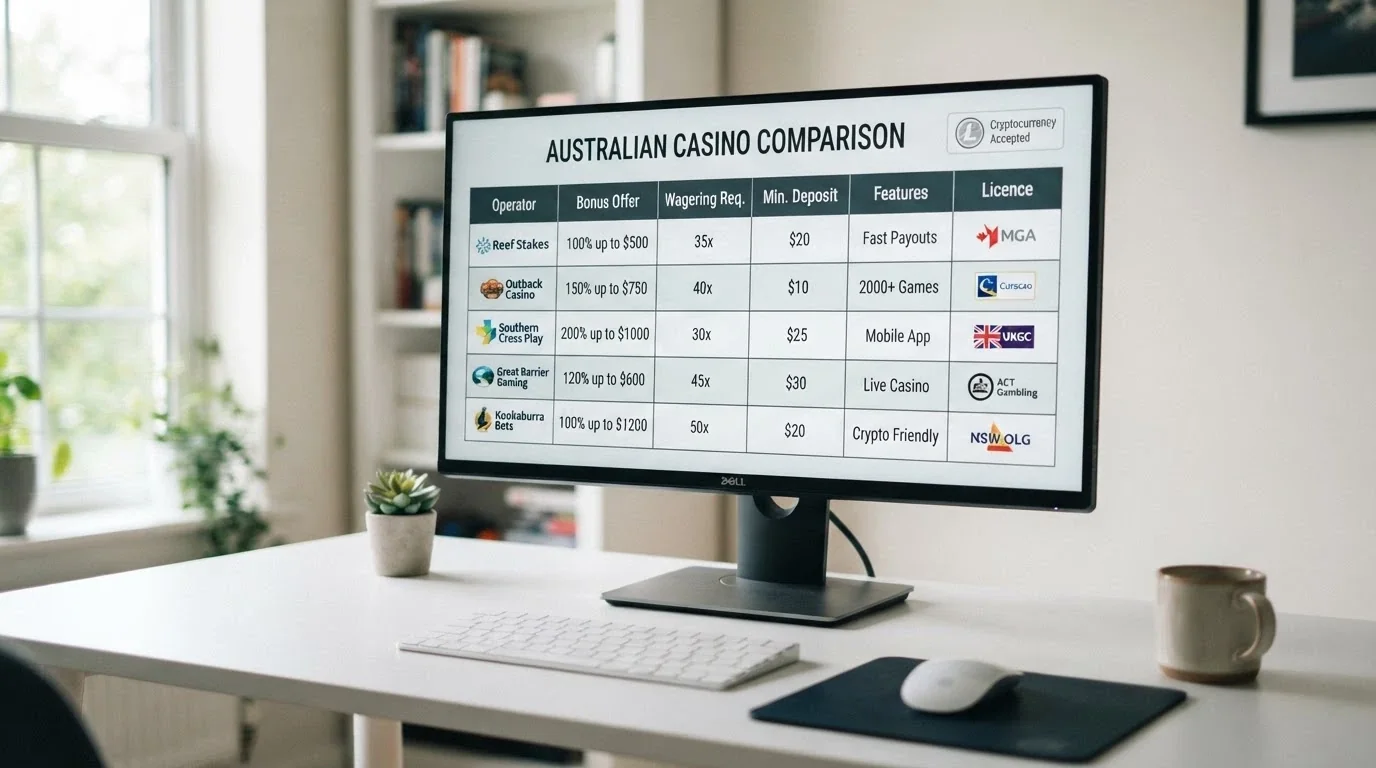
| Operator | Licence | Welcome Bonus | Wagering | Free Spins | LTC Support |
|---|---|---|---|---|---|
| Stake | Curaçao eGaming | 0x wagering rakeback (no traditional welcome) | 0x | — | Yes |
| Rainbet | Curaçao eGaming | 250% up to $2,100 across three deposits | 40x | 60 | Yes |
| Rocket Play | Offshore, not licensed in AU | 100% up to $300 + 100 free spins | 40x | 100 | Yes |
| Skycrown | Offshore, not licensed in AU | Up to C$7,500 + 400 free spins across four deposits | 40x | 400 | Yes |
| WinSpirit | Offshore, not licensed in AU | 100% + 100 free spins + 200% on second deposit | 40x | 100 | Yes |
| FairGO | Curaçao eGaming (Deckmedia N.V.) | 100% up to $200 AUD on each of five deposits | — | — | Yes |
| Royal Reels | Offshore, not licensed in AU | — | — | — | — |
| Bizzo Casino | Offshore, not licensed in AU | — | — | — | — |
| Rocket Casino | Offshore, not licensed in AU | — | — | — | — |
| Scream Casino | Offshore, not licensed in AU | — | — | — | — |
The thin rows are not a typing error. Four operators in the set have not published enough confirmed detail to populate the comparison fairly. Each is written up below with what is and is not known, and what a player should verify directly before depositing.
Stake — Rakeback Without Wagering, and Why That Matters
Stake is the only operator in this list that does not run a traditional welcome bonus. In its place sits a continuous rakeback model that returns a percentage of the house edge on every bet, with zero wagering requirement attached. The mechanism is simple: a percentage of theoretical loss comes back as cash, and that cash is yours to withdraw the moment it lands. No $12,000 turnover target, no max-bet cap, no five-day validity window.
The operator was established in 2017, runs a Curaçao eGaming licence, and carries more than 3,000 games. The on-chain transparency that crypto-native operators publish is significant — Stake carries $1.86 billion in tracked volume with an average deposit of $690, against Rainbet’s $301 million and $324. The figures are not a quality score; they are a signal that the operator has been processing crypto at scale for long enough that the figures exist at all.
For a player who would otherwise grind through a 40x wagering target to extract a deposit match, Stake’s model changes the cost arithmetic. A rakeback percentage at 0x is structurally cheaper than a higher headline bonus at 40x, because the expected cost of clearing a 40x bonus is roughly $433 on a $300 bonus at NetEnt-average games (more on that calculation below). The trade-off is that there is no bonus pool to chase — if you lose, you lose, with only the rakeback percentage coming back.
The verdict: best suited to high-volume players who would otherwise grind bonus terms, and to anyone who prefers a continuous return over a one-off match.
Rainbet — The Biggest Welcome Package and a Curaçao Licence
Rainbet posts the largest headline number in the set: 250% up to $2,100 plus 60 free spins across three deposits, structured as 100% then 50% then 100% on each of the next three deposits up to $700 each. The casino was established in 2023, runs a Curaçao eGaming licence, and offers more than 4,000 games — the largest library in the ranking.
The terms sit at the hard end of the market. The bonus is wager-locked, with 40x wagering required within seven days. The max bet is capped at 2% of the deposit during bonus play. Games with an RTP above 97.4% are disabled while the bonus is active, and Hacksaw and Nolimit slots are excluded outright from bonus play. Those restrictions are not unique to Rainbet, but they sit at the upper edge of how aggressively a casino can shape bonus play in its own favour.
The free spins run on Sweet Bonanza (Pragmatic Play), at 20 per deposit. There is no stated maximum cashout on the bonus once wagering is cleared, which is a genuine positive in a market where $3,000 caps are routine.
The verdict: the headline is the biggest, the terms are the hardest, and only worth the time if a player intends to claim all three deposit tiers and grind through them.
Rocket Play — Strong Bonus Terms with Clear Limits
Rocket Play posts a 100% first-deposit match up to $300 plus 100 free spins, with the spins dripped at 20 a day for five days. Wagering is 40x on the bonus, the maximum bet during bonus play is $7.50, and the maximum cashout on bonus winnings is $3,000. Bonus validity is five days. Every ceiling is stated up front.
For a player who values transparency over headline size, that is the point of Rocket Play. There is no second-tier bonus buried in the terms, no game-weighting surprise. The 9.4% Australian market share is the largest in this set, and that is part of the picture: this is the litecoin-accepting offshore casino Australian players actually use most.
The 40x wagering on a $300 bonus is still $12,000 in turnover before any of it converts to withdrawable cash, and the five-day window is tight against that turnover target at any reasonable stake. A player who treats the bonus as a one-deposit commitment should not expect to clear it without a meaningful session.
The verdict: best for players who want every limit named before they deposit, and who are not chasing the absolute largest match.
Skycrown — A Four-Deposit Package That Rewards Commitment
Skycrown’s headline figure is the largest in the ranking: up to C$7,500 plus 400 free spins across four deposits, beginning with a 120% match up to C$1,000 and 125 free spins on the first deposit. Wagering is 40x, and the minimum deposit is C$30.
The per-deposit caps tell a quieter story than the aggregate. The first-deposit bonus carries a C$300 maximum cashout — modest against a C$1,000 ceiling — and the free-spin expiry on the first tier is one day, against a five-day cash bonus validity. Across four deposits, a player has to clear four separate 40x wagering targets, each with its own validity window. That is the cost of the headline.
Skycrown’s 8.55% Australian market share puts it second in this set. The brand carries Bitcoin, Ethereum, Litecoin, Ripple, Tether and Dogecoin at the cashier, which is one of the broadest crypto line-ups among the featured operators.
The verdict: only worth the time for a player who intends to claim all four tiers and clear them in sequence; everyone else should compare the first-deposit offer against Rocket Play’s.
WinSpirit — Match Bonuses and Weekly Cashback
WinSpirit runs a two-deposit welcome structure — a 100% match plus 100 free spins (20 a day for five days) on the first deposit, a 200% match on the second — and adds a recurring rewards programme that is unusual in this set. Midweek carries up to 50 free spins on Wednesdays, and weekly cashback runs up to 15% on net losses.
The wagering on both deposits is 40x. The exact maximum cashout and validity figures are not confirmed in the operator’s publicly available terms, which is a gap — and one a player should check directly with support before claiming the bonus.
For a player who plans to stay, the recurring cashback is the point. A 15% weekly cashback on net losses is a genuine reduction in expected cost over time, and the Wednesday free spins add a small ongoing bonus cycle. The 1.55% Australian market share is modest, but WinSpirit’s structure rewards longevity more than headline size.
The verdict: the closest thing in this set to an ongoing rewards programme, and the right fit for a player who plans to deposit weekly rather than once.
FairGO — AUD-Denominated Bonuses on an RTG Library
FairGO is the only operator in the ranking that quotes its welcome bonus in Australian dollars: 100% up to $200 AUD on each of the first five deposits, totalling $1,000 AUD across the package. The casino runs on a single-provider RealTime Gaming catalogue of 280 titles — narrower than the multi-provider libraries at Stake and Rainbet, but with the advantage that every game on the site comes from one well-established supplier.
The licence is Curaçao eGaming, issued to Deckmedia N.V., a known operator of multiple casino brands. FairGO accepts AUD, Bitcoin, Ethereum and Litecoin at the cashier. The wagering on the welcome package is in the 30x–40x range, consistent with RTG-standard bonus terms, though the exact figure is not published on the operator’s main terms page and should be confirmed at the cashier.
For an AUD-only player who wants to skip the BTC/LTC-to-AUD conversion, FairGO is the cleanest option in the set. The narrow catalogue is the trade-off — 280 RTG titles is a small library next to Rainbet’s 4,000.
Our take: FairGO is the top choice for AUD-denominated play, particularly for players who favour a curated, single-provider library over a sprawling, multi-provider one.
Royal Reels — An Established Name with Gaps in Public Data
Royal Reels holds a 2.51% Australian market share, which puts it ahead of FairGO and well ahead of the smaller operators in the ranking. Beyond the name recognition, the publicly available detail on bonus terms, free-spin offers, game providers and confirmed LTC support is thin this round — most specifics have not been published in a form this review can verify.
That is not the same as saying the operator is untrustworthy. It is saying the operator has not put enough on the public record for a third party to assess it fairly. The licence status is offshore, not licensed in Australia, consistent with the rest of this set.
A player considering Royal Reels should verify three things before depositing: the licence number printed on the operator’s footer, the bonus terms at the cashier (not the marketing page), and the LTC deposit minimum in the cashier screen. These are checks that take ten minutes and answer most of the questions a comparison table would otherwise answer.
The verdict: too well-known to ignore, too thinly documented to rank above the operators with confirmed terms — verify before depositing.
Bizzo Casino — A Familiar Brand, Light on Confirmed Detail
Bizzo’s 0.57% Australian market share puts it among the smaller operators in this set, and the brand carries more recognition than the documented data justifies. Bonus structure, free-spin offers, game providers and confirmed LTC support were not confirmed in this review round; what is known is that the operator runs offshore, outside the Australian licence framework.
For a player who already knows the brand, the absence of a comparison-table entry is a useful prompt rather than a verdict. The same three checks apply — licence number, bonus terms at the cashier, LTC deposit minimum — and the same ten-minute effort covers the gaps.
The verdict: name recognition is not a substitute for published terms; treat it as a starting point, not a shortlist.
Rocket Casino — Same Word, Different Operator
Rocket Casino is not Rocket Play. They are separate offshore brands, and the confusion is forgivable given the similar name. Rocket Casino holds a 0.57% Australian market share, matching Bizzo, and runs offshore without an Australian licence. The publicly available detail on bonus terms, game providers and LTC support is again thin this round.
What separates Rocket Casino from Rocket Play is the documented bonus structure. Rocket Play publishes a clear $300 first-deposit match with a $7.50 max bet and a $3,000 max cashout. Rocket Casino has not published the equivalent detail in a form this review can verify. That alone is reason enough to put one above the other in the ranking.
The verdict: distinct from Rocket Play; do not assume shared terms — confirm directly with the operator.
Scream Casino — A Newer Entry with Room to Prove Itself
Scream Casino holds a 0.99% Australian market share, just below the 1% line, and runs offshore without an Australian licence. The brand has not published enough bonus, free-spin, game-provider or LTC-specific detail in this review round to populate a comparison row.
A newer or smaller operator is not automatically a worse one, but the thinner the public data, the more a player is trusting the brand rather than the terms. The same three checks apply — licence footer, bonus terms at the cashier, LTC deposit minimum — and the operator’s responsiveness to those checks is itself a useful signal.
The verdict: worth watching as the published detail matures, but not yet worth a deposit ahead of the operators with confirmed terms.
The Legal Reality — Offshore Litecoin Casinos and Australian Law
No online casino is licensed in Australia. Every operator on this page is offshore. The law is unambiguous about what that means, and it is the single most important fact on the page — the one that explains every other limit a litecoin casino player runs into.

What the Interactive Gambling Act 2001 Actually Prohibits
The Interactive Gambling Act 2001 (IGA) makes it an offence to provide online casino games, online pokies and in-play sports betting to people in Australia. The Act does not name litecoin, bitcoin or any specific cryptocurrency, and it does not target the player. It targets the provider — the company operating the site, the person running the platform, the entity that accepts the deposit.
What is permitted is narrower than most players expect. Wagering on races and sport placed before the event begins is licensable, and so are lotteries and keno, through operators licensed by an Australian state or territory. The Northern Territory Racing and Wagering Commission is the de facto national licensor for online wagering. Online casino products are not on that list, and adding them would require an amendment to the Act. No such amendment exists.
This is why every litecoin casino serving Australia is offshore. The market for online casino games to Australians exists; the Australian licence to supply it does not. Operators meet the demand from Curaçao (typically), and Australian players access them because the IGA does not stop them from doing so — the law’s target is the provider, not the consumer.
The ACMA, Site Blocking, and the 2026 Payment Ban
The Australian Communications and Media Authority enforces the IGA. Its main enforcement tools are site blocking and operator-exit pressure. Since November 2019 the ACMA has had 1,751 illegal gambling and affiliate marketing websites blocked at the ISP level, using its authority under section 313 of the Telecommunications Act 1997. Over 230 unlicensed services have exited the Australian market since enforcement began in 2017.
In June 2024 a second front opened. The Interactive Gambling Amendment (Credit and Other Measures) Act 2023 made credit cards and digital currency — including cryptocurrency — illegal as payment methods for interactive gambling. Penalties for non-compliant operators run up to $247,500. The ban applies to Australian-licensed wagering services. An offshore casino accepting an LTC deposit from an Australian wallet is already outside the Australian licence framework, so the ban reads as a confirmation of what was already true: an LTC deposit is a tell that the operator is offshore.
The next front opens on 1 January 2027. The Interactive Gambling Amendment (Gambling Reform) Bill 2026, passed on 19 August 2026, gives banks and payment providers express authority to block transactions to illegal gambling operators. The advertising reforms in the same Bill — wagering-ad bans during live sport, an opt-out register, inducement restrictions — apply to licensed wagering and tighten the licensed market. For offshore casinos, the transactional-block authority is the more material change: a player whose bank declines a transfer to an exchange that has handled LTC for gambling may find their deposit route closing without notice.
What You Forfeit When You Play Offshore
The protections an Australian punter takes for granted stop at the border.
BetStop, the National Self-Exclusion Register, has recorded 67,480 registrations since launching in August 2023, with 41,290 exclusions still active as at 31 July 2026. Seventy-eight per cent of registrants are under 40, and thirty-eight per cent chose lifetime exclusion. The register binds Australian-licensed wagering services. Offshore casinos are not connected to it. A self-excluded Australian can still deposit at any litecoin casino in this ranking, and the operator has no obligation to refuse them.
The Australian Financial Complaints Authority does not have jurisdiction offshore. The regulator that licensed the operator — typically Curaçao eGaming — has its own complaint pathways, but they operate in another legal system, in another language, with another enforcement posture. For an Australian player whose LTC deposit has been frozen or whose withdrawal has been delayed past the operator’s stated window, the practical recourse is the operator’s support team and whatever public pressure a review site can muster. There is no statutory backstop.
The irreversibility of crypto amplifies the gap. A chargeback on a credit card deposit recovers the funds; a chargeback on an LTC deposit does not exist. If the operator is blocked by the ACMA tomorrow, the player has no Australian body to call to recover the balance on the site. The site may still be reachable through a VPN, but the operator’s obligation to pay out — and the player’s recourse if it does not — is a function of the licence the operator holds, not the law the player lives under.
Litecoin Casino Bonuses — What’s Actually Behind the Numbers
A 100% match plus 100 free spins reads as generosity. A 250% match across three deposits reads as a windfall. Read two lines further and the same offers read differently. Wagering requirements, validity windows and max-cashout caps are where the marketing stops and the cost starts.

Welcome Bonuses and Deposit Matches — What the Headline Leaves Out
A matched-deposit bonus replaces a percentage of the player’s first deposit with bonus funds, on the condition that the player wager the bonus (or the bonus plus the deposit) a set number of times before any winnings become withdrawable. The percentage and the cap are the headline. The multiple, the window and the cashout ceiling are the cost.
Rocket Play’s first-deposit offer is the cleanest illustration in this set. A 100% match up to $300 means a $300 deposit becomes a $300 bonus on top. The wagering is 40x on the bonus, which sets the turnover target at $12,000. The max bet during bonus play is $7.50, and the max cashout on the bonus is $3,000. The validity window is five days. At a $1 stake per spin, clearing $12,000 in turnover within five days requires roughly 12,000 spins at a pace of one every three seconds — ten hours of continuous play. That is the timeline the headline does not show.
Two structural points matter beyond the numbers. First, wagering on the bonus only (rather than on bonus plus deposit) is the cheaper structure, because the deposit itself is not locked into the turnover requirement — but it is the rarer one, with most operators now applying the multiple to the combined total. Second, the validity window is short by design: at a $1 stake against a 40x multiple, even a 30-day window leaves little margin for variance. A player who hits a cold streak in the first third of the window cannot recover in time.
The market norm is 35x to 40x on the combined bonus and deposit; anything above 50x is poor value, and anything below 25x is excellent and rare. The standard maximum bet during bonus play sits between $5 and $10 AUD per spin.
No-Deposit Free Spins — What’s Actually Available
The no-deposit free-spin offer is the most searched-for bonus type under this search term, and for a clear reason: it advertises a chance to win real money without risking any. In practice, it is almost extinct at the litecoin casinos in this ranking.
BitStarz — an operator outside the featured set — runs a benchmark offer of 100 no-deposit free spins to new players who register and verify their account, with low wagering attached. That is the cleanest example on the market. Among the ten operators on this page, no-deposit free spins are not a standard feature; the free-spin offers that exist (Rocket Play’s 100, Skycrown’s 400, Rainbet’s 60) are deposit-gated, awarded on the deposit that activates the welcome package, and dripped across days to extend the bonus period.
For a player who specifically wants no-deposit free spins, the realistic answer is that this set does not offer them, and the search for an operator that does usually ends at a brand with lighter bonus terms elsewhere. The promotional headline does not change the underlying economics: free-spin winnings are still subject to wagering, and a 25x to 40x multiple on $20 in free-spin winnings still means $500 to $800 in turnover before any of it becomes withdrawable.
Wagering Requirements — The Maths That Swallows Your Bonus
The number that matters is the multiple, and the multiple determines a cost most players never calculate.
Take Rocket Play’s structure as the worked example: a $300 bonus, 40x wagering on the bonus, $7.50 maximum bet, $3,000 maximum cashout, five-day validity. The required turnover is $300 × 40 = $12,000 before any of the bonus balance converts to withdrawable cash. That figure is mechanical and unavoidable; it is the price of entry.
The harder number is what the turnover costs the player. NetEnt’s average RTP across its catalogue is 96.39%; assume the player wagers the $12,000 entirely on NetEnt-average games. The expected loss is $12,000 × (1 − 0.9639) = $12,000 × 0.0361 ≈ $433. That is the statistical cost of clearing the bonus — an average over many spins under the stated assumptions, not a guaranteed outcome for any single session. A player can clear the bonus and finish ahead; a player can also finish $2,000 behind and still have $9,000 of turnover left to complete.
Three variables move that figure. Wagering on the combined bonus and deposit rather than bonus-only raises the turnover target by the deposit amount. A 50x multiple — poor value by the market norm — raises it by 25%. A game with an RTP below the NetEnt average (Play’n GO sits at 94.79%, Hacksaw at 94.81%) raises the expected loss in proportion. Rainbet’s exclusion of games above 97.4% RTP during bonus play, and of Hacksaw and Nolimit slots outright, is the operator moving in the opposite direction — restricting the games on which a player could reduce the expected cost.
The maths swallows most bonus balances because the structural incentives are aligned that way. A player who wants to come out ahead has to clear the wagering, take the volatility, and still be ahead at the end — three requirements that compound rather than cancel.
Deposits and Withdrawals — How Fast Litecoin Actually Moves
The 2.5-minute Litecoin block time is the easy half. The casino’s internal approval window is where the real wait lives, and the operator that names its thresholds is the operator worth trusting.
How to Deposit with Litecoin at an Online Casino
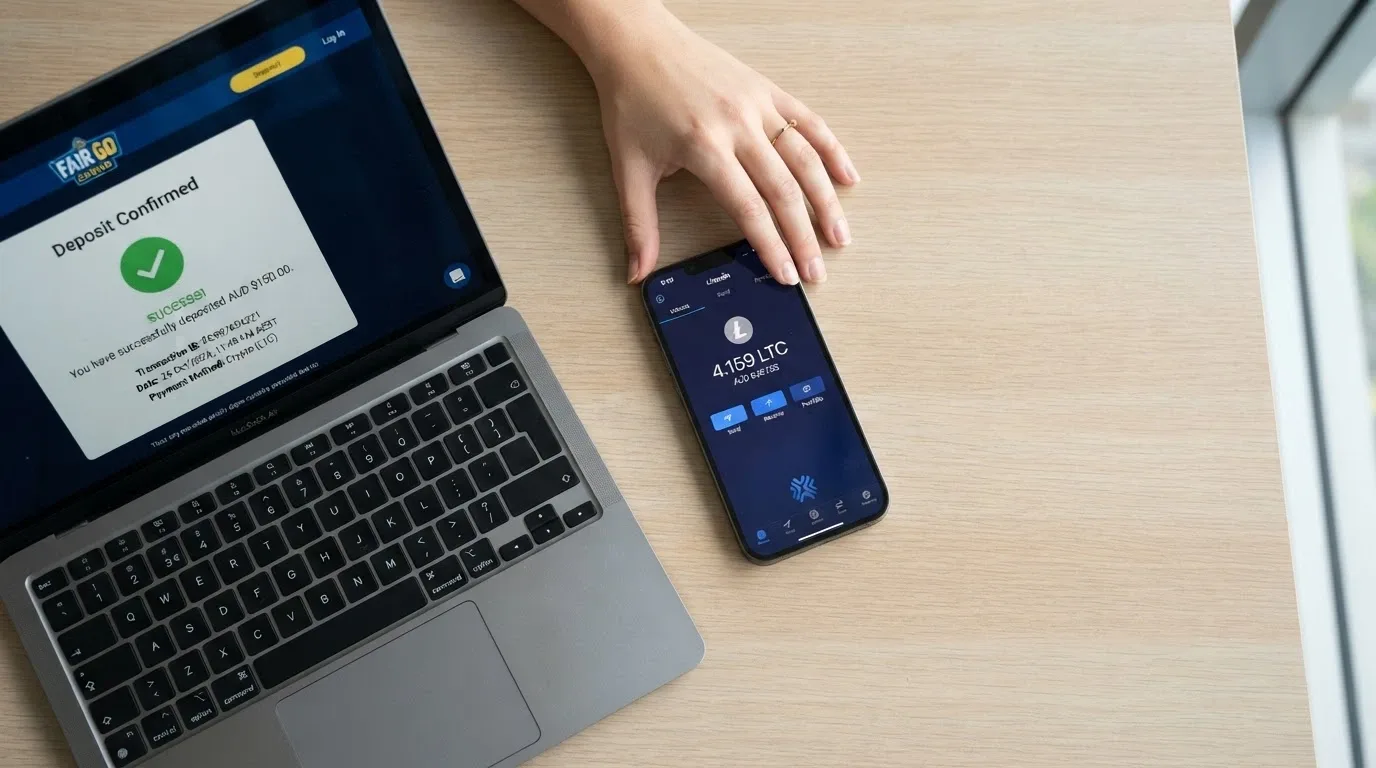
The deposit flow runs exchange → wallet → casino. The player buys LTC on a crypto exchange (or transfers LTC they already hold), opens the casino’s cashier, copies the LTC deposit address the site provides, and sends the funds from their wallet to that address. The transaction broadcasts to the network; the casino credits the player’s balance after one, two or three confirmations, depending on its risk policy.
Most operators credit on two or three confirmations, which lands at roughly seven or eight minutes from broadcast. A handful credit on zero confirmations after an internal risk check, which can be faster. The transaction ID returned by the wallet is the only record of the transfer — there is no bank statement to cross-reference, and no support agent who can trace a transaction that lacks an ID.
The minimum varies. BitStarz — outside the featured set — publishes a 0.075 LTC minimum, with a 0% casino fee and instant processing, which is the cleanest published figure in the market. Among the operators on this page, the minimum sits in the $10 to $25 range in LTC value, with most not publishing the exact figure in their public terms.
The two errors that catch first-time depositors are sending LTC to a Bitcoin address (the chains look similar at the wallet level but are not interchangeable) and sending from an exchange account that has a withdrawal lock or a manual-review threshold. Both are slow to diagnose and impossible to recover from once the transaction confirms.
Withdrawal Speed — Minutes on the Blockchain, Hours or Days at the Cashier
The blockchain settles an LTC withdrawal in seven to eight minutes. The cashier can take longer.
The casino’s internal approval is the variable. At an instant-payout operator on a clean account, the approval can take less than a minute — the cashier receives the request, the automated system approves it, the LTC broadcasts. On the same operator, a first withdrawal, a flagged IP, a large amount, or a recently changed payment method can trigger manual review, and the wait stretches to ten or thirty minutes. On a slower operator, the wait can stretch to days.
The minimum and fee structures vary widely. Wild.io publishes a 0.05 LTC minimum and a 0.000138 LTC fee. BitStarz publishes a 0% casino fee on LTC withdrawals with a €50-equivalent minimum. The operators on this page do not all publish their LTC withdrawal minimums and fees with that level of clarity, and that is itself a signal: a cashier that names its thresholds outranks one that reserves the right to review “any withdrawal at our discretion,” even when the second site pays faster on a good day.
KYC triggers at withdrawal are the rule rather than the exception. The first withdrawal usually requires a government ID, a proof of address, and sometimes a source-of-funds check — even at operators whose deposit flow does not require verification. A player who plans to deposit and withdraw within the same week should complete verification before depositing, so that the first withdrawal is not delayed by a compliance queue.
Why Most Litecoin Casinos Skip the App Store — Mobile Play Explained
There is no litecoin casino app on the Australian App Store. There is no litecoin casino app on Google Play either, at least not from any of the operators in this ranking. Apple and Google both restrict real-money gambling apps from unlicensed operators in their respective stores, and every litecoin casino serving Australian players is, by definition, unlicensed in Australia.
The consequence is that the mobile experience is a browser experience. Every featured operator runs a responsive mobile site that loads in Safari or Chrome, scales to a phone screen, and exposes the full game library, the cashier and the bonus activation flow. The quality of the mobile web build is, in most cases, deliberately high — these are crypto-native operators whose primary user base is mobile, and they have invested in the browser experience accordingly.
The functional difference between a browser casino and a native app is small. Push notifications, biometric login and a home-screen icon are the main losses; touch responsiveness, game loading and cashier flow are typically equivalent or better in the browser, because the operator does not have to route through Apple’s or Google’s payment restrictions to accept an LTC deposit. A native app would force the operator into in-app payment rails that do not include crypto; the browser version does not.
Depositing LTC on mobile is the same flow as on desktop: open the cashier, copy the LTC address, send from the wallet. Most modern wallets — including the in-app wallets of major exchanges — handle the address detection and the QR-code scan natively.
Anonymity, KYC, and Provably Fair — The Crypto Casino Promise
The two words that sell crypto casinos to privacy-conscious players are “no KYC” and “provably fair.” Neither does what most players think it does.
Provably Fair Games — What the Verification Actually Proves
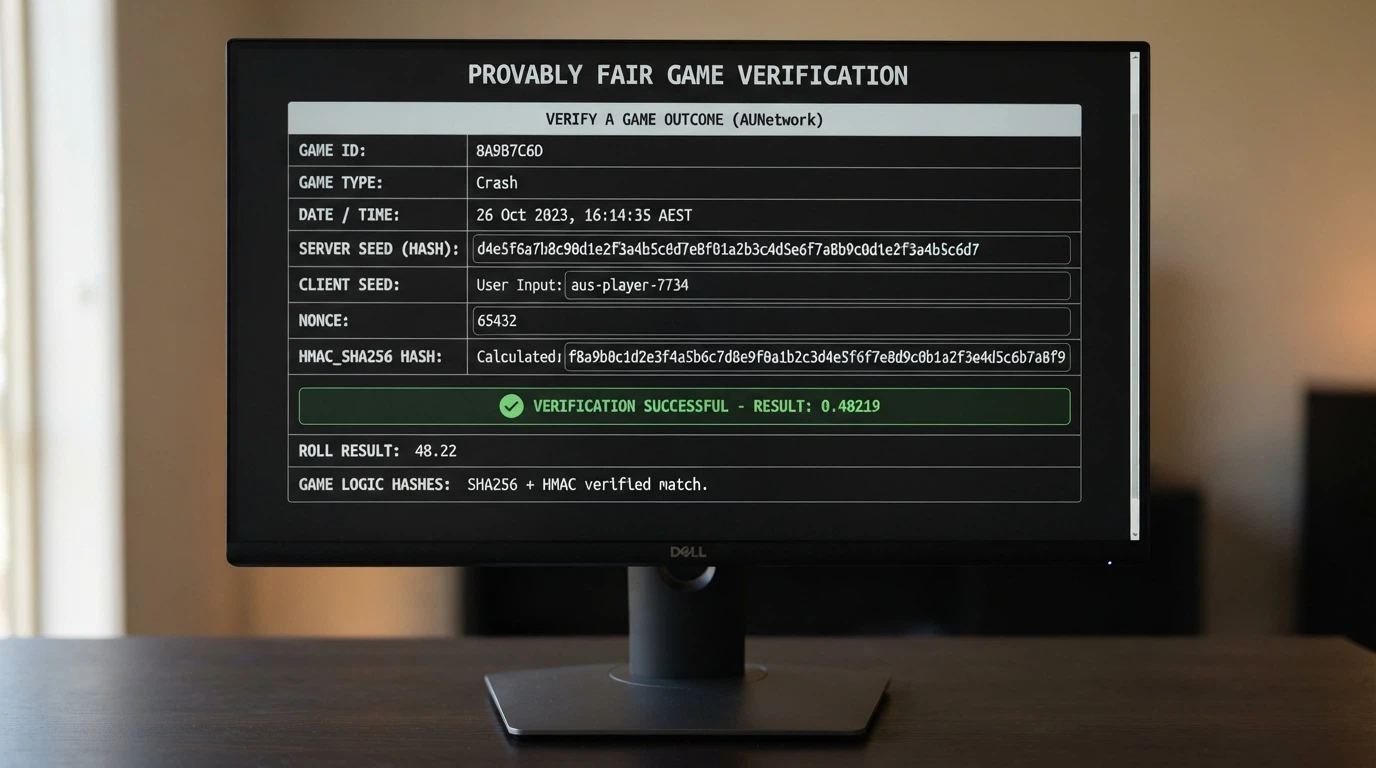
“Provably fair” is a real cryptographic technology, and it does one job: it lets a player verify, after a spin or a hand, that the result was not tampered with by the operator. The mechanism is straightforward — a server seed and a client seed combine to produce the outcome, the player can see both, and the result is reproducible from the seeds. The verification is genuine and useful at the round level.
It is not a substitute for a licence. Provably fair verifies that a single game round was not manipulated. It does not verify that the operator will honour withdrawals, protect personal data, pay out jackpots, stay in business next week, or respond to a complaint. It says nothing about the operator’s solvency, its banking relationships, its corporate structure or its willingness to abide by its own terms.
For an Australian player, “provably fair” is a feature of the games and nothing else. The protection that matters at the cashier level comes from the operator’s licence, its reputation, its published payout terms and its history of honouring withdrawals — and that is where the litecoin casino market, with its offshore licences and its limited public data, offers thin coverage compared with a regulated Australian wagering operator.
Crypto-Native vs Crypto-Accepting — Why the Difference Matters
A casino built on crypto from day one operates differently from a fiat casino that added an LTC deposit button.
The crypto-native operators in this set — Stake, established 2017, and Rainbet, established 2023 — design around crypto mechanics. Stake’s rakeback replaces a welcome bonus because the model fits continuous crypto play. Rainbet publishes its volume and average deposit on-chain ($301 million and $324 respectively) because the operator’s ledger is the blockchain. Both have rakeback structures, both run continuous bonus programmes rather than one-off welcome packages, and both treat KYC as a withdrawal-time compliance step rather than a registration gate.
The crypto-accepting operator in this set — FairGO, with its AUD-denominated bonuses and its RTG catalogue — added LTC to a cashier that was originally built for fiat. The bonuses are quoted in dollars, the wagering terms are RTG-standard, and the game library is single-provider rather than aggregated. The conversion happens at the cashier, not at the design level.
The distinction matters for two reasons. First, the bonus design differs: crypto-native operators tend to offer rakeback or continuous rewards; crypto-accepting operators tend to offer matched deposits with traditional wagering. Second, the published transparency differs: crypto-native operators publish on-chain data because that data is native to their operation; crypto-accepting operators publish what their terms page says, and little more.
For a player who treats the bonus structure as the deciding factor, this distinction is more useful than any comparison table.
The Games Worth Your Litecoin — From High-RTP Pokies to Live Dealer Tables
A litecoin casino’s game library is only as good as the titles the player actually plays. The headline game count — 3,000, 4,000, sometimes more — reflects the catalogue breadth, not the catalogue quality. A handful of slots return over 98% to the player; the average sits closer to 95%.
Online Pokies and Slots at Litecoin Casinos
Pokies dominate every LTC casino lobby, and the provider behind the reels matters more than the theme on them. NetEnt’s catalogue averages 96.39% RTP across its titles; Big Time Gaming sits at 96.25%, Push Gaming at 96.15%. At the bottom end, Play’n GO’s catalogue averages 94.79% and Hacksaw Gaming 94.81%. The spread between the highest and lowest provider averages is roughly 1.6 percentage points — small in absolute terms, large in expected value over thousands of spins.
A high-RTP title is identifiable in two ways. The first is the per-game paytable, which lists the RTP for that exact title; a pokie with a 96.5% RTP pays back $96.50 for every $100 wagered, on average across its lifetime. The second is the provider average, which is a proxy when the per-title RTP is not published. The third route — selecting games whose bonus-buy RTP is higher than their standard RTP — is a narrower version of the same idea: Gates of Olympus’s bonus-buy RTP is 96.58%, against a 96.50% standard play.
The pokie experience at an LTC casino is identical to the pokie experience at a fiat casino. The reels do not know what currency the balance is denominated in. What changes is the speed at which the balance moves, which on a fast crypto cashier can be faster than a player intends.
Table Games — Blackjack, Roulette and More
Table games give the player a better mathematical baseline than pokies. Blackjack with basic strategy carries a house edge below 0.5% — substantially below a pokie’s typical 4% house edge (100% minus RTP). Roulette’s edge sits at 2.7% on a single-zero wheel and 5.26% on a double-zero wheel; baccarat’s banker bet carries roughly 1.06%.
The reason to play table games is therefore not novelty — it is that the player’s money lasts longer on every bet, which means more decisions per session and a higher chance of catching a variance window that returns more than the house edge would predict. The downside is that the per-bet stake typically contributes less to bonus wagering than pokies do at some operators, and many table games are excluded from bonus play outright.
The per-title RTP on table games is less published than on slots, and the exact edge depends on the rule set the operator has chosen (number of decks in blackjack, presence of surrender, double-zero or single-zero roulette). The categorical advantage over pokies is reliable; the precise figure varies.
Live Dealer Tables — Real Dealers, Real-Time Play
Live dealer tables stream from a studio, with a real dealer, real cards or a real wheel, and a chat interface for the players at the table. The format is closer to a land-based casino floor than to an RNG pokie, and the pace is correspondingly slower — a blackjack hand takes 30 to 45 seconds, a roulette spin takes 45 to 60, against a pokie spin at three seconds.
The slower pace changes the session-loss maths in the player’s favour, but only marginally. The house edge on a live blackjack table is the same as the house edge on the RNG version; what the slower pace changes is the number of bets per hour, which is what determines the expected loss over a session of a given length.
Most crypto casinos in this set carry a live dealer lobby from one of the major providers (Evolution, Pragmatic Play Live, Ezugi). The exact titles vary; the format is consistent. Per-title RTPs are rarely published for live games in the same way as for slots, but the house-edge advantage over pokies holds at the category level.
The Highest-RTP Pokies Worth Your Litecoin
Eight slot titles with published RTPs from 96.0% to 98.6% form the data-backed shortlist for a player who wants the best return on every spin. Max-win and volatility figures are published where the provider has confirmed them.
| Slot | RTP | Provider | Max Win | Volatility |
|---|---|---|---|---|
| 1429 Uncharted Seas | 98.6% | Thunderkick | — | Medium |
| Blood Suckers | 98.0% | NetEnt | — | Low |
| Gates of Olympus | 96.50% (96.58% bonus buy) | Pragmatic Play | 5,000x | High |
| Wanted Dead or a Wild | 96.38% | Hacksaw Gaming | 12,500x | — |
| Book of Dead | 96.21% | Play’n GO | — | — |
| Money Train 3 | 96.1% | Relax Gaming | 100,000x | — |
| Mental | 96.08% | Nolimit City | 66,666x | — |
| Bonanza Megaways | 96.0% | Big Time Gaming | 26,000x | — |
The two top-returning titles — 1429 Uncharted Seas and Blood Suckers — sit well above the field, and both are available at most LTC casinos through their respective providers. The remaining six cluster in the 96% to 96.5% band, where the practical difference between providers is small and the choice comes down to theme, mechanics and volatility preference.
Can You Really Play Litecoin Slots for Free? — Demo Mode Explained
Demo mode is real, available at most LTC casinos, and risk-free in the only sense that matters: no real money is wagered and no real money is won. Every slot in the operator’s library, including the high-RTP titles in the table above, can usually be opened in demo mode without a deposit or a registered account.
Demo mode is a practice tool. It lets a player learn a pokie’s bonus triggers, see how the volatility feels, and decide whether the theme is worth a real-money session. It is not a path to winnings: every demo spin is played with a virtual balance that cannot be withdrawn.
The “free” in no-deposit free spins is a different word. A no-deposit free-spin offer awards real spins on a real pokie, with real winnings — but the winnings are subject to wagering before they become withdrawable, and most offers are gated behind registration, account verification or a first-deposit trigger. The benchmark offer on the market (BitStarz’s 100 no-deposit spins on registration, with low wagering) sits outside the featured set; within the set, free-spin offers are deposit-gated.
For a player who wants to learn a game before committing, demo mode is the right tool. For a player who wants a no-risk path to withdrawable winnings, demo mode is not it.
New Litecoin Casinos — Fresh Faces, Same Offshore Reality
A new Curaçao licence issued in 2026 is not a stronger guarantee than a Curaçao licence issued in 2020. The regulator has not tightened its requirements, the licence still binds the operator to Curaçao law rather than Australian law, and the protections an Australian player gets from the licence are exactly what they were before.
Rainbet, the newest operator in the featured set, was established in 2023 and holds a Curaçao eGaming licence. The novelty is in the game catalogue (4,000+ titles) and the bonus structure (the largest headline in the set). It is not in the legal standing — which is the same Curaçao standing every other operator on this page holds.
For a player weighing a brand-new operator, the same checks apply as for any other entry on the list. The licence footer, the bonus terms at the cashier, the LTC deposit minimum, the withdrawal terms, and the responsiveness of the support team are the five data points that matter. A new operator with clear answers to all five is at least as trustworthy as a long-established operator with thin answers to two of them. A new operator with no published answers to any of them is not worth a deposit yet.
The market moves quickly. Operators launch, rebrand and exit without notice. BetStop does not cover them; the ACMA can block them tomorrow. A player who treats any new litecoin casino as a long-term relationship is overestimating the durability of the operator’s presence in the market.
Staying Safe While You Play — Responsible Gambling When the Safety Net Is Missing
Australia has world-class responsible gambling infrastructure. Almost none of it reaches an offshore litecoin casino.

The National Gambling Helpline (1800 858 858) is free, confidential and staffed 24 hours a day. Gambling Help Online provides chat and counselling at gamblinghelponline.org.au. BetStop, the National Self-Exclusion Register, has recorded 67,480 registrations since launching in August 2023, of which 41,290 exclusions were still active as at 31 July 2026. Seventy-eight per cent of registrants are under 40, and thirty-eight per cent chose lifetime exclusion.
The Australian Institute of Health and Welfare puts problem gambling prevalence at 2.1% of adults — roughly 430,000 people — with high-risk gambling at 1.8% in 2022. These are the people the infrastructure exists to help.
The infrastructure stops at the border. BetStop binds Australian-licensed wagering services only; an offshore casino is not connected to the register. A self-excluded Australian can still deposit at any litecoin casino in this ranking, and the operator has no obligation — and no automated mechanism — to refuse them. The helpline and Gambling Help Online remain available regardless of where a player gambles, but they cannot recover a crypto deposit, block an offshore account, or enforce a self-exclusion the operator has not agreed to honour.
The structural risk of crypto deposits amplifies the harm-prevention gap. A bank transfer can be declined, a credit card can be charged back, a debit card can be switched off. An LTC transfer cannot. The same irreversibility that makes crypto attractive at deposit makes chasing losses dangerously easy — there is no friction between the player and the next deposit, and no friction between the player and the decision to deposit more than they intended.
Help Resources That Actually Work for Australian Players
- National Gambling Helpline: 1800 858 858 — free, confidential, 24/7. The first call to make when gambling stops being fun.
- Gambling Help Online (gamblinghelponline.org.au) — online chat and counselling, available regardless of where the gambling happens.
- BetStop — National Self-Exclusion Register — covers Australian-licensed wagering services; will not exclude from offshore litecoin casinos.
- Australian Institute of Health and Welfare data — problem gambling prevalence sits at roughly 2.1% of adults (2022 figures); the figures are a useful reality check on the assumption that “it won’t happen to me.”
How We Selected and Ranked These Litecoin Casinos
The operator universe is the set of offshore crypto casinos that accept litecoin and serve Australian players. The exclusion list is the set of Australian-licensed wagering brands — SportsBet, TAB, Ladbrokes, Bet365 and others — which do not offer online casino products. What sits between them is the market this page addresses.
Each operator was checked against five criteria. Bonus value and the transparency of the terms attached to it (whether the wagering multiple, the validity window and the max cashout are published at the cashier, not just on the marketing page). Wagering fairness (where the multiple sits against the 35x to 40x market norm, and whether the max-bet cap is reasonable). Confirmed LTC support at the cashier (not just a logo on the homepage — the cashier actually lists LTC as a deposit and withdrawal method with a published minimum). Licence transparency (the operator names its regulator and prints a licence number in its footer). Game count and provider breadth, as a tie-breaker.
The data sources were the operator’s own terms page, the cashier flow itself where it was accessible, the Curaçao eGaming public licence register, the ACMA’s published list of enforcement actions, and the SlotRandomizer dataset for provider RTP averages. For operators with thin public data — Royal Reels, Bizzo Casino, Rocket Casino, Scream Casino — the absence of confirmation is itself a finding, and is reported as such rather than filled in with a guess.
The ranking is not a recommendation. No page that lists ten offshore operators as accessible options for Australian players can recommend any of them, because the legal status of the activity they offer is unambiguous. The ranking is a comparison of what each operator delivers, given that a player has decided to access them anyway.
Should You Play at a Litecoin Casino from Australia?
The page has laid out the law, the operators, the bonuses and the risks. The decision is the reader’s; the facts point to a clear conclusion about what “playing safely” actually requires.
No online casino is licensed in Australia. Every operator on this page is offshore, typically Curaçao-licensed, and outside the reach of the ACMA, BetStop, the Australian Financial Complaints Authority and any Australian consumer-protection framework. The crypto deposit is fast, cheap and irreversible — and irreversibility cuts both ways when the operator is the one who decides when a withdrawal is approved. The bonus maths is structural: at the market norm of 35x to 40x wagering, the expected cost of clearing a $300 bonus is roughly $433 at NetEnt-average RTP, and that figure is a statistical estimate across many spins, not a guarantee for any session. The protection gap is real, and no offshore casino closes it.
A player who chooses to play anyway can reduce the exposure in five ways. Verify the licence number in the operator’s footer before depositing, and cross-check it against the Curaçao eGaming register. Read the bonus terms at the cashier, not on the marketing page — the wagering multiple, the validity window, the max cashout and the game exclusions are where the cost lives. Set a deposit limit on the exchange side, not the casino side, because the casino’s limit is the casino’s to change. Test the withdrawal with a small amount before committing a balance, to confirm the cashier actually pays out. Never deposit more than the player can afford to lose to a site that can be ACMA-blocked tomorrow with funds still on it.
The honest verdict: no offshore litecoin casino offers the protections an Australian-licensed service would. The crypto rail makes the experience fast and cheap; the offshore licence makes the recourse thin. A player who decides the trade is worth it can reduce the exposure; a player who decides it is not has read the right page.
Frequently Asked Questions
What is the minimum deposit for litecoin at online casinos?
Most crypto casinos set their LTC deposit minimum between $10 and $25 in litecoin value. The exact figure varies by operator — some, like Wild.io and BitStarz, publish theirs explicitly (0.05 LTC and 0.075 LTC respectively). Check the cashier screen before you transfer; the network fee is small but it adds to the deposit requirement.
Are Litecoin casino payouts quicker than Bitcoin’s?
Yes, on the blockchain side. Litecoin blocks land every 2.5 minutes versus Bitcoin’s 10, so a withdrawal that needs three confirmations arrives in roughly 7–8 minutes on LTC versus 30+ on BTC. The casino’s internal approval is the real wait, and that varies by operator — from under a minute at instant-payout sites to half an hour under manual review.
What can I do if a litecoin casino won’t pay out?
Honestly, very little. Crypto transactions are irreversible, so there is no chargeback. Offshore casinos fall outside the Australian consumer-protection framework — no regulator to complain to, no complaints body to escalate through. The only meaningful recourse is to use operators that publish clear payout terms and a verifiable licence, and to test withdrawals with a small amount first.
Do I have to verify my identity at a litecoin casino?
At registration, often no — many offshore casinos accept an email and a password. At withdrawal, almost always yes. KYC (a government ID, a proof of address, sometimes a source-of-funds check) is commonly triggered the first time a player requests a payout. A no-KYC casino that demands verification at withdrawal is not breaking its word; it is following the industry norm.
Does provably fair technology actually protect litecoin players?
It protects one thing only: the integrity of a single game round. Provably fair lets you verify, after a spin or a hand, that the result was not tampered with. It says nothing about whether the operator will honour your withdrawal, protect your data, or stay in business next year. It is a feature, not a substitute for a licence.
What is a realistic wagering requirement for a litecoin bonus?
For a deposit-match bonus, 35x to 40x on the bonus amount (or on bonus plus deposit combined) is the current market norm. Above 50x is poor value; below 25x is excellent and rare. A 40x multiple on a $300 bonus means $12,000 in turnover before any of it converts to withdrawable cash — the multiple is the headline number to read, not the percentage match.
No-KYC Casinos — Convenience or Trap?
“No KYC” reads as a freedom. In practice, it is a marketing line that runs aground the first time a player requests a withdrawal.
The standard pattern: the operator accepts an email and a password at registration, takes an LTC deposit without verification, lets the player play and even win. At the first withdrawal, the operator requests a government ID, a proof of address and sometimes a source-of-funds declaration. This is not a bait-and-switch — it is industry-standard compliance that the operator has not chosen to surface in its marketing. The deposit did not require KYC because the deposit carried no compliance risk; the withdrawal does, because the operator has to account for the funds it is sending out.
For an Australian player, the absence of KYC at the operator is the absence of any meaningful consumer protection. There is no regulator with an Australian footprint to complain to, no chargeback on a crypto deposit, and no BetStop coverage. If the operator freezes the withdrawal for KYC reasons and the player cannot or will not provide the requested documents, the funds are stuck — and the only way out is the operator’s own dispute process, which runs under the operator’s own rules.
“No KYC” is therefore not a feature. It is a risk indicator — a signal that the operator is operating outside every framework that would otherwise give a player a way back.