A $5 PayID Casino No-Deposit Bonus in Australia: What the Bonus Is Actually Costing You
 Available in AU
A $5 no-deposit bonus at a PayID casino is a real offer. It is also a small one, and the wagering that sits between a player and a withdrawal turns it from a freebie into a trial. Every operator offering one to an Australian player is doing so from offshore, because the Interactive Gambling Act 2001 makes it an offence to provide online casino games to anyone in Australia, and no licence exists for the product. That single fact shapes everything that follows: the bonus terms, the cashout cap, the payment routes that work and the consumer protections that do not.
The data behind this page is current as of 18 October 2026 and was checked against the Australian Communications and Media Authority’s published register, the operator’s own terms pages and independent casino-review platforms. A figure next to a specific brand belongs to that brand; the same number carried over to another operator would be a guess and is not in this article.
Table of Contents
- What a $5 No-Deposit Bonus Actually Means for Australians
- The Bonus Types You’ll Actually Find at AU-Facing Casinos
- PayID: The Fastest Way to Fund a $5 Bankroll
- The Offshore Casinos Australians Actually Use in 2026
- Why Every Online Casino You Visit From Australia Is Unlicensed
- Staying Safe When the Safety Net Doesn’t Cover You
- How We Selected and Ranked These Operators
- What Your $5 Budget Should Actually Buy You
- Frequently Asked Questions
What a $5 No-Deposit Bonus Actually Means for Australians
Real Money vs Bonus Money: Why Your $5 Balance Isn’t Yours Yet
The single most important mechanic a first-time bonus player meets is the separation of two balances. Real money — funds a player deposited — is the player’s from the moment it clears. Bonus money is the operator’s until the wagering is done. The two pools do not mix for the purposes of withdrawal, and most operators will not let a player forfeit the bonus to cash out their deposit while a bonus is active.
The cashout cap is what the cap does to a winning run. A player who hits a bonus-feature payout of A$400 on a $5 free chip will see the win credited to the bonus balance, finish the wagering, and withdraw A$50 or A$100 — the cap, not the win. The remaining balance is voided. The mechanic exists because the bonus is a marketing cost and the cap is the ceiling on that cost. Wagering must be completed before any withdrawal is possible, and a withdrawal before the target is reached voids both the bonus and any associated winnings.
This is the part the marketing copy elides. A “$5 free” offer is not a $5 credit; it is a $5 credit with a wagering multiple, a cashout cap and a clock, and the offer’s value to the player is the take-home after all three, not the headline figure.
The Bonus Types You’ll Actually Find at AU-Facing Casinos
| Bonus Type | Standard Terms |
|---|---|
| No-Deposit Free Chip | 60x wagering, A$50–A$100 cap |
| Welcome Bonus | 100%–200% match, A$20+ deposit |
| Free Spins | 40x–60x wagering, 10–50 spins |
No-Deposit Free Chips: The $5 Offer That Costs Nothing to Claim
The $5 no-deposit free chip is exactly what the offer promises: a small credit, no deposit required, no money out of the player’s pocket before play. It is also the rarest of the structures a $5 player will meet, and the one with the steepest terms. Fair Go Casino, the only operator in the reviewed set with confirmed no-deposit bonus coupons, runs them at 60x wagering, with a maximum bet while any bonus is active of A$10. Two consecutive free bonuses cannot be redeemed without a real-money deposit between them, so the offer is not a tool for serial-claimers.
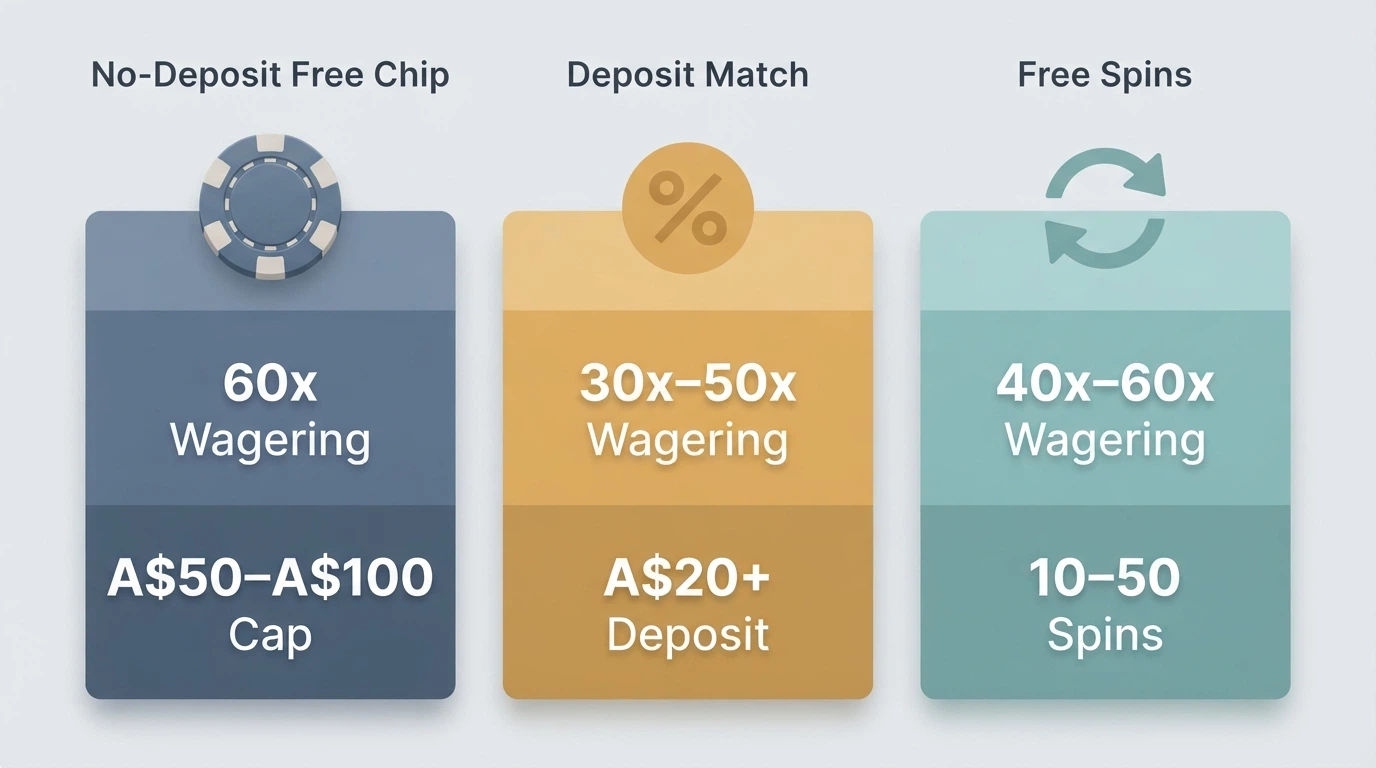
The cashout cap is the structural ceiling. Across the market, $5 free-chip offers cap withdrawals at A$50–A$100, the same range the wagering target sits in. A player who manages to clear the wagering on a no-deposit bonus has usually spent a meaningful fraction of the cashout cap’s worth in expected loss along the way, which is the arithmetic of the promotion working as designed. The wagering range across fourteen tested casinos runs 20x to 50x for the broader market; the no-deposit lane sits at the high end because the operator is taking the entire deposit risk.
Welcome and Sign-Up Bonuses: Why Most Need More Than $5
A welcome package is the headline offer at every operator on this page, and almost none of them triggers at $5. The reason is that a match bonus is sized to the deposit: a 100% match on A$20 produces A$40 of bonus value, which the operator can price against an expected loss. Match a $5 deposit and the operator’s loss-leader is half the size of the welcome offer is supposed to communicate. So the welcome offer’s real floor sits higher than the deposit floor the cashier shows.
Nine of eleven operators running a traditional match-style welcome bonus require A$20 or A$30 to trigger the bonus, even where a lower minimum deposit is advertised. SkyCrown sets A$20 as the minimum qualifying deposit for its A$8,000 + 400 free-spin welcome. Fair Go Casino’s 100% match is redeemable five times, each at A$20 minimum. PlayAmo requires A$25 to trigger the welcome package. The A$10 deposit without bonus route at PlayAmo, via Neosurf or crypto, is a way to play for real money on a small bankroll, but it skips the welcome offer entirely.
The $5 player who arrives at these operators is therefore looking at one of two paths: a no-deposit coupon where one exists, or a small real-money deposit at the cashier that does not unlock any of the welcome value. The welcome offer is a deposit-gated product, and the gate is not at $5.
Deposit Match and First-Deposit Bonuses: The Fine Print on the Percentage
A 100% or 200% match is a percentage of the deposit, returned as bonus money, with terms attached. The terms are the offer, and the four numbers to read are the percentage, the maximum, the wagering multiple and the maximum bet. The percentage and the maximum are the headline. The wagering multiple and the maximum bet are the take-home.
Fair Go runs 100% up to A$200 at 30x on deposit plus bonus combined, a relatively gentle structure. Stake runs 200% up to $1,000 at 40x on bonus plus deposit combined, a larger headline with a heavier turnover. SkyCrown runs 40x on the bonus only, which is materially different from a 40x on the combined figure: a A$20 deposit on a 100% match at 40x bonus-only means A$8 of bonus and A$320 of wagering; the same offer at 40x combined means A$20 of bonus and A$800 of wagering. The qualifier on the wagering target is the largest single number on the page.
The maximum bet during bonus play is the rule a player forfeits the offer by breaking. Bizzo Casino enforces a A$5 maximum bet per spin when using bonus funds, and a single A$6 spin has been observed to void bonus winnings. The same structure exists at most operators, expressed at different ceilings, and a player who plays above the ceiling on a lucky spin is paid for the lucky spin by losing the rest of the bonus balance. Reading the maximum bet before playing is the cheapest bit of due diligence on this page.
Bonus Codes: Where to Find Them and How to Redeem
A bonus code is a short string the player enters at the cashier or during registration to unlock an offer. It is the operator’s way of separating a bonus from a deposit: a code is the key, the offer is the door. Codes are distributed through the operator’s own promotions page, email lists and, sometimes, third-party affiliate sites. They are distribution details rather than editorial content; the offer they unlock is the topic, and the topic is the same offer with or without the code.
The redemption flow is short. The player either enters the code at registration or pastes it into the cashier’s “bonus code” field before confirming a deposit. Some operators apply the bonus automatically once a qualifying deposit lands; others require the code to be entered before the deposit is made. The terms attached to the offer are not affected by the code’s presence; the code is the access mechanism, not the offer’s value. No working code appears in this article, because codes expire, are region-restricted and shift, and quoting one that no longer works is the easiest mistake a guide can make.
Free Spins on a $5 Budget: What 10 to 50 Spins Are Really Worth
Free spins are the most common bonus structure across the offshore market, and the most misleading. The headline reads “50 free spins.” The player reads “50 chances to win.” The take-home is something smaller: a fixed wagering requirement on the winnings, applied to a spin value the operator sets, capped at a withdrawal the operator sets.

The structure is the same across operators. No-deposit free-spin offers in the Australian market typically include 10 to 50 free spins at A$0.10 per spin value, with wagering of 40x–60x on winnings and a maximum cashout cap of A$50–A$100. The 50 free spins at A$0.10 represent A$5 of spin value, the same dollar figure the free chip carries. The winnings from those spins are credited to the bonus balance, the wagering applies, the cap holds. The expected return on a 50-spin package is small, and the cashout is small even when the spin returns are not.
Which pokies the spins land on matters more than the spin count. Big Bass Bonanza, by Pragmatic Play / Reel Kingdom, runs a default RTP of 96.71% with medium-high volatility, a 5×3 grid and ten fixed paylines. Wolf Gold, by Pragmatic Play, runs 96.01% at medium volatility on 25 paylines. Both are higher-RTP than the older Aristocrat-style pokies that dominated the Australian pub market. The bonus is the same dollar figure on either; the math is what the player is actually choosing between when the casino names a slot.
Wagering Requirements: Why a 35x Multiplier Turns $5 Into $175 Before You See a Cent
The wagering multiple is the single number that decides whether a bonus is worth claiming. It is expressed as a multiplier on either the bonus amount or the deposit plus bonus combined, and the difference between the two is the difference between a manageable target and a punishing one.
The arithmetic on a $5 no-deposit bonus is clean. Five dollars at 35x is A$175 of total bets, which at a A$0.10 stake is 1,750 individual spins, which at five seconds per spin is just over two and a quarter hours of play. The cashout cap sits at A$50–A$100, so the maximum a player can walk away with after the two hours is one tenth of the turnover, before the house edge takes its cut. A 50x bonus at the same A$0.10 stake is A$250 of turnover across 2,500 spins and around three and a half hours of play, with the same cashout ceiling. The wagering is the cost of clearing the bonus, and the cost is the same dollar figure the player would have lost to the house edge on the same number of spins.
Game contribution is the second variable. Pokies almost always contribute 100% of the bet to wagering; table games typically contribute 10–25%; some live-dealer games contribute nothing. A player who tries to clear a bonus at blackjack is doing ten to twenty times the turnover a pokie player is, and is still under the clock. The expected loss on the way to clearing is sized to the turnover, not the contribution percentage, so a player trying to grind through at low-contribution games is paying for the same expected loss the pokie player is, over a longer session, with less of it credited toward the wagering target.
The expected loss on A$175 of turnover at a 96.71% RTP is A$5.76, the difference between the total bet and the RTP-weighted return. That is the real cost of the bonus to the player who clears the wagering, the number the cashout cap and the expected value of the offer rest on. A player who fails to clear the wagering loses the A$5 bonus and the time spent trying; a player who clears it and wins big takes the cap; a player who clears it without a win has effectively paid A$5.76 for the privilege of playing through A$175 with a A$5 stake and no further upside. The bonus is a coupon, not a profit.
PayID: The Fastest Way to Fund a $5 Bankroll
What PayID Is and Why Every Australian Bank Supports It
PayID is not a casino payment method. It is a national payments infrastructure that Australian banks have issued to their customers since the New Payments Platform went live. The casino accepting PayID is the casino taking advantage of a rail the player already has; the rail itself was built by the banks and the Reserve Bank, not by the offshore operator.
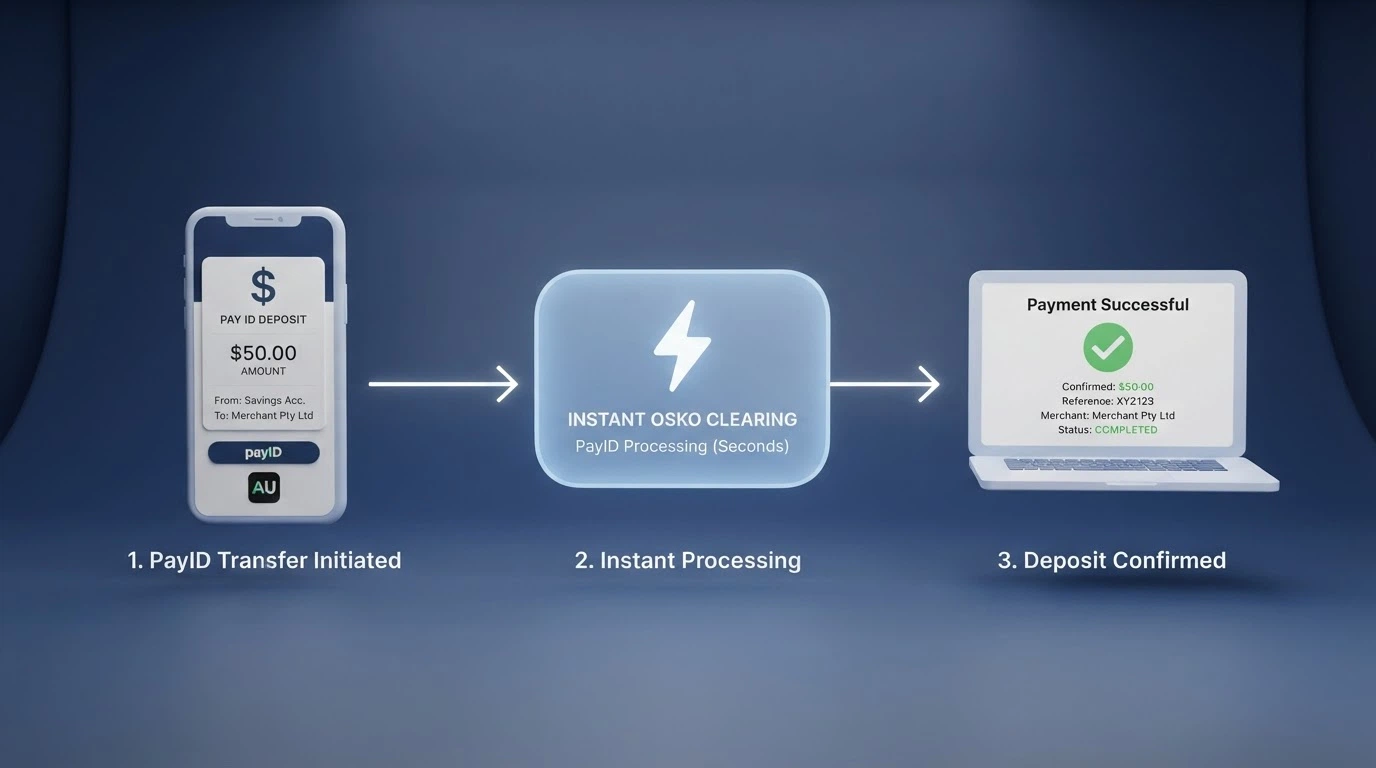
The mechanics underneath matter because they explain why the deposit is instant. PayID sits on the NPP, with Osko handling the real-time clearing, so a transfer from a player’s banking app to the operator’s PayID string arrives in seconds. The major Australian banks — Commonwealth, Westpac, ANZ, NAB, Macquarie, ING — all issue PayID, and setup takes about 90 seconds in a banking app, usually a phone number, an email address or an ABN linked to the account.
The legal status of PayID as a payment route is separate from the legal status of the operator receiving it. PayID is a legal deposit route for licensed wagering, alongside debit cards, bank transfer and BPAY; the offshore casino using it is, in itself, the issue, not the rail. A player using PayID to fund a deposit is doing nothing the player’s own bank prohibits; the bank is, in fact, the only party with perfect information about the destination, which is what the 2026 reform’s transaction-blocking authority for banks (commencing 1 January 2027) will activate for illegal operators.
Credit cards, credit-related products and digital currency are banned as payment for online wagering in Australia, effective 11 June 2024, and an operator accepting them is itself a signal of an unlicensed operator. PayID and debit are the legal routes; the offshore casinos that accept PayID are not legal operators, but the deposit itself is not the breach.
The $5 Minimum Deposit: Which Casinos Actually Let You Start That Low
The $5 deposit minimum is the offer’s central hook. The cashier floor and the bonus-qualifying floor are not the same number, and the gap is what catches the A$5 player out.
Nine of eleven operators running a traditional match-style welcome bonus require A$20 or A$30 to trigger the bonus. SkyCrown’s cashier minimum is A$20 for the welcome offer. Fair Go’s is A$20 per stage. PlayAmo’s is A$25 for the welcome, with a A$10 deposit option without a bonus via Neosurf or crypto. Rainbet’s welcome bonus floor is $30, with a separate $5 minimum on a handful of cryptocurrencies (Solana, Litecoin, Dogecoin, Tron, Stellar, Cardano and XRP), which puts the operator under that A$5 figure for the crypto route, not the PayID route. Stake is crypto-only and has no traditional minimum, so the $5 ceiling does not apply in the way it does at PayID-accepting brands.
The pattern, in other words, is that a PayID $5 deposit is universally possible at the cashier and almost universally useless for triggering the welcome offer. The operators that go lower on deposits do so for crypto, which a PayID-funded player is not using. The A$5 budget is real at the deposit screen, but the bonus it unlocks lives at A$20 or above.
From Deposit to Play: How the PayID-to-Pokies Flow Works in Practice
The end-to-end PayID flow is short. The player opens the cashier, selects PayID, copies the operator’s PayID string (an email, a phone number or an ABN), opens their banking app, pastes the string into a transfer, confirms the amount and authorises. The confirmation arrives in the cashier in seconds, because PayID deposits at AU-facing casinos are typically instant, with no casino-side fees, and full AUD support.
The reverse path — withdrawal — uses the same rail. PayID withdrawals at the operators reviewed are processed in 5–40 minutes on the same rail, faster than a card refund and faster than a bank transfer. The player requests the withdrawal at the cashier, the operator’s payments team approves, the funds clear back to the player’s bank account via Osko. There is no fee on the casino side; the player’s bank does not charge for incoming PayID either, which is part of why the route is the cheapest deposit-and-withdrawal cycle available.
The catches are at the operator’s discretion. Most operators require the withdrawal to go back to the same PayID the deposit came from, on anti-fraud grounds; a deposit from one PayID and a withdrawal to a different PayID will usually be rejected until the player verifies both. The wagering requirement, where one applies, is checked at the cashier before the withdrawal button activates, which is where most first-time bonus players first see the cap. A site that has been ACMA-blocked since the deposit will not process the withdrawal at all, because the player cannot reach the cashier — which is the structural risk an offshore player takes on every deposit.
The Offshore Casinos Australians Actually Use in 2026
The ten operators in the table below are the ones Australians in fact reach. None holds an Australian online casino licence, because none can: the Interactive Gambling Act 2001 makes it an offence to provide online casino games to a person in Australia, and no licence exists for the product. The presence of these brands in search results and traffic data reflects where Australians go, not what is legal. The ranking reflects bonus value and wagering fairness against the same offshore peer set, not regulatory status.
| Operator | Licence | Welcome bonus | Wagering | Max bet during bonus |
|---|---|---|---|---|
| SkyCrown | Offshore (Curacao) | A$8,000 + 400 FS across 4 deposits | 40x bonus | A$5 |
| RocketPlay | Offshore (Curacao) | 100% up to €200 + 100 FS | 40x bonus | A$7.50 |
| Fair Go Casino | Offshore (Curacao) | 100% up to A$200, 5x (up to A$1,000) | 30x deposit + bonus | A$10 |
| Stake | Offshore (Curacao) | 200% up to $1,000 | 40x bonus + deposit | — |
| PlayAmo | Offshore (Curacao, Dama N.V.) | Up to A$1,400 + 150 FS across 2 deposits | 50x bonus | A$5 |
| Bizzo Casino | Offshore (Curacao) | — | — | A$5 |
| Rainbet | Offshore — AU restricted | 250% up to $1,750 + 60 FS | 40x | 2% of deposit |
| Royal Reels | Offshore | — | — | — |
| WinSpirit | Offshore | — | — | — |
| Scream Casino | Offshore | — | — | — |
Wagering is the multiplier applied to the bonus, unless otherwise stated. Max bet is the per-spin ceiling during bonus play. Em dashes mark where a figure was not confirmed in the inputs and the operator should be checked directly.
SkyCrown
The highest headline welcome figure in the reviewed set is SkyCrown’s A$8,000 + 400 free spins, distributed across four deposits: 120% up to A$700 + 125 spins on the first, 100% up to A$1,500 + 75 spins on the second, 80% up to A$1,500 + 50 spins on the third and 150% up to A$3,800 + 150 spins on the fourth. The wagering is 40x on the bonus amount, 30x on free-spin winnings, with a A$20 minimum qualifying deposit, a A$5 maximum bet during bonus play and 14 days per tier to clear. The structure splits the welcome across four separate deposits, so a player who tops up once gets the first tier and walks away from the rest, while a player who keeps depositing keeps earning. The 14-day window per tier is the clock most players trip: the first tier expires while the player is still working on the second.
The exclusions are the second part of the offer. SkyCrown’s bonus terms exclude deposits via Skrill, Neteller and cryptocurrency from the welcome offer entirely, so the headline figure applies only to players depositing through other routes, including PayID. The on-site weekly cashback of 10% up to A$500 carries no wagering, which is rare in the set and worth more than it looks: cashback without wagering is real money back into the player’s withdrawable balance, not a re-credit that has to be cleared.
For a player planning to deposit across four separate sessions, SkyCrown is the headline-value pick. For a player who wants the full A$8,000 in one go, the structure is not what it looks like. The 40x on bonus only is on the lighter end of the reviewed set, but the 14-day per-tier window and the payment-method exclusions narrow who actually realises the offer.
RocketPlay
RocketPlay’s 100% up to €200 + 100 free spins is a single-tier welcome in a market that mostly hands out four-tier packages, and the structure underneath is more generous than the headline suggests because the bonus is non-sticky. A non-sticky bonus means the player’s real money plays first; the bonus money only enters the wagering cycle after the real-money balance hits zero. A player who deposits €200 and wins €250 before the bonus is touched can withdraw the €250 and forfeit the bonus; a player who loses the deposit starts the wagering clock against the bonus.
The terms that bite are the time and the bet cap. RocketPlay’s default maximum bet during bonus wagering is A$7.50 for AUD accounts, and the bonus validity is 5 days from receipt unless otherwise stated, which is the tightest clock in the reviewed set. The free-spin winnings carry a €200 cap. A player who can clear €8,000 of wagering inside five days at A$7.50 a spin is a high-volume player; everyone else is forfeiting the bonus at the expiry.
The single-tier structure is a better fit for the casual player who wants one deposit, one bonus, one wagering cycle and a clean exit than for a player who plans to deposit weekly. The €200 ceiling is small in AUD; the 40x on the bonus is standard; the 5-day clock is the cost.
Fair Go Casino
Fair Go is the only operator in the reviewed set with confirmed no-deposit bonus coupons, and that fact alone puts it on the page for a $5-budget reader. The no-deposit coupons carry 60x wagering and a A$10 maximum bet while any bonus is active, and two consecutive free bonuses cannot be redeemed without a real-money deposit between them. The coupon is the offer that delivers on that promise; the wagering and the cap are the terms behind the offer.
The welcome package is a different product. The 100% match up to A$200 is redeemable five times, up to A$1,000 total, with a A$20 minimum deposit per stage and 30x wagering on deposit plus bonus combined. There is no maximum cashout on deposit bonus winnings, which is unusual in the set and is the reason Fair Go’s welcome has a long-tail reputation among players who can clear the wagering. The 30x on the combined figure is the lowest wagering multiple in the reviewed welcome set, and the absence of a cashout cap means a large balance at the end of wagering is not clipped.
The two structures exist on the same brand for two different reader profiles. A no-deposit player meets the 60x coupon and the A$50–A$100 cashout cap on free play. A depositing player meets the 30x combined wagering and no cap on deposit bonus winnings. The wagering multiple is the right number to compare across the two, and 30x combined is friendlier than 40x bonus only on a small deposit.
Stake
Stake is the only crypto-only operator in the top half of the ranking, and that fact decides the rest of the profile. The 200% first-deposit bonus up to $1,000 is the largest percentage in the reviewed set, and 40x on bonus plus deposit combined is on the heavier side. The bonus is sized to the deposit, and the deposit is sized to whatever the player sends; the absence of a traditional minimum is the part of the offer that fits a $5 bankroll, but the absence of PayID is the part that does not.
Game contribution is the second issue. Table games contribute roughly 25% to wagering at Stake, and sports bets roughly 75%; the full 100% applies to the slots the operator has approved for the bonus. A player who tries to clear a 40x combined wagering requirement at the blackjack table is doing four times the dollar volume the slot player is, which collapses the time-to-clear calculation and the expected-loss calculation in the same direction. The expected loss is the same dollar figure over a longer session; the cap is the same; the time spent is not.
The verdict is the absence of PayID. A PayID-funded player cannot use the welcome offer at all, because the rail does not connect. The 200% headline is real, and the operator is the right fit for a player who already holds crypto and is comfortable with the contribution-weighting, and not the right fit for a $5 PayID player.
PlayAmo
PlayAmo’s welcome package is up to A$1,400 + 150 free spins across two deposits: 100% up to A$400 + 100 spins on the first, 50% up to A$1,000 + 50 spins on the second. The wagering is 50x on the bonus, the steepest multiplier in the reviewed set, and the A$5 maximum bet during bonus play applies across the full bonus cycle. The minimum qualifying deposit is A$25 to trigger the welcome, with a A$10 deposit without bonus available via Neosurf or crypto. The library is large — 3,000+ games across NetEnt, BetSoft, Microgaming and others — and the on-site High Roller bonus up to A$3,000 is a separate offer for the larger deposit.
The 50x is the number that decides whether the welcome is worth claiming. On a A$25 deposit with a 100% match, the bonus is A$25 and the wagering is A$1,250 — a meaningful turnover on a small bonus. A A$10 deposit without bonus is the small-bankroll route: the player skips the welcome and plays for real money on the games they want, with no turnover requirement and no cap, but also no bonus value.
The verdict is that PlayAmo fits the player who values the game library and the High Roller path more than the welcome offer. The 50x welcome is the cost of a large library; the A$10 Neosurf deposit is the cost of a small bankroll.
Bizzo Casino
Bizzo’s profile is short on confirmed welcome specifics and long on a single enforcement rule. The A$5 maximum bet per spin when using bonus funds is the offer’s most consequential term, because a single A$6 spin has been observed to void bonus winnings. The strictness is the point of the rule, and the forfeit is the cost of breaking it. Some providers on Bizzo may run adjustable RTP versions of their games (a 94.5% vs a 96.5% variant, for example), which the player can check at the in-game information panel. Crypto deposits may be excluded from some promotions.
The terms that would let a reader compare the welcome offer to the rest of the set were not confirmed this run, and the right way to read this profile is the rule, not the missing welcome. The A$5 max-bet enforcement is the same rule that appears at PlayAmo and SkyCrown, but the framing at Bizzo is the one that is enforced strictly enough that a single A$6 spin forfeits the balance. A player who can stay at A$5 and below on every spin is fine; a player who is tempted to round up on a hot streak is not.
Rainbet
Rainbet’s 250% up to $1,750 + 60 free spins is the highest percentage match in the reviewed set, distributed across three deposits (20 free spins per stage) with 40x wagering on a wager-locked option or a no-wager gradual-release alternative. The minimum deposit for the welcome is $30, and the bonus expires seven days after activation, which is the shortest clock in the set. The minimum deposit on a handful of cryptocurrencies (Solana, Litecoin, Dogecoin, Tron, Stellar, Cardano and XRP) is $5, which is the operator’s claim to that low-deposit figure. The welcome bonus itself is a $30 product, not a $5 product.
The structural problem is not the bonus. It is the terms of service. Rainbet explicitly restricts Australian players, with Australia and its territories listed as a fully restricted market. An Australian player who signs up is signing up against the operator’s own terms, and the operator can restrict the account at withdrawal, at any time, for any reason consistent with the restriction. The 250% headline is real, and the offer is not available to the reader this page is written for.
Royal Reels
Royal Reels is in the reviewed set for one reason: it holds 2.51% of AU-facing traffic to the operators covered, which is enough to make it a place Australians go. The bonus terms, the welcome offer, the wagering multiplier, the maximum bet and the minimum deposit were not confirmed in the inputs. The operator is offshore, not licensed in Australia, and the same caveats that apply to the rest of the set apply here.
The verdict is the verification step. A player who has heard of Royal Reels and is considering it should check the operator’s terms page directly for the current welcome offer, the wagering, the maximum bet and the minimum deposit before depositing. The page is not the place to guess the missing terms, and the operator is not the place to play without them.
WinSpirit
WinSpirit holds 1.55% of AU-facing traffic in the reviewed set. The bonus terms, the welcome offer and the wagering specifics were not confirmed. The operator is offshore, not licensed in Australia. The same structural caveats apply.
The verdict is the same as Royal Reels. A player considering WinSpirit should check the terms directly before depositing, because the page cannot quote a welcome offer or a wagering multiple that the inputs did not carry.
Scream Casino
Scream Casino holds 0.99% of AU-facing traffic in the reviewed set — the smallest confirmed share. The bonus terms, the welcome offer, the wagering, the maximum bet and the minimum deposit were not confirmed. The operator is offshore and not licensed in Australia. The same structural caveats apply.
The verdict is unchanged. A player considering Scream should check the terms directly, because the page does not have the figures a comparison would need.
Why Every Online Casino You Visit From Australia Is Unlicensed
The Interactive Gambling Act: What It Prohibits and What It Doesn’t
The Interactive Gambling Act 2001 draws a line, and online casino in Australia is on the wrong side of it. The Act prohibits the provision of online casino games, online pokies and in-play sports betting to a person in Australia. There is no licence for any of those products, at any level of government, in any state or territory. What remains licensable is pre-event wagering on races and sport, lotteries and keno, all licensed by state or territory regulators, with the de facto national licensor for online wagering being the Northern Territory Racing and Wagering Commission, administered through Licensing NT. Major bookmakers — Sportsbet, bet365, Ladbrokes — hold NT licences running up to twenty years, and the 2026 reform updated the regime for new entrants. The IGA does not reach the licensed wagering market, and licensed wagering does not include online casino.

The IGA was strengthened by the Interactive Gambling Amendment Act 2017, which closed the loopholes offshore operators had been using and gave the Australian Communications and Media Authority express enforcement and site-blocking powers. The ACMA investigates complaints, issues formal warnings, runs civil penalty proceedings, refers operators for enforcement, and directs Australian ISPs to block illegal sites. Since the first blocking request in November 2019, the ACMA has had 1,564 illegal gambling and affiliate websites blocked by Australian ISPs, as of March 2026. More than 225 illegal services have withdrawn from the Australian market since 2017. The enforcement is real, ongoing, and aimed at the operator.
The individual player is not the target. The IGA prohibits the provision of prohibited interactive gambling services; it does not make it an offence for a person in Australia to access one. The 1,564 blocked sites and the 225 withdrawn services are the visible end of an enforcement regime aimed at the supply side, not the demand side. A player who accesses an offshore casino is not committing an offence under the IGA.
The 2026 Reform: What Changes on 1 January 2027
The Interactive Gambling Amendment (Gambling Reform) Bill 2026 passed both Houses of Parliament — the House of Representatives on 18 August 2026 and the Senate on 19 August 2026 — with its measures commencing on 1 January 2027. The reform does not legalise online casino. It tightens the prohibition, on both the demand and supply sides, and it gives new tools to the regulator, the banks and the consumer.
The advertising changes are the visible part. From 1 January 2027, wagering advertising on television and radio is capped at three ads per hour between 6:00 am and 8:30 pm, with a live-sport blackout from 15 minutes before until 5 minutes after a live event. Wagering advertising is banned in sports venues, on uniforms, and by athletes, celebrities and influencers. AdStop, a national wagering advertising opt-out register administered by the ACMA, lets individuals opt out of wagering advertising across online platforms. Civil penalties for advertising prohibitions run up to 1,000 penalty units for individuals (A$364,000) and up to 5,000 penalty units for corporations (A$1,820,000).
The inducement rules are the consumer-facing part. Direct marketing of inducements is prohibited for 14 days after a customer signs up, for three months after a person deregisters from BetStop, and indefinitely for customers identified as at risk of gambling-related harm. The cooling-off periods are written to take the welcome-bonus push off the table at the moments a player is most likely to be receptive to it.
The payment-block authority is the supply-side lever. From 1 January 2027, banks and payment providers gain express authority to block transactions to illegal gambling operators. The legal deposit route is already PayID, debit and BPAY for licensed wagering; the new authority lets the banks refuse to send the same routes to unlicensed operators. The penalty for an operator that fails to enforce the existing credit-and-crypto ban is already up to A$247,500, and the new authority extends the obligation to the receiving bank. The reform is the largest change to the IGA in a decade, and it does not move the line on online casino.
What You Lose When You Play Offshore: Protections That Don’t Cross the Border
The Australian consumer-protection framework — BetStop, ACMA recourse, debit-card chargeback rights, state-level dispute resolution — stops at the licensed border, and the offshore operator has no obligation to honour any of it.
BetStop is the clearest example. BetStop launched on 21 August 2023 and lets a person exclude themselves from all approximately 150 licensed Australian online and phone wagering services in a single step. As of 31 December 2025, 54,859 people had registered, of whom 35,135 had active exclusions. The register binds only Australian-licensed services. An offshore casino is not connected to BetStop, and will keep accepting a self-excluded person’s deposits, because the operator has no Australian obligation to check the register. The exclusion is a door, and the offshore operator is not behind it.
The credit-card and crypto ban is the second example. Credit cards, credit-related products and digital currency are banned as payment for online wagering, effective 11 June 2024. An operator that accepts these payment methods is operating outside the Australian regulatory framework, because the only operators bound by the ban are the licensed ones. An Australian player using a credit card to fund an offshore casino deposit is, in addition to breaching the credit ban personally, depositing with an operator that has demonstrated it does not follow Australian rules. The payment method is a signal, and the signal is that the operator is unlicensed.
The ACMA’s blocking authority is the third example. The ACMA can direct Australian ISPs to block an illegal site, and the site becomes inaccessible to Australian players. A player who has an open balance on a blocked site cannot reach the cashier to withdraw it. The 1,564 sites blocked since November 2019 are the visible count; the count of players who lost access to their balance on a blocked site is not published, but the mechanism is unambiguous. A site that is illegal in Australia can be made inaccessible to Australian players at the regulator’s discretion, and the regulator has used that discretion.
The individual player is not prosecuted. The IGA targets the provider. The cost to the player is the absence of every Australian protection the player would otherwise have, and the absence of recourse for any loss the player suffers as a result.
Staying Safe When the Safety Net Doesn’t Cover You
Deposit Limits, Budget Control and the Tools You Actually Have
Offshore casinos are not bound by Australian licence conditions, so the deposit limits and self-exclusion tools that a $5 player meets on a licensed wagering site do not travel. Most offshore operators do offer player-set deposit limits, session timers and self-exclusion at the operator level, and the tools work the way they would at a licensed site — but they bind only that operator, not the industry.
The right way to use the tools is before play, not after. A player who sets a weekly deposit limit of A$50 at the cashier and sticks to it has built a budget that the operator’s bonus schedule cannot push past. A player who sets a session timer at 30 minutes and stops at the alert has built a clock the wagering requirement cannot extend. A player who activates operator-level self-exclusion at the first sign of a chase has closed the door the player is most likely to walk back through. None of these tools is BetStop, and none of them gives a player the same protection BetStop gives, but they are the tools that exist on the operator in question.
BetStop is the gap. BetStop covers approximately 150 licensed Australian wagering services in a single registration, with a minimum three-month exclusion and the option of a lifetime ban. It does not cover offshore casinos, and it is not a tool an offshore player can rely on. The licensed wagering market is a closed system by design, and the offshore market is the open one. The player who has registered with BetStop and is still playing offshore is playing without the protection the registration was meant to give.
Where to Get Help: The Numbers and Services Every Australian Player Should Know
The help is free, confidential and 24/7, and it does not depend on where the play happened. The National Gambling Helpline is 1800 858 858, staffed around the clock, every day, with online chat and counselling through Gambling Help Online. The National Debt Helpline is 1800 007 007, for gambling-related financial counselling. BetStop is at betstop.gov.au for self-exclusion from licensed Australian wagering services. None of these numbers require the player to have played at a licensed site; the service is the same regardless.
The prevalence figures explain why the numbers are easy to remember. About 2.1% of Australian adults — roughly 430,000 people — experience problem gambling, and the Australian Institute of Health and Welfare put high-risk gambling at 1.8% in 2022. As of March 2026, 15.1% of the Australian adult population — an estimated 3.32 million people — are experiencing some level of gambling harm, with 13.0% (2,857,000) from their own gambling behaviours and 5.4% (1,177,000) from other people’s gambling. A $5 habit is the size of any other habit at the start, and the population-level figures describe a country in which gambling harm is not a marginal condition.
The hard cut is the one the player makes. A $5 budget honoured as a budget is a limit. A $5 budget that escalates is the start of the harm figure. The help line is one call away, and the call is free.
How We Selected and Ranked These Operators
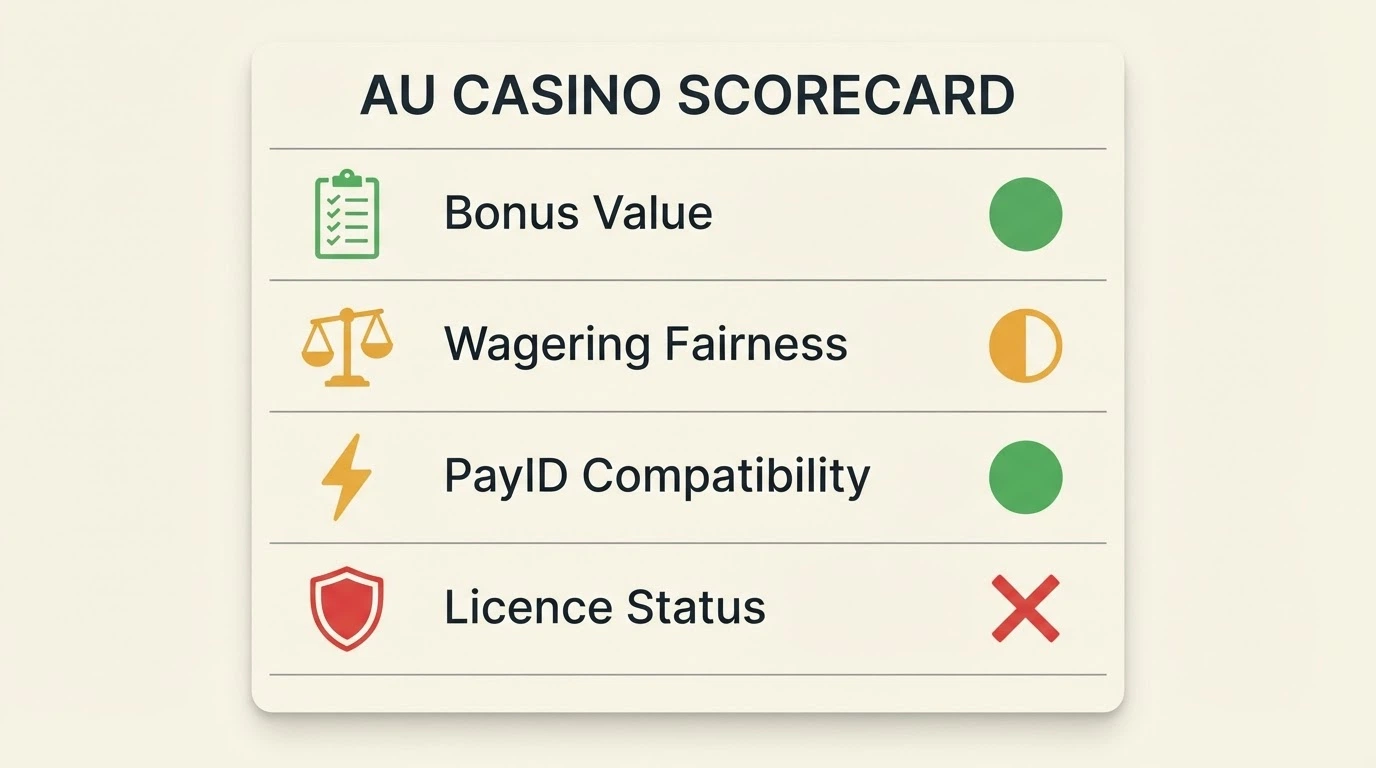
The set was assembled from three sources: the operator’s own terms pages, independent casino-review platforms (Betzoid, Wildfish, Slotspeak, Payoutverdict, Casino.band, Aussieslotscasino, Clearcasinos, QR Solutions, Slot Expanse, Casinoshub, iGamingFuture, VIP Grinders), and the Australian Communications and Media Authority’s published enforcement data. The criteria that ordered the ranking were bonus value, wagering fairness, PayID compatibility, and the strictness of the maximum-bet rule, with the ACMA licence framework as a baseline check that every operator on the page fails, because every online casino product is prohibited in Australia. The ranking is of the operators as the operators are, not as a marketing version of them.
Three caveats the methodology needs to carry. First, the ranking is of bonus terms, not of regulatory standing: every operator on this page is offshore and not licensed in Australia, and the order does not make any of them legal. Second, a per-operator finding the inputs did not confirm is left as a gap, marked with an em dash in the table and a verification note in the profile; the audit prefers an empty cell to a guessed one. Third, market-share figures for the smaller operators (Royal Reels, WinSpirit, Scream Casino) are included to show that these are operators Australians in fact reach, not to make a claim about their quality; the bonus terms are unconfirmed because the inputs did not carry them.
What Your $5 Budget Should Actually Buy You
A $5 no-deposit bonus is a trial, not a profit opportunity. The wagering — A$175 at 35x on the bonus — is the cost of clearing, and the expected loss along the way is the dollar figure the player is actually paying to find out whether the bonus clears at all. The cashout cap of A$50–A$100 is the ceiling on a successful clear, which is the take-home the player walks away with if everything goes right. The cap is the number the offer is built around, and the offer is built to make the cap a rare outcome.
The deposit-match alternative is a different calculation. A$20 at a 30x combined wagering means A$1,200 of turnover for a A$20 bonus, with no cashout cap at Fair Go and a 100% match up to A$1,000 across five deposits. The offer is real, the bonus is meaningful, and the wagering is on the lighter end of the market. A$25 at 50x means A$2,500 of turnover for a A$25 bonus, with a cashout cap that may or may not apply. The deposit-match path is the better value in dollar terms, and the cost is real money at risk.
The recommendation is the part the page is allowed to make. Use the no-deposit offer to test the platform — the cashier, the withdrawal flow, the games — before committing real money. Set a hard budget before the first deposit. Read the maximum-bet rule and the wagering target before the first spin. Walk away at the bonus’s end, whether the bonus cleared or not. The numbers on this page are the marketing material of the bonus; the budget is the player’s.
The help line is 1800 858 858. The line is free, the line is 24/7, and the line does not require the player to have lost the budget before calling it. The numbers above are why.
Frequently Asked Questions
Could I face prosecution for playing at an offshore casino from Australia?
No. The Interactive Gambling Act 2001 makes it an offence to provide prohibited interactive gambling services to a person in Australia; it does not make it an offence for a person in Australia to access one. The IGA targets the provider. The Australian Communications and Media Authority’s enforcement — 1,564 blocked sites and 225+ withdrawn services since 2017 — is aimed at operators, not players. The cost to a player who accesses an offshore casino is the absence of Australian consumer protections, not the risk of prosecution.
How does PayID compare to other deposit methods like Neosurf, crypto or BPAY for a $5 minimum deposit?
PayID is instant and fee-free on the casino side, with full AUD support and withdrawals on the same rail in 5–40 minutes. The major Australian banks — Commonwealth, Westpac, ANZ, NAB, Macquarie, ING — all issue PayID, and setup takes about 90 seconds. Neosurf and crypto can drop the deposit minimum to A$5–A$10 at some operators, but crypto is banned as a payment method for online wagering in Australia, and using it signals an unlicensed operator. BPAY is slower (often 1–2 business days) and is generally not a withdrawal route. PayID is the right balance for an Australian player on the PayID-funded path.
What pokies can I play with a $5 bankroll, and which ones have the best RTP for small deposits?
Big Bass Bonanza (Pragmatic Play / Reel Kingdom) runs a default RTP of 96.71% with medium-high volatility, a 5×3 grid and ten paylines. Wolf Gold (Pragmatic Play) runs 96.01% at medium volatility on 25 paylines. Both are higher-RTP than the older pokies common in Australian venues, and both accept A$0.10 spins, which is the stake size a A$5 bankroll needs. For the lowest house edge per spin, look at the in-game information panel; some providers run adjustable RTP versions, and the version the player is on is the one the math runs against.
What is the maximum amount I can withdraw from a $5 no-deposit bonus?
Most $5 free-chip offers cap withdrawals from the bonus at A$50–A$100, regardless of what the balance reads when the wagering is done. The cap is structural: it is the ceiling on the operator’s cost of the promotion, and the wagering is what the player pays to reach it. A player who hits a feature payout of A$400 on a $5 free chip and clears the wagering will withdraw A$50 or A$100, with the rest voided. The cap is the number the offer is built around.
Does BetStop cover the offshore casinos Australians actually use, or only licensed wagering sites?
BetStop covers only licensed wagering sites. The register, launched on 21 August 2023, lets a person exclude themselves from all approximately 150 licensed Australian online and phone wagering services in a single step. As of 31 December 2025, 54,859 people had registered, of whom 35,135 had active exclusions. The register binds Australian-licensed services. An offshore casino is not connected to the register and will keep accepting a self-excluded person’s deposits. The exclusion is a door, and the offshore operator is not behind it.
What protections do I lose when playing at an offshore casino instead of a licensed Australian wagering operator?
The short list is BetStop coverage, ACMA recourse for lost funds or refused withdrawals, debit-card chargeback rights on disputed transactions, and state-level dispute resolution. An offshore operator is not bound by any of these, and the operator’s own terms are the only contract. The site can also be ACMA-blocked at any time, with a balance still held on the account. The individual player is not prosecuted, but the player has no Australian recourse if the operator refuses a withdrawal, voids a win for a max-bet breach, or simply closes the account. The protection framework is what licensing buys, and offshore play does not buy it.
The $5 No-Deposit Bonus: Free Money or a Marketing Hook?
A no-deposit bonus is the only category of casino promotion that genuinely costs the player nothing to claim, because no money moves from the player’s bank account to the operator before play begins. The marketing copy leans on that fact. The arithmetic, less so. A $5 bonus with a 35x wagering requirement means A$175 must be bet before any withdrawal is possible, even at a stake small enough to keep the bonus alive. The cap is the second cut: most $5 free-chip offers limit withdrawals from bonus play to A$50–A$100, regardless of what the balance reads when the wagering is done. A run that looks like a five-figure win on screen, and the player walks with a capped hundred.
The range across the market makes the point sharper. Among fourteen Australian-facing casinos tested offering $5 no-deposit bonuses, wagering requirements spanned 20x to 50x. The same headline figure, $5 free, lands a player in twelve minutes or an hour of play depending on which operator they signed up with. The free chip is real. The “free” is the part to read.
The reason operators offer it is straightforward. A no-deposit bonus is a loss-leader: the house edge on the wagering the bonus forces, combined with the cashout cap, almost always leaves the operator ahead on the player who wanders off after a single session. The player who walks away with A$100 from a A$5 free chip is the exception, not the target, and the bonus terms are written around the exception, not for it.
Published by the Online Pokies Real Money team.