Best Casinos for Online Craps in Australia in 2026
 Available in AU
Australian players cannot reach online craps through any Australian-licensed route. The Interactive Gambling Act 2001 makes it an offence to provide an online casino game to a person physically in Australia, and craps is a casino game. Every real-money craps table an Australian joins sits on a server licensed somewhere else, governed by a non-Australian regulator, and answerable to no Australian consumer law. The search for a trustworthy craps site starts there — not with a welcome bonus, not with a payout claim, and not with a star rating.

Data current as of 18 October 2026; licence claims verified against the Australian Communications and Media Authority’s prohibited-services list and the Curaçao eGaming, Kahnawake Gaming Commission and Panama Gaming Control Board registers.
Table of Contents
- Where Australian players actually find online craps in 2026
- The top 10 craps casinos Australians can actually join in 2026
- How to play craps — from your first roll to the smartest bets on the table
- Craps table layouts, the variants that rewrite the odds, and the machines that reshaped the game
- Live dealer craps vs RNG tables — which one gives you the real game?
- Free craps and demo mode — try every strategy before a dollar leaves your pocket
- Why your craps bonus is smaller than the headline number
- Why no Australian casino can legally offer you online craps — and where that leaves the player
- Playing smart — the tools, limits and help every Australian craps player should know
- How we selected and ranked the best craps casinos for Australian players
- Is online craps worth it for an Australian player in 2026?
- Frequently asked questions
Where Australian players actually find online craps in 2026
The offshore craps landscape — what “online craps in Australia” actually describes
No .au domain runs a legal craps table. That sentence has been true since the Interactive Gambling Act 2001 came into force, and the Interactive Gambling Amendment Act 2017 closed the loopholes that briefly let offshore advertising reach Australian audiences. As of March 2026, the Australian Communications and Media Authority has had 1,564 illegal gambling and affiliate websites blocked by Australian ISPs, and more than 225 illegal services have withdrawn from the Australian market since 2017. The product an Australian sees when a craps site loads is one the operator has chosen to provide anyway, knowing the regulator can knock it offline with a single direction.
The market that does reach Australian players clusters around three licence jurisdictions. Curaçao eGaming is the most common — seven of the ten operators on this page hold a Curaçao permit. Kahnawake Gaming Commission sits behind a single brand. The Panama Gaming Control Board covers another two. None of these regimes offers anything like the protection an Australian would have at Crown Melbourne or The Star Sydney; what each offers is a paper trail back to a registered operator, a complaint channel that may or may not respond, and an audit standard that varies by jurisdiction.
The Northern Territory Racing and Wagering Commission licences online wagering through Licensing NT, but the licensed product is wagering — sports and racing bets placed before the event — not casino games. A punter who opens a TAB account gets a wagering product. A punter who opens a craps account does not. The two markets sit in different legal universes.
Real-money craps for Australian players — what a deposit actually sets in motion
The first practical filter an Australian craps player meets is the AUD banking rail. PayID and POLi are the workhorses — both settle from an Australian bank account in real time, both leave a paper trail a player can point to if anything goes wrong. Osko and BPAY are slower but functional. Crypto is the third option, and it is the one that splits the player from the Australian consumer-law backstop entirely.
Australia banned credit cards, credit-related products and digital currency as payment for online wagering on 11 June 2024 under the Interactive Gambling Amendment (Credit and Other Measures) Act 2023. The rule applies to AU-licensed operators. An offshore casino that still asks for a credit card or a Bitcoin deposit is outside the Australian rules entirely — the payment method is itself a tell. An operator that fails to enforce the ban faces penalties up to $247,500 per breach.
From 1 January 2027, banks and payment providers gain express authority to block transactions to illegal gambling operators under the Interactive Gambling Amendment (Gambling Reform) Bill 2026. That changes the deposit side of the equation, but it does not change the fundamental posture: an offshore craps site operates outside Australian law today, and it will operate outside Australian law on 2 January 2027.
The withdrawal side is where most offshore friction surfaces. There is no Australian consumer-law backstop on a withdrawal from a Curaçao casino. There is no ACMA complaint channel that returns a player’s bankroll. There is only the operator’s own stated payout window, the player’s record of identity documents, and the patience to wait out a discretionary review. A bank-blocking power does nothing for the player whose withdrawal was declined last Tuesday.
How the shortlist was built — the filter an Australian craps player actually needs
Four criteria eliminate most of the offshore universe before the comparison even starts. The first is AUD banking: a player who cannot deposit in Australian dollars without a currency-conversion fee and a two-day wait is not going to be a returning customer. PayID and POLi support is the gate. The second is licence jurisdiction: a Curaçao permit is a thin credential but a real one, and a no-licence operator is not on this page. The third is craps-specific game count and provider quality — a casino with a single Betsoft craps table sits below one running Evolution Craps Live, and the reason is not just the live-dealer novelty but the mechanical dice launcher that resolves the trust question.
The fourth criterion is the one that quietly disqualifies most welcome bonuses. Craps contributes roughly 5% to wagering requirements at Joe Fortune, the only operator in the set to publish a percentage. That 5% rate is the market norm — slots drive most casino revenue, and the contribution table is built around them. A 30× wagering requirement on a slots-friendly AU$1,000 bonus becomes, for a craps player, a turnover requirement twenty times larger than the headline suggests. The bonus that looks good in the comparison table may be mathematically unreachable at the craps table.
That is the filter this list has been built against. The next section applies it.
The top 10 craps casinos Australians can actually join in 2026
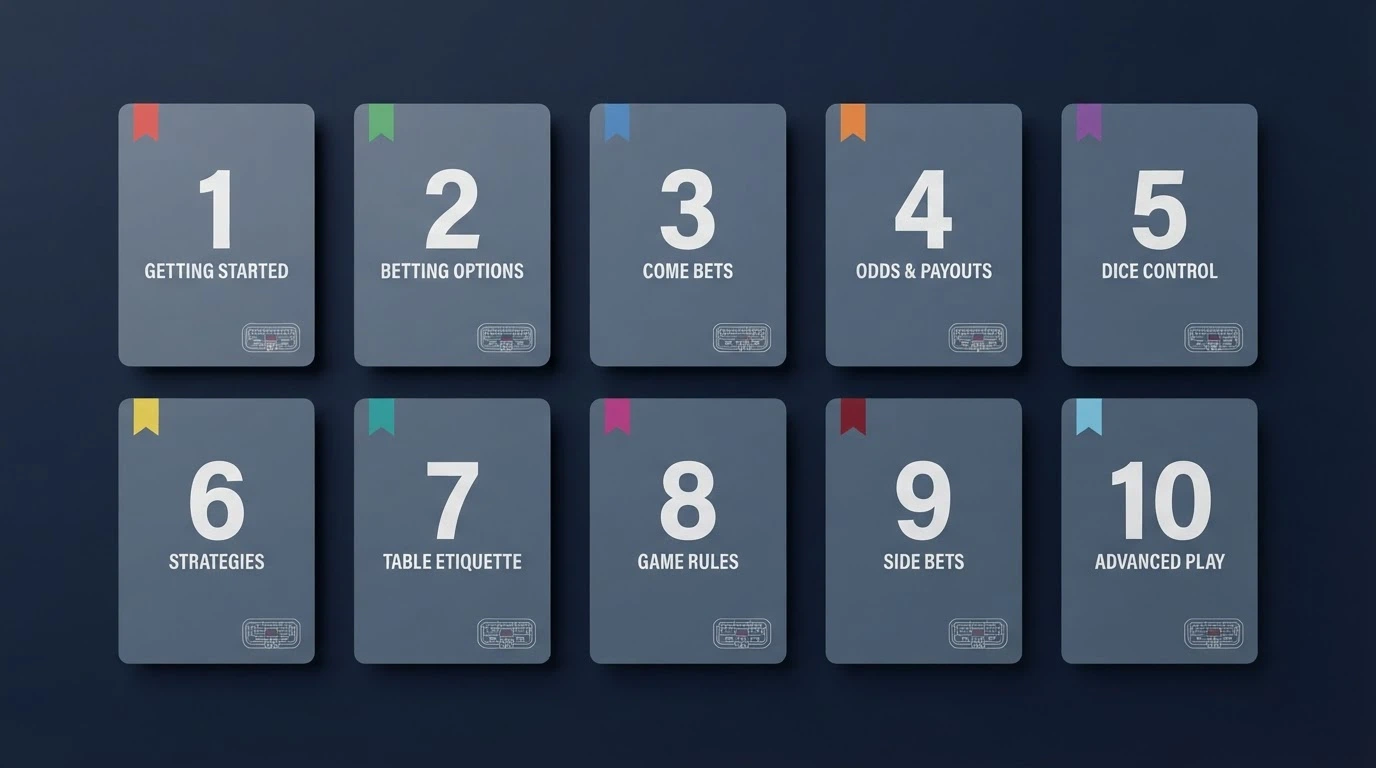
What “best” means here is a craps-friendly offshore operator that takes AUD, holds a real licence, runs a non-trivial craps lobby, and posts bonus terms a craps player can actually work through. The table below ranks ten operators against those four tests. The licence column tells you which regulator signed off. The bonus column tells you what the offer looks like on day one. The wagering column tells you what clearing it costs — and the contribution rate, where published, tells you what fraction of craps play counts toward that cost. Seven of the ten operators sit under a Curaçao permit; one holds a Kahnawake licence; two sit under Panama. The bonus-contribution trap, explained in the section on craps bonus maths, is what makes the wagering column the most important number on the page for a craps player.
| Online Craps Casino | Licence/Jurisdiction | Welcome Bonus (AU$) | Wagering (×) | Bonus Validity | Craps Software Providers |
|---|---|---|---|---|---|
| Joe Fortune | Curaçao eGaming (#8048/JAZ) | 200% up to A$1,000 | 30× | 30 days | Betsoft, Nucleus Gaming, Evolution |
| Ricky Casino | Kahnawake Gaming Commission | 150% up to A$750 | 50× | 3 days | Pragmatic Play Live, Betsoft, Evolution |
| Ignition | Curaçao eGaming | $3,000 (combined) | 25× | 30 days | Betsoft 3D craps, in-house RNG |
| BetOnline | Panama | 100% up to $1,000 | 30× | 30 days | Nucleus Gaming 3D, in-house RNG |
| King Billy | Curaçao eGaming | $2,500 + 250 free spins | 30× | 30 days | Pragmatic Play, Evolution, NetEnt, Play’n GO |
| PlayAmo | Curaçao eGaming | 100% up to A$1,500 + 150 free spins | 50× | 7 days | Evolution, Ezugi, Spribe |
| Joka | Curaçao eGaming | $5,000 + 75 free spins | 40× | 7 days | Pragmatic Play, Evolution, Betsoft |
| Slots.lv | Curaçao eGaming | 200% up to $1,000 | 35× | 30 days | RTG, Rival, Betsoft |
| Super Slots | Panama | 250% up to $1,000 | 35× | 30 days | Betsoft, Nucleus Gaming, Concept Gaming |
| Wild Casino | Panama | 250% up to $1,000 | 35× | 30 days | Betsoft, Nucleus Gaming, Concept Gaming |
The columns that do not appear are the ones the comparison cannot honestly fill. There is no published RTP for craps at most of these operators — only Ignition and BetOnline post one, and the figure is for the Pass Line specifically, not the game as a whole. There is no per-operator max-cashout figure for the welcome bonus. There is no deposit-method-specific bonus exclusion. The gaps are real, and the next ten sections say what each operator does carry.
Joe Fortune — Curaçao-licensed, AU-focused, and the longest-running craps option on the list
Joe Fortune has been serving Australian players since 2016 under Curaçao eGaming licence #8048/JAZ. That tenure matters in a market where today’s brand can be tomorrow’s ACMA block: nine years in the Australian-facing offshore market is a record most operators on this list cannot match. The craps lobby runs on three engines — Betsoft’s 3D craps, Nucleus Gaming’s RNG craps, and Evolution’s live-dealer suite. The virtual tables open at AU$1 minimum and cap at AU$500 per round; live-dealer ceilings reach AU$2,000.
The welcome offer is a 200% match up to AU$1,000 with a 30× wagering requirement and 30 days to clear it. The figure that does the real work, though, is the 5% craps contribution rate — the only one published in this set. At that rate, the AU$30,000 base turnover required to clear a maxed bonus becomes an effective AU-denominated set; it is also the one whose craps value is most reduced by the contribution rate.
Joe Fortune is the longest-running AU-focused craps option in the featured set, and the only operator with the full Betsoft, Nucleus and Evolution trio behind the table.
Ricky Casino — four craps variants under a Kahnawake permit
Ricky Casino is the only Kahnawake Gaming Commission–licensed operator in this list, which is either a positive or a non-event depending on what the player makes of a Kahnawake permit relative to a Curaçao one. The craps lobby is the deepest in the set by variant count: standard, simplified, live-dealer (Pragmatic Play Live) and speed. Speed craps compresses the roll cadence into something between a slot spin and a roulette decision, which suits a player who wants craps without the table ritual.
The welcome offer is a 150% match up to AU$750 on first deposit, with a 50× wagering requirement and a 3-day validity window. The Wednesday reload — 50% — keeps the offer relevant for returning players. The 3-day clock is the issue. Most craps players clear a slots-friendly bonus through a mix of high-contribution games and low-contribution ones; a craps-only player on a 3-day clock has essentially no chance of clearing a 50× requirement, because the contribution rate reduces the credit a craps wager earns toward the threshold by 95%.
Ricky Casino is the only Kahnawake-licensed option in the set, and the 3-day validity window is the single sharpest constraint on the craps clearing maths.
Ignition — fast crypto payouts and a 98.59% RTP on the Pass Line
Ignition runs on a Curaçao permit and a reputation for speed. The combined welcome package totals $3,000 split across poker and casino, with a 25× wagering requirement and 30 days to clear. Bitcoin withdrawals post inside an hour in the optimistic case and within four hours in the typical one — a turnaround no bank-rail operator in this market can match. The craps table is Betsoft 3D alongside an in-house RNG product.
The published figure worth knowing is the 98.59% RTP on baseline Pass Line wagers, with a betting range from $1 to $100. That RTP is the same number Evolution Craps Live posts on its Pass Line, and it puts Ignition’s RNG craps in the same statistical neighbourhood as the live-dealer gold standard. The wagering requirement is the lowest in the set at 25× — still slots-priced, still punishing for a craps player clearing alone, but the smallest multiplier a craps player would face here.
Ignition is the fastest payout operator in the set, and the only Curaçao brand with a published Pass Line RTP matching Evolution’s live-dealer number.
BetOnline — high-stakes craps tables that go up to $50,000
BetOnline is a Panama-licensed operator with 1,500+ games and the highest craps table limits in the set: Pass Line and standard craps wagers scale up to $50,000 for the player who sizes up rather than down. The craps lobby runs on Nucleus Gaming’s 3D craps and an in-house RNG product. House edge on the Pass Line sits at 1.41%, True Odds at 0%, and the published RTP at 98.6% — the same baseline numbers that apply to every standard craps game in any casino, land-based or online.
The welcome offer is a 100% match up to $1,000 across the poker and casino verticals, with a 30× wagering requirement and 30 days of validity. The bonus is not craps-specific. The craps offering, though, is — BetOnline’s tables accommodate a bankroll that none of the other nine operators can clear at the table.
BetOnline is the only operator in the set where a player sizing up can find a table that holds them; for the player sizing down, the AU$1 minimums at Joe Fortune and the $1 minimums at Playtech-powered alternatives are a better fit.
King Billy — 250 free spins riding shotgun on a Curaçao-licensed Evolution suite
King Billy posts a $2,500 welcome bonus plus 250 free spins at 30× wagering and 30 days of validity. The craps lobby sits inside an Evolution live-casino suite backed by Pragmatic Play, NetEnt and Play’n GO — the broadest provider stack in the set. Evolution Craps Live carries the live-dealer side; Pragmatic Play covers most of the RNG table-games complement.
The bonus carries the standard slots-priced 30× requirement, and the published craps contribution rate at Joe Fortune — the only one published in the set — suggests craps is unlikely to be the route through the requirement here. The 250 free spins are slots-only by default, and the operator’s published terms position the welcome package as a slots promotion with a live-dealer suite attached.
King Billy is the broadest-provider option in the set, and the craps offering lives inside an Evolution suite that Joe Fortune, PlayAmo and Joka also draw from.
PlayAmo — AU$1,500 welcome package with Evolution and Ezugi live craps
PlayAmo is the highest AU$-denominated welcome bonus in the set: 100% up to AU$1,500 plus 150 free spins. The wagering requirement is 50× and the validity window is 7 days — a tighter combination than most of the field. The craps lobby draws on Evolution Gaming, Ezugi and Spribe — two live-casino providers and one provably-fair studio, which is unusual for a Curaçao-licensed operator in this market.
The 7-day clock against a 50× requirement is the load-bearing constraint. A craps player clearing alone would need to run AU$75,000 through the table at standard craps contribution rates to clear AU$1,500 of bonus. At AU$1 minimum bets that is 75,000 rolls in seven days, or roughly 10,700 rolls per day — about two rolls per waking minute if a player sat down and played for 16 hours straight. The maths does not work for a craps-only approach.
PlayAmo is the highest AU$-denominated bonus in the set, and the 7-day clock is the constraint that decides whether the offer is for a craps player or a slots player.
Joka — the AU$5,000 headline with a 7-day clock
Joka posts the largest nominal welcome bonus in the featured ten — -denominated, which means the AUD cost to the player depends on the exchange rate at deposit.
A 40× wagering requirement at 7-day validity against a craps-only clearing approach is, in practical terms, unclimbable. The 5% craps contribution rate that Joe Fortune publishes is not necessarily Joka’s rate, but the underlying economics — craps is a low-margin game for the operator, and operators price their contribution tables to protect that margin — are uniform across the market.
Joka’s headline is the largest in the set, and the 7-day window against a 40× requirement is the single sharpest reminder on this page that craps bonus maths is not slots bonus maths.
Slots.lv — RTG-powered craps with a 200% match at 35×
Slots.lv runs on a Curaçao permit and an established RealTime Gaming, Rival and Betsoft software stack — the longest-running RTG-backed craps option in the AU offshore market. The welcome offer is a 200% match up to $1,000 at 35× wagering with 30 days of validity. RTG craps has been running in the Australian-facing offshore market since the early 2010s, and Slots.lv is one of the older skins on the platform.
The craps lobby is RNG-only, with no live-dealer craps in the standard offering. For a player whose only interest is in the standard craps maths at the standard craps pace, that is a non-issue. For a player who wants Evolution Craps Live’s mechanical dice launcher, Slots.lv is not the place.
Slots.lv is the longest-running RTG craps option in the set, and the absence of live-dealer craps is the only significant gap against the field.
Super Slots — a 250% bonus on Betsoft and Nucleus 3D craps
Super Slots posts the highest match percentage in the set: 250% up to $1,000 at 35× wagering with 30 days of validity. The craps lobby sits on Betsoft, Nucleus Gaming and Concept Gaming — the same provider stack that powers Wild Casino a few entries down. The Panama licence puts Super Slots alongside Wild Casino and BetOnline in the three-operator Panama subset.
The bonus maths is no different from the rest of the set. A 250% match on a $1,000 deposit adds $2,500 in bonus funds; the 35× requirement multiplies that to $87,500 in contribution terms; the craps share of that contribution is, per the market norm, a small fraction.
Super Slots is the highest match percentage in the set, and the underlying maths — bonus cost, craps contribution, time to clear — runs in the same band as every other Curaçao and Panama operator on this page.
Wild Casino — Panama-licensed with Nucleus Gaming table games
Wild Casino matches Super Slots on jurisdiction (Panama), match percentage (250%), bonus ceiling ($1,000) and wagering (35×), and runs the same Betsoft, Nucleus Gaming and Concept Gaming provider stack. The craps lobby is the RNG product from those three studios — no live-dealer craps in the standard offering. The Panama licence is the only meaningful point of differentiation from Super Slots, and even that is a thin distinction in practice: the Panama Gaming Control Board and Curaçao eGaming operate at broadly similar rigour, and the player-facing experience on either licence is hard to tell apart at the table.
Wild Casino is the third Panama-licensed option in the set, and the closest twin to Super Slots on offer, wagering and provider stack — for the player choosing between the two, brand preference is the operative variable.
How to play craps — from your first roll to the smartest bets on the table
Craps looks like a carnival from the rail. The stickman calls, the boxman watches, the players shout, and the dice carry the table’s whole attention for the few seconds they are in the air. Strip the noise away and the game a player actually needs runs on three bet types and a single sequence — everything else is decoration.
The rules every craps player learns in the first five minutes
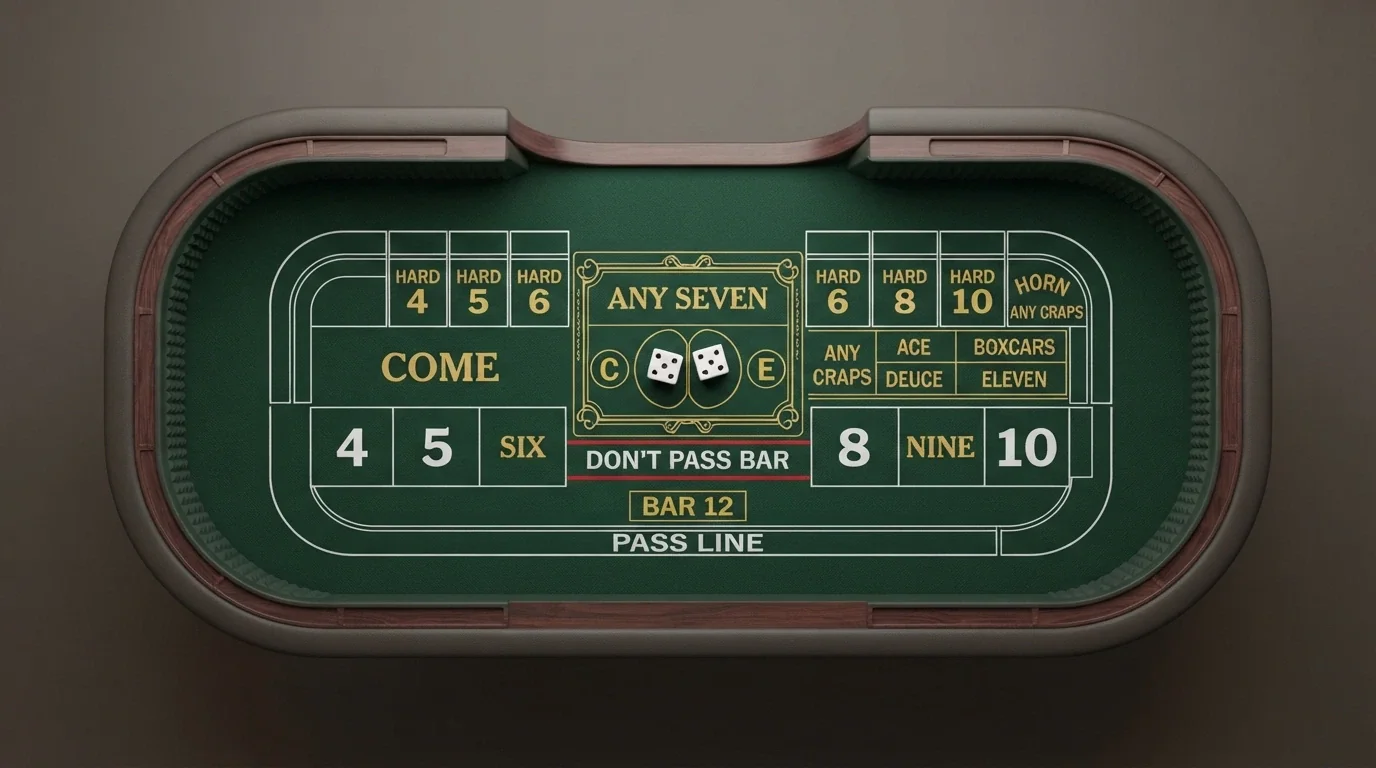
The shooter rolls two dice on the come-out roll. If the dice show 7 or 11, Pass Line bets win. If they show 2, 3 or 12, Pass Line bets lose — the table calls that “crapping out”. Any other number — 4, 5, 6, 8, 9 or 10 — becomes the point. The stickman slides the puck to the point number, and the game shifts from a one-roll event to a race: the shooter keeps rolling until either the point repeats (Pass Line bets win) or a 7 appears first (Pass Line bets lose, the table calls that “seven out”, and the dice pass to the next shooter).
That sequence — come-out, point, seven-out — is the entire game. The Don’t Pass bar runs the same sequence in reverse: it wins on a come-out 2 or 3, loses on 7 or 11, and pushes on 12. Once a point is established, Don’t Pass wins if a 7 shows before the point, and loses if the point shows first. Don’t Pass carries a slightly lower house edge than Pass Line (1.36% vs 1.41%) but is socially marked at a live table — online, that social cost does not exist.
The interface replaces the ritual. An online craps table shows the felt, the chip stack, the dice animation, and a tap-to-place bet control. The maths is identical. The pace is faster — there is no need to wait for the stickman to clear the previous round’s losing bets — and the minimum bet drops to a dollar.
Which craps wagers actually give you the best odds
Five craps wagers carry a house edge under 2%, and one of them carries no house edge at all. The bets below the table — the centre proposition bets — light up the felt because they pay 30:1 on a single roll. They are also the worst bets in any casino.
| Bet Type | Payout | House Edge |
|---|---|---|
| Free Odds (on 6 / 8) | 6:5 | 0% |
| Free Odds (on 5 / 9) | 3:2 | 0% |
| Free Odds (on 4 / 10) | 2:1 | 0% |
| Don’t Pass | 1:1 | 1.36% |
| Pass Line | 1:1 | 1.41% |
| Place 6 / Place 8 | 7:6 | 1.52% |
| Place 5 / Place 9 | 7:5 | 4.00% |
| Place 4 / Place 10 | 9:5 | 6.67% |
| Big 6 / Big 8 | 1:1 | 9.09% |
| Any 7 | 4:1 | 16.67% |
The Free Odds bet is the only wager in any casino game with zero house edge. The catch is that it sits behind the Pass Line or Don’t Pass and cannot be placed on its own — it is the player’s leverage on the original line bet, paid at true mathematical odds. A $10 Pass Line bet with $50 in Free Odds behind it (the standard 5× multiple at most bubble-craps machines) drops the combined house edge to roughly 0.33%.
Place 6 and Place 8 sit at 1.52% — the next-lowest edge after the line bets, and the workhorse repeat bet for a player who wants to skip the come-out roll. Place 5 and Place 9 jump to 4.00%. Place 4 and Place 10 reach 6.67%. The centre proposition bets sit above them all, with Any 7 — a one-roll bet that a 7 appears next — carrying the worst edge in the casino at 16.67%.
Big 6 and Big 8 are the trap. They look like Place 6 and Place 8 (same winning number), but they pay even money instead of 7:6, which gives them a house edge of 9.09% — almost six times the Place-bet equivalent. A player who notices the Big 6 / Big 8 box on the felt should walk past it.
A craps strategy that does not ask you to memorise 40 bets
The only craps strategy a player needs is Pass Line with maximum Free Odds behind it. That combination drops the effective house edge to a fraction of a percent at a 5× odds table and requires no chart, no progression, and no belief in a hot streak.
Three notes on the maths. First, systems and progressive betting do not change the house edge — they change the variance. The expected loss on a session of craps is fixed by the maths; the distribution of wins and losses is what the system moves around. Second, the Come bet works the same way as Pass Line, but it activates on every roll rather than only on the come-out — for a player who wants action after the puck is on, Come with max odds is the same bet as Pass Line with max odds, mathematically. Third, the proposition bets should be treated as a fixed entertainment cost — what a player budgets for the visual of a 30:1 payout hitting once an hour — and never as part of a strategy. At 16.67% on Any 7, the proposition bets are not a system, they are a tax on excitement.
Land-based craps vs online — what changes when the table is a screen
The dice still roll and the odds still hold, but three things shift when craps moves online. Pace is the first. Online rolls resolve faster than a live table because there is no chip-clearing time, no stickman, and no players reloading chips. A 30-minute session online runs through more decisions than a 30-minute session at Crown Melbourne. That pace difference matters because every additional decision costs the player a fraction of a percent of expected value, and the cumulative effect is that an online session burns through more of a bankroll per hour than a comparable live one.
Minimum bets drop. Joe Fortune’s virtual tables open at AU$1, and Playtech’s online craps runs $1 to $300. A land-based craps table minimum sits at $10 or $15 at most Australian casinos, and the proposition-bet minimum is typically a multiple of that. An AU$1 minimum means a craps player can test a strategy with one dollar of real exposure per roll — a proposition that does not exist on a live floor.
Trust moves to a different question. A land-based craps table is its own audit: the dice are visible, the shooter is a person, and any dispute runs through the boxman. An online craps game is either an RNG (the outcome comes from a random-number generator that has been certified by a testing lab) or a live-dealer game (a human or a mechanical launcher produces the outcome in real time, with multiple camera angles and the operator’s certification to back it). Each model has its own audit trail, and the trust equation is different in each. The next section runs through the live-dealer case in detail.
Craps table layouts, the variants that rewrite the odds, and the machines that reshaped the game
The felt layout is a map of risk. The bets closest to the player — the Pass Line, the Don’t Pass bar, the Come boxes — carry the lowest house edge. The bets in the centre of the felt — the proposition bets, the Any 7, the hop bets — carry the highest. Knowing which zone a chip is being placed in is half the game. The other half is knowing which variants rewrite those edges.
The standard craps table — reading the felt before you place a chip
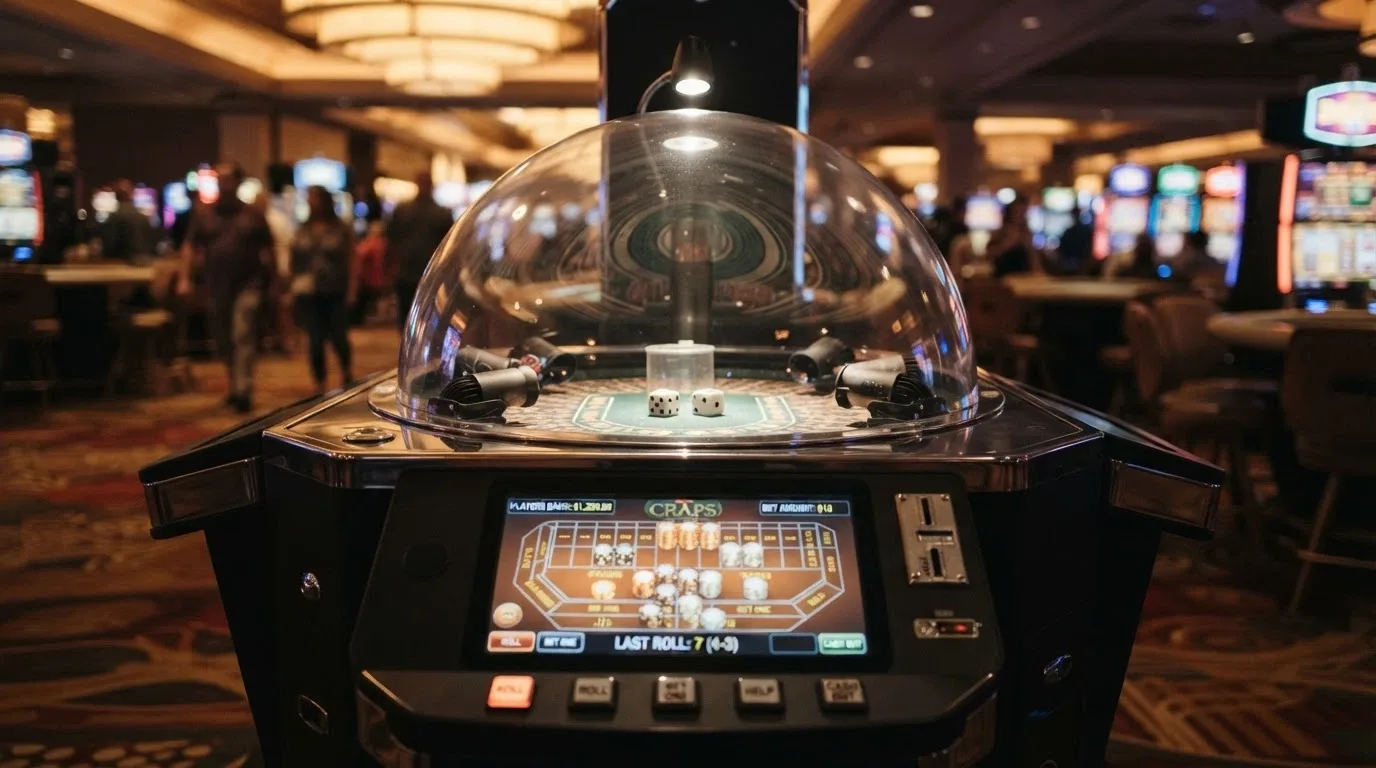
The standard craps table is a long oval felt with two identical halves mirrored across the centre. The stickman stands at the centre, the boxman opposite, and the dealer on either side runs the chips. The Pass Line runs along the bottom edge of each half, with the Don’t Pass bar above it. Above that sits the Come box and the Don’t Come box. The Place-number boxes — 4, 5, 6, 8, 9, 10 — fill the next band up. The centre is the proposition-bet zone: Any 7, the hardways, the horn bets, the hop bets, the Big 6 / Big 8.
The visual hierarchy mirrors the house edge. The Pass Line, at 1.41%, sits where the player’s chips naturally fall. The proposition bets, with edges from 9% to 16.67%, sit where the stickman’s voice pulls attention. A new player who follows the stickman’s calls is being steered toward the worst bets on the felt. A player who reads the layout for themselves is not.
Big 6 and Big 8 deserve a second note because they sit in the Place-bet zone visually but are not Place bets. They pay even money on a 6 or 8, where Place 6 and Place 8 pay 7:6. That payout difference takes the house edge from 1.52% (Place) to 9.09% (Big 6 / Big 8) on the same winning numbers. The boxes are deliberately drawn to look like a discount on the Place bet; they are not.
Crapless Craps — the variant that sounds safer and costs four times as much
Crapless Craps removes the instant-loss on a come-out 2, 3 or 12. In exchange, it lifts the Pass Line house edge from 1.41% to roughly 5.4% — almost four times the cost. The rule change is small. In standard craps, a come-out 2, 3 or 12 is an automatic loss on the Pass Line. In Crapless Craps, those numbers become point numbers — the puck moves to 2, 3, 11 or 12, and the player needs the point to repeat before a 7. Behind the line, the true-odds payoff shifts: a 2 or 12 point pays 6:1, and a 3 or 11 point pays 3:1. Those are accurate odds for a one-roll repeat on a number that just landed — the maths behind the line holds.
The catch is the Pass Line edge itself. Crapless Craps is the variant that reads like a friendly version of the game (no instant loss!) and plays like the most expensive standard craps bet a casino runs. The 5.4% Pass Line edge is higher than every Place bet except Place 4 / Place 10, and well above every bet a player would consider making at a standard table. A player who finds Crapless Craps in an online lobby and assumes it is a friendlier game is being charged four times the standard rate for the privilege.
Bubble craps and electronic craps — the solo machines that changed the minimum bet
Bubble craps replaced the stickman with a vibrating dome and the chip stack with a touchscreen. The dice sit inside a clear plastic bubble; the player taps the screen to place bets; the dome fires the dice; the result lands on the display. The minimum bet drops to a dollar, the 5× odds multiple is standard, and the combined Pass Line + max-odds edge falls to roughly 0.33% — the lowest craps edge available on a real-money game.
Electronic craps runs the same interface without the physical dice — the outcome comes from a certified random-number generator, the roll animation is on-screen, and the audit trail is the RNG certificate rather than a camera angle. Playtech’s craps runs $1 to $300 limits with Low volatility and a 98.95% RTP.
For an Australian player, bubble craps and electronic craps are the route into real-money craps with a bankroll a land-based table would not accept. The $10 to $15 minimum at Crown Melbourne or The Star is not negotiable down to a dollar. An AU$1 minimum at Joe Fortune or a $1 minimum at Playtech-powered rooms is. That accessibility change is the practical reason online craps exists as a market at all — the players who would never approach a live table minimum are exactly the ones the offshore operators built the product to reach.
Live dealer craps vs RNG tables — which one gives you the real game?
Most online craps is RNG. A random-number generator produces the outcome, an animation displays it, and a testing-lab certificate backs the maths. Live-dealer craps is a different product: a real physical outcome, captured by cameras, streamed to the player, with an audit trail that runs through the operator’s live-casino certification rather than an RNG certificate. There is one credible live-dealer craps product in the market.
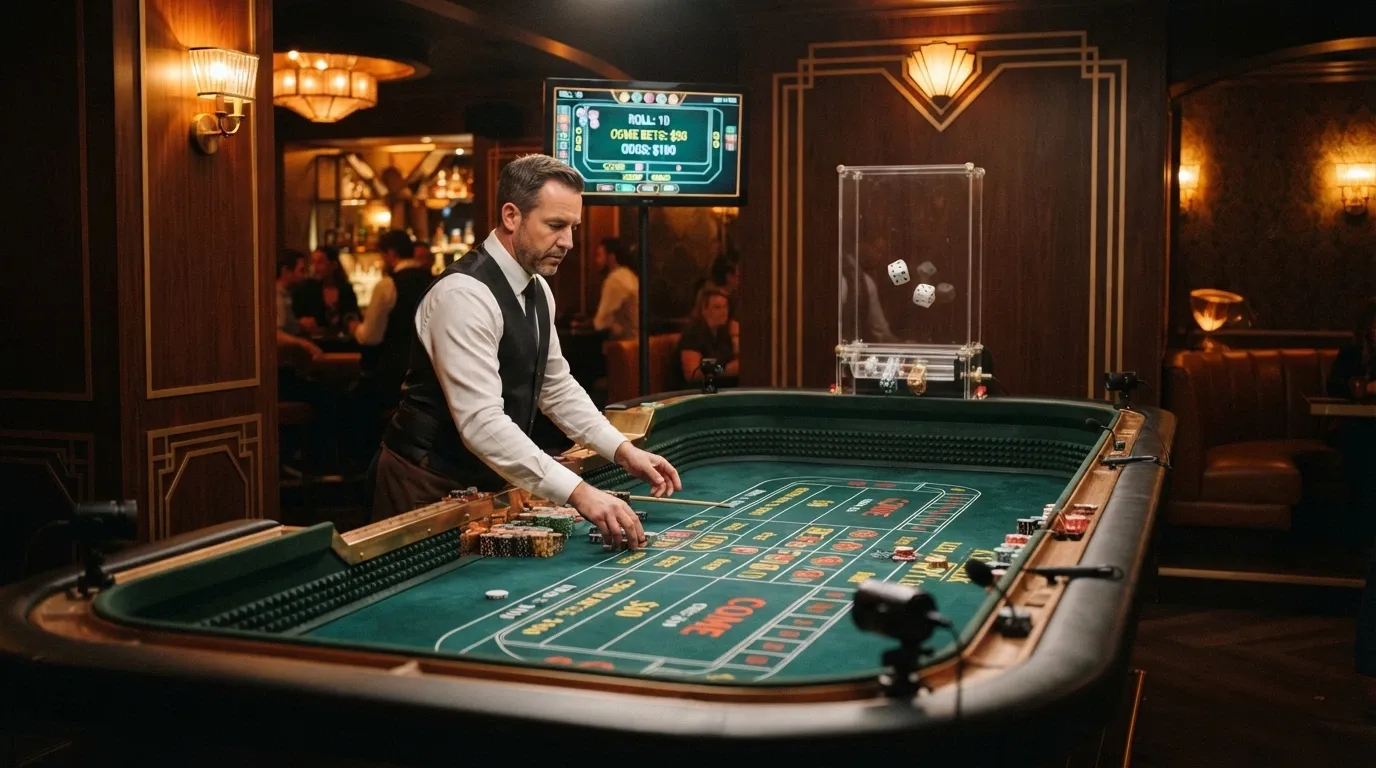
Inside Evolution Craps Live — the RTP, the limits and the 16-point spread in the bet menu
Evolution released Craps Live in 2020, themed as a 1920s speakeasy, with a mechanical dice launcher replacing the human shooter. The mechanical launcher is the product’s centrepiece: dice sit in a clear chamber, the launcher fires them, cameras capture the result from multiple angles, and the bet resolution runs through the same live-casino pipeline that powers Evolution’s blackjack and roulette. There is no human dealer rolling the dice — the trust mechanism is the mechanical launcher and the multi-camera audit trail.
The published numbers tell the player what to expect. Bet limits run from €0.50 to €5,000, with a max payout of 30:1 on certain single-roll bets. Optimal RTP sits at 99.17% — the figure achievable on the lowest-edge wagers, dominated by the Pass Line and the Free Odds. The Pass Line RTP specifically is around 98.59%. The proposition bets fall as low as 83.33%. The volatility classification is Medium, which translates to a session-to-session variance that sits in the middle of Evolution’s live-casino range — bigger swings than baccarat, smaller swings than the bonus-heavy slots.
The 16-percentage-point spread between the best and worst bets on the same table is the practical lesson. Evolution Craps Live returns 99.17% on smart wagers like the Pass Line and Free Odds, but drops to 83.33% on proposition bets. Treating the table as a menu rather than a single product is the only way to avoid the high-margin traps.
Where live craps actually appears in the featured casino set
Four of the ten operators on this page carry Evolution Craps Live. Joe Fortune, King Billy, PlayAmo and Joka all run the Evolution suite. Ricky Casino runs a Pragmatic Play Live craps table alongside its Betsoft and Evolution RNG products. The remaining five — Ignition, BetOnline, Slots.lv, Super Slots, Wild Casino — run RNG-only craps, drawing on Betsoft, Nucleus Gaming, RTG, Rival, Concept Gaming and the operator’s own in-house RNG products.
The distinction matters because the trust and pace profiles differ. Evolution Craps Live’s mechanical dice launcher resolves the trust question for a player who does not want to take an RNG certificate on faith; the pace is closer to a land-based table than to an RNG craps game. RNG craps is faster, cheaper to operate, and easier for the operator to scale across an unlimited number of “tables” — but the outcome is generated by software, and the player’s trust runs through a testing-lab certificate rather than a camera.
For a player choosing between operators on this page, the live-dealer option is the meaningful differentiator. RNG craps is a competent product; live craps is the closer-to-real experience.
Free craps and demo mode — try every strategy before a dollar leaves your pocket
Every featured operator on this page offers a demo-mode craps table. None of them offers a no-deposit craps bonus. The two products are not the same — demo mode gives a player a virtual balance that resets and carries no wagering requirement, while a no-deposit bonus gives a player real-money play with a small bankroll and a wagering multiplier on any winnings. The featured set is entirely demo-mode.
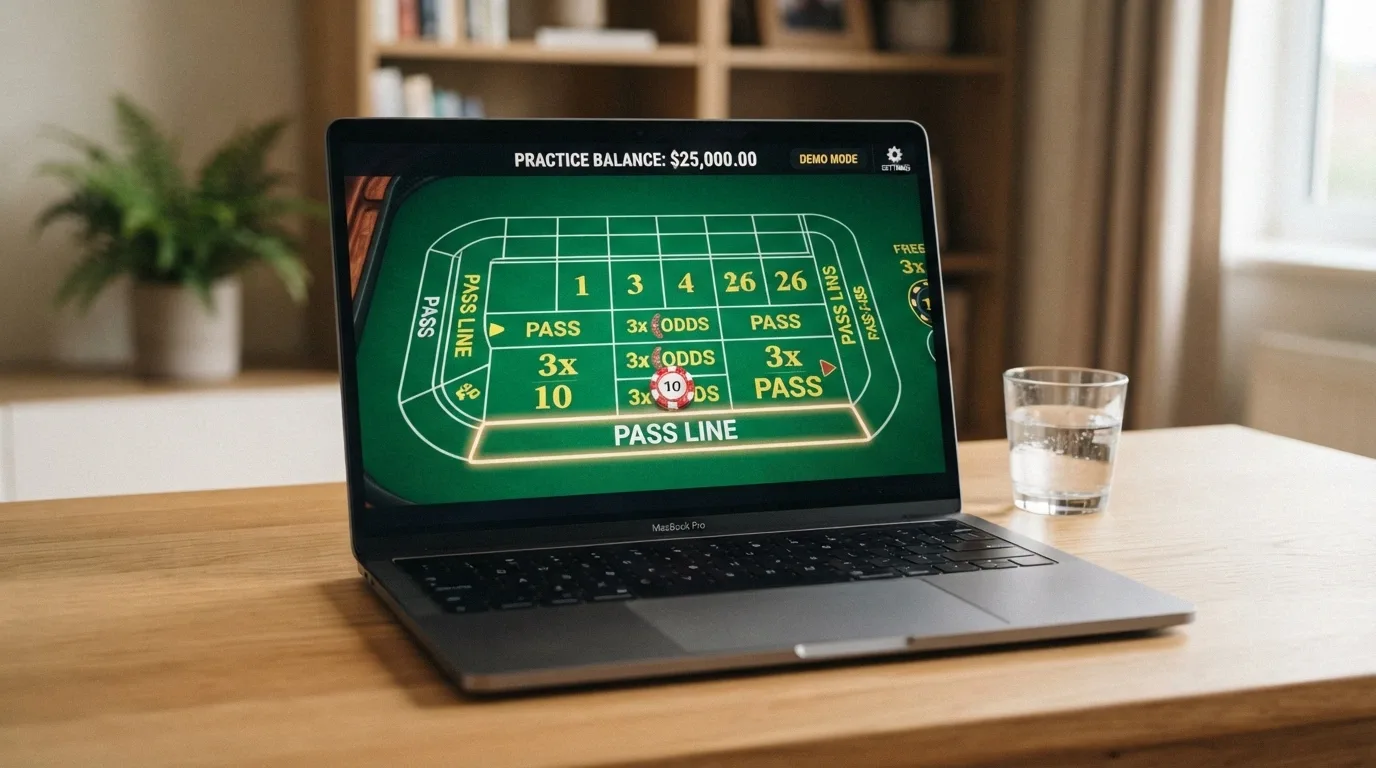
How to use free craps as a rehearsal room, not a predictor
Demo-mode craps is useful for exactly three things and useless for everything else. It is useful for learning the interface — the chip-stack controls, the bet-placement rhythm, the undo button when a chip lands in the wrong box. It is useful for timing how fast an online craps round resolves — the difference between a 12-second live-dealer roll and a 4-second RNG roll is the difference between an hour-long session and a four-hour-long session at the same bankroll. And it is useful for stress-testing a strategy at a virtual bankroll — sitting down with AU$100 of demo money and a Pass Line + max odds plan to see how long that bankroll lasts against the 0.33% combined edge.
Demo mode is not useful for predicting how a real-money session will feel. Demo wins feel like wins and demo losses feel irrelevant; both reactions are wrong. A real-money craps session has a different psychological texture, and the only honest rehearsal for that texture is real money at the lowest minimum the operator accepts. AU$1 minimums exist for this reason.
The other gap demo mode cannot close is the withdrawal friction. A demo-mode craps table does not ask for identity documents, does not impose payout windows, and does not decline a withdrawal on a discretionary review. The offshore craps player who has never seen a payout request rejected in real time has not finished rehearsing for the offshore craps experience. The demo teaches the table; the first deposit teaches the operator.
Why your craps bonus is smaller than the headline number
The headline is the easiest part of an online craps bonus to read and the hardest part to clear. A 200% match up to AU$1,000 looks like a AU$1,000 gift. By the time the craps player works through the wagering requirement, it is something closer to a long shift at a table where the house keeps a larger cut than the player expected.
The mechanism is the craps bonus contribution rate. Most online casinos pay 100% on slots, 10% to 25% on table games like blackjack and roulette, and roughly 5% on craps. The rate is set by the operator to reflect the fact that craps is a low-margin game for the house — the 1.41% Pass Line edge is one of the better deals a casino offers, and the operator cannot afford to credit craps wagers at the same rate as slots wagers without losing the maths that pays for the bonus in the first place.
The effect of a 5% contribution rate on a 30× wagering requirement is the lesson that matters. At Joe Fortune — the only operator in the featured set that publishes a contribution percentage — a player taking the maximum AU$1,000 bonus faces a base wagering requirement of AU$1,000 multiplied by 30, or AU$30,000 in contribution terms. But because craps only contributes 5%, every AU$1 the player wagers on craps only earns AU$0.05 toward that AU$30,000. The effective turnover the player must run through the craps table is AU$30,000 divided by 0.05, or AU$600,000. At Joe Fortune’s AU$1 minimum on virtual tables, that is 600,000 individual rolls. At roughly five seconds per roll, the time to clear the bonus — assuming the player plays nothing but craps at the minimum — sits at around 833 hours of play. The expected loss on that turnover at the Pass Line’s 1.41% house edge is AU$8,460 — more than eight times the headline value of the bonus.
This is the maths that converts a “200% welcome offer” into a working session at the craps table. The same arithmetic, run on a 50× wagering requirement at 7-day validity, produces numbers that are reachable only by a player with a stack of slots play to mix in. Craps players who clear their welcome bonus alone on a low-contribution rate are not clearing the bonus — they are paying for it.
The bonus types that actually work for a craps player are the ones whose terms do not depend on the craps contribution rate to make the offer reachable. A reload bonus with a 30-day validity and a low multiplier is workable if the player is willing to mix in slots play to satisfy the contribution mix. A short-window, high-multiplier welcome bonus is not, and the 3-day validity at Ricky Casino or the 7-day windows at PlayAmo and Joka fall into that bracket by design — they are slots-priced bonuses that the craps player cannot realistically clear alone.
Why no Australian casino can legally offer you online craps — and where that leaves the player
The Interactive Gambling Act 2001 makes it an offence to provide an online casino game — including craps — to a person in Australia. There is no state or territory licence for online casino. There is no federal carve-out. Every site on this page operates outside Australian law.
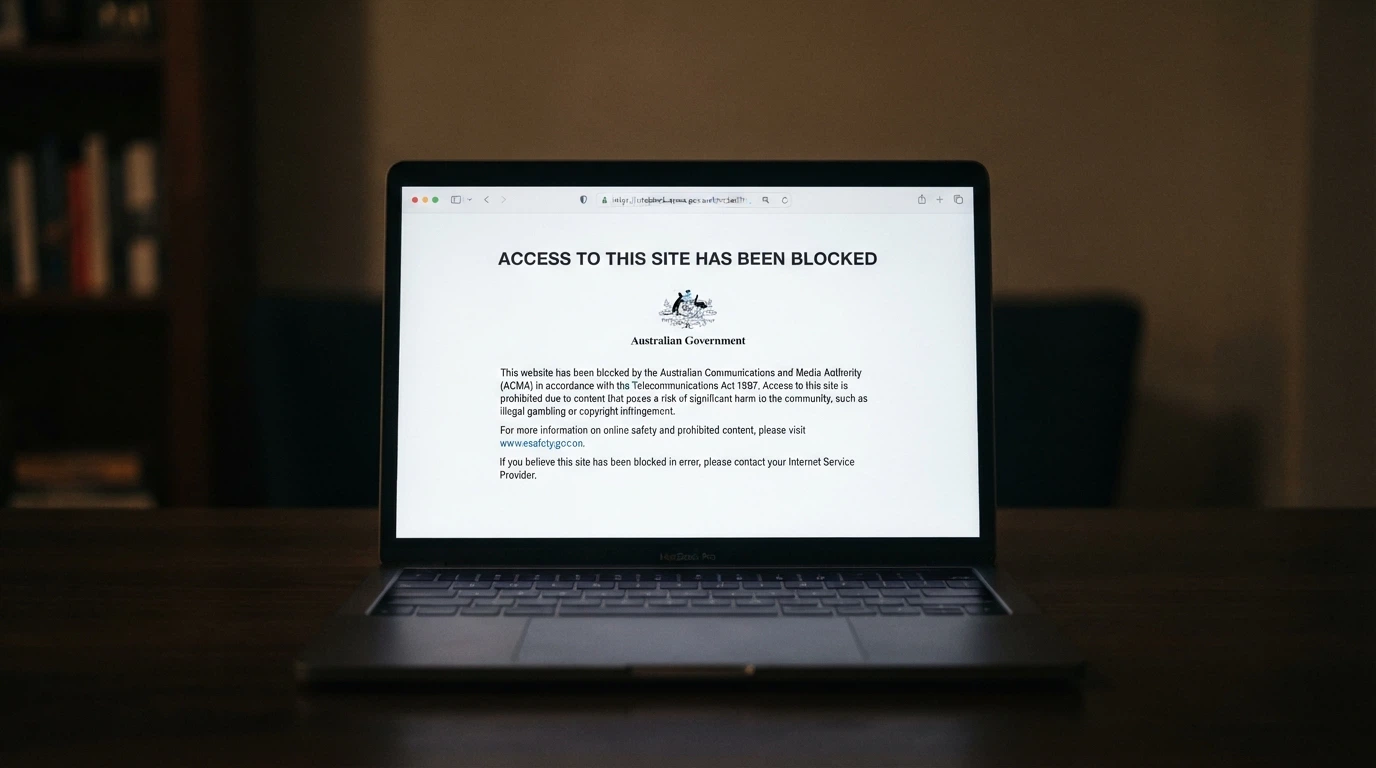
The Australian Communications and Media Authority enforces the prohibition. ACMA investigates complaints, issues formal warnings, refers operators for civil penalty proceedings, and directs Australian ISPs to block illegal sites. Since its first blocking request in November 2019, ACMA has had 1,564 illegal gambling and affiliate websites blocked, and more than 225 illegal services have withdrawn from the Australian market since the 2017 amendment strengthened the regulator’s hand. Today’s craps site may be gone tomorrow; the only protection against that disappearance is the operator’s own continuity.
The individual player’s position is different from the operator’s. The IGA targets the provider, not the consumer — no Australian is prosecuted for playing online craps. What the player gives up by going offshore is the entire Australian consumer-law backstop: no Australian Financial Complaints Authority recourse, no ACMA complaint channel to recover a stuck withdrawal, no BetStop coverage (the offshore casino is not connected to the register and is not obliged to honour an exclusion), and no guarantee that a withdrawal will be honoured at all. The site can be blocked at any time with a balance on it.
What the 2026 gambling reform changes for Australian craps players
The Interactive Gambling Amendment (Gambling Reform) Bill 2026 was introduced on 2 July 2026 and passed Parliament on 19 August 2026; its measures commence on 1 January 2027. The reform does not legalise online casino. It tightens the perimeter around the prohibition.
Three changes matter for a player running craps through an offshore site. The first is the bank-blocking power: from 1 January 2027, banks and payment providers gain express authority to block transactions to illegal gambling operators. A PayID or POLi deposit to a Curaçao casino that has been on ACMA’s radar may be declined by the player’s own bank. The second is the advertising cap: broadcast wagering advertising is limited to three ads per hour between 6:00 am and 8:30 pm, with a live-sport blackout from 15 minutes before to 5 minutes after a live event. The third is the inducement restriction: from 1 January 2027, direct marketing of inducements is prohibited for 14 days after a customer signs up, for three months after a person deregisters from BetStop, and indefinitely for customers identified as at risk.
None of this changes the legal status of online craps in Australia. The product remains prohibited; the reform expands the enforcement perimeter, not the legal product. For the offshore craps player, the practical effect is a smaller deposit surface, fewer promotional nudges, and a higher chance that a transaction is refused at the banking layer.
Tax, winnings and the Australian player — what the ATO actually says
Australian gambling winnings are not assessable income under section 6-5 of the ITAA 1997, and gambling losses are not deductible under section 8-1. A recreational craps player who deposits at an offshore casino, plays, wins or loses, and withdraws what is left reports nothing to the ATO. The offshore status of the operator does not change that tax position.
The exception is the player who is carrying on a business of betting — a professional craps player whose activity meets the ATO’s indicators of a business (regularity, scale, profit motive, repetition). That player is taxed on net profits as ordinary income, and can claim deductions for losses against that income. A recreational player does not trip that test.
The licensed Australian wagering market sits behind the player, not around them. The Northern Territory Racing and Wagering Commission licences online wagering through Licensing NT at a 5% wagering tax plus a 0.05% racing levy. States set their own point-of-consumption tax at 10% to 15% of net wagering revenue. The wagering product is sports and racing, not casino — and no Australian jurisdiction taxes, licences, or otherwise legitimises online casino. The tax layer is a reminder that the legal product the player is not using is taxed; the illegal product the player is using is not.
Playing smart — the tools, limits and help every Australian craps player should know
Offshore craps sits outside every Australian consumer protection. The self-exclusion register does not reach it. The helpline does. The data says roughly 430,000 Australians needed that helpline last year.
BetStop — the National Self-Exclusion Register — has recorded 67,480 registrations since going live in August 2023, of which 41,290 exclusions were still active as at 31 July 2026. Seventy-eight per cent of registrants were under 40, and 38% chose lifetime exclusion. BetStop binds Australian-licensed wagering services only — an offshore casino is not connected to the register and is not obliged to honour an exclusion. A player who has registered with BetStop and then opens a Curaçao account is functionally still playing.
The prevalence context is the wider frame. About 2.1% of Australian adults — roughly 430,000 people — experience problem gambling, with high-risk gambling at 1.8% (AIHW, 2022). The number is the reason the support infrastructure exists, and the number is also the reason an offshore craps player should know it is there before a session goes wrong.
Self-exclusion that stops at the border — what BetStop can and cannot do
BetStop works exactly as advertised for Australian-licensed wagering. A registration is processed within minutes; every Australian-licensed sportsbook and racing book is required to honour it; deposits are blocked, marketing is suppressed, and account reinstatement is time-locked for the duration of the exclusion. For a player whose gambling is contained to the licensed market, BetStop is a strong intervention.
For a player whose craps play runs through offshore operators, BetStop is invisible. The Curaçao and Panama casinos that dominate the AU-facing offshore market have no integration with BetStop, no obligation to check it, and no incentive to honour a self-exclusion from a register they are not connected to. A player who has registered with BetStop and continues to play at offshore craps sites has not self-excluded from craps — they have self-excluded from wagering, which is not the product they were playing.
The alternative tools a player can use are jurisdiction-proof. Deposit caps set inside the offshore casino account are honoured by the operator (because the operator wants the player to manage the bankroll they have, not the bankroll they do not). Session timers close the table after a configured interval. Reality checks display the player’s session length and net position at fixed intervals. The payment-method friction strategy — using a banking rail with its own daily cap rather than a crypto wallet with no ceiling — is the most powerful self-imposed limit available, because it sits at the deposit surface where no operator override can reach it.
The deposit and time-limit tools that work regardless of jurisdiction
- Deposit caps set inside the offshore account are operator-honoured and player-controlled. A weekly cap of AU$200 is a different game from a weekly cap of AU$2,000.
- Session timers shut the table at a fixed interval and force a cool-down before the player can resume.
- Reality checks display session length and net position at fixed intervals, breaking the immersion long enough for the player to make a deliberate decision.
- Banking-rail friction — using PayID with a daily transfer cap rather than a crypto wallet with no ceiling — is the strongest self-imposed limit because it sits before the deposit.
The tool that works after every other tool has failed is the helpline. The National Gambling Helpline on 1800 858 858 is free, confidential and staffed 24 hours a day, every day of the year. Gambling Help Online offers free 24/7 chat and email counselling. Both are accessible from anywhere in Australia, regardless of where the gambling happens, and both are funded to stay that way.
How we selected and ranked the best craps casinos for Australian players
The ten operators on this page were filtered against the same four tests set out at the start: AUD banking support, licence jurisdiction, craps-specific game count and provider quality, and bonus terms that do not lock a craps player out of their own offer. Operators that failed any one of those tests were excluded.
Licence claims were verified against three registers. The Curaçao eGaming register covers seven of the featured operators; the Kahnawake Gaming Commission register covers one; the Panama Gaming Control Board register covers two. Each register was checked for active licence status at the time of writing. The ACMA prohibited-services list was used to confirm that every operator on the list is, in fact, offshore — no .au-licensed casino was considered for inclusion because no such licence exists for online casino games.
AUD banking was verified through each operator’s published deposit and withdrawal pages. Operators that did not list PayID, POLi, Osko, BPAY or a comparable AUD-native rail were excluded. Bonus terms were cross-checked against each operator’s published bonus pages at the time of writing; the wagering multiples, validity windows and craps contribution rates stated in the operator write-ups above reflect those pages as published.
What this ranking does not do is invent a numeric scoring system. There is no weighted score, no proprietary rating algorithm, and no third-party badge the operators have not earned themselves. The order is editorial — the operators at the top of the list are the ones that best combine licence credibility, craps depth, AUD banking and bonus terms a craps player can work through. The order is not a guarantee, and the comparison table above is the primary reference.
Is online craps worth it for an Australian player in 2026?
The game itself has not changed. The Pass Line still pays even money at a 1.41% house edge, the Free Odds still cost nothing, and the dice still have no memory. The Free Odds bet works the same in Curaçao as it does at Crown Melbourne, and the maths is identical. The proposition bets are still a tax on excitement, and the best strategy is still Pass Line with maximum odds behind it.
The wrapper around the game has changed. An Australian playing online craps in 2026 is playing outside Australian law, without Australian consumer protection, without BetStop coverage, without a guaranteed withdrawal, and with a deposit surface that the 2026 reform will tighten from 1 January 2027. The offshore casino the player opens an account with can be blocked by ACMA at any time, with a balance on the account. The bank the player uses can be directed to refuse the next deposit from 1 January 2027.
Online craps is worth playing for an Australian who can price that risk correctly. The player who checks the licence register, deposits via PayID with a daily transfer cap, treats the welcome bonus as a slots offer with craps attached, sets a deposit cap and a session timer inside the operator account, and treats the Free Odds bet as the only wager that matters — that player is getting the craps maths at a price the operator cannot beat, with a risk profile the player has priced themselves.
Online craps is not worth playing for an Australian who treats the offshore operator as an Australian one, who expects a withdrawal dispute to be resolved by an Australian regulator, who reads the welcome bonus as a free AU$1,000, or who has registered with BetStop and assumes the exclusion covers the offshore casino. The game is the same; the player-side context is not.
Frequently asked questions
What are the best bets in craps for a beginner who has never placed a chip?
Pass Line and Don’t Pass, with the Free Odds bet behind them, are the three wagers a beginner needs to know. Place 6 and Place 8 are the only other bets worth learning. Everything else on the felt carries a higher house edge, and the centre proposition bets carry the highest.
Can I play craps for real money on my phone in Australia?
Yes. Every operator in the featured set runs HTML5 mobile craps that loads in a phone browser, with AUD deposits via PayID or POLi and the same minimums as the desktop client. The offshore status of the operator does not change.
What is the house edge on a Pass Line bet in craps?
The Pass Line carries a house edge of 1.41%. The Don’t Pass runs slightly lower at 1.36%, and the Free Odds bet behind either line carries 0% house edge — the only wager in any casino game with no house edge.
How do craps bonuses work and what does the wagering contribution mean for a craps player?
A welcome bonus is a match on the player’s deposit, with a wagering multiplier that determines how much the player must wager before withdrawing the bonus. The craps contribution rate — typically 5% — determines what fraction of craps wagers count toward that requirement.
What payment methods can I use to deposit at an online craps casino in Australia?
PayID and POLi are the AUD-native workhorses. Osko and BPAY are slower. Crypto works at most offshore operators, but Australia has banned crypto as a payment for online wagering, so an AU player using crypto with an offshore site is outside the payment-safety net.
What is the RTP of Evolution Craps Live?
The optimal RTP on Evolution Craps Live is 99.17%, achieved on the lowest-edge wagers. The Pass Line specifically runs at about 98.59%. Proposition bets fall as low as 83.33%, giving the table a 16-percentage-point spread between best and worst wagers.
Created by the ”Online Pokies Real Money” editorial team.