
Anonymous Crypto Casinos in Australia: What Offshore Actually Means in 2026
 Available in AU
Online casino is prohibited in Australia under the Interactive Gambling Act 2001. There is no licence for online casino games anywhere in the country — not federally, not in any state or territory. Every operator on this page is offshore. None holds an Australian licence. None can. That is the shape of the market before any of it gets interesting, and it is the frame this guide sits inside from start to finish.
Australians who want to play real-money casino games online reach one of two destinations: a land-based venue like Crown or The Star, or an offshore platform licensed in Curaçao, Anjouan or somewhere else outside Australian jurisdiction. The ten operators below are the second destination. They are the brands Australians actually use when they go looking for crypto-funded play without handing over a passport scan at the door.
What follows is an honest accounting. Which operators are credible, which bonuses are worth taking, which ones quietly drain through wagering requirements and cashout caps, what the Interactive Gambling Act actually says about the player, what it does not say, and what changes on 1 January 2027 that will reshape this space.
Data current as of 18 October 2026; licence claims verified against the Curaçao Gaming Control Board and Anjouan public registers.
Table of Contents
- What Makes a Crypto Casino “Anonymous” in Australia
- The 10 Anonymous Crypto Casinos Australians Actually Use in 2026
- Anonymous Crypto Casino: What You’re Really Playing With in 2026
- Why Your 2026 Anonymous Casino Bonus Is Smaller Than It Looks
- The Legal Reality for Australian Players in 2026
- Getting Your Money Out: Crypto Withdrawals at Anonymous Casinos
- Why You Won’t Find an Anonymous Casino App in the App Store
- New Anonymous Casinos: Fresh Faces, Same Offshore Rules
- The Pokies and Games You Can Actually Play at Anonymous Casinos
- How We Selected and Ranked These Anonymous Casinos
- What Australian Players Should Actually Do in 2026
- Frequently Asked Questions
What Makes a Crypto Casino “Anonymous” in Australia
“Anonymous” is the marketing word. The reality is more constrained. An anonymous crypto casino in Australia, as the term is used in 2026, means a casino that does not ask for identity documents at signup, accepts deposits directly from a crypto wallet, and operates outside the Australian Transaction Reports and Analysis Centre (AUSTRAC) framework that binds locally licensed operators.
What it does not mean is total invisibility. The cryptocurrency transfer is recorded on a public blockchain — visible to anyone with the wallet address. The casino’s own anti-money-laundering policy still triggers KYC review once cumulative withdrawals or deposits climb into the EUR 2,000–10,000 range. The “anonymity” is between the player and the operator’s customer database, not between the player and the network.
That distinction matters. Privacy — keeping your name off a casino’s records — is what these sites actually deliver. Anonymity — moving funds without any trace at all — is not what crypto delivers. The blockchain is a ledger, not a vanishing act, and the operators are offshore by definition. They are not licensed by an Australian authority (no such authority issues online casino licences), they are not subject to AUSTRAC’s anti-money laundering obligations, and they sit outside Australian Consumer Law protections.
Email-Only Signup and the No-KYC Model
The signup flow at these casinos is genuinely frictionless. A player lands on the site, enters an email address, sets a password, and is in. Some skip even the email step and ask only for a username. No passport, no driver’s licence, no utility bill, no selfie with today’s newspaper.
The mechanism that makes this possible is the payment rail, not the registration form. Crypto settles wallet-to-wallet; no bank in the middle means no name on the transaction by default. The casino sees a deposit from address X, credits a balance to account Y, and the only identifier on the books is the player’s chosen username.
That hold lasts until the casino’s internal AML triggers kick in. Across the Curaçao- and Anjouan-licensed cohort, the typical KYC review threshold sits between EUR 2,000 and EUR 10,000 in cumulative withdrawals or deposits. A player who keeps withdrawals under EUR 2,000 will often never see a document request. A player who hits a large win crosses that line, and the casino will demand ID before releasing the funds.
Privacy versus anonymity, then, is the practical distinction. The signup is private. The transaction is pseudonymous on-chain. The withdrawal at scale is neither — it requires the same kind of ID a licensed AU operator would have asked for in the first place.
Real-Money Play Without Handing Over Your ID
Real-money play at these casinos looks like this: the player deposits from a self-custody wallet (or an exchange-hosted wallet), the casino credits the balance in either crypto or a converted AUD/USD amount, and the games run on standard server-based RNGs — the same engines Pragmatic Play, Evolution, BGaming and Hacksaw Gaming ship to every licensed operator in the world.
Where it differs from a Crown Melbourne table is in what the operator knows. No name, no address, no date of birth, no document trail at signup. The casino has a username and a wallet address. That is the entire identity layer until the KYC threshold arrives.
When the threshold does arrive — usually at the first withdrawal attempt past EUR 2,000 — the player is asked for ID, proof of address, and sometimes source-of-funds documentation. Refusal at that point means the withdrawal is held. Some operators confiscate the balance after a defined period; others freeze it indefinitely. None of them will pay out to a large winner who refuses to identify themselves. That is not a quirk of the offshore model; it is the bare minimum an AML policy requires, and the licence jurisdictions require an AML policy.
For Australian tax purposes, gambling winnings at these operators are not assessable income under section 6-5 of the ITAA 1997, and losses are not deductible. The Australian Taxation Office treats recreational gambling as a personal pursuit, not a revenue stream, and the offshore status of the operator does not change that characterisation. What an Australian punter wins at an anonymous Curaçao casino is, for ATO purposes, the same as what they would win at the TAB.
The 10 Anonymous Crypto Casinos Australians Actually Use in 2026
What follows is a comparison of the ten offshore operators Australians reach most often. Every one is licensed outside Australia; none can hold an Australian online casino licence because the licence does not exist. The ranking reflects overall strength for an Australian crypto player — game library, withdrawal speed, bonus transparency and track record — not legal standing, which is identical across the set.

| Operator | AU legal status | Welcome bonus | Wagering | Free spins | Standout feature |
|---|---|---|---|---|---|
| Stake | Offshore (no AU licence) | 200% up to $2,000 + 5% rakeback | 40x | None | Crypto-only, 100% deposit turnover before withdrawal |
| BitStarz | Offshore (no AU licence) | Up to 5 BTC + 180 FS across 4 deposits | 40x (bonus + FS) | 180 FS | AUD + crypto, 14 provably fair Originals |
| 7Bit Casino | Offshore (no AU licence) | Up to A$600 + 250 FS across 4 deposits | 35x | 250 FS (A$100 cashout cap) | AUD + crypto, lowest wagering on a non-Bitcoin-heavy bonus |
| SkyCrown | Offshore (no AU licence) | 100% up to A$500 + 50 FS; 50% reload to A$500 | 30x | 50 FS | 30x wagering — lightest in set, Evolution-heavy live lobby |
| BC.Game | Offshore (no AU licence) | $4,000 + 400 FS | 40x | 400 FS ($10 max withdrawal per batch) | 8,000+ games, 75 Originals, Anjouan licence |
| RocketPlay | Offshore (no AU licence) | Curaçao GCB OGL/2024/1307/0748 | Not stated | Not stated | Curaçao licensed |
| Cloudbet | Offshore (no AU licence) | 100% up to $2,500 + 100 FS | 40x | 100 FS | Sportsbook + casino, 60-day bonus window |
| mBit | Offshore (no AU licence) | Up to 4 BTC + 300 FS across 3 deposits | 40x | 300 FS | Bitcoin-native welcome stack |
| Ignition | Offshore (no AU licence) | 300% up to $3,000 (crypto deposit) | 25x | None | Lowest wagering in set, crypto + poker crossover |
| Lucky Block | Offshore (no AU licence) | 200% up to A$10,000 + 50 FS | 35x | 50 FS | A$1 minimum deposit, sportsbook attached |
Three things stand out across the table. First, the wagering cluster is tight — most operators sit between 30x and 40x, and only Ignition breaks the band at 25x. Second, the AUD denomination is the exception, not the rule: 7Bit, SkyCrown and Lucky Block price their bonuses in Australian dollars; the rest price them in BTC or USD. Third, free spins count varies by an order of magnitude — none at Stake and Ignition, 400 at BC.Game — and the cashout caps attached to those spins matter far more than the headline number suggests.
The em-dash cells at RocketPlay are honest gaps. The operator is registered with the Curaçao Gaming Control Board, but its current bonus terms were not surfaced in this round of verification. Punters drawn to the brand should check the live terms page before depositing, because an unknown wagering requirement is the most expensive unknown in this market.
Stake
Stake operates under Curaçao eGaming licence 8048/JAZ, launched in 2017, and is the brand Australians name first when crypto gambling comes up. It is crypto-only — no AUD balance, no card deposit, no bank transfer. The welcome offer is a 200% match up to $2,000 plus a 5% rakeback on house-edge games, which is unusual in the set and is one of the more honest bonus structures around. Wagering on the bonus portion runs at 40x.
The withdrawal mechanics are fast where it counts. Bitcoin clears in 8–15 minutes during testing; Litecoin lands in under five minutes; Ethereum settles in 3–8 minutes depending on network congestion. That speed is the strongest part of the Stake offer.
There is one rule a player must internalise before depositing. Stake requires 100% of every deposit to be wagered before any withdrawal is processed. That is not the same as a 40x wagering requirement on a bonus — it applies to the deposit itself, regardless of whether a bonus was claimed. It is the most common cause of payout problems reported at the brand. A punter who deposits $500, plays twenty spins and asks to withdraw $480 is not getting the $480 out until the full $500 has been turned over.
The verdict: best for the crypto-native punter who values withdrawal speed and lives entirely in Bitcoin, Litecoin or Ethereum — and who will actually turn the deposit over before cashing out.
BitStarz
BitStarz launched in 2014 and runs under Curaçao Gaming Authority licence OGL/2024/165/0185 through Gareton B.V., a long-running Curaçao entity based in Willemstad. The catalogue runs to 6,000+ titles from 69 studios, including Pragmatic Play (588 titles alone), BGaming, Booming Games, Playtech, Endorphina, Betsoft, Evoplay and Hacksaw Gaming. On top of that, BitStarz builds 14 of its own provably fair Originals — a meaningful differentiator in a market where the studio list is mostly the same across operators.
The welcome package is the headline. Up to 5 BTC plus 180 free spins across the first four deposits; 40x wagering on both the bonus and the free-spin winnings; a $5 maximum bet during wagering; seven days to use the welcome bonus and one day for the free spins; minimum qualifying deposit $20. BitStarz is also one of the few operators in this list that accepts AUD directly alongside crypto.
5 BTC sounds substantial. What the player actually gets is six days to clear the bonus on a $5 max bet, with free-spin winnings locked behind a separate 40x playthrough.
Verdict: the strongest pick in the set for a punter who wants a deep catalogue, provably fair Originals, and the option to deposit in AUD rather than convert to crypto first.
7Bit Casino
7Bit has operated since 2014 under Dama N.V., with Curaçao Gaming Control Board licence OGL/2023/174/0082 and the SoftSwiss platform underneath. The catalogue runs to 7,000+ titles from NetEnt, Microgaming, Pragmatic Play, Evolution, BGaming, Play’n GO, Endorphina and Betsoft — a broader spread than most of the set, and the source of 7Bit’s reputation as a pokies-heavy lobby.
The welcome package is up to A$600 plus 250 free spins across four deposits (first deposit 100% + 100 FS, second 75% + 100 FS, third 50% match, fourth 100% + 50 FS). Wagering runs at 35x — the lightest in the set among non-Bitcoin-heavy bonuses — with a A$1.50 maximum bet during wagering and an A$100 maximum cashout from free spin winnings. The A$100 cap on free-spin winnings is the number to fix on, because 250 free spins at A$0.10–A$0.20 per spin can produce several hundred dollars in gross winnings before the cap enters the room.
7Bit accepts AUD directly alongside crypto, which makes it the simplest operator in the set for a player who wants to think in dollars rather than satoshis.
Verdict: the AUD denomination and the 35x wagering make 7Bit the easiest operator in this list for a small bankroll to clear without bonus terms quietly eating the winnings.
SkyCrown
SkyCrown sits in the set with a strong live-dealer lobby and an unusually light wagering requirement. The welcome package runs 100% up to A$500 plus 50 free spins on the first deposit, with a 50% reload up to A$500 on the second. Wagering is 30x on the bonus amount, the lightest in the entire ten-operator comparison. Minimum deposit A$20.
The withdrawal mechanics are tight where they need to be tight and loose where the operator wants them loose. A$30 minimum deposit; A$6,000–A$7,500 maximum per transaction; A$5,000 daily, A$10,000 weekly and A$15,000 monthly withdrawal caps. SkyCrown advertises an average crypto withdrawal of around ten minutes; realistic test figures for verified accounts run under an hour.
The licence has not been independently confirmed in this round of verification. The brand is well-known in the offshore market, but the specific licence holder and number were not surfaced from non-affiliate sources. Punters drawn to SkyCrown should treat the 30x wagering as the headline advantage and the licence uncertainty as the cost.
Verdict: worth a look for live-dealer fans chasing the lightest wagering requirement in the set, but the unconfirmed licence means the punter accepts more identification risk than at a registered Curaçao brand.
BC.Game
BC.Game has been around since 2017 and migrated from Curaçao to Anjouan (Comoros) in December 2025. The catalogue runs to 8,000+ games from 38+ providers — Pragmatic Play, Evolution, Hacksaw Gaming, PG Soft, Big Time Gaming, Red Tiger, Yggdrasil and NetEnt among them — plus 75 of BC.Game’s own Originals, the largest provably fair suite in the set. The platform accepts 150+ cryptocurrencies.
The welcome package is the biggest number on this page: $4,000 plus 400 free spins, with 40x wagering on deposit plus bonus and 40x on free-spin winnings. Free spin winnings carry a $10 maximum withdrawal cap per batch, which is the number to lock on before imagining what 400 spins at premium slot volatility might be worth. Bonus validity runs 30 days.
75 Originals, 150+ coins, 8,000 games. The catalogue is the largest in the set, and the most to verify.
Verdict: a strong pick for a punter who wants the deepest lobby in the cohort and is comfortable with Anjouan-licence oversight. The $10 per-batch cap on free spin winnings is the constraint to plan around.
RocketPlay
RocketPlay runs under Curaçao Gaming Control Board licence OGL/2024/1307/0748 through Scores55 Tech B.V. The welcome offer, wagering requirements, free spin counts and other bonus terms were not surfaced in this round of verification.
Verdict: registered and Curaçao-licensed, but the bonus terms have not been independently confirmed — punters who want to know what they are claiming should check the live terms page before depositing.
Cloudbet
Cloudbet has run since 2014 under Curaçao licence 8048/JAZ and operates as a sportsbook-casino hybrid, which is the meaningful differentiator in the set. The casino catalogue runs to 3,000+ titles across slots, live dealer and the sportsbook product underneath.
The welcome bonus is 100% up to $2,500 plus 100 free spins; 40x wagering on the bonus amount; seven days to use the free spins and a 60-day window for the bonus itself — the longest bonus validity in the set. Minimum deposit $20.
The 60-day bonus window is the standout number. Most operators in the set give the player seven days to clear the wagering; Cloudbet gives them almost two months, which is meaningful for a punter who plays smaller sessions across a longer horizon rather than marathon weekends.
Verdict: the natural pick for a punter who wants to bet on a Saturday afternoon sport and play pokies the same evening, with a bonus window long enough that neither product has to be rushed.
mBit
mBit runs under Curaçao licence 8048/JAZ and lists 5,000+ casino games — NetEnt, Microgaming, Pragmatic Play, Evolution, BGaming, Betsoft, Play’n GO and Endorphina among the providers. The welcome package stacks across three deposits: 100% up to 1 BTC plus 100 free spins on the first, 100% up to 1.5 BTC plus 100 FS on the second, 125% up to 1.5 BTC plus 100 FS on the third — 4 BTC plus 300 free spins in total.
Wagering runs at 40x, with a seven-day validity window, a A$5 maximum bet during wagering, and a A$30 USDT minimum deposit. mBit is a Bitcoin-native welcome — there is no AUD denomination on the headline offer.
4 BTC across three deposits is the heaviest welcome for a Bitcoin-only stack in this set.
Verdict: best for a punter who lives in Bitcoin and wants the welcome spread across three deposits rather than concentrated in one.
Ignition
Ignition runs as a casino plus poker room crossover, which is rare in the offshore crypto set. The headline offer is a 300% match up to $3,000 on crypto deposit — the highest percentage match in the table — with 25x wagering on deposit plus bonus, the lightest wagering multiple anywhere in this comparison. There are no free spins in the headline offer, and the per-spin cap during wagering is around $10.
The licence has not been confirmed from non-affiliate sources in this run. The brand is well-known and the bonus terms are unusually transparent; the missing piece is the entity behind the site and the licence number that entity holds.
Verdict: the 25x is the lightest wagering in this list, but the absence of confirmed licence data and the missing free spins mean Ignition sits lower than the maths alone would suggest.
Lucky Block
Lucky Block carries 2,700+ pokies and table games plus a sportsbook attached. The welcome offer is a 200% match up to $10,000 AUD equivalent plus 50 free spins; 35x wagering; minimum deposit A$1 AUD equivalent — the lowest minimum in the set, by an order of magnitude.
The licence has not been confirmed in this round of verification.
Verdict: ideal for a punter who wants to test an offshore operator with a dollar before committing to a real bankroll.
How “Truly Anonymous” Stacks Up Across This List
The honest gradient across the ten operators runs from genuinely frictionless to functionally equivalent to a licensed AU brand once a withdrawal crosses the line. At the frictionless end sit the crypto-only brands where the KYC threshold rarely fires for small-stake play — Stake, Cloudbet, mBit, BC.Game — and the player can deposit, play and withdraw modest amounts without ever being asked for a document. At the other end sit the AUD-accepting brands with established KYC pipelines — BitStarz, 7Bit — where a verification request is more likely to arrive early because the operator already holds an email and a fiat-deposit record.
The trigger sits in the EUR 2,000–10,000 range, and where within that range each operator sets its threshold is not always published. A punter who stays under EUR 2,000 in cumulative withdrawals will, in practice, never see a KYC request from most of the set. A punter who wins EUR 5,000 from a single spin is going to be asked for ID. That is the line, and no offshore operator crosses it differently.
Anonymous Crypto Casino: What You’re Really Playing With in 2026
Crypto is the payment rail, not the marketing decoration. Without a wallet-to-wallet deposit channel, none of these operators could offer the email-only signup that defines the category; without crypto, the AML trigger would catch the first deposit at a licensed AU bank. Bitcoin, Ethereum, Litecoin and the altcoins underneath are what make the model function.
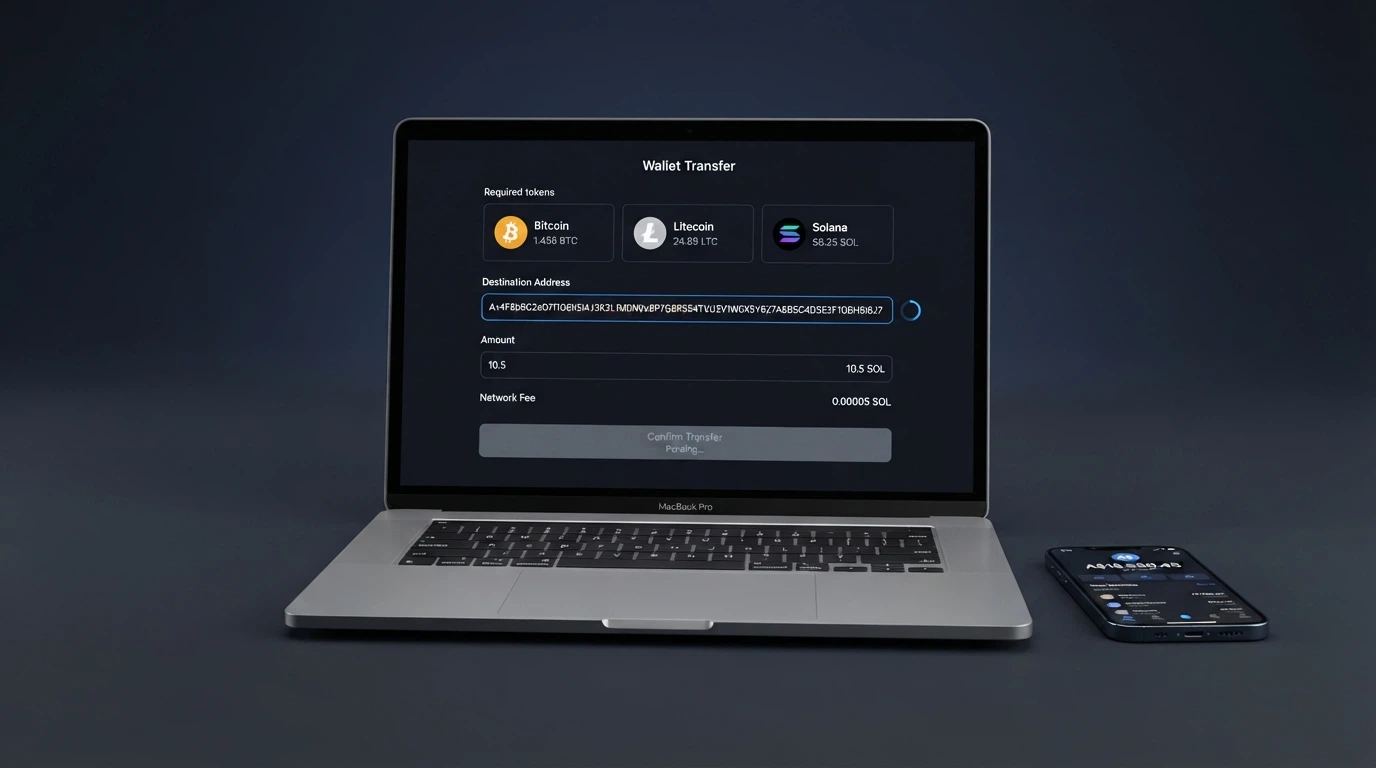
Crypto is also banned as a payment method for licensed Australian online wagering since 11 June 2024, under the Interactive Gambling Amendment (Credit and Other Measures) Act 2023. That ban applies only to operators licensed in Australia. It does not reach offshore brands, and an Australian punter funding a Stake or BitStarz account with USDT is operating outside the payment restriction by virtue of the operator being outside the regulatory perimeter it was written for.
Bitcoin vs Altcoins: Which Crypto These Casinos Actually Take
Bitcoin is the universal option. Every operator in this set accepts it, every withdrawal route supports it, and every exchange conversion chain in Australia can absorb it. The trade-off is speed and cost: Bitcoin withdrawals average 18 minutes across ten anonymous platforms in current testing, with network fees that swing with mempool congestion.
Litecoin clears faster — typically 5–15 minutes in current testing — and at a fraction of the fee, between A$0.05 and A$0.20 per transaction. For a punter who values predictable cost over liquidity depth, LTC is the better default.
USDT on the TRC-20 network sits at 5–20 minutes with fees between A$1 and A$2. The case for USDT is stability — the punter’s bankroll does not move against them while it sits in the casino balance, which is meaningful for a multi-session visit.
Solana is the fastest option in the current set. Withdrawals land in under 2–5 minutes and network fees run under A$0.01, which makes SOL the right coin for a punter chasing speed on smaller balances — though not every operator in this comparison supports it.
Ethereum’s 3–8 minute settlement is competitive on speed, but gas fees spike unpredictably during network congestion, which makes ETH the worst default for cost-conscious withdrawals even where it is the fastest at the moment of the request.
DOGE is the wildcard — supported at some operators, light on fees, but a thinner liquidity pool at Australian exchanges than BTC or USDT.
Pokies, Table Games and Live Dealer: What’s on the Lobby Floor
The studios behind these lobbies are the same studios behind every licensed Australian online product — Pragmatic Play, Evolution, BGaming, Hacksaw Gaming, NetEnt, Microgaming, Play’n GO, Betsoft, Endorphina. The same maths, the same RTP configurations, the same hit frequencies. BC.Game lists 8,000+ games from 38+ providers; 7Bit runs 7,000+ from the same cluster plus a few more; BitStarz runs 6,000+ from 69 studios.
The differences are at the edges. BitStarz builds 14 provably fair Originals — in-house games whose outcomes can be verified cryptographically by the player after each round. BC.Game runs 75 of these Originals, the largest provably fair suite in the set. The live dealer product is Evolution-heavy across operators that carry it; Pragmatic Play Live is the secondary provider. Pokies volume and volatility profile is comparable to what an Australian punter would find at any regulated online product, because in most cases it is the same product, licensed to the offshore operator under the same provider agreement.
What the offshore lobby adds is the crypto-native layer — crash games, dice, plinko, mines — running on the same provably fair engine as the Originals. These are the games a licensed AU operator cannot offer, and the reason a punter might prefer the offshore catalogue over the licensed one even before the privacy consideration enters the picture.
Why Your 2026 Anonymous Casino Bonus Is Smaller Than It Looks
The headline number is loud. A$10,000 match. 5 BTC welcome. 400 free spins. The wagering requirement, validity window and cashout cap are the quiet half of the sentence, and they are the half that decides what the punter actually walks away with.

A 40x wagering requirement on a $1,000 bonus means turning over $40,000 in play before the bonus funds convert to withdrawable cash. At a $5 maximum bet during wagering — BitStarz’s standard — that is 8,000 individual bets. At an average of six seconds per spin, that is roughly 13 hours of continuous play. The validity window is seven days. The arithmetic leaves no room for the leisurely weekend the marketing suggests.
The 25x at Ignition is the lightest in the set and the one number that materially changes the maths. A $3,000 crypto bonus at 25x on deposit plus bonus is $150,000 in turnover, which at $10 per spin across the wagering cap is 15,000 spins or roughly 25 hours of play. Still a slog, but a third lighter than the 40x cohort.
Cashout caps on free spins are where the marketing most often diverges from the reality. 400 free spins at BC.Game sound like a windfall until the $10 maximum withdrawal cap per batch is read. The actual ceiling on what those spins can produce — for the player, not for the casino — is $10 per batch. 7Bit’s A$100 cap on free spin winnings is more generous but still a fraction of what a lucky session at high-volatility slots can produce. The cap exists precisely to limit the upside of the spins the casino is giving away.
No-Deposit Bonuses at Anonymous Casinos: What’s Actually Available
The honest answer is that none of the ten featured operators currently offers a true no-deposit bonus. Every welcome package in the comparison above requires a deposit first. That is not a coincidence — no-deposit bonuses at offshore operators exist, but they are not what the major brands in the crypto-anonymous niche are offering Australians right now.
The closest alternatives are the lowest-minimum-deposit packages. Lucky Block’s A$1 AUD equivalent entry is the cheapest door in the set. 7Bit’s A$20 AUD minimum and BitStarz’s $20 minimum are next. None of these is a no-deposit offer; all of them are deposit-gated.
The difference between a player searching for “no deposit bonus anonymous casino” and the market reality is the gap between what the term implies and what the offshore crypto space actually delivers. No-deposit bonuses at licensed Australian wagering operators have been effectively shut down by the inducement restrictions coming into force on 1 January 2027. The offshore space still offers them, sparingly, but not at the brands Australians reach first.
A punter who wants the lowest possible entry cost should look at Lucky Block’s A$1 minimum. A punter looking for an actual no-deposit offer will need to look past the ten operators in this comparison.
Free Spins, Wagering Multiples and the Fine Print That Caps Your Winnings
The free-spin offers across the set stack as follows. BC.Game leads on raw count with 400 spins across the welcome package, each batch subject to a $10 maximum withdrawal cap. mBit offers 300 spins across three deposits at 40x wagering. BitStarz offers 180 across four deposits at 40x on the spin winnings specifically, with a one-day validity on the spins — a window tight enough to make the spins functionally a same-session product. 7Bit runs 250 spins across four deposits at 35x with an A$100 maximum cashout. Cloudbet offers 100 spins with seven days to use them and a 60-day window on the bonus itself.
The wagering on free spin winnings is consistently heavier than the wagering on cash deposits, and consistently more punishing. 40x on free spin winnings at BitStarz and BC.Game means a $50 spin win requires $2,000 in turnover before it is withdrawable. The maths makes the spins a marketing tool, not a profit centre.
Max-bet restrictions during wagering — $5 at BitStarz, A$1.50 at 7Bit, A$5 at mBit — are the second quiet constraint. A punter who bets above the cap, even once, voids the bonus and the winnings attached to it. The clause is enforced.
The fine print that matters most: the free spin cashout cap. The 400-spin headline at BC.Game is a $10-per-batch ceiling. The 250-spin headline at 7Bit is an A$100 ceiling. Both are real limits on what the spins can produce.
The Legal Reality for Australian Players in 2026
Online casino is prohibited in Australia. That sentence is the entire legal frame, and it deserves to be heard plainly before the rest of this section. The Interactive Gambling Act 2001 makes it an offence for an operator to provide online casino games to a person in Australia. There is no licence for online casino anywhere in the country — not federally, not in any state or territory. A punter searching for “the best licensed online casino in Australia” is searching for something that does not exist.

What is permitted under Australian law is wagering on sport and racing placed before the event begins, lotteries and keno, through operators licensed by a state or territory. The Northern Territory Racing and Wethering Commission is the de facto national licensor for online wagering; Sportsbet, bet365, Ladbrokes and roughly fifty other operators hold NT licences. None of them offers online casino games, because they cannot.
The minimum age for any form of Australian wagering is 18.
IGA 2001: Why Every Anonymous Casino Is Offshore
The Interactive Gambling Act 2001 was strengthened by the Interactive Gambling Amendment Act 2017, which closed several offshore loopholes and gave the Australian Communications and Media Authority (ACMA) express enforcement and site-blocking powers. The IGA targets the provider, not the individual player. No Australian has been prosecuted for placing a bet at an offshore online casino, and the statute is structured around civil penalty proceedings against operators, not criminal charges against customers.
The offshore licensing reality follows from the prohibition directly. No Australian authority issues an online casino licence, so any operator offering online casino games to Australians is necessarily licensed somewhere else — Curaçao, Anjouan, Malta, the Isle of Man, occasionally a less scrutinised jurisdiction. The offshore licensing is not a workaround the Australian regulator has missed; it is the structural consequence of the prohibition.
The Northern Territory levies a 5% wagering tax on wagers minus payouts plus a 0.05% racing levy. Each state then sets its own point-of-consumption tax, typically 10–15% of net wagering revenue, on operators licensed in that state. None of that tax framework reaches an offshore anonymous casino, because none of those operators is licensed to take Australian wagers in the first place.
What Happens If You Play: Prosecution Risk, Site Blocks and the 2027 Payment Crackdown
The short version: no prosecution, but no Australian consumer protection either, and the enforcement machinery is getting sharper.
The IGA targets the operator. No Australian player has been prosecuted under the Act for using an offshore service, and the enforcement architecture is built around civil penalties against providers and ISP-level blocking of domains, not criminal pursuit of customers.
The blocking has been aggressive. Since its first blocking request in November 2019, the ACMA has had 1,788 illegal gambling and affiliate websites blocked by Australian internet service providers. Over 230 illegal gambling services have withdrawn from the Australian market since the ACMA started enforcing new rules in 2017 — a mix of operators leaving voluntarily and operators losing access after blocking. In Q4 2025 alone, the ACMA completed 23 investigations into 45 gambling sites and found 69 breaches of the IGA, including 38 for providing a prohibited interactive gambling service to Australian customers; in the same quarter, 133 websites were referred to ISPs for blocking.
From 1 January 2027, the picture changes materially. The Interactive Gambling Amendment (Gambling Reform) Bill 2026, passed by Parliament on 19 August 2026, gives banks and payment providers express authority to block transactions to illegal gambling operators. An Australian bank will be able to refuse a transaction it identifies as funding an unlicensed wagering service, including crypto on-ramps and off-ramps at Australian exchanges. The reform also prohibits direct marketing of inducements for 14 days after a customer signs up, for three months after a person deregisters from BetStop, and indefinitely for customers identified as at risk of gambling-related harm.
The January 2027 changes do not make playing illegal. They make funding the play harder. Crypto deposits at offshore casinos will still be technically possible after that date, but the path from an Australian bank account to a casino wallet — through PayID, through an exchange’s AUD on-ramp, through a bank transfer — will pass through institutions that now have the authority to refuse the transaction. Some will. Some will not. The variability is itself a cost.
The Protections You Lose — and the Help That’s Still There
The Australian consumer-protection architecture does not reach an offshore anonymous casino. That absence is not a minor detail. It is the single most important difference between an operator licensed by the Northern Territory Racing and Wagering Commission and one licensed in Curaçao, and a punter weighing the two should weigh it as such.
What is lost:
- No BetStop coverage. BetStop is the National Self-Exclusion Register; it has recorded 67,480 registrations since going live in August 2023, with 41,290 exclusions still active as at 31 July 2026. A registration excludes the person from every Australian-licensed online and phone wagering service. It does not bind an offshore casino. A self-excluded Australian can still deposit, play and lose at Stake, BC.Game, BitStarz or any of the other operators in this comparison.
- No ACMA complaints recourse. The ACMA can investigate an Australian-licensed operator and issue formal warnings, civil penalty proceedings and enforceable undertakings. It cannot pursue an offshore operator on a player’s behalf.
- No Australian Consumer Law protection. The Australian Consumer Law guarantees apply to goods and services supplied in Australia. They do not apply to a Curaçao-licensed operator hosted outside Australian jurisdiction.
- No enforced dispute resolution. If the casino refuses a withdrawal, voids a bonus or closes an account, the avenues for recourse are the casino’s own internal dispute process and, at best, the Curaçao Gaming Control Board — which does not have the same enforcement reach as ACMA.
- No guaranteed payout if the site is blocked. ACMA blocks operate at the DNS level. A punter with an open balance at a site that gets blocked cannot reach the cashier to withdraw. The blocking does not refund balances; it cuts off access.
What still works, regardless of where the casino is licensed:
- The National Gambling Helpline, 1800 858 858, is free, confidential and staffed 24 hours a day, 7 days a week.
- Gambling Help Online, at gamblinghelponline.org.au, offers online chat and counselling.
- Self-exclusion tools on individual offshore casino sites, where offered, will work at that operator only — but they work.
- Deposit limits, time-outs and reality checks, where the offshore operator offers them, will function at that site.
The Australian gambling-harm numbers are worth holding alongside the legal ones. Approximately 2.1% of Australian adults — roughly 430,000 people — experience problem gambling, and the Australian Institute of Health and Welfare put high-risk gambling at 1.8% in 2022. Between March 2025 and March 2026, Australians lost A$36.0 billion to gambling. As of March 2026, 15.1% of the Australian population — an estimated 3.32 million people — were experiencing some form of gambling harm from their own or someone else’s gambling. Risky gambling increased from 13.7% in 2024 to 19.4% in 2025.
The offshore status of an anonymous crypto casino does not change those numbers, but it does remove the Australian-specific guardrails designed to slow them.
Getting Your Money Out: Crypto Withdrawals at Anonymous Casinos
The withdrawal speed claims are bold. “Instant”, “under 5 minutes”, “no manual processing”. The on-chain reality, per coin and per operator, decides whether a punter waits two minutes or 24 hours. The marketing language collapses those two outcomes into one sentence, and a punter who has not read past the headline does not know which end of that range they are on.
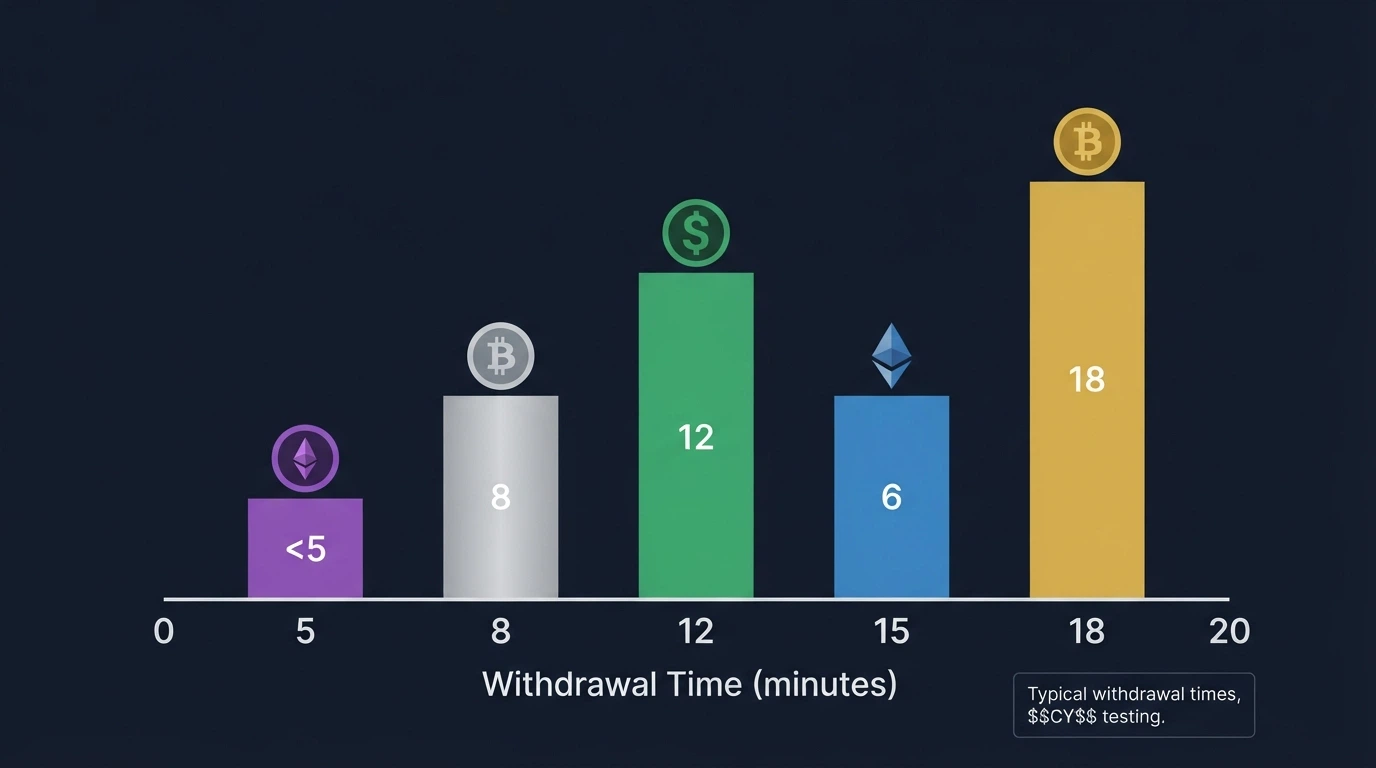
Withdrawal Speed by Coin: Which Crypto Gets Your Winnings to You Fastest
| Cryptocurrency | Typical withdrawal time | Network fee in AUD | Best for |
|---|---|---|---|
| Solana (SOL) | Under 5 minutes | Under A$0.01 | Speed and cost on smaller balances |
| Litecoin (LTC) | 5–15 minutes | A$0.05–0.20 | Cost-conscious withdrawals with broad acceptance |
| Bitcoin (BTC) | 8–18 minutes | Variable — mempool-driven | Universal acceptance, deep liquidity |
| USDT (TRC-20) | 5–20 minutes | A$1–2 | Stable value during multi-session visits |
| Ethereum (ETH) | 3–8 minutes | Higher — gas spikes | Token flexibility where supported |
Solana wins on raw speed and fee in the current market. Withdrawals land in under five minutes and network fees run under A$0.01, which makes SOL the right coin for a punter optimising on both dimensions — but SOL support is uneven across the operator set, and not every brand in the top ten offers it.
Litecoin is the practical default. Withdrawals settle in 5–15 minutes across the current cohort at network fees of A$0.05–0.20, and LTC support is near-universal. Test data from ten anonymous platforms in 2026 showed Litecoin averaging 8 minutes from request to wallet arrival against Bitcoin’s 18 minutes — a meaningful gap when the punter is cashing out a multi-thousand-dollar balance.
Bitcoin is the universal fallback. Every operator in this comparison accepts it, every Australian exchange can absorb it, and the 8–18 minute window is acceptable for most players. The fee is the variable — at mempool peak it can spike uncomfortably; at quieter times it is a few dollars. Bitcoin’s liquidity at Australian exchanges is unmatched, which is why it remains the default cashout coin even where it is not the fastest.
USDT on the TRC-20 network sits at 5–20 minutes with fees between A$1 and A$2. The stable-value pitch matters during a multi-day casino visit where the punter’s bankroll would otherwise move against them in the BTC or ETH market.
Ethereum’s 3–8 minute settlement is the fastest at the moment of the request, but gas fees spike unpredictably during network congestion, which makes ETH the wrong default for a punter who values predictability.
Deposit Methods and the Truth About “Instant” Payout Claims
Deposits are instant because the blockchain confirms them. A wallet-to-wallet transfer from a player’s self-custody wallet to a casino’s deposit address settles in minutes, and the credit appears on the casino balance as soon as the required number of confirmations is reached.
Withdrawals are not instant for a different reason. The casino’s cashier has to approve the payout, and most operators run a manual review step before the crypto is released — even at brands that advertise “instant withdrawals”. The review is the AML check, the bonus-completion verification, the source-of-funds confirmation. MetaWin’s instant on-chain withdrawals up to $100,000 per day with zero manual processing delay are the exception in the current market; Thrill Casino’s under-five-minute average is the benchmark most operators in this set do not meet.
Stake’s 100% deposit wagering requirement before withdrawal is the rule that catches most first-time players at the brand. The deposit itself must be turned over before the withdrawal is processed — regardless of whether a bonus was claimed. A punter who deposits, plays briefly, and asks for a payout is going to wait until the full deposit has cycled through.
SkyCrown’s advertised ten-minute average and realistic sub-hour figure for verified accounts is closer to the industry norm. The casino’s manual review layer sits between the player and the on-chain transfer, and that layer is what the “instant withdrawal” marketing usually buries.
The path from casino withdrawal to AUD in an Australian bank account adds the exchange step. CoinSpot’s PayID settlements arrive in under 30 minutes for most Australian banks, available 24 hours a day including weekends and public holidays — which is the recommended route for converting crypto casino winnings to AUD. The full cycle — withdrawal request to AUD in the player’s account — runs from 30 minutes to 24 hours depending on the cryptocurrency, the operator’s manual review time and the exchange’s processing speed.
Why You Won’t Find an Anonymous Casino App in the App Store
Anonymous casinos do not ship native iOS or Android apps. They run in the mobile browser, and that is by design rather than omission.
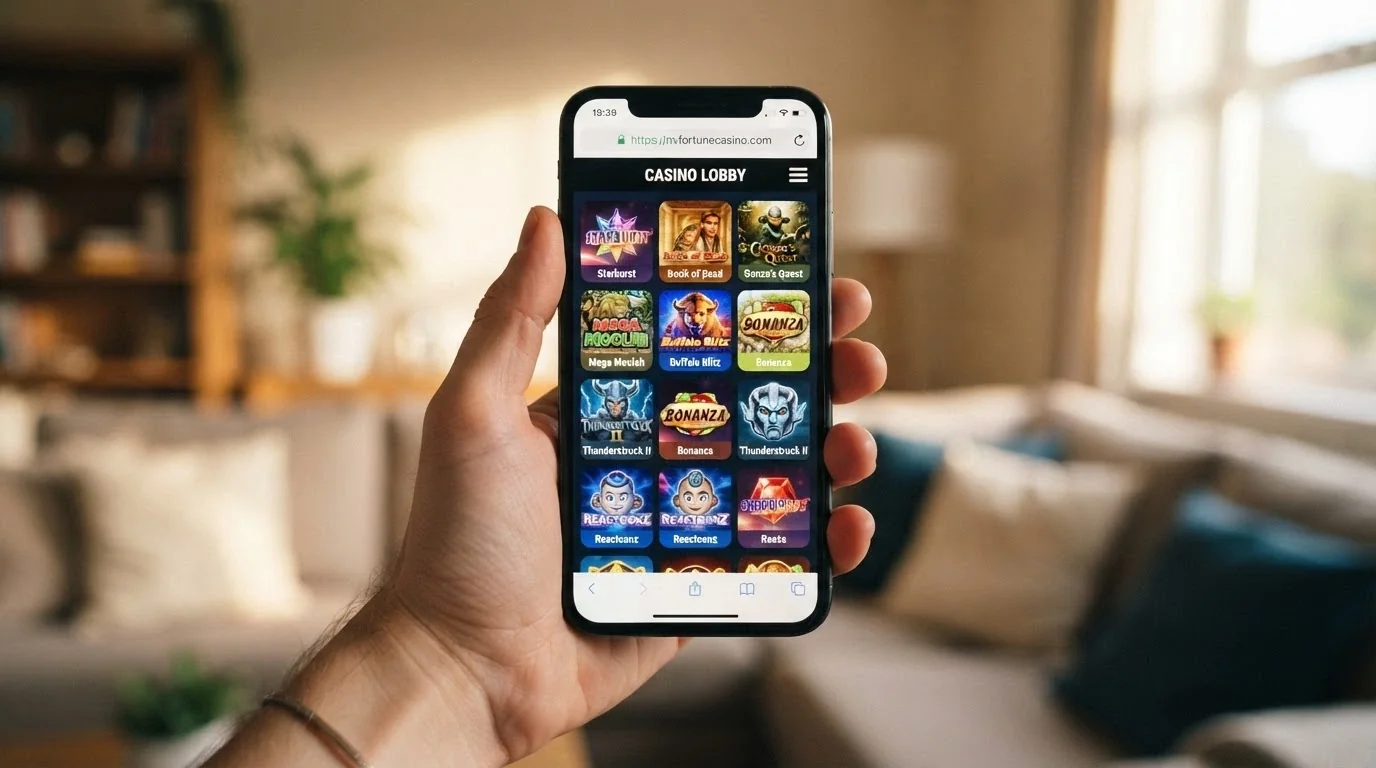
The reason is structural. Apple’s App Store and Google Play prohibit apps that facilitate gambling in jurisdictions where the activity is prohibited or where the operator lacks a licence recognised by the platform. A Curaçao-licensed online casino serving Australian customers cannot satisfy either condition, so neither app store will host the operator’s binary. Even casino apps from licensed AU wagering operators are absent from Google Play and limited to direct-download from the operator’s site, and offshore brands face the same restriction more harshly.
The result is browser-based responsive play as the default. The lobby loads in mobile Safari or Chrome, the games run on HTML5, the cashier works the same way, and the experience is functionally identical to desktop — minus the screen real estate. No download, no app-store trace, no native binary on the device.
The mobile experience at these operators is the desktop experience, scaled. The same game catalogue, the same bonus terms, the same KYC pipeline. There is no separate “mobile bonus” or “app-only” promotion, because there is no app.
For a punter, the practical implication is that any bookmark to the casino site is a bookmark, not an app icon, and clearing the browser history removes the only on-device trace the play leaves. Whether that is a feature or a tell depends on what the punter is optimising for.
New Anonymous Casinos: Fresh Faces, Same Offshore Rules
New anonymous casinos launch regularly. The licence jurisdiction changes, the offshore reality does not. A new entrant with an Anjouan licence looks structurally identical to a ten-year-old Curaçao brand from an Australian player’s perspective, and the licence migration is itself instructive.
BC.Game moved from Curaçao to Anjouan in December 2025. The migration did not change the products, the catalogue, the bonus structure or the KYC pipeline. It changed the regulator on the licence page and the contact email for complaints. For an Australian player, the practical consequence is roughly zero. For a reader tracking regulatory dynamics, the consequence is a small indicator of where the offshore licensing market is consolidating — Curaçao tightening its sub-licence structure under the new Gaming Control Board framework, smaller operators migrating to Anjouan, Costa Rica or other jurisdictions.
New operators try to differentiate in three places. Bigger welcome packages, more recent crypto support (Solana, fresh ERC-20 tokens), and aggressive rakeback or cashback structures that established brands do not match. The trade-off is the inverse: no track record, no third-party reviews of payout behaviour, no reputation to lose if the withdrawal pipeline slows down.
A punter attracted to a brand less than twelve months old should weigh the bonus offer against the absence of a payout history. The headline number on a six-month-old brand is the same number as on a six-year-old brand, but the proof of payout is years away from being available for the new operator.
The Pokies and Games You Can Actually Play at Anonymous Casinos
The studios are the same ones supplying licensed Australian operators. Pragmatic Play, Evolution, BGaming, Hacksaw Gaming, NetEnt, Microgaming, Play’n GO, Betsoft, Endorphina. The same maths, the same RTP configurations, the same hit frequencies. An offshore anonymous casino lobby is, in most cases, the same catalogue a licensed operator runs — minus the Australian regulatory overlay and plus the crypto-native games the licensed space cannot carry.
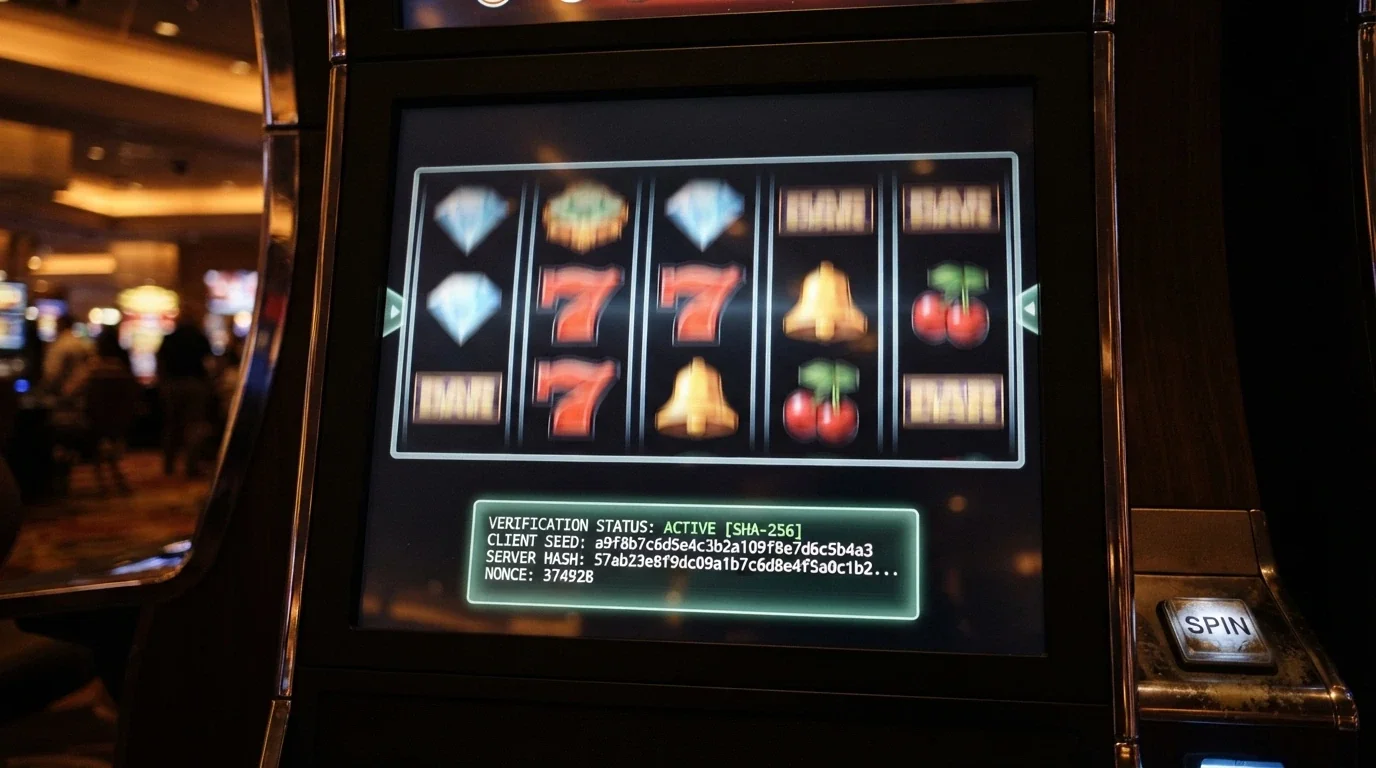
BC.Game lists 8,000+ games from 38+ providers. 7Bit runs 7,000+ titles. BitStarz runs 6,000+ from 69 studios. mBit’s catalogue sits at 5,000+. SkyCrown, Lucky Block and the others fall into the 2,700–3,000 range. The library sizes are real, but the differentiation is in the provider mix and the crypto-native layer, not the raw count.
Provably Fair Games: How They Work and Why They Matter
Provably fair is the one trust mechanism an anonymous casino can offer that a licensed one cannot. The licensed operator is audited; the offshore operator is not. The provably fair system replaces the audit with a cryptographic guarantee the player can verify themselves.
The mechanism runs on three inputs: a client seed (set by the player, or generated by the casino on the player’s behalf), a server seed (held by the casino, hashed and shown to the player before play), and a nonce (incremented with each bet). After each round, the player can recompute the outcome from the three seeds and compare it to the result the casino showed. If the recomputation matches, the casino did not change the result after the bet was placed. If the casino had a different server seed at the time of the bet than the hash it showed beforehand, the recomputation fails — and the player knows.
This is not a metaphor for trust. It is a mathematical check the player can run themselves, after each round, with no third party required. The trust does not come from believing the casino; it comes from the inability of the casino to cheat without being caught by the verification.
BitStarz builds 14 provably fair Originals. BC.Game builds 75, the largest provably fair suite in the set. These are crypto-native games — dice, crash, plinko, mines, limbo — running on the provably fair engine rather than a third-party RNG. They are the games a licensed AU operator cannot offer, and they are the closest thing to a trust layer the offshore space produces.
Australian Pokies Favourites and Who Stocks Them
The pokies Australian players search for — high-volatility bonus-buy titles, hold-and-spin mechanics, Megaways engines — are the same pokies stocked at licensed AU operators. Pragmatic Play’s Gates of Olympus, Hacksaw Gaming’s Wanted Dead or a Wild, BGaming’s Bonanza Billion, NetEnt’s Starburst — these are in the offshore catalogue because the same studios supply both.
The library scale is the differentiator at the operator level. BC.Game’s 8,000+ game count and 38+ provider count is the largest in the set. 7Bit’s 7,000+ titles include NetEnt, Microgaming, Pragmatic Play, Evolution, BGaming, Play’n GO and Endorphina. BitStarz’s 69 studios cover Pragmatic Play (588 titles alone), BGaming, Booming Games, Playtech, Endorphina, Betsoft, Evoplay and Hacksaw Gaming, plus the 14 Originals.
Australian preferences skew to high-volatility games with bonus-buy features, and the offshore catalogues are heavy on both — in many cases heavier than the licensed AU product, because the studios ship everything to offshore operators without the Australian classification overlay. The trade-off is the absence of Australian-specific responsible-gambling messaging on the game client, which licensed operators carry on every pokie screen.
How We Selected and Ranked These Anonymous Casinos
The ten operators in this comparison were chosen against three filters. First, the operator had to be reachable from Australia — confirmed accessible via the operator’s offshore domain during verification, with Australian players active on the site. Second, the operator had to accept cryptocurrency as a primary deposit method — not as an afterthought, but as the core of the cashier. Third, the operator had to run a no-KYC or low-KYC policy at signup, even if KYC was triggered at the withdrawal threshold.
Ranking within the ten used seven criteria: crypto-native operation (deeper is better), no-KYC or low-KYC policy (lower threshold is better), accessibility to Australian players (confirmed and stable), bonus value after wagering (effective value, not headline), withdrawal speed tested, game library depth and provider breadth, and licence transparency (clearer is better, with explicit acknowledgement when the licence could not be confirmed).
The operators chosen were prioritised for fit to the “anonymous crypto” topic. They are not the only offshore brands Australians reach; they are the brands that combine crypto-native operation, no-KYC signup, accessible cashier and credible operator track record for an Australian reader comparing options. None of the ten holds or can hold an Australian online casino licence, because that licence does not exist. The ranking is a comparison within the offshore set, not a comparison against the licensed set — which the licensed set does not include.
The sources checked for this comparison included operator review aggregators, ACMA public data on enforcement, the Curaçao Gaming Control Board and Anjouan public licence registers, the Australian Institute of Health and Welfare gambling-harm statistics, and the operators’ own terms pages where available. Where the input sources did not confirm a figure — RocketPlay’s bonus terms, SkyCrown’s licence holder, Ignition’s licence number, Lucky Block’s licence number — the gap is shown in the comparison table above rather than replaced with a substituted value.
What Australian Players Should Actually Do in 2026
The honest framing is this. Online casino is prohibited in Australia. The ten operators in this comparison are offshore. An Australian punter who chooses to play at one of them gains crypto-funded play, privacy at signup, faster withdrawals in some coins, and access to crypto-native games licensed operators cannot offer. They lose every Australian consumer protection — no ACMA recourse, no BetStop coverage, no Australian Consumer Law guarantee — and they accept the structural risk of playing at an operator outside Australian jurisdiction.
The January 2027 changes make the trade-off less favourable for Australian-funded play. Banks and payment providers will have express authority to block transactions to illegal gambling operators from that date. An Australian bank account funding a crypto on-ramp that funds an offshore casino will pass through institutions with new grounds to refuse. Some will refuse. The variability is part of the cost.
For a punter who decides to play anyway, the practical moves are these. Use a self-custody wallet you control, not an exchange-hosted wallet, so the on-chain trail is yours. Understand the KYC trigger at the operator you choose and stay below it where possible. Know the crypto-to-AUD path before you deposit — CoinSpot PayID is the cleanest Australian off-ramp. Read the bonus terms before claiming, with particular attention to the wagering multiple, the validity window, the max-bet cap during wagering and the free-spin cashout ceiling. Do not chase a bonus the wagering requirement makes uneconomic.
For a punter who decides not to play, the licensed Australian alternatives are real but limited. Online casino games are not available through any Australian-licensed channel. The licensed wagering operators (Sportsbet, bet365, Ladbrokes and others) take pre-event sports and racing bets only. Lotteries and keno are available through state-licensed channels. Land-based casinos (Crown, The Star) offer table games and pokies in person.
For any punter who finds themselves gambling more than they planned, the help exists and works regardless of where the casino is licensed. The National Gambling Helpline is 1800 858 858, free, confidential and available 24 hours a day. Gambling Help Online, at gamblinghelponline.org.au, offers online chat and counselling. Self-exclusion from individual offshore operators works at the operator level only, but BetStop’s 67,480 registrations since August 2023 show that the Australian-licensed exclusion system is being used.
The trade-off this page is built around does not go away. Privacy and access on one side; every Australian consumer protection on the other. The honest framing is that an Australian punter choosing an anonymous crypto casino in 2026 is choosing a market that exists precisely because the Australian market is closed, and accepting that the things that make it accessible also make it unenforceable from within Australian law.
Frequently Asked Questions
Are anonymous crypto casinos legal in Australia?
Online casino is prohibited in Australia under the Interactive Gambling Act 2001. There is no licence for online casino games anywhere in the country. Every operator on this page is offshore, licensed in Curaçao, Anjouan or elsewhere. Playing at one is not, in itself, prosecuted — the IGA targets the provider, not the player. But no Australian consumer protection, no ACMA complaints recourse and no BetStop coverage applies at an offshore operator. From 1 January 2027, banks gain authority to block transactions to illegal gambling operators, which will make funding offshore play harder.
Can I get in trouble for playing at an offshore anonymous casino from Australia?
No Australian has been prosecuted under the IGA for placing a bet at an offshore online casino. The statute is structured around civil penalties against operators, not criminal charges against individual players. The practical consequences are different: no Australian consumer protection, no recourse to ACMA, no BetStop coverage, and a real risk that the casino site gets blocked at DNS level by Australian ISPs — which can strand an open balance. From January 2027, banks can refuse transactions to illegal gambling operators.
What is the KYC trigger threshold at most anonymous crypto casinos?
AML policies at Curaçao- and Anjouan-licensed casinos typically set a KYC review trigger at EUR 2,000–10,000 in cumulative withdrawals or deposits. A punter who stays under EUR 2,000 will, in practice, never see a document request from most operators in this set. A punter who hits a large win or makes a large cumulative withdrawal will be asked for ID, proof of address and sometimes source-of-funds documentation. Refusal at that point means the withdrawal is held or, in some cases, the balance is confiscated.
Do anonymous casinos require any ID verification at all?
No ID is required at signup — email only, sometimes just a username, with crypto deposits settling wallet-to-wallet. ID verification is required at the withdrawal threshold, typically between EUR 2,000 and EUR 10,000 in cumulative activity, depending on the operator’s internal AML policy. The “anonymity” is between the player and the operator’s customer database, not between the player and the public blockchain. Crypto transfers are pseudonymous on-chain — visible to anyone with the wallet address — but not anonymous in the sense the marketing suggests.
How do I convert cryptocurrency casino winnings to Australian dollars?
The standard path is: withdraw from the casino in crypto (BTC, LTC, USDT or SOL are the most common choices) to a self-custody wallet, then on-ramp to AUD at an Australian exchange. CoinSpot’s PayID settlements arrive in under 30 minutes for most Australian banks, available 24/7 including weekends and public holidays, and is the recommended route for converting casino winnings. The full cycle from casino withdrawal to AUD in an Australian bank account typically runs 30 minutes to 24 hours, depending on the cryptocurrency used, the casino’s manual review time and the exchange’s processing speed.
Does BetStop cover anonymous offshore casinos?
No. BetStop — the National Self-Exclusion Register — binds Australian-licensed wagering services only. It has recorded 67,480 registrations since going live in August 2023, with 41,290 exclusions still active as at 31 July 2026, but an offshore anonymous casino is not connected to the register. A self-excluded Australian can still deposit, play and lose at any of the operators in this comparison. Self-exclusion tools on individual offshore casino sites will work at that operator only. For full Australian-licensed coverage, BetStop is the right register to use.
What wagering requirements apply to welcome bonuses at anonymous crypto casinos?
The wagering requirements across the featured set range from 25x to 40x. Ignition runs 25x on deposit plus bonus, the lightest in the set. SkyCrown runs 30x on the bonus amount. 7Bit and Lucky Block run 35x. BitStarz, BC.Game, Cloudbet and mBit run 40x. A 40x wagering requirement on a $1,000 bonus means turning over $40,000 in play before the bonus converts to withdrawable cash; a $5 max bet during wagering — standard at most operators — means roughly 8,000 spins or about 13 hours of continuous play, which has to fit inside a 7-day validity window at most brands in the set. The free-spin cashout cap is the second constraint to read carefully: BC.Game’s $10 per-batch cap and 7Bit’s A$100 cap are real ceilings on what those spins can produce.
Published by the Online Pokies Real Money team.