
The $300 no-deposit bonus in Australia: what the headline actually delivers
 Available in AU
The “$300 no-deposit bonus” dominates Australian casino search results, but the number on the banner rarely matches the offer behind it. A systematic check of the Australian market in August 2026 turned up zero live A$300 no-deposit offers. What the search delivers instead is a handful of free-spin packages worth a few dollars, small cash bonuses around A$10, and a constant churn of deposit-match welcome packages dressed up in “free money” language. Every one of them comes from an operator licensed in Curaçao, Anjouan or Kahnawake, not Australia, because Australia does not issue online casino licences at all. The Interactive Gambling Act 2001 makes providing that product to anyone in Australia a criminal offence, and the Act’s target is the provider, not the player. The “free A$300” is the bait; the offshore reality is the trap.

This page is built around that gap. It explains what a no-deposit bonus actually is, why the A$300 figure is functionally mythical, what wagering requirements do to a headline number, which pokies give a bonus the longest run, and what protection the player forfeits by playing offshore. It also ranks the ten offshore operators an Australian search actually surfaces, two of which carry a live no-deposit offer at the time of writing. The rest either hide the offer behind a deposit gate or have terms that could not be confirmed during this review.
Current as of 18 October 2026, verified against ACMA enforcement data, BetStop registrations, and operator licence registers.
Table of Contents
- The $300 no-deposit bonus: what the headline hides
- Every $300 no-deposit casino is offshore — here is what that costs you
- Why your 2026 bonus shrinks before you see a cent
- PayID and the payment maze at offshore casinos
- The pokies that give your bonus a fighting chance
- The no-deposit offers Australians can actually claim in 2026
- How we chose and ranked these operators
- What to do with your search for a $300 no-deposit bonus in 2026
- Responsible gaming — playing within limits when the limits are yours to set
- Frequently asked questions
The $300 no-deposit bonus: what the headline hides
A “no-deposit bonus” is a casino credit applied to a new account without the player making an initial deposit. In theory, the player signs up, verifies an email or phone number, and receives a cash balance, a bundle of free spins, or both, which can be played on selected games. Any winnings generated are subject to wagering requirements, after which a capped amount can be withdrawn. In practice, the mechanism is a marketing funnel: the casino trades a small guaranteed loss (the bonus face value, with most never cashed out) for a registered customer, a verified identity, and a deposit the operator can later convert into a larger welcome package.
The A$300 figure is unusually large for this product. Genuine no-deposit offers in the Australian-facing market run far smaller. Two live offers were confirmed during this review, both from the same offshore segment the A$300 banner itself comes from: one gives 20 free spins with a A$40 maximum win, the other gives A$10 in cash after SMS verification. The A$300 headline almost always redirects to a deposit-match welcome package on the landing page, or to a stale bonus code from a promotion that ended long ago. The mismatch is structural. The A$300 term drives search traffic because the number is attention-grabbing; the actual conversion offer is smaller because the economics only work at that scale.
The claim flow itself follows a standard sequence. Registration captures an email and password. A profile-completion step or SMS verification confirms the player is a real person at a real number. The bonus is credited either automatically, by entering a code, or by requesting it from support. The player then plays through the bonus, usually on pokies, while a max-bet cap of A$5 to A$10 per spin is in force. Once wagering is met, the bonus balance converts to a withdrawable amount, capped at somewhere between A$50 and A$200 for the largest legitimate offers. Anything above the cap is forfeited when the player cashes out.
How the offer actually works
The mechanical steps look simple from the outside, and most of the friction sits in two places: identity verification and the wagering phase. Sign-up typically takes two minutes: an email, a password, a country selection. The casino then asks for a mobile number and sends a one-time code by SMS. Some operators, including Royal Reels, gate the no-deposit bonus behind this step. SkyCrown’s free-spin offer works similarly, with profile completion unlocking the credit.
Once the bonus is live, the wagering phase begins. The casino names a multiple, usually between 25x and 60x the bonus amount, which the player must turn over in qualifying bets before any winnings become cash. Most operators cap the maximum bet during this period at A$5 or A$10 per spin, an anti-abuse rule that also stretches the time it takes to clear the bonus. Game contribution rules funnel play toward pokies, which typically count 100% toward wagering, while table games, live casino and crash titles contribute between 0% and 20%. A blackjack player who tries to clear a bonus on even-money bets will watch the wagering meter barely move.
After wagering is met, the player requests a withdrawal. This is where offshore reality sets in. The casino runs a Know Your Customer (KYC) check at first cashout: passport, driver’s licence, proof of address, sometimes a selfie. The withdrawal is then processed through whatever method the casino supports, which is rarely the same method the player used to deposit. PayID, when supported, is the fastest route, but most offshore operators do not support PayID withdrawals at all, and route cashouts through bank transfer or cryptocurrency instead. The deposit was instant; the withdrawal can take days.
The traps sit in three places: the maximum cashout cap, the game contribution rules, and the bonus validity window. Each of these is a number, and the numbers interact. A A$300 bonus with 50x wagering, a 30-day validity, and a A$100 max cashout is a different product from the same headline bonus with 60x wagering, 14 days, and a A$200 cap. The player who reads only the A$300 figure has not yet seen the offer.
Who can claim it — eligibility reality
Australian residency is an acceptance criterion, not a legal permission. The casino will accept the account because the player is in the market the operator is targeting; the casino is not accepting the account because the player has any right to be there. Offshore operators that block Australian IPs one month may accept them the next, depending on the operator’s own risk assessment and the legal climate. Some flag Australian sign-ups for enhanced due diligence. Others route them through Curaçao-licensed entities with no Australian footprint at all.
Age verification is standard. The casino requires the player to be 18 or older, in line with Australian land-based gambling law, and verifies this at registration or first withdrawal. Identity verification follows the same logic: passport, driver’s licence, or national ID. The casino’s interest in this is not player protection but anti-money-laundering compliance, and the verification is run against the casino’s own rules, not against any Australian standard.
The rule that catches most players is the one-bonus-per-household clause. Casinos track accounts by IP address, device fingerprint, payment method, and physical address. A second account from the same household typically voids the bonus on both, and any winnings generated. The rule exists because the same player with two accounts can clear a bonus twice, and the casino’s terms position this as fraud. Players who share an address with a partner or family member, or who have previously claimed the same bonus from a sister site, are the ones who hit this.
The eligibility gap that nobody in the affiliate space talks about openly is the one the law creates. Because the IGA prohibits providing online casino games to anyone in Australia, every bonus the player can claim sits in a legal grey area by the casino’s standards, not the player’s. The player is not prosecuted; the Act targets the provider. But the player has signed up with an offshore entity that holds no Australian licence, has no obligation under Australian consumer law, and is not connected to any Australian complaints body. Eligibility to claim the bonus is not the same thing as eligibility to enforce a withdrawal.
Every $300 no-deposit casino is offshore — here is what that costs you
The central legal fact about this market is that no online casino anywhere in the world is licensed to serve Australian customers. The Interactive Gambling Act 2001 prohibits the provision of online casino games, online pokies, and in-play sports betting to anyone physically in Australia. The prohibition is not a licensing gap or a regulatory grey area; it is a black-letter ban on the product. Every operator an Australian player can sign up with is doing so from outside Australia, under a licence from Curaçao, Anjouan, Kahnawake, or another jurisdiction, and outside the reach of Australian consumer law.
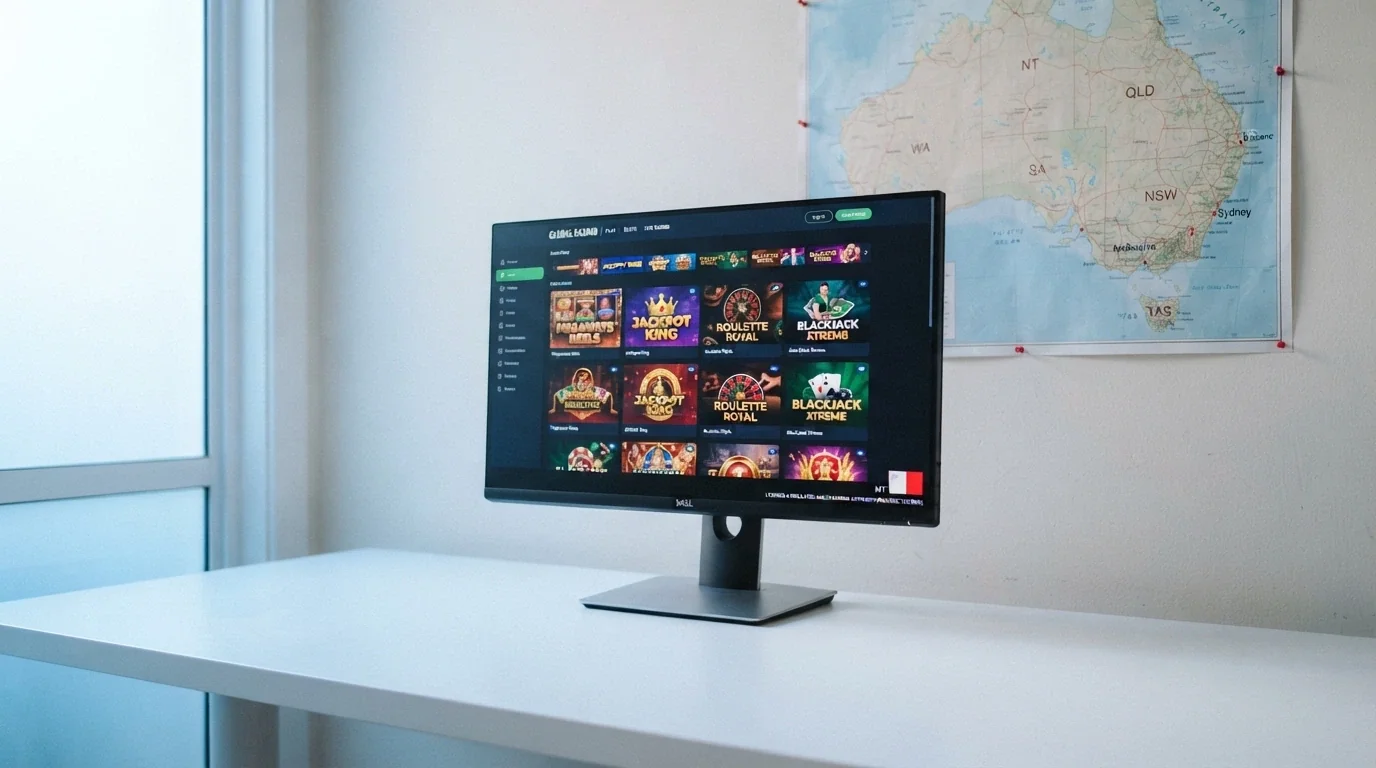
The Australian Communications and Media Authority (ACMA) is the federal regulator that enforces the prohibition. It investigates complaints, issues formal warnings, brings civil penalty proceedings, and directs Australian internet service providers to block illegal sites. The agency’s enforcement record is substantial: 1,564 illegal gambling and affiliate websites have been blocked since the first blocking request in November 2019, and more than 225 illegal services have withdrawn from the Australian market since 2017, when enforcement was strengthened. An operator that continues to serve Australian customers despite enforcement action is making a commercial decision to do so.
The player forfeits a specific set of protections by playing offshore. There is no BetStop coverage, because BetStop binds only Australian-licensed wagering services and offshore casinos are not connected to the register. There is no ACMA complaints pathway, because ACMA’s jurisdiction ends at the Australian border. There is no Australian consumer law to fall back on if the operator refuses a withdrawal, voids a win, or simply closes the account. The site can be blocked at any time, with a balance on it, and the player has no recourse.
The 2026 reform tightens the rules further. The Interactive Gambling Amendment (Gambling Reform) Bill passed Parliament on 19 August 2026, and its measures commence on 1 January 2026. From that date, wagering advertising is capped at three ads per hour between 6:00 am and 8:30 pm, inducement marketing is prohibited for 14 days after sign-up and for three months after a person deregisters from BetStop, and banks and payment providers are given express authority to block transactions to illegal gambling operators. The reform does not change the offshore casino product itself; the prohibition on providing it has been in force since 2001. What it does is harden the perimeter around the legal Australian wagering market and make the offshore path harder to use without naming it.
What the Interactive Gambling Act actually bans
The Interactive Gambling Act 2001 prohibits the provision of three categories of interactive gambling service to customers physically in Australia: online casino games, online pokies (slots), and in-play sports betting. The ban applies to the provider, not the customer. An individual player is not prosecuted for using an offshore casino; the operator is the target of the Act, and ACMA enforcement is directed at providers, advertisers, and the Australian-based infrastructure that supports them.
What the Act does not ban is the bulk of Australia’s legal gambling market. Pre-event wagering on racing and sport is licensed, predominantly through the Northern Territory Racing and Wagering Commission, which acts as the de facto national licensor for online wagering. Operators like Sportsbet, bet365 and Ladbrokes hold NT licences, typically for terms of up to 20 years. Lotteries and keno are licensed, although the 2026 reform will prohibit online keno and foreign-matched lotteries from 1 January 2026. Land-based casinos are licensed by the states: Crown, The Star, and a handful of regional operators. None of these licences covers online casino, because the IGA forecloses that product altogether.
ACMA’s enforcement toolkit includes formal warnings, civil penalty proceedings, infringement notices, and the power to direct Australian ISPs to block illegal services. The agency’s blocking power is the most visible instrument. Once an ISP receives a direction, the named domain becomes inaccessible to Australian customers without a VPN. The 1,564 sites blocked since November 2019 include both offshore casino operators and the affiliate sites that market them to Australian players. The 225-plus services that have withdrawn from the Australian market since 2017 did so in response to ACMA pressure: enforcement letters, blocking threats, and the cumulative reputational cost of being named in a regulator’s action.
What protection you forfeit when you play offshore
The simplest way to see what offshore play costs is to list the Australian infrastructure the player leaves behind. BetStop, the National Self-Exclusion Register, covers Australian-licensed wagering only. As at 31 July 2026, 67,480 people had registered, of whom 41,290 exclusions were still active. Offshore casinos are not connected to the register, so a person who has self-excluded from Australian wagering can still sign up with an offshore operator, deposit, and play. The protection the player thought they had built for themselves does not extend to the casino they are actually using.
The ACMA complaint pathway is similarly bounded. The regulator can take action against an offshore operator, but it cannot compel a withdrawal, order an account reinstated, or arbitrate a dispute between a player and an offshore casino. A player whose offshore operator refuses a cashout has, in practical terms, no Australian body to complain to. The dispute is between the player and a company registered in another jurisdiction, governed by that jurisdiction’s contract law and that jurisdiction’s courts.
The credit-card-and-crypto ban is a useful diagnostic. From 11 June 2024, credit cards, credit-related products, and digital currencies (cryptocurrencies) are banned as payment for online wagering in Australia, with penalties for non-compliance up to A$247,500. An operator that asks for a credit card or a crypto deposit is, by definition, not an Australian-licensed wagering provider. It is an offshore operator. The test is mechanical: if the deposit screen offers Visa or Bitcoin, the operator is outside the Australian rules. Licensed wagering operators offer debit card, bank transfer, PayID/Osko, and BPAY.
The “credit card or crypto” signal is worth dwelling on, because it is the single most reliable way to identify an offshore operator without reading the licence page. The Australian rules have removed credit and crypto from the legal payment stack for online wagering; the offshore stack has not. An Australian player who sees either option at the deposit screen is being served by someone outside the Australian rules, and every protection that flows from those rules, including BetStop, ACMA complaints, and consumer law, does not apply.
The 2026 reform and what changes on 1 January 2026
The Interactive Gambling Amendment (Gambling Reform) Bill 2026 passed Parliament on 19 August 2026. Its core measures commence on 1 January 2026, and the changes are directed at the licensed wagering market rather than the offshore casino market. The reform does not amend the prohibition on providing online casino to Australians; that has been the law since 2001. What it does is tighten the perimeter around legal wagering, which has the secondary effect of making the offshore path look more obviously different from the licensed one.
The advertising cap is the most visible change. From 1 January 2026, no more than three wagering advertisements are permitted per hour between 6:00 am and 8:30 pm on television. A live-sport blackout window runs from 15 minutes before to 5 minutes after the start of a sporting event, during which wagering ads cannot air. The cap is aimed at licensed wagering operators, who are the ones the ACMA can regulate; offshore casino marketing, which already runs through affiliate sites and unbranded social media, sits outside the cap’s reach.
The inducement marketing restrictions are the second major change. Direct marketing of wagering inducements, including bonus offers, free bets, and sign-up promotions, is prohibited for 14 days after a customer signs up with a licensed operator, and for three months after a person deregisters from BetStop. For customers identified as at-risk, the prohibition applies indefinitely. The restriction is targeted at licensed operators, who can be policed, and the intent is to interrupt the marketing funnel that pushes recent sign-ups and former self-excluders back into wagering.
The payment-blocking authority is the third change, and arguably the most consequential for offshore play. The reform gives banks and payment providers express authority to block transactions to illegal gambling operators. A PayID transfer, a debit card charge, or a BPAY payment to a known offshore casino can be refused by the bank, which now has legal cover for the refusal. The mechanism is opt-in for individual banks, but the direction is clear: the legal payment stack is being pruned to make it harder to reach illegal operators by legitimate means.
What the reform does not change is the player’s situation. The prohibition on providing online casino to Australians remains. The player is still not prosecuted. The offshore operator is still outside Australian law. What changes is the surface area: the legal market has tighter rules, the illegal market has fewer legitimate payment routes, and the gap between the two is wider.
How to spot an offshore operator
Three signals reliably identify an offshore operator. The first is the credit-card-or-crypto test. If the deposit screen offers a credit card or a cryptocurrency, the operator is offshore. The Australian rules have banned both since 11 June 2024, with penalties up to A$247,500 for non-compliance. A licensed Australian wagering operator cannot offer either, and an offshore operator has no reason not to.
The second is the licence-jurisdiction test. The footer of the casino’s homepage names a licensing authority. For Australian-facing offshore casinos, the authority is almost always Curaçao, Anjouan, or Kahnawake. None of these is Australia. The licence is real in the sense that it exists, but it is not an Australian licence, and it does not bind the operator to Australian consumer law, Australian responsible-gambling rules, or Australian complaint pathways.
The third is the BetStop test. BetStop is a public register of self-excluded Australians, and an Australian-licensed wagering operator checks new sign-ups against it. Offshore casinos do not. A player who has registered with BetStop and is still blocked from Australian wagering can sign up with an offshore casino without the offshore operator raising a flag. The absence of BetStop connection is itself a signal that the operator is outside the Australian regime.
A useful mnemonic: if the operator takes credit cards, takes crypto, and does not check BetStop, it is offshore, unlicensed in Australia, and outside Australian consumer protection. All three signals point the same way, and the player who checks all three before depositing is doing the diligence the affiliate sites do not do on their behalf.
Why your 2026 bonus shrinks before you see a cent
The mechanics of a no-deposit bonus reduce the headline number before the player places a single bet. A A$300 bonus with 50x wagering requires A$15,000 in qualifying bets. The same bonus at 70x requires A$21,000. The bet cap, usually A$5 to A$10 per spin, stretches the time to clear the bonus, and the maximum cashout cap, typically A$50 to A$200 on a genuine A$300 offer, limits what survives the playthrough. The arithmetic is unforgiving, and the player’s expected loss over the playthrough is built into the bonus economics.

The industry-standard RTP for Australian-facing online pokies runs between 95% and 96%, which means a 4% to 5% house edge on every dollar wagered. A A$15,000 playthrough at 4% house edge carries an expected loss of A$600; the same playthrough at 5% carries an expected loss of A$750. The bonus face value is A$300; the expected cost of clearing it is two to two-and-a-half times that. The bonus is a losing proposition in expectation, and the player who treats it as a free trial rather than a discount coupon is the player who finishes surprised.
The cashout cap is where the bonus becomes genuinely punitive. A player who hits a lucky streak on a high-volatility pokie, runs the balance up to A$10,000, completes wagering, and tries to withdraw is told the maximum cashout is A$100. The remaining A$9,900 is forfeited at the moment of withdrawal. The cap is the operator’s risk-management tool: it limits the upside on free money, and it pushes the bonus toward being a marketing loss leader rather than a real profit opportunity. The player’s path to a withdrawable balance is to clear wagering on a small balance, not to chase a large one.
Wagering requirements explained — 40x to 60x
A wagering requirement is a multiplier applied to the bonus amount that the player must turn over in qualifying bets before the bonus balance becomes cash. A 50x requirement on a A$300 bonus is A$15,000 in bets. A 60x requirement on the same bonus is A$18,000. The multiplier looks abstract on a bonus page, and the player who reads only the headline sees a free A$300. The player who reads the terms sees a contract to risk A$15,000 of their own time and luck.
The multiplier interacts with the bet cap. A A$5 max bet during bonus play at five seconds per spin runs 12 spins per minute, or 720 spins per hour. A A$15,000 playthrough at A$5 per spin is 3,000 spins; at A$10 per spin, 1,500. At the faster pace and lower bet, 3,000 spins at 12 per minute is 250 minutes, or just over four hours of continuous play. At the slower pace and higher bet, 1,500 spins at 12 per minute is 125 minutes, or just over two hours. The bet cap is the operator’s tool for stretching the time on task, and the longer the bonus takes to clear, the more the house edge compounds.
The multiplier alone does not tell the full story. The same 50x requirement on a A$50 bonus is A$2,500 in bets, an order of magnitude less demanding than A$15,000 on a A$300 bonus. The player who sees two offers with identical multipliers, one small and one large, is not looking at two equivalent products. The larger bonus demands more turnover, more time, and more exposure to the house edge, and the expected loss scales linearly. The headline number is the size of the bonus; the multiplier is the size of the work.
A worked example makes the math concrete. A A$300 no-deposit bonus with 50x wagering requires A$15,000 in bets. At a 96% RTP pokie and a A$5 max bet, the expected loss over the playthrough is roughly A$600. The expected loss is greater than the bonus face value, and the player must additionally survive variance, the bet cap, the validity window, and the cashout cap. The expected value of the bonus to the player is negative before any of those factors are added. The bonus is paid for in time and risk, not just in time.
Maximum cashouts and the real ceiling on your winnings
The maximum cashout cap is the rule that converts a bonus from a small discount into a hard ceiling on the upside. A genuine A$300 no-deposit offer in the Australian-facing market typically allows a maximum cashout of A$50 to A$200, with A$100 the most common figure. The cap is applied to the withdrawable balance, not the bonus balance or the gameplay balance. The player can hold a A$10,000 on-screen balance through a hot streak, complete the wagering, and find that the most they can take out is A$100, with the rest forfeited at the moment of withdrawal.
SkyCrown’s confirmed no-deposit offer illustrates the mechanism. Twenty free spins on Aztec Clusters, with 25x wagering and a A$40 max win. The maximum win is not a hidden term; it is the cap. The player who hits a feature on a single spin and the screen shows A$2,000 in winnings can withdraw A$40, not A$2,000. The mechanic is the operator’s defence against a free-spin bonus that pays out a jackpot, and it is the rule that determines what the bonus is actually worth.
The cap exists because the operator is giving away something for free. A no-deposit bonus has no deposit to claw back from, and the operator’s only cost-control levers are the wagering multiple, the bet cap, the game contribution rules, the validity window, and the cashout cap. Each lever is a number that constrains the player’s upside. The cap is the most visible because it is the one that surprises: the player who has cleared wagering on a A$10,000 balance and is told they can withdraw A$100 learns what the bonus was worth at the moment of cashout.
The structural reason caps exist is the operator’s risk management. A no-deposit bonus is a marketing cost; the operator trades a small expected loss per bonus for a registered customer. The cap bounds that cost on the upside. A player who could withdraw unlimited winnings from a no-deposit bonus would represent an unbounded liability, and no operator would offer the product. The cap is what makes the offer possible, and the player who understands it sees the offer for what it is: a small, capped discount in exchange for a long playthrough.
Game contributions — why pokies are your only realistic path
The contribution table determines which games move the wagering meter and how fast. Pokies almost always contribute 100% toward wagering, meaning every A$5 bet on a qualifying pokie counts as A$5 toward the A$15,000 target. Table games, live casino, and crash titles typically contribute between 0% and 20%, meaning a A$5 blackjack bet at 10% contribution counts as A$0.50 toward the target. A player who tries to clear a A$15,000 playthrough on blackjack at 10% needs to wager A$150,000, ten times the stated target. The math makes table play a dead end for bonus clearance.
The weighting exists because pokies produce faster house-edge realisation for the operator. A pokie spin resolves in seconds; a blackjack hand takes minutes. The house edge on a pokie is 4% to 5% on every dollar wagered, and the operator’s expected profit per minute of play is higher on a pokie than at a blackjack table. The contribution table is the operator’s way of steering play toward the product that pays the operator fastest, and the player who wants to clear the bonus in the stated time plays pokies, by design.
The practical result is that “bonus play” means “pokies play.” A player who prefers blackjack, roulette, or baccarat and accepts a no-deposit bonus has, in effect, agreed to play pokies until the wagering is met. The alternative is to play the preferred game and watch the wagering meter barely move, then run out of validity days before the bonus is cleared. The choice is between the game the player likes and the bonus the player accepted, and the contribution table has decided the outcome in advance.
The interaction with the cashout cap reinforces the conclusion. Even if a player could clear wagering on table games at 20% contribution, the cap on a no-deposit bonus means the upside is bounded anyway. A A$100 max cashout is A$100 whether the player earned it on pokies or on blackjack. The path of least resistance, the fastest playthrough with the highest contribution, is pokies, and the contribution table is built to make that path obvious.
The $300 no-deposit that is not — rare offers and smaller realities
The A$300 no-deposit bonus is a search term, not a product. NoDepositKings, the longest-running no-deposit bonus tracking site, reports “there are currently no $300 no deposit bonuses at any casinos in your jurisdiction,” and describes the offer as “extremely rare.” A direct check of the Australian-facing market in August 2026 turned up zero live A$300 no-deposit offers. The number drives the search because the number is attention-grabbing, and the affiliate sites use it because the search volume justifies the page. The offer itself does not exist in any volume at any operator in any given week.
What does exist is the bait-and-switch pattern. A landing page advertises a A$300 no-deposit bonus. The player signs up, completes the SMS verification, and lands in a promotion page offering a 100% deposit match up to A$300, or a smaller no-deposit bonus plus a welcome package, or free spins that activate after the first deposit. The A$300 has not disappeared; it has been moved to a product the player must pay to access. The marketing claim and the live offer are not the same product, and the difference is the conversion funnel.
The offers that do exist at the top of the Australian-facing market are small. SkyCrown’s 20 free spins with a A$40 max win is one. Royal Reels’ A$10 cash bonus with SMS verification is the other. Both are no-deposit offers. Both are confirmed. Neither comes close to A$300, and neither carries a headline figure that would justify a search-optimised page. The A$300 is the number the affiliate pages use; A$10 and 20 free spins are the numbers the operators actually credit.
The gap between the search term and the live offer persists because the gap is profitable. The A$300 term drives traffic to affiliate sites, which monetise the traffic through sign-up commissions on whatever offer the player actually claims. The real offer converts at a fraction of the headline value because the real offer is the offer the operator can afford to give away. The A$300 is the bait; the A$10 is the hook. The player who arrives at the affiliate page expecting A$300 and leaves with A$10 has experienced the market as it actually is.
Bonus validity and expiry — the clock that runs out
A no-deposit bonus typically has a validity window of 14 to 30 days from the moment it is credited. If the wagering is not met within the window, the bonus balance and any winnings from it are forfeited. The window is short by design: the operator wants the player to play through the bonus before the player has time to think about it, and the bet cap and contribution rules stretch the playthrough so that the window becomes a hard constraint.
The interaction with the bet cap and the wagering multiple makes the window tighter than it looks. A A$300 bonus with 50x wagering and a A$5 max bet requires 3,000 spins, or about four hours of continuous play at 12 spins per minute. A 30-day window sounds generous for four hours of play, and a player with a job, a family, and a life outside the casino cannot realistically compress the playthrough into a single session. The play gets spread over days, and the validity clock runs while the player sleeps.
The practical takeaway is to claim the bonus only when the player has the time to clear it. A A$300 no-deposit bonus with a 14-day window and a 60x multiplier is a different commitment from the same headline bonus with a 30-day window and a 40x multiplier. The shorter window with the higher multiplier is the harder offer to clear, and the player who cannot commit the play time in advance is the player who will forfeit the bonus on day 15.
PayID and the payment maze at offshore casinos
PayID is the closest thing the Australian banking system has to an instant, low-friction transfer mechanism. It uses the New Payments Platform (NPP) and Osko settlement to clear in under a minute, 24/7, with no fees. The player’s PayID is usually a mobile number or an email address, and the transfer is linked to a real bank account in the player’s name. The convenience is genuine, and the privacy cost is specific: every PayID transfer carries the player’s name on the recipient’s record. At an offshore casino, that name is on file with an entity that is outside Australian law.

The PayID deposit experience is the fastest part of the offshore casino flow. The player opens the casino cashier, selects PayID, enters the amount, and confirms. The transfer lands in under 60 seconds, with no fee charged by the bank and usually no fee charged by the casino. Most Australian banks impose a daily PayID limit of A$1,000 to A$5,000, which caps the size of a single deposit but is more than enough for a typical first deposit. The deposit screen is the smoothest part of the entire experience.
The withdrawal experience is the opposite. Most offshore casinos do not support PayID as a withdrawal method, and the ones that do quote a window of 25 to 35 minutes at the fastest, up to 5 hours at the slower end. The standard cashout routes are bank transfer, which takes 1 to 5 business days, or cryptocurrency, which takes 5 to 30 minutes. The asymmetry is structural: PayID’s instant clearing is a feature for deposits, where the casino wants the player’s money, and an inconvenience for withdrawals, where the casino would prefer the player keep playing. Most offshore operators route withdrawals through slower channels, and the player who chose PayID for the speed learns at cashout that the speed was for the casino, not for them.
PayID deposits — speed, limits and the bank trail
PayID deposits at Australian-facing offshore casinos clear in under 60 seconds. There is no fee from the player’s bank, and the casino typically does not charge a deposit fee either. The transaction is settled through Osko, the real-time payments overlay that sits on the New Payments Platform, and the funds appear in the casino account almost immediately. The deposit is the simplest part of the entire flow.
The daily limit is the binding constraint. Most Australian banks impose a per-account PayID limit of A$1,000 to A$5,000 per day, which is set by the bank rather than by the casino. A player who wants to deposit more than the daily limit in a single session cannot do so through PayID and must either split the deposit across days, use a different method, or use a different account. The limit is a feature of the player’s bank, not a restriction imposed by the casino, and it applies to all PayID transfers, not just gambling deposits.
The bank trail is the privacy cost. Every PayID transfer is linked to a real bank account, and the player’s name appears on the recipient’s transaction record. At an offshore casino, that name is on file with a Curaçao- or Anjouan-licensed entity that holds no Australian licence and is not bound by Australian privacy law. The data is stored on servers in another jurisdiction, governed by another jurisdiction’s data-protection rules, and accessible to that jurisdiction’s law enforcement. The player who values transactional privacy is the player who uses a method that does not carry their name; the player who values speed accepts the trade-off.
PayID is deposit-only at most Australian-facing offshore casinos. The deposit screen offers PayID; the withdrawal screen offers bank transfer or crypto. The asymmetry is the casino’s choice, and the reason is operational: instant deposits are a marketing feature, and slow withdrawals are a retention feature. The player who has just won a withdrawal and is asked to wait 1 to 5 business days for a bank transfer has time to reconsider, time to play one more session, and time to reverse the cashout if the casino’s interface makes reversal easy. PayID’s instant clearing works in the operator’s favour on the way in and against the operator’s interest on the way out, which is why most operators do not offer it for withdrawals.
Getting money out — withdrawal timelines and methods
Withdrawal timelines at Australian-facing offshore casinos vary by method, and the variation is wider than the deposit timelines suggest. The fastest path is cryptocurrency: Bitcoin, Ethereum, and USDT typically clear in 5 to 30 minutes once the operator approves the withdrawal. The approval step is where most of the delay sits; the on-chain transfer is fast. Bank transfer is the standard fallback: 1 to 5 business days, with the actual time depending on the operator, the receiving bank, and whether the transfer crosses multiple intermediaries. PayID withdrawals, where supported, run 25 to 35 minutes at the fastest operators and up to 5 hours at the slower ones; most operators do not support PayID withdrawals at all.
Neosurf is deposit-only. The voucher is purchased at Coles, 7-Eleven, or another retail outlet with cash, and the voucher code is redeemed at the casino cashier. The deposit is anonymous in the sense that no bank account is involved, and there is no bank trail. The voucher cannot be used for withdrawals, and a player who deposits with Neosurf must withdraw through bank transfer, crypto, or another method the casino supports. Neosurf’s privacy is one-directional.
The withdrawal delay is a feature, not a bug, from the operator’s perspective. A player who requests a cashout and waits 3 business days for the bank transfer has time to play one more session, lose some of the winnings, and request a smaller withdrawal. A player who requests a cashout and waits 5 business days has time to play several more sessions. The operator’s optimal withdrawal timeline is the longest one the player will tolerate, and most operators set their internal processing windows accordingly. The player who reads the withdrawal timeline before depositing knows what to expect; the player who reads it at cashout has already learned.
| Method | Deposit speed | Withdrawal speed | Fees | Daily limit |
|---|---|---|---|---|
| PayID | Under 60 seconds | Not supported at most casinos; 25–35 min where supported | None from bank; casino fees rare | A$1,000–A$5,000 (bank-imposed) |
| Bank transfer | 1–3 business days | 1–5 business days | Possible intermediary fees | Typically uncapped |
| Cryptocurrency (BTC/ETH/USDT) | 5–30 minutes after network confirmation | 5–30 minutes after operator approval | Network fee only | Set by wallet; no bank-imposed cap |
| Neosurf | Instant via voucher code | Not supported for withdrawals | Retail purchase fee at outlet | Voucher denomination (typically A$10–A$200) |
| Credit card | Banned for AU wagering since 11 June 2024 | N/A | N/A | N/A |
| Crypto | Banned for AU wagering since 11 June 2024 | N/A | N/A | N/A |
The table makes the asymmetry obvious. PayID is the fastest deposit method and the most restricted withdrawal method. Bank transfer is the slowest in both directions. Crypto is fast in both directions but banned for Australian-licensed wagering (and therefore a tell that the operator is offshore). Neosurf is deposit-only and anonymous. The player who wants speed on both sides of the transaction has PayID on the way in and crypto on the way out, with the trade-off that both methods carry specific risks: PayID names the player, and crypto exits the Australian banking system entirely.
The pokies that give your bonus a fighting chance
The pokie the player chooses for bonus playthrough matters, and the difference between the best and the worst choices is the difference between a bonus that survives the wagering and a bonus that does not. Return to Player (RTP) is the percentage of wagered money a pokie returns to players over a long run; the house edge is 100% minus the RTP. A 96% RTP pokie returns A$96 for every A$100 wagered in expectation; a 99% RTP pokie returns A$99. The 3% difference is small per spin, and it is substantial over the thousands of spins a bonus playthrough requires.
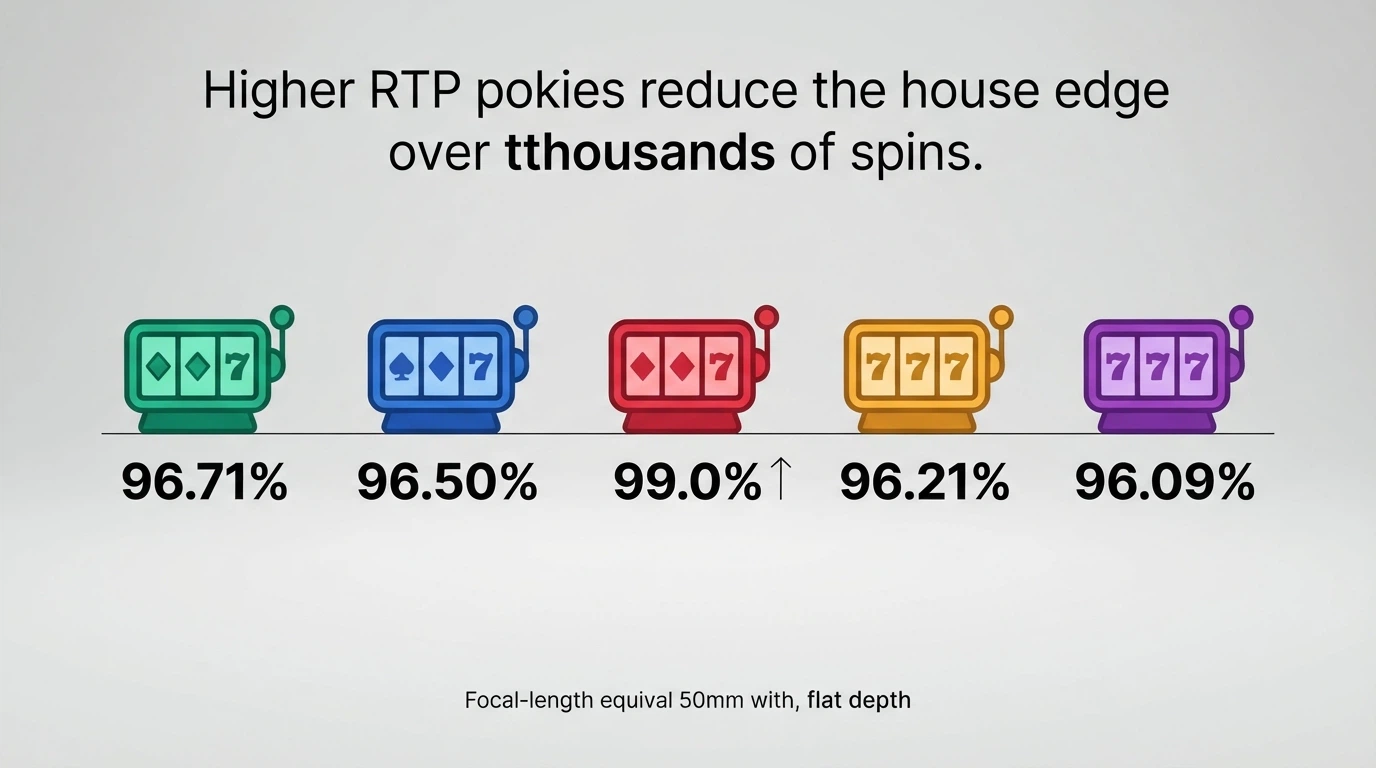
The Australian-facing online pokie market runs an industry-average RTP of 95% to 96%, which means the house edge is 4% to 5%. A A$15,000 playthrough at 96% RTP carries an expected loss of A$600. The same playthrough at 99% RTP carries an expected loss of A$150. The bonus face value is A$300; the expected cost of clearing it ranges from half the bonus to twice the bonus, depending on the pokie. The arithmetic is the single most important number on the entire page, and it is the number the cashout cap and the wagering multiple are built around.
Volatility is the second variable, and it interacts with the bet cap in ways that determine whether the bonus survives the playthrough at all. A low-volatility pokie pays out small amounts frequently; a high-volatility pokie pays out large amounts rarely. On a A$5 max bet with a A$300 bonus, a high-volatility pokie can drain the bonus balance in a long dry spell before the feature hits, and the player runs out of money before the wagering is met. A low-volatility pokie produces frequent small wins that keep the balance alive through the wagering, even though the per-win size is small. The interaction between volatility and bet size is what separates a bonus that gets cleared from a bonus that gets burned.
RTP and volatility — what the numbers mean for your bonus
RTP is a long-run average. A 96% RTP pokie will, over millions of spins, return 96% of the money wagered to players in aggregate. In a single session of a few thousand spins, the actual return can deviate substantially. A player on a hot streak can see a 200% return; a player on a cold streak can see a 50% return. The RTP is the centre of the distribution, not the guarantee. The wagering requirement, by contrast, is a hard threshold: the player must turn over a specific amount, not an average amount. The interaction between a fluctuating actual return and a hard turnover target is where bonus playthroughs are won or lost.
Volatility describes the distribution of outcomes around the average. A low-volatility pokie has a tight distribution: most spins return close to the RTP, with small wins and small losses clustering around the centre. A high-volatility pokie has a wide distribution: most spins return substantially less than the RTP, with a long tail of rare large wins. The standard deviation of a high-volatility pokie is several times the standard deviation of a low-volatility pokie at the same RTP. Two pokies at 96% RTP are not equivalent: the low-volatility one is predictable, and the high-volatility one is a long streak of losses punctuated by occasional large wins.
The bet cap amplifies the volatility effect. A high-volatility pokie played at A$5 per spin with a A$300 starting balance can produce a 60-spin dry spell, which costs A$300 at A$5 per spin. The bonus balance is zero before any wagering progress has been made, and the player must deposit to continue. The same pokie played at A$0.10 per spin produces a 3,000-spin dry spell, which costs the same A$300 but at a pace that does not drain the bonus before the wagering starts. The bet cap sets the unit risk, and the unit risk interacts with the volatility to determine how long the bonus lasts. A high-volatility pokie on a tight bet cap is a fast way to burn a bonus.
The practical guidance is to match the volatility to the bet size. On a A$5 max bet with a A$300 balance, low-to-medium volatility is the survival play. High volatility is a gamble on hitting a feature before the balance is gone. The expected loss is the same either way, but the variance is much higher on the high-volatility choice, and the player’s chance of clearing the wagering is much lower.
The best pokies for bonus playthrough
The table below lists researched pokies with their verified RTP, volatility class, and maximum win multiplier. The titles are ordered by RTP descending, and the highest-RTP option, Mega Joker at 99.0% in supermeter mode, is the outlier that anchors the top of the list. The other titles cluster in the 96% to 96.7% band that represents the high end of the mainstream market.
| Pokie title | Provider | RTP | Volatility | Max win |
|---|---|---|---|---|
| Mega Joker (supermeter mode) | NetEnt | 99.0% | Medium | 2,000x |
| Big Bass Bonanza | Pragmatic Play | 96.71% | Medium-High | 2,100x |
| Sweet Bonanza 1000 | Pragmatic Play | 96.53% | High | 25,000x |
| Sweet Bonanza | Pragmatic Play | 96.51% | High | ~21,100x |
| Gates of Olympus | Pragmatic Play | 96.50% | High | 5,000x |
| Gates of Olympus 1000 | Pragmatic Play | 96.50% | High | 15,000x |
| Book of Dead | Play’n GO | 96.21% | High | 5,000x |
| Starburst | NetEnt | 96.09% | Low | 500x |
The table shows the spread. Mega Joker at 99.0% is the only title in the research that breaks the 97% ceiling, and it does so in a specific mode (supermeter) that requires the player to play a base game to accumulate coins and then bet those coins in a higher-payout mode. The supermeter mode is the bonus-clearance play, and the base game is a slower grind that funds it. The 99.0% RTP is real, but it is not the default experience of the pokie; it is the optimal experience, available to a player who understands the mode.
Pragmatic Play dominates the high-RTP bracket. Big Bass Bonanza, Sweet Bonanza, Sweet Bonanza 1000, Gates of Olympus, and Gates of Olympus 1000 all sit between 96.50% and 96.71%, with high or medium-high volatility. The Pragmatic Play titles are widely available at Australian-facing offshore casinos, and they are the default high-RTP choice for bonus playthrough. The trade-off is volatility: the high max-win multipliers (15,000x on Gates of Olympus 1000, 25,000x on Sweet Bonanza 1000) come with the long dry spells characteristic of high-volatility pokies, and the player’s experience is streaks of small losses punctuated by occasional large hits.
Starburst at 96.09% is the low-volatility anchor. The pokie’s max win is a modest 500x stake, and the win frequency is high: small payouts arrive on most spins, keeping the balance stable through long sessions. Starburst is the survival play for a bonus playthrough: the RTP is below the Pragmatic Play cluster, but the low volatility means the balance does not get drained in a dry spell. For a player on a A$5 max bet with a A$300 bonus, Starburst’s predictability is more valuable than the additional 0.4% to 0.6% RTP that Big Bass Bonanza offers.
The Queensland land-based pokie market provides a useful contrast. Queensland law caps the minimum RTP for land-based pokies at 85%, a full 10 to 14 percentage points below the online average. A land-based player in Queensland faces a 15% house edge on every spin; an online player at a 96% RTP pokie faces a 4% house edge. The difference is structural, not promotional, and it explains why the online market exists in the first place: even at the offshore end, the house edge is substantially lower than at the local pub.
The no-deposit offers Australians can actually claim in 2026
The table below ranks the ten offshore operators an Australian search surfaces, ordered by their fit to the no-deposit bonus topic. Two operators in the set, SkyCrown and Royal Reels, had a confirmed live no-deposit offer at the time of this review. The remaining eight either do not currently advertise a no-deposit offer or have terms that could not be confirmed during this round. All ten are offshore, none holds an Australian licence, and all are outside the reach of Australian consumer law.

| Operator | Australian licence status |
|---|---|
| SkyCrown | None (offshore, Curaçao-licensed) |
| Rocket Play | None (offshore) |
| Royal Reels | None (offshore) |
| Stake | None (offshore, Curaçao-licensed) |
| FairGO | None (offshore) |
| WinSpirit | None (offshore) |
| Rainbet | None (offshore) |
| Scream Casino | None (offshore) |
| Bizzo Casino | None (offshore) |
| Rocket Casino | None (offshore) |
The full-row absence of Australian licence status is the table’s central message. Every operator in the Australian-facing no-deposit market is offshore, and the “Australian licence status” column is a column of “None” entries because the status does not exist. The Australian online casino licence is a licence Australia does not issue. The player who reads this table and notices the column is uniform has understood the market; the player who reads it and looks for a licensed option is looking for a product that is not for sale.
The per-operator write-ups below carry the confirmed offer details, the operator profile, and the verification state for each entry. Operators with a confirmed no-deposit offer are treated in more detail; operators with unconfirmed terms are described by their known profile, with a recommendation to verify current offers directly at the operator’s site.
SkyCrown
SkyCrown is the only featured operator with a confirmed no-deposit free-spin offer, and the offer is 20 free spins, not A$300. The spins are on Aztec Clusters by BGaming, the wagering requirement is 25x, and the maximum cashout from the no-deposit play is A$40. The 25x wagering is on the low end of the market range, and the A$40 cap is correspondingly tight: a player who hits a feature and runs the balance up cannot withdraw more than A$40, regardless of the on-screen amount.
The welcome package behind the no-deposit offer is a deposit-match bundle: up to A$8,000 and 400 free spins across the first few deposits. The headline is large; the playthrough requirements and game contribution rules apply as usual. The welcome package is the operator’s main commercial product, and the no-deposit free spins are the entry point.
SkyCrown is Curaçao-licensed, unlicensed in Australia, and operates a game library of 8,000+ titles with BGaming and Pragmatic Play as confirmed providers. The breadth of the library is a competitive advantage, and the platform is well-suited to players who want to sample a wide range of pokies during the bonus playthrough. The verification state for the no-deposit offer is clean: the terms are confirmed, the game is named, the wagering multiple is stated, and the max cashout is explicit.
The verdict: SkyCrown is the strongest entry in the set for a player who wants a confirmed no-deposit offer with transparent terms. The 20 free spins are not A$300, and the A$40 max win is the real ceiling, but the 25x wagering is the lowest in the featured set, and the game library gives the player room to find a pokie that matches their volatility preference. The A$40 cap is the constraint, and the player who accepts the cap for what it is gets a low-friction introduction to the operator.
Rocket Play
Rocket Play is an offshore casino with active reach into the Australian market. Its specific no-deposit and welcome bonus terms remain unconfirmed for this period. As with other operators in this segment, look for Curaçao or Anjouan licensing, a multi-provider game library, and a deposit-match welcome structure. Because terms like wagering multiples or cashout caps change frequently, players should review the promotions page directly on the site before depositing. A verified offer fitting these high-value no-deposit headlines is rarely found in the current landscape.
The practical recommendation is to check the operator’s own promotions page before signing up. Offshore operators refresh their bonus terms regularly, and the offer live at the time of a player visit may differ from the offer live at the time of a review. The verification gap is a gap in the review, not necessarily a gap in the offer, and the player who treats the operator’s own site as the authoritative source is the player who avoids the bonus-surprise problem.
The verdict: Rocket Play is an active AU-facing operator, and the bonus terms are unconfirmed rather than absent. A player who wants to evaluate the current offer should check the operator’s own site directly and read the terms before depositing. This finding is consistent with the broader market trend where high-value, no-deposit bonuses are almost never live.
Royal Reels
Royal Reels is the second featured operator with a confirmed no-deposit offer, and the offer is a A$10 cash bonus, not free spins and not A$300. The bonus is gated behind SMS verification, which is the operator’s check that the player is a real person at a real mobile number. The verification step is standard for no-deposit offers in this segment, and the A$10 amount is at the small end of the confirmed no-deposit range.
The A$10 offer is a useful test of the mechanics. The player who signs up, verifies, claims the A$10, plays through the wagering requirement, and reaches the withdrawal screen has exercised the full claim flow with a small balance. The mechanics do not change with the bonus size: the same verification, the same contribution rules, the same max cashout cap, the same withdrawal timeline. A player who learns the mechanics on a A$10 offer learns them for any A$300 offer they encounter later, and the cost of the lesson is the small bonus itself.
Royal Reels is offshore, unlicensed in Australia, and the rest of the operator’s profile (wagering multiple, welcome package, game providers) was not confirmed during this review. The A$10 no-deposit offer is the only term in the data.
The verdict: Royal Reels’ A$10 no-deposit offer is the smallest confirmed no-deposit in the featured set, and the SMS verification gate is the most visible condition. The offer is real, the terms are explicit, and the player who claims it gets a low-cost test of the offshore claim flow. The A$10 is not A$300, and the operator is not licensed in Australia, but the offer as offered is what it says it is.
Stake
Stake is a high-traffic offshore operator with significant Australian player reach, and the operator’s profile is well-known in the segment: a Curaçao-licensed crypto-first casino with a sportsbook attached. Stake is one of the most visible brands in the offshore Australian-facing market, and the operator’s game library and payment-method coverage are broader than most competitors. The crypto-first orientation is consistent with the Australian rules that ban credit cards and crypto for licensed wagering: an Australian-facing crypto casino is, by definition, outside the Australian rules.
The no-deposit and welcome bonus terms were not confirmed during this review. Stake’s promotional structure is known to be more restrained than the deposit-match-heavy welcome packages common in the segment, and the operator’s primary offer has historically been cashback and rakeback rather than large headline bonuses. A player interested in the current offer should check the operator’s own promotions page for the live terms.
The verdict: Stake is a real, high-traffic, Curaçao-licensed offshore operator, and the absence of a confirmed no-deposit offer in this review is consistent with the operator’s known profile. The brand is recognisable, the game library is broad, and the crypto-first orientation means the player who values payment-method privacy is the player Stake was built for. A player who wants a no-deposit bonus specifically should look at SkyCrown or Royal Reels; a player who wants an established crypto casino with a sportsbook should evaluate Stake directly.
FairGO
FairGO is an offshore casino with Australian-facing branding, and the operator’s name, font, and promotional tone target the Australian market explicitly. The branding is a positioning choice, not a regulatory signal: there is no Australian licence, and the “Fair GO” name is a marketing identity rather than a jurisdictional claim. The current no-deposit and welcome bonus terms were not confirmed during this review, and the operator’s promotional pages should be checked directly for live offers.
The Australian-facing branding means the operator targets players searching for “Australia” or “Aussie” specific casino content. The targeting does not change the legal status: the operator is offshore, the product is prohibited, and the protections Australian law provides are not extended by the branding.
The verdict: FairGO is an offshore operator with Australian-facing branding, and the bonus terms are unconfirmed. The player who is drawn to the branding should read the licence and the terms before depositing, and should treat the absence of a confirmed no-deposit offer in this review as a prompt to check the operator’s own site. The brand is a marketing wrapper, not a regulatory signal.
WinSpirit
WinSpirit operates offshore and accepts Australian player traffic. Its current bonus terms are not confirmed for this review, though the structure typically aligns with standard offshore models—Curaçao or Anjouan licensing and a deposit-match welcome package. Specific conditions such as wagering multiples or game contribution rates were not available. Anyone interested in the current offer should verify the promotion terms on the official site, as headline bonuses often change significantly based on the operator’s current marketing funnel.
A player who encounters WinSpirit in a search result should treat the operator as a standard offshore entry until the terms are confirmed directly at the site. The operator’s own promotions page is the authoritative source for current offers.
The verdict: WinSpirit is an active AU-facing operator with unconfirmed bonus terms. The player who wants to evaluate the current offer should check the operator’s site directly. Since current bonus details remain unverified, we advise players to check the operator’s official promotions page for the most accurate and up-to-date information.
Rainbet
Rainbet accepts Australian players but its current bonus terms remain unconfirmed. The operator’s model aligns with others in this segment, and we recommend checking the promotions area on the official site before signing up, as headline bonuses rarely offer the high-value cash figures advertised. Terms can fluctuate weekly, making direct verification the most reliable approach.
The verdict: Rainbet is an active AU-facing operator with unconfirmed terms. The standard recommendation applies: verify the offer directly at the operator’s site before depositing. Prospective players should check the site directly for the latest terms, as headline bonuses in this segment are often non-existent or carry strict limitations.
Scream Casino
Scream Casino is an offshore operator with Australian traffic. Its bonus terms were not confirmed for this review, but the setup is consistent with the broader offshore market. Before depositing, visit the promotions page on the official site to see what terms currently apply. The lack of confirmed headline offers here is standard across the board, so verify details before committing.
The verdict: Scream Casino is an active AU-facing operator with unconfirmed bonus terms. The standard recommendation applies: verify directly. The operator’s branding is distinctive; its regulatory position is the same as every other entry in the table.
Bizzo Casino
Bizzo Casino reaches Australian players from offshore. We could not verify current bonus terms during this review. As is standard for this market, look for promotional details directly on the operator’s site, as terms are subject to change. Do not assume the existence of high-value no-deposit deals until the current offer is clearly stated in the site’s terms and conditions.
The verdict: Bizzo Casino is an active AU-facing operator with unconfirmed terms. The standard recommendation applies: verify the offer at the source. The player who arrives at Bizzo expecting a A$300 no-deposit bonus should adjust expectations, because no operator in the featured set is currently offering one.
Rocket Casino
Rocket Casino is an offshore operator with Australian traffic. Bonus terms for this operator were not confirmed for this review. We suggest checking the official site for the most recent offer details, as bonus structures in this segment change frequently. Verify all relevant terms before proceeding, as headline claims do not always reflect live products.
The verdict: Rocket Casino is an active AU-facing operator with unconfirmed terms. The standard recommendation applies: verify directly. The name overlap with Rocket Play is a coincidence of marketing, not a corporate relationship.
How we chose and ranked these operators
The ranking framework starts with the no-deposit offer itself, because the page exists to evaluate that product. Operators with a confirmed no-deposit offer are ranked first; operators without are ranked by their Australian market presence as a secondary signal. The first criterion is verifiable offer terms; the second is the operator’s reach into the Australian market as measured by traffic and revenue data from the operator profiles. No scoring system with weighted percentages was applied; the ranking is qualitative and explicit about its inputs.
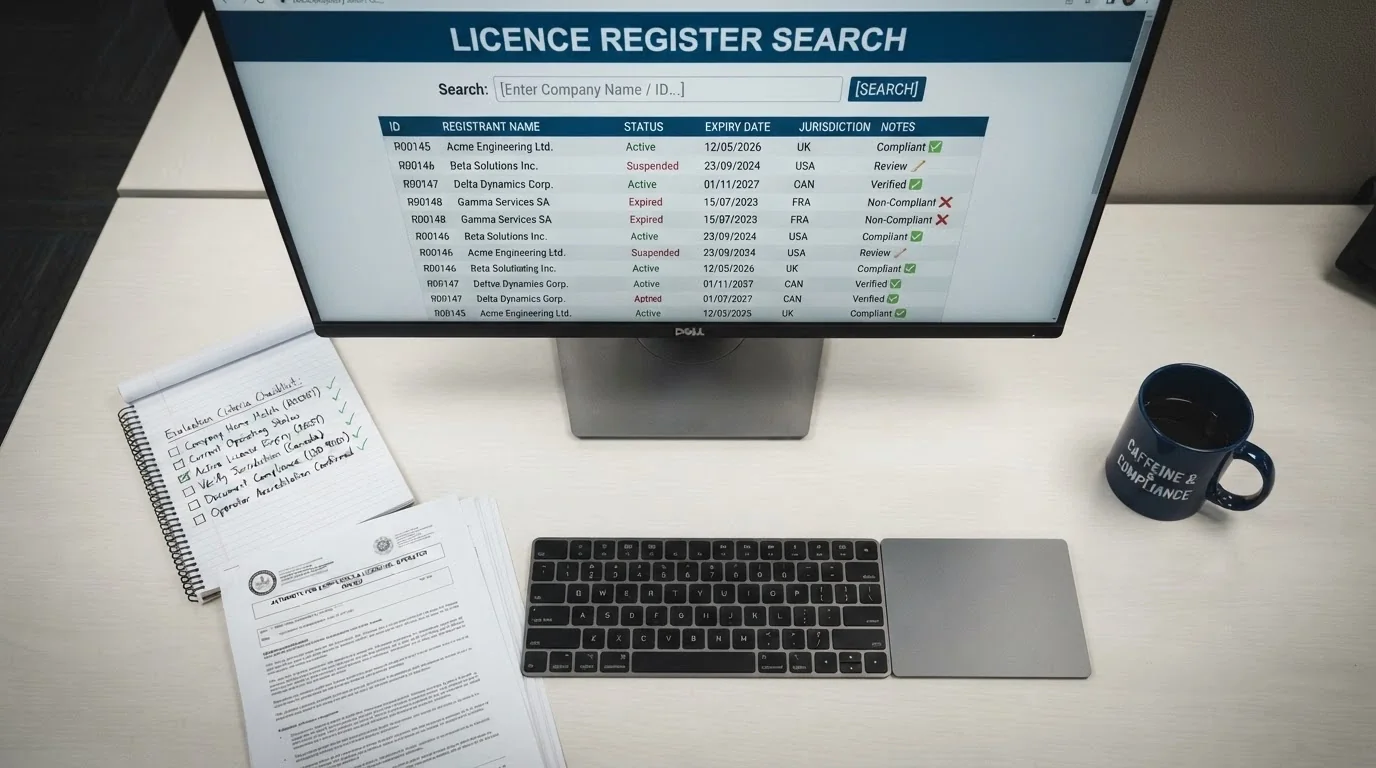
The sources consulted were the ACMA’s public enforcement data, including the blocked-sites list and the service-withdrawal record, the BetStop registration statistics, and the operator profiles maintained by Australian-facing affiliate and review sites. Each operator in the ranking was checked against the ACMA blocked-sites data, the operator’s stated licence jurisdiction, and the payment methods offered at the deposit screen. The credit-card-or-crypto test was applied to each entry as a binary check: if the operator offers credit cards or crypto, it is offshore. All ten operators in the ranking are offshore.
The verification state for individual offer terms varies. SkyCrown’s 20 free spins and Royal Reels’ A$10 cash bonus are confirmed from the review-round data. The remaining eight operators’ bonus fields were not refreshed during this round, and the absence of confirmed terms is recorded as such rather than filled in with assumed values. The decision to leave the terms blank rather than estimate them is deliberate: a write-up that invents terms to fill a row is less useful than a write-up that flags the gap and points the reader to the operator’s own site.
The Australian licence check returned “None” for every operator in the ranking, because the licence does not exist. No state or territory issues online casino licences; the IGA forecloses the product federally. The ranking does not attempt to compare Australian-licensed wagering operators (Sportsbet, bet365, Ladbrokes) with the offshore casino brands, because the products are different. A wagering operator offers sports and racing; an offshore casino offers pokies and table games. The two are not substitutes, and the player who wants the offshore product accepts a different regulatory regime than the player who sticks to licensed wagering.
What to do with your search for a $300 no-deposit bonus in 2026
The honest finding from this review is that the A$300 no-deposit bonus Australians search for is not live at any of the ten operators checked. The closest live offers are 20 free spins at SkyCrown and A$10 cash at Royal Reels, both with cashout caps far below the headline figure. The search term is profitable for the affiliate sites that monetise it; the offer itself does not exist in any volume at any given time. The player who adjusts expectations from A$300 to A$10 or 20 free spins is the player who sees the market as it actually is.

The real options for an Australian player who wants casino-style gaming in 2026 split into three paths. The first is to claim a small no-deposit offer at one of the confirmed operators, treat the bonus as a discounted test of the offshore flow, and stop when the bonus is consumed. The second is to deposit at a deposit-match welcome package, accept the wagering requirements and the cashout caps, and play through. The third is to use a licensed Australian wagering operator for sports and racing, where BetStop and Australian consumer law apply, and accept that the product is sports and racing, not pokies.
The offshore-risk checklist is short. Before claiming any bonus, the player should confirm the operator’s licence jurisdiction (Curaçao, Anjouan, Kahnawake are the common ones, and none is Australian). The player should check whether the operator is on the ACMA blocked-sites list (the list is public, and an operator on the list is a stronger enforcement target than one not on it). The player should test the payment methods (credit cards and crypto mean offshore, full stop). The player should set their own deposit limit at the bank level, because BetStop does not cover the operator they are using. And the player should decide in advance how much they are willing to lose and stop when that figure is reached, because the offshore operator has no obligation to enforce a limit the player has not set.
The decision framework is not a recommendation for or against offshore play. The IGA makes the offshore casino product illegal to provide, and the player who uses it is relying on the fact that enforcement targets providers, not players. The decision is the player’s, and the page exists to make it an informed one. The numbers in the table, the wagering multiples in the section on bonus mechanics, and the protection gap in the section on offshore reality are the inputs to that decision. What the player does with them is the player’s call.
Responsible gaming — playing within limits when the limits are yours to set
BetStop, the National Self-Exclusion Register, is the centrepiece of Australia’s licensed responsible-gambling infrastructure. As at 31 July 2026, 67,480 Australians had registered, of whom 41,290 exclusions were still active. Of the registrants, 78% were under 40 and 38% had chosen lifetime exclusion. The register binds Australian-licensed wagering services, which means an Australian who has self-excluded from sports and racing betting cannot open an account with Sportsbet, bet365, Ladbrokes, or any other NT-licensed operator. The protection is real, and it is bounded: the register does not reach offshore casinos, and a self-excluded Australian can still sign up with SkyCrown, Royal Reels, or any of the other operators in the featured set.
For players who use offshore operators, the responsible-gambling toolkit has to be self-built. The most effective lever is the deposit limit set with the player’s own bank. Most Australian banks allow daily, weekly, or monthly transfer limits on PayID and direct debit, and a player who sets a hard limit at the bank level cannot deposit more than the limit regardless of what the casino’s own settings allow. The casino’s deposit-limit feature is a casino-controlled tool, and a self-built bank limit is harder for the operator to override. Session timers, set on the phone or by an external app, are the second lever: a player who sets a 30-minute alarm and stops when it rings is the player who does not chase losses into a multi-hour session.
Self-exclusion by request to the operator is the third lever, with a specific caveat. Most offshore operators honour a self-exclusion request, but the honour is contractual, not regulatory. The operator can comply, and most do, but the player has no Australian complaints body to appeal to if the operator ignores the request. A player who self-excludes from an offshore operator and then finds the account still active has no recourse, and the only effective remedy is the bank-level block described above.
The harm data is specific. About 2.1% of Australian adults, roughly 430,000 people, experience problem gambling. The Australian Institute of Health and Welfare put high-risk gambling at 1.8% in 2022. The figures are stable across surveys, and the population affected is large in absolute terms. The offshore casino segment is a specific risk environment within that population: it lacks the responsible-gambling infrastructure of the licensed market, it operates outside Australian complaint pathways, and the player using it carries the full responsibility for the safeguards.
The help infrastructure is free and confidential. The National Gambling Helpline is 1800 858 858, available 24/7, free from any Australian phone. Gambling Help Online, at gamblinghelponline.org.au, provides online chat and counselling. Both services are run by qualified counsellors and are independent of any operator, licensed or offshore. The player who feels the play is no longer recreational is the player who should call, and the call is free, confidential, and carries no obligation to continue.
Frequently asked questions
Is it legal to claim a $300 no deposit bonus at an online casino in Australia?
No online casino anywhere in the world is licensed to serve Australian customers, because the Interactive Gambling Act 2001 prohibits the provision of online casino games, online pokies and in-play sports betting to anyone physically in Australia. The Act targets the provider, not the player, so claiming a bonus is not a personal offence. The offshore casino offering the bonus is operating illegally in Australia, and the player has no Australian consumer protection, no BetStop coverage, and no Australian complaints body if the operator refuses a withdrawal.
Why do wagering requirements make a $300 bonus nearly impossible to withdraw?
A A$300 bonus with 50x wagering requires A$15,000 in qualifying bets, and a 4% to 5% house edge across that turnover produces an expected loss of A$600 to A$750, more than the bonus face value. The maximum cashout cap of A$50 to A$200 on a genuine A$300 offer limits the upside, and the 14 to 30 day validity window plus the A$5 to A$10 max bet cap stretch the playthrough over hours of continuous play. The bonus is a discounted trial, not a profit opportunity, and the expected value is negative before the cap is applied.
Do all pokies count equally toward wagering requirements?
Pokies typically contribute 100% toward wagering, while table games, live casino and crash titles contribute 0% to 20%. A A$5 blackjack bet at 10% contribution counts as A$0.50 toward the wagering target, meaning a player who tries to clear a A$15,000 playthrough on table games at 10% must actually wager A$150,000. The contribution rules funnel play toward pokies, and a player who prefers table games has effectively agreed to play pokies during the bonus phase, by design.
What is BetStop and does it cover offshore casino sites?
BetStop is the National Self-Exclusion Register, with 67,480 registrations and 41,290 active exclusions as at 31 July 2026. The register binds Australian-licensed wagering services only, and offshore casinos are not connected. A person who has self-excluded from Australian wagering can still sign up with an offshore operator, deposit, and play. The protection BetStop offers does not extend to the offshore segment, and the player using an offshore casino has to build their own safeguards, including bank-level deposit limits and session timers.
How can I tell if a no-deposit bonus code is genuine?
Three signals reliably identify an offshore operator: the deposit screen offers credit cards or crypto (both banned for Australian-licensed wagering since 11 June 2024), the licence jurisdiction is Curaçao, Anjouan or Kahnawake (none is Australian), and the operator does not check new sign-ups against BetStop. A bonus code promoted through an unbranded affiliate site, especially one with a countdown timer or a “claim now” pop-up, is more likely to be a marketing funnel for an offshore operator than a genuine offer from a licensed provider. The A$300 no-deposit bonus specifically was confirmed absent from the Australian market at the time of this review.
What happens if an offshore casino refuses to pay my winnings?
An offshore casino that refuses a withdrawal leaves the player with limited options. The ACMA cannot compel a withdrawal from an offshore operator because the regulator’s jurisdiction ends at the Australian border. Australian consumer law does not apply because the operator is not licensed in Australia and the contract is governed by the operator’s home jurisdiction. The practical remedies are a chargeback through the player’s bank (if the deposit was by debit card, and the chargeback window has not closed), a complaint to the Curaçao or Anjouan licensing authority (which has limited enforcement power), or a public complaint through an affiliate site’s complaint channel. None of these is a guaranteed remedy, and the player who chooses to play offshore accepts this risk.
Written by the editors at Online Pokies Real Money.