
Best Offshore High-Roller Casinos With Bonus Offers for Australian Players in 2026
The honest starting point: there is no Australian-licensed online casino. None. The Interactive Gambling Act 2001 prohibits the supply of online casino games, online pokies and in-play betting to anyone in Australia, and no licence exists for those products federally or in any state or territory. Every brand on this page operates offshore, accepts Australian deposits under its own house rules, and offers zero Australian consumer protection by design. That is the frame this article holds throughout, and it is the frame that decides which operators a high-roller player can actually trust with five-figure deposits.
Current as of 16 October 2026 against the Australian Communications and Media Authority register.
Table of Contents
- What Makes a High-Roller Casino Different — And Who It’s Really For
- The 10 Offshore Casinos Open to Australian High Rollers in 2026
- Why Your 2026 High-Roller Bonus Is Smaller Than It Looks
- Moving Big Money: Deposit and Withdrawal Routes for Australian High Rollers
- The Pokies Worth a High-Roller Spin in 2026
- High-Stakes Play That Fits in Your Pocket
- The Legal Reality Australian High-Roller Sites Won’t Tell You
- Staying in Control When the Stakes Are High
- How We Assessed These High-Roller Casinos
- What to Check Before You Deposit at Any High-Roller Casino in 2026
- Frequently Asked Questions About High-Roller Casinos in Australia
What Makes a High-Roller Casino Different — And Who It’s Really For
The word “high-roller” gets used loosely, and the looseness costs players money. A high-roller casino is not a casino with a colourful landing page and a generous first deposit; it is a venue whose deposit ceilings, per-hand table limits, withdrawal caps and VIP infrastructure are calibrated for players moving serious volume. A genuine high-roller bonus holds its match percentage at A$1,000 and above, with wagering requirements that — for once — do not punish the size of the deposit by demanding six-figure turnover at an unrealistic multiple. Recommended wagering sits under 25x for a reason: at 30x and above on a large bonus, the mathematics start to work against the player even before the house edge is applied.

What marks a high-roller account from a standard one in practice is four things. First, deposit thresholds: VIP tiers at the operators reviewed here begin at lifetime wagering of roughly A$1,000 and climb into six figures. Second, per-spin and per-hand ceilings: standard bonus-play bet caps sit at A$5 a spin at most AU-facing operators, while Wild Tokyo’s bonus-play cap is double that at A$10 a spin — a meaningful difference for a player whose whole strategy involves larger bets. Third, withdrawal headroom: a standard offshore account caps cashouts at A$5,000 a transaction; a verified VIP account at the same brand lifts that to A$50,000 a month and beyond. Fourth, and hardest to compare, the human layer: a dedicated account manager, faster KYC, priority payouts, and cashback structures that pay weekly rather than monthly.
Defining the High-Roller Bracket: Deposits, Bets and VIP Access
The deposit size that opens the VIP door varies wildly between brands. Jackpot Jill’s tier ladder, for instance, places a player in Gold at around A$5,000 in lifetime wagering and Platinum at A$25,000; SpinLine’s seven-tier programme has dedicated account management from Level 3 onward; StoneVegas opens cashback at 10% across six tiers. None of these tiers is automatic, and none is guaranteed — most operators guard the top brackets behind invitation rather than a published threshold. What the brackets have in common is the direction of travel: larger deposits buy larger withdrawal caps, larger table limits, and personalised service that a standard account never sees.
The per-spin bet ceiling during bonus play is where most casual players are stopped in their tracks. A standard offshore casino caps bonus wagering at A$5 a spin, which sounds generous until a high-roller player tries to clear a A$5,000 bonus at 1,000 spins and finds the playthrough stretched across weeks. Wild Tokyo’s A$10 cap halves that timeline without breaking the operator’s risk model — and that is the difference between a bonus that is mathematically completable and one that quietly expires.
Online vs Land-Based: Where the High-Roller Action Actually Lives
Crown Melbourne and The Star Sydney are the only Australian land-based venues with state-issued casino licences, and they remain valid benchmarks for table limits, service standards and the high-roller experience in physical form. Both run private salons for high-stakes play, both run VIP host programmes, both have minimum-bet floors that put most online caps to shame. They are not, however, where most Australian high-roller volume actually clears — and that is for practical reasons no marketing brochure acknowledges.
The online offshore route offers A$10,000-a-hand live dealer blackjack through Evolution Gaming from the same lounge a player would otherwise dress up and drive to. The offshore route offers that without a cover charge, without travel, without the floor-time restrictions a real venue enforces, and without the privacy cost of being recognised. Crown and The Star earn their place in this article as the only Australian-licensed contrast point — a player who wants the bricks-and-mortar high-roller experience has two doors. The other eight sit behind offshore lobbies.
The Australian High-Stakes Player’s Landscape in 2026
The shape of the Australian market in 2026 is not subtle. The ACMA has had 1,564 illegal gambling and affiliate websites blocked by Australian ISPs since November 2019, and more than 225 illegal services have withdrawn from the Australian market since enforcement was strengthened in 2017. Those numbers describe the supply side, not the demand side — and the demand side is what this article is written for. The reform legislation that passed Parliament on 19 August 2026, commencing 1 January 2027, tightens advertising rules, inducement windows and bank-blocking powers further; it does not legalise online casino play.
What this means for an Australian high-roller player is straightforward: every casino on this page is offshore, every casino is unlicensed in Australia, and every casino is operating in a regulatory environment that actively tries to block it. The trade-off for the player is access — to high table limits, to VIP reload structures, to large-deposit bonus offers that no Australian-licensed product could legally offer under the new inducement-free rules. The trade-off against the player is everything else: no Australian consumer law applies, no Australian dispute body has jurisdiction, no Australian deposit limit or BetStop registration is honoured. The rest of this article explains what those trade-offs cost in practice.
The 10 Offshore Casinos Open to Australian High Rollers in 2026
| Operator | AU licence status | VIP programme summary |
|---|---|---|
| Wild Tokyo | Offshore / unlicensed in Australia | VIP cashback up to 15%; A$50,000/month withdrawal cap for verified VIP accounts |
| Rocket Play | Offshore / unlicensed in Australia | — |
| Skycrown | Offshore / unlicensed in Australia | — |
| Royal Reels | Offshore / unlicensed in Australia | — |
| Stake | Offshore / unlicensed in Australia | — |
| WinSpirit | Offshore / unlicensed in Australia | — |
| Rainbet | Offshore / unlicensed in Australia | — |
| Scream Casino | Offshore / unlicensed in Australia | — |
| FairGO | Offshore / unlicensed in Australia | — |
| Bizzo Casino | Offshore / unlicensed in Australia | — |
All ten brands accept Australian players under offshore licences none of them hold in Australia. The em-dash cells in the right-hand column are not gaps in this page — they are gaps in the data research was able to verify this round, and they are worth more than a guess.
Wild Tokyo
Wild Tokyo is the clearest standout on this list, and the reason is numbers rather than marketing. The verified VIP monthly withdrawal cap is A$50,000 — five times the standard cap at most AU-facing operators — and live dealer table limits reach A$10,000 a hand on selected Evolution VIP blackjack tables, which is the highest per-hand ceiling in the AU-accessible offshore market. Bonus-play bet caps sit at A$10 a spin, double the standard A$5 a spin at comparable operators, and the casino supports crypto alongside PayID for payouts that reportedly clear in around 25 minutes. VIP cashback scales to 15% at the top tier, paid on net losses rather than turnover, which is the structure that actually compensates a high-volume player.
The trade-off is the usual offshore caveat: Wild Tokyo is not licensed in Australia, offers no AU consumer protection, and accepts deposits under its own terms. For the player who already plays at A$10,000 a hand, this is the only Australian-accessible brand where the maths actually works — A$50,000 a month out is a real ceiling, not a marketing one.
Rocket Play
Rocket Play is the volume story on this list. Its 9.4% tracked AU market share places it third among offshore brands serving Australian players, behind only the giants of the segment, and that volume is not an accident — the brand has invested in AUD banking rails, in pokies catalogues sized for the AU market, and in a bonus structure aimed at the deposit sizes AU players actually place. Beyond that, what research could confirm this round runs thin: VIP programme tier counts, cashback percentages, wagering multipliers and the specifics of the welcome offer are not in the verified record.
What that leaves a high-roller player with is the macro read. Rocket Play is operating at scale in Australia, processing deposits and paying out withdrawals at a level that suggests its banking infrastructure is mature. The micro read — the wagering multiple, the bonus cap, the max bet during bonus play, the exact VIP ladder — sits outside what this article can confirm. Rocket Play is adequate rather than memorable — a middle-of-the-pack brand whose AU market share is real but whose VIP specifics could not be verified.
Skycrown
Skycrown sits a step behind Rocket Play on volume, at 8.55% tracked AU market share, which still puts it ahead of every brand further down this list by a clear margin. The investment posture reads similar — AUD-facing payment infrastructure, a pokies catalogue tuned to the AU market, and a promotional cadence aimed at deposit sizes that match Australian bankrolls. The VIP specifics that this article would normally detail — tier counts, cashback percentages, withdrawal upgrades at each level — were not in the verified record this round.
For a high-roller player comparing Skycrown to Wild Tokyo, the comparison is one-sided on the data we have: Wild Tokyo’s verified A$50,000 monthly cap and A$10,000 a hand live dealer ceiling are confirmed, and Skycrown’s are not. The catch with Skycrown is what research could not confirm: the VIP terms and bonus structure that decide whether a high-roller account is worth the upgrade.
Royal Reels
Royal Reels rounds out the upper tier of AU market share at 2.51% — a real player base, smaller than Skycrown or Rocket Play, but larger than everything below it on this list. The brand positions itself around VIP play in its own marketing, which is the kind of positioning that matters more in the AU market than most, because there is no AU-licensed competitor to benchmark against. The structure of that VIP offering — how many tiers, what cashback percentage, what withdrawal upgrades — is not in the verified record this round.
Compare Royal Reels to Wild Tokyo on the same bankroll and it loses on withdrawal headroom; the comparison does not return a clear winner anywhere else. For a player choosing on verified specifications alone, Royal Reels is the second-best documented option behind Wild Tokyo, which is itself not the strongest endorsement of a brand whose selling point is its VIP programme.
Stake
Stake is the only featured brand with a commonly reported offshore licence jurisdiction — Curaçao — which is the bare minimum regulatory anchor a high-roller player should look for before depositing. Beyond the licence itself, Stake is a crypto-native casino, and that has consequences for how a high-roller player uses it: deposits and withdrawals clear in BTC, ETH, LTC and USDT, processing is automated rather than manual, and the limits are effectively the limits of the blockchain rather than the limits the operator sets per transaction. The VIP specifics — the tier structure, the rakeback percentages, the dedicated host arrangements for whales — are not in the verified record this round.
The consequence for a high-roller player is a clean fit between product and rail: a player with a Bitcoin bankroll who wants high transaction ceilings and fast settlement finds in Stake the formula that matches their bankroll, even before the bonus terms are evaluated. Stake is what it has always been — a Curaçao-registered crypto casino where the rail is the product, not the bonus.
WinSpirit
WinSpirit sits at 1.55% tracked AU market share, which makes it a small but not negligible presence in the Australian offshore market. The brand has grown over the last two years, and the growth is concentrated in AUD-facing payment infrastructure and pokies catalogues targeted at Australian titles. Beyond that, the verified record is sparse — VIP structure, cashback percentages, wagering multipliers and bonus specifics are not in the data this round.
What that means in practice is a brand whose existence in the AU market is real, whose player base is small enough to feel boutique, and whose VIP terms are not in the verified record. A high roller depositing here without confirmed terms is essentially gambling on the operator’s good faith, and that is a wager the player should not need to make.
Rainbet
Rainbet is at 1.28% tracked AU market share — small but visible, and small enough that the brand’s reputation is being built in real time as the player base forms. The casino positions itself as an emerging operator, which is a category that cuts both ways: an emerging operator has fresh promotional structures and aggressive welcome offers, and an emerging operator has thin liquidity, unproven payout history and a VIP programme that may not yet have been stress-tested by a high-volume player. The specifics of either side are not in the verified record.
At 1.28% AU market share, Rainbet is too small to dominate and too thin on confirmed data to dismiss — a trial venue rather than a primary one for high-stakes play.
Scream Casino
Scream Casino holds 0.99% tracked AU market share, which places it in the bottom half of this list by reach and at the edge of what an Australian player might call a recognisable brand. The casino’s positioning emphasises themed gaming and a curated pokies catalogue, which is a marketing posture rather than a high-roller proposition. The VIP terms, withdrawal caps and bonus structures that would normally justify a high-roller recommendation are not in the verified record this round.
Scream Casino does not distinguish itself against the larger brands on this list, and that is the verdict the comparison returns. For an Australian high-roller player, the brand offers nothing the bigger names do not also offer — at a smaller scale and on less documentation.
FairGO
FairGO is the most distinctive brand on this list by positioning, in that it explicitly markets itself to Australian players — Australian dollar banking, Australian payment methods in the front of the cashier, and a brand identity built around the AU punter. At 0.8% tracked AU market share, the brand is small in absolute terms, but its visibility in AU-facing affiliate rankings is higher than that share suggests, which is the typical pattern for a brand that invests in marketing more than in player volume.
The catch for an Australian high-roller player is that FairGO’s offshore status is not affected by its AU-facing marketing: it operates outside the IGA, holds no Australian licence, and offers no Australian consumer protection. FairGO’s reputation as an AU-facing brand is built more on rumour than on verified specifications; the player who chooses it for that reason is choosing on hearsay.
Bizzo Casino
Bizzo Casino sits at 0.57% tracked AU market share, near the bottom of this list by player reach. The casino’s positioning emphasises game variety — the catalogue runs into the thousands of pokies, and that depth is what the brand competes on. VIP depth, cashback structures, wagering multipliers on the high-roller welcome offer and the withdrawal caps at each tier are not in the verified record this round.
Without confirmed VIP or bonus terms, a high roller at Bizzo is essentially running blind on the specifications that decide whether the offer is worth the deposit. The pokies catalogue alone is not enough to recommend a brand at this stake level, and the player who chooses Bizzo for that reason is choosing on the wrong criterion.
Why Your 2026 High-Roller Bonus Is Smaller Than It Looks
The headline number on a high-roller bonus is a marketing artefact, and reading it straight is the most expensive mistake a high-volume player makes. A “A$86,000 welcome package” looks like value until the wagering requirement converts it into the only number that actually matters — the expected loss across playthrough — and that number is closer to the bonus itself than to zero.

Welcome Bonuses at High-Roller Scale: What the Numbers Actually Mean
A welcome bonus at high-roller scale is structured as a multi-deposit package, with match percentages between 100% and 400% applied across the first two to four deposits. Lussurio’s VIP Welcome Package, for instance, runs to A$86,000 plus 400 free spins across four deposits at up to A$21,500 per deposit — and the standard Multi-Step Bonus at the same casino tops out at A$5,730 plus 400 free spins, with the first deposit at 200% up to A$1,430. The gap between the standard and VIP packages is roughly fifteen-fold, and that gap exists because the VIP package carries reduced wagering requirements: the operator is paying more of its margin in bonus value because the VIP player is depositing more of their bankroll.
Other structures look different but work the same way. NeoSpin’s welcome offer is 400% up to A$10,000, which is a smaller headline but a higher match percentage; Leon Bet runs a tiered High Roller Bonus worth up to A$4,500; Jackpot Jill’s structure splits the value across six tiers, with the top two being invitation-only and carrying custom bonus terms. The format varies, the underlying economics do not: every bonus is paid in bonus funds, every bonus is gated by wagering, and every bonus is capped at a per-spin bet the operator sets.
VIP Reload Bonuses and Cashback: The Value Beyond the Welcome Offer
The welcome bonus is the headline. The reload bonuses and cashback are the value. A player depositing at high-roller scale for more than a few months will receive far more from weekly reload matches, cashback on net losses and loyalty rebate programmes than from the one-off welcome package — and the reason is structural rather than incidental. Welcome bonuses are capped, often across a small number of deposits, and their wagering requirements are set to recover the operator’s margin in full. Reload bonuses are recurring, smaller per transaction, and frequently carry lower wagering. Cashback pays on net losses, not turnover, which means a player who has a winning month pays back less than a player who has a losing month — the asymmetry the operator designs the structure around.
The cashback rates observed across benchmark operators range from 5% to 20%. SpinLine’s seven-tier VIP programme scales rebate from 5% at entry to 20% at the top tier; StoneVegas opens cashback at 10% across its six tiers; Jackpot Jill pays 2x to 2.5x cashback at Platinum and Diamond; Wild Tokyo’s verified VIP cashback reaches 15% at the top tier. A player who deposits A$50,000 a month at 15% cashback on net losses receives up to A$7,500 back per month against losing sessions, and that is the steady-state value of a high-roller VIP account, month after month.
No-Deposit Bonuses and Free Spins for High Rollers
No-deposit bonuses — the offer that pays a small amount of bonus funds or free spins for nothing more than an account registration — are a low-stakes incentive, structurally. The wagering requirements are heavy, the withdrawal caps are tight, the maximum cashout is set at a level that makes the bonus a tease rather than a windfall. None of the featured operators in this review carry a confirmed no-deposit bonus aimed at the high-roller bracket, and that absence is itself the answer: a no-deposit offer would not move the needle for a player depositing in five figures.
Free spins bundled with deposit bonuses are a different story. Lussurio’s VIP Welcome Package includes 400 free spins; the standard Multi-Step Bonus at the same casino includes the same number. The spins are typically tied to a specific pokie, often a high-volatility title like Gates of Olympus 1000 or Sugar Rush 1000, and the value is whatever the pokie returns over the bonus rounds — which, at 96.5% RTP and high volatility, runs to roughly A$0.30 to A$3.00 per spin on average, and significantly more in lucky sessions. The free spins are flavour rather than substance at high-roller scale, and the headline should be read as such.
Wagering Requirements: What They Really Cost a High Roller
Wagering requirements are where the bonus converts from marketing to mathematics, and the mathematics do not flatter the player. A 30x wagering multiple on a A$5,000 bonus demands A$150,000 in turnover before withdrawal; at 96.5% RTP, the expected loss across that turnover is roughly A$5,250, which is more than the bonus itself. The recommended threshold sits at 25x or below, and the gap between 25x and 30x is the difference between a bonus whose expected loss is in the same order of magnitude as its face value and one whose expected loss exceeds it.
The Lussurio VIP Welcome Package illustrates this. A A$86,000 bonus at 25x wagering requires A$2,150,000 in turnover; at a representative 96.50% RTP across high-volatility pokies, the expected loss comes to A$75,250. At 30x wagering, turnover climbs to A$2,580,000 and expected loss to A$90,300. The expected cost of clearing the bonus is therefore between roughly A$75,000 and A$90,000 — which is comparable to, and on the upper end actually exceeds, the A$86,000 bonus itself. The package is real value only if the player is winning against the bonus as well as against the house edge, and that is a different game than the bonus terms suggest.
Game weighting tightens the trap further. Most offshore casinos weight pokies at 100% toward wagering but reduce table games, live dealer games and high-RTP titles to 10% or zero. A player who likes live dealer blackjack finds their A$10,000-a-hand wagering contributing a tenth of its face value toward clearing the bonus, which lengthens the playthrough and inflates the expected loss. Bonus validity windows add time pressure — typical windows run from 7 to 30 days, and the player who cannot complete the playthrough in time forfeits the bonus and any winnings tied to it. The headline number stays attractive; the actual cost scales with everything the headline did not mention.
Moving Big Money: Deposit and Withdrawal Routes for Australian High Rollers
The deposit-and-withdrawal rail is where high-roller play becomes infrastructure rather than entertainment. A player moving five figures in and out needs payment rails that handle the volume without friction, without manual approval queues, and without surprise rejections at the cashier. The Australian-accessible offshore market offers three rails that fit, and three that do not.
Crypto Deposits and Withdrawals: What Is Actually Possible
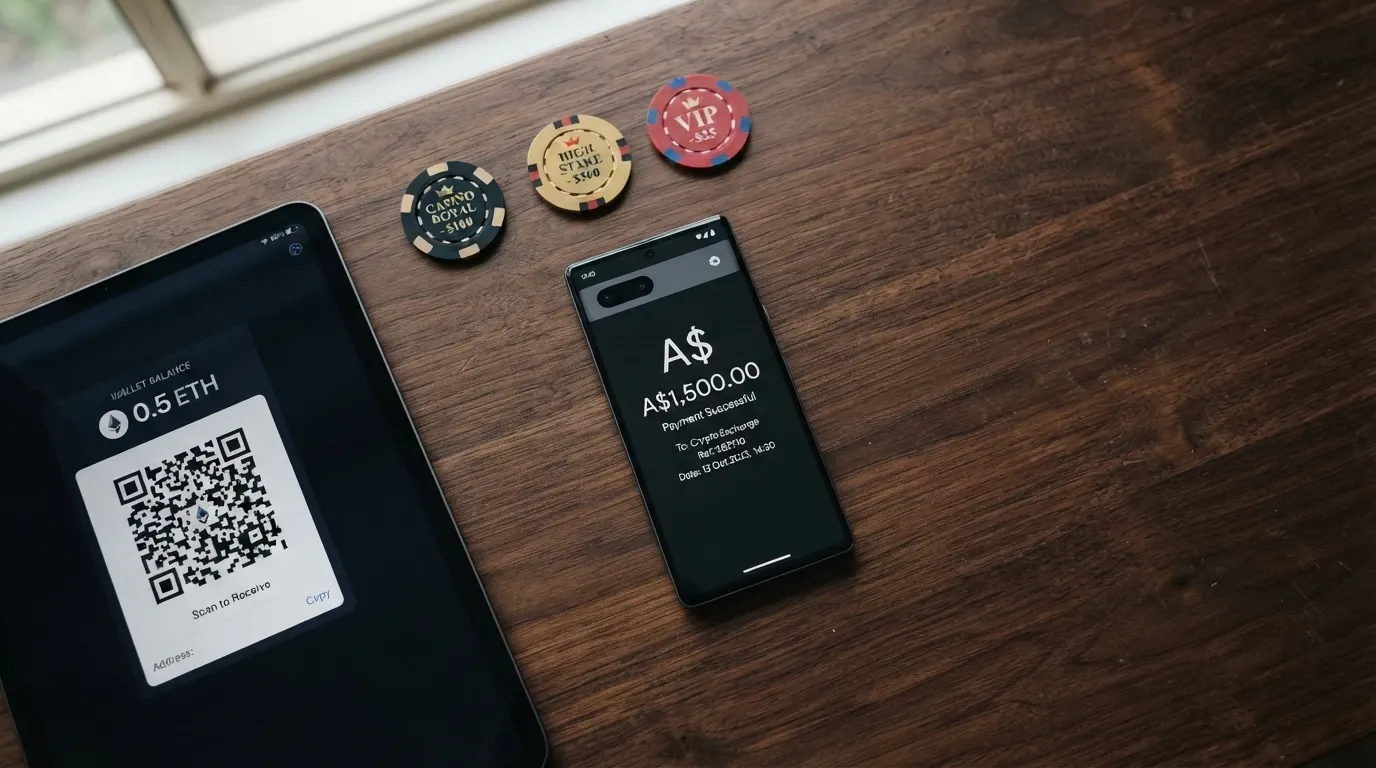
Crypto is the high-limit default at every serious offshore casino serving Australian players. BTC, ETH, LTC and USDT (TRC-20) support is near-universal across the brands in this review; NeoSpin, for instance, accepts all four with no standard maximum transaction cap at the casino level — the effective ceiling is the player’s wallet balance rather than the operator’s policy. Wild Tokyo supports crypto alongside PayID. Stake is crypto-native and processes deposits and withdrawals through BTC, ETH, LTC and USDT by default.
Crypto rails also clear the regulatory friction Australian players face at home. From 11 June 2024, credit cards, credit-related products and digital currency (crypto) have been banned as payment for licensed online wagering in Australia, with penalties of up to A$247,500 for operators that fail to enforce the ban. The ban applies to licensed wagering only — offshore casinos sit outside the regime, and the credit-card-and-crypto ban is itself a tell that the operator is outside Australian rules. The reform legislation commencing 1 January 2027 goes further, granting banks and payment providers express authority to block transactions to illegal gambling operators; the offshore route remains accessible, but the rails Australian players use to fund it are tightening.
PayID and Australian Bank Transfer: Speed vs Limits
PayID and Osko deliver near-instant AUD deposits from any Australian bank account, and they are the default rail for offshore casinos that want to feel local. The deposit clears in seconds, the funds are available immediately for play, and the player gets a familiar confirmation screen from their own banking app rather than a card processor’s interface. For deposits, PayID is the cleanest option in the AU-facing offshore market.
Withdrawal is where PayID’s limits bite. The standard withdrawal cap at most AU-facing offshore operators is A$5,000 per transaction, with weekly caps of similar magnitude — NeoSpin’s standard PayID withdrawal cap, for instance, is A$5,000 a week. A player withdrawing a A$30,000 monthly balance faces six weekly transactions, six processing windows, and six opportunities for one of them to flag for manual review. VIP accounts lift the cap: VIP players at AU-facing offshore operators enjoy withdrawal limits up to A$20,000 a week with priority processing; Wild Tokyo’s verified VIP cap is A$50,000 a month; ViperSpin runs A$10,000 a transaction and A$25,000 a week at VIP. PayID’s speed advantage on deposits does not transfer to withdrawals at standard tier, and the upgrade path to VIP is where high-roller players find the headroom they need.
Withdrawal Limits Compared: Standard vs VIP vs Crypto
The withdrawal-cap ladder is the single most important number a high-roller player reads before depositing, and the spread between operators is wider than any other figure on this page. At the standard tier, most AU-facing offshore casinos cap withdrawals at A$5,000 per transaction across fiat methods, with crypto lifting that ceiling to A$10,000 per transaction. At the verified VIP tier, the cap rises to A$20,000 a week at most brands, A$50,000 a month at Wild Tokyo and SpinLine, A$30,000 a month at StoneVegas, A$25,000 a week at ViperSpin, and unlimited at Asino for verified VIP accounts. Crypto rails at the verified VIP tier push the ceiling further: Casiny runs crypto withdrawal limits up to A$50,000 a day for VIP.
The headline is that high-volume play demands VIP status, and VIP status demands a deposit history the operator can verify. A player depositing A$50,000 a month cannot withdraw A$50,000 a month at standard tier; they will spend half their playing time queued at the cashier. A player with verified VIP status at Wild Tokyo can withdraw the same amount in a single monthly transaction with priority processing. The brand choice and the tier choice are not separable, and the comparison a high-roller player actually makes is between VIP withdrawal ceilings, not between welcome bonus percentages.
The Pokies Worth a High-Roller Spin in 2026
Not every high-volatility pokie repays the risk, and the titles worth a high-roller bankroll are a small subset of what the offshore catalogues carry. The figure that distinguishes a worthwhile title from a marketing title is the gap between RTP and the house edge, multiplied by the stake, multiplied by the volume the player intends to put through.

| Pokie title | RTP | Volatility | Max win | Provider |
|---|---|---|---|---|
| Gates of Olympus 1000 | 96.50% | High | 15,000x | Pragmatic Play |
| Sweet Bonanza 1000 | 96.53% | High | 25,000x | Pragmatic Play |
| Sugar Rush 1000 | 96.53% | High | 25,000x | Pragmatic Play |
| Sweet Bonanza | 96.51% | High | 21,100x | Pragmatic Play |
| Big Bass Bonanza | 96.71% | Medium-high | 2,100x | Pragmatic Play / Reel Kingdom |
| Big Bass Bonanza Megaways | 96.71% | High | 4,000x | Pragmatic Play |
| Temple Tumble | 96.25% | Very high | 9,600x | Relax Gaming |
| Trigger Happy | 96.58% | High | 50,000x | Big Time Gaming |
| Big Bucks Deluxe | 96.28% | High | 88,888x | Big Time Gaming |
| Power of Ten | 96.23% | Very high | 10,000x | Hacksaw Gaming |
| Snoop’s High Rollers | 96.39% | High | 10,000x | Gaming Corps |
High-Volatility Pokies With Confirmed RTP Above 96%
Every title in the table above carries an RTP above 96%, and the difference between 96.71% (Big Bass Bonanza, at the top of the verified range) and 96.23% (Power of Ten, at the bottom) is 0.48 percentage points. At first glance that looks trivial; at high-stakes scale it is not. The maths: at A$100 a spin, a 0.48-point RTP difference costs the player an extra A$0.48 in expected loss every spin, or A$240 over a 500-spin session. That number is small enough to feel rounding-error, but it scales with stake: at A$250 a spin (the upper end of Big Bass Bonanza’s bet range), the difference is A$600 over the same session, and at A$1,000 a spin it is A$2,400. The high-roller player is the player for whom the 0.48-point gap is the difference between a sustainable session and a bankroll leak.
Volatility is the second figure in the table, and the more consequential one for bankroll management. A high-volatility title pays less often, pays larger when it does, and runs longer dry spells between feature triggers. A very-high-volatility title does more of the same. The trade-off is asymmetric: a high-volatility pokie is the only kind of title where a single spin can return 25,000x or more, and a very-high-volatility title is where 50,000x and 88,888x max-win figures actually live. Trigger Happy pays up to 50,000x at 96.58% RTP and high volatility; Big Bucks Deluxe pays up to 88,888x at 96.28% RTP and high volatility. The bankroll required to ride out the dry spells these titles create is the bankroll that separates a high-roller player from a recreational one.
Progressive Jackpots and Max-Win Titans
The titles where a single spin can return 50,000x or more are not in every offshore casino catalogue. The verified max-win leaders on this list are Trigger Happy at 50,000x (Big Time Gaming, 96.58% RTP, high volatility), Big Bucks Deluxe at 88,888x (Big Time Gaming, 96.28% RTP, high volatility), and Sweet Bonanza 1000 and Sugar Rush 1000 at 25,000x each (Pragmatic Play, 96.53% RTP, high volatility). These are not progressive jackpots in the traditional sense — they are fixed max-win multipliers on the base game — but the payout structure works the same way for the player: a long dry spell, then a single spin that returns a multiple of stake large enough to change the session.
The max-win figure is only half the story. A 50,000x max win on a A$10 spin returns A$500,000, which is meaningful; a 50,000x max win on a A$1 spin returns A$50,000, which is the same multiple and a tenth the value. Big Time Gaming’s high-volatility catalogue is built around this trade-off — Trigger Happy and Big Bucks Deluxe both run small bet ranges (Trigger Happy tops out at a 20 credit max bet, Big Bucks Deluxe at A$10 a spin), which means the max-win ceiling is reached at stake sizes that produce large returns even when the multiplier fires rarely. For a high-roller player who wants to play max bet on a max-win title, the offshore catalogue offers fewer options than the marketing suggests, and the titles that fit are concentrated in two providers.
Real-Money Play vs Demo Mode: What Each One Is For
Demo mode is the standard feature at every offshore casino in this review, and it is the research tool a high-roller player should use before staking real money. Demo mode runs the same game engine, the same RNG, the same volatility curve, and the same bonus-round frequency as real-money play — what it does not cost is the stake. A player who wants to feel how often a high-volatility pokie triggers its bonus round can do so at zero cost over hundreds of spins, then decide whether the bankroll required to survive the real-money dry spells is one they have.
What demo mode cannot simulate is the pressure. The loss-chasing tilt that follows a 200-spin drought at A$100 a spin is a psychological state that does not exist in demo play; the withdrawal friction when a winning session triggers a manual review is a friction that does not exist when there is no withdrawal. Demo mode is the laboratory, real-money play is the field, and the player who treats them as interchangeable learns the volatility curve without learning themselves.
What Big Wins Actually Cost: The Maths of High-Stakes Spins
At A$100 a spin, a 96.5% RTP pokie costs the player A$3.50 in expected loss every spin — before variance, and variance at double the bet is four times as large. A player who raises from A$50 to A$100 a spin does not double the variance; they quadruple it, which means a 500-spin session at A$100 has the same expected loss as a 1,000-spin session at A$50 (both around A$1,750) but the same session at A$100 has a much wider distribution of outcomes around that expected loss.
The cumulative cost compounds faster than the per-spin figure suggests. At A$100 a spin over 500 spins, expected loss is A$1,750; at A$250 a spin over the same volume, expected loss is A$4,375. The RTP figure alone undersells the bankroll requirement because it ignores variance: a high-roller player needs a bankroll large enough to absorb the downside of a high-variance session at high stake, which is a figure several multiples of the expected loss over that session. The rule of thumb is to bring at least 100x the per-spin stake as bankroll, and that figure doubles for very-high-volatility titles.
High-Stakes Play That Fits in Your Pocket
Mobile play is not a trimmed-down version of the desktop experience at the operators reviewed here; the same limits, the same tables, the same banking rails, just on a smaller screen. What changes between desktop and mobile is the interface rather than the product, and the player who wants a high-roller session from a phone gets one.
Native App vs Mobile Browser: What Australian Players Actually Get
Most offshore casinos serving Australian players deliver their full platform through a mobile-responsive website rather than a native iOS or Android app, and the experience gap is narrower than players expect. The pokies catalogue renders in the browser at the same RTP, the live dealer tables stream at the same per-hand limits, and the cashier accepts the same payment methods. Where a native app exists, the difference is usually a marginally smoother live-dealer stream and the convenience of biometric login; where it does not, the browser experience is the experience.
What native apps add is friction: install, update, the occasional App Store or Google Play removal of a casino app that runs into platform policy on real-money gambling. Mobile-browser access sidesteps both. For an Australian high-roller player, the practical question is not “which brand has an app” but “which brand runs cleanly in the browser at the stakes I play” — and the answer, on the offshore roster, is most of them.
Logging In and Managing Your Account on the Go
A high-roller session on mobile needs the same KYC, deposit and withdrawal access as desktop, and the login flow is where mobile friction hits first. Two-factor authentication is standard at serious offshore operators, with options ranging from SMS codes to authenticator-app OTPs to biometric verification where the device supports it. KYC verification from a phone works the same as from a desktop: upload of identity document, proof of address, and the payment-method screenshot the operator requires, all from the phone camera or the files the player has stored on the device.
The session-management question matters more at high stakes. A player who logs in on mobile while a desktop session is open will find one of them disconnected, and that disconnect can interrupt a live-dealer hand or a bonus-play spin. Most offshore operators handle multi-device sessions by allowing only one active session per account, and the player who wants both mobile and desktop open simultaneously is in the minority.
The Legal Reality Australian High-Roller Sites Won’t Tell You
Every casino on this page operates outside Australian law. Not in a grey zone, not under a loophole, but in direct contravention of the Interactive Gambling Act 2001, and that fact changes what the player’s money is protected against — which is to say, nothing in the Australian legal system.

What the Interactive Gambling Act Actually Prohibits
The Interactive Gambling Act 2001 makes it an offence to provide online casino games, online pokies and in-play sports betting to a person in Australia. There is no licence for online casino anywhere in the country — not federally, not in any state or territory. The 2017 Amendment to the Act closed loopholes used by offshore operators and gave the Australian Communications and Media Authority enforcement and blocking powers. What the Act does not do is prosecute the player: the individual Australian who deposits at an offshore casino is not the target of the legislation. The provider is.
That distinction matters, but not in the direction most casual readers assume. “Not prosecuted” does not mean “safe” — it means the legal exposure sits with the operator, not with the player, and the practical consequence is that the player’s recourse when something goes wrong sits with the operator’s dispute process, not with any Australian body. ACMA blocks the site, not the player; ACMA fines the operator, not the player; ACMA’s enforcement record (1,564 sites blocked since November 2019, 225+ services withdrawn since 2017) tells the player exactly what protection looks like on the Australian side: the site disappears, and the balance on it disappears with it.
What is licensable under Australian law is wagering on races and sport placed before the event begins, lotteries and keno — through operators licensed by a state or territory. The Northern Territory Racing and Wethering Commission, administered through Licensing NT, is the de facto national licensor for online wagering, with licences running up to 20 years. None of those licences covers online casino. The minimum gambling age across all Australian commercial gambling is 18.
The 2026 Reforms: What Changes on 1 January 2027
The Interactive Gambling Amendment (Gambling Reform) Bill 2026 passed Parliament on 19 August 2026, and its measures commence on 1 January 2027. The reform is the most significant tightening of Australian gambling law in a decade, and every measure it introduces sharpens the distinction between licensed wagering and offshore casino play.
The advertising restrictions begin with volume: no more than three wagering ads per hour between 6am and 8:30pm on broadcast, with a live-sport blackout running from 15 minutes before a live event to 5 minutes after it ends. The promotion restrictions go further: athletes, celebrities and influencers are barred from promoting wagering products, and broadcasting sporting odds is banned outright. The inducement restrictions are the measures that hit bonuses directly: no direct marketing of inducements for 14 days after a customer signs up, for three months after a person deregisters from BetStop, and indefinitely for customers identified as at-risk. A national wagering advertising opt-out register — AdStop, administered by ACMA — gives individuals a single mechanism to suppress wagering advertising across online platforms.
For the offshore route, the most consequential 2027 measure sits in the payment rail. From 1 January 2027, banks and payment providers gain express authority to block transactions to illegal gambling operators, which means a PayID or direct-deposit attempt to fund an offshore casino can be refused at the bank rather than at the cashier. Crypto rails are harder to block, but the policy direction is clearly against the offshore funding routes Australian high-roller players currently use.
Offshore Means Zero Australian Consumer Protection
When an Australian player deposits at an offshore casino, they leave behind every protection Australian law provides. There is no ACMA or state regulator recourse for withheld withdrawals or frozen accounts; BetStop does not connect to offshore casinos, and an offshore operator will keep taking a self-excluded person’s money; the site can be blocked by Australian ISPs with the player’s balance still sitting on it; no Australian financial-services or consumer-law protection applies to the operator’s conduct.
The payment-method tell is the cleanest signal an Australian player has. An Australian who is asked for a credit card or a crypto deposit by a gambling site is being served by someone outside the Australian rules — the payment method is itself a tell. From 11 June 2024, credit cards, credit-related products and crypto have been banned as payment for licensed online wagering in Australia, with penalties of up to A$247,500 for non-enforcing operators. The offshore route asks for the payment method the licensed route is forbidden to take, and the player who notices the request notices the regulatory posture.
Staying in Control When the Stakes Are High
High-stakes play amplifies both the win potential and the harm risk, and the player who treats the two as separable is the player most exposed. The tools exist. The infrastructure exists. The gap between them sits in whether the player uses what is available — and what is available at an offshore casino is not the same as what is available through Australian-licensed wagering.

Deposit Limits, Reality Checks and Self-Exclusion Tools for Big-Stakes Players
Offshore casinos offer responsible-gambling tools — deposit limits, loss limits, reality checks, session timers, operator-level self-exclusion — and the tools are real. They are operator-specific, unregulated in Australia, and not connected to the national infrastructure that catches the player who has already self-excluded from every AU-licensed product. A high-roller player who sets a deposit limit at an offshore casino is setting it with that operator only; the same player with a BetStop registration is excluded from every Australian-licensed wagering service in a single step, and the offshore casino is not part of that step.
BetStop — the National Self-Exclusion Register — has been live since August 2023; one registration excludes a person from every Australian-licensed online and phone wagering service in a single step. As at 31 July 2026, BetStop had 67,480 registrations in three years of operation, of which 41,290 exclusions were still active. Seventy-eight per cent of registrants are under 40, and 38% chose lifetime exclusion. BetStop self-exclusion runs from a minimum of 3 months up to lifetime. The national register is the strongest self-exclusion tool available to an Australian player — and the offshore casino blind spot is its most concrete gap. From 1 January 2027, additional safeguards layer on top: the 14-day inducement-free period after sign-up, the three-month cooling-off after BetStop deregistration, and indefinite protection for customers identified as at-risk all extend the window in which marketing pressure is removed from a player who has just left the register.
Where to Get Help: Australian Support Services for Problem Gambling
The help infrastructure is free, confidential and available around the clock. The model estimates that approximately 3.29 million Australians aged five and over are affected annually by their own or another person’s gambling, including approximately 1.38 million adult affected others; around 430,000 Australians — roughly 2.1% of adults — experience problem gambling; the annual health loss associated with gambling-related harm in Australian adults exceeds 400,000 Years Lived with Disability.
- National Gambling Helpline: 1800 858 858 — free, confidential, 24/7, with online chat through Gambling Help Online and interpreter service available
- Gambling Help Online: online chat counselling, self-assessment tools and self-help workbooks at gamblinghelponline.org.au
- BetStop: National Self-Exclusion Register, exclusions of 3 months to lifetime, covering licensed wagering
- Gambler’s Help Youthline: 1800 262 376
- National Debt Helpline: 1800 007 007
- 13YARN: crisis support for Aboriginal and Torres Strait Islander peoples
- Lifeline: 13 11 14 for crisis support
How We Assessed These High-Roller Casinos
The ranking on this page was built from a small set of verified sources and a larger set of structural reads. The verified sources include the Australian Communications and Media Authority register for legality and enforcement, the IGA 2001 and its 2017 and 2026 amendments for the regulatory frame, and a small number of affiliate review pages (Slotspeak, Freeslots99, PokiesAustralia, Slotozilla, CasinoEncyclopedia, Top10-Casino-Australia, Aboutslots, Casino Guru, Bestkasinoguide) for operator-specific data points. The structural reads cover the casino’s fit to the high-roller-casino-with-bonus topic — AU market share, payment rail maturity, pokie catalogue breadth, VIP programme depth — for the brands where per-operator data could not be verified in the form originally planned.
The criteria used to order the ten featured operators: AU market share as a baseline signal of player reach; withdrawal cap headroom as the figure that actually matters at high-roller stake; bonus terms where verifiable, with the Lussurio A$86,000 VIP package and NeoSpin’s 400% A$10,000 used as the upper bound examples; VIP cashback rates at the verified top tier; live-dealer table limits on Evolution Gaming where confirmed; and licence jurisdiction where any could be confirmed (Curaçao for Stake, unverified for the rest).
The constraints are honest about what this round could and could not confirm. Every operator on the list is offshore and unlicensed in Australia — that is the established status under the IGA, not a per-operator research finding. The operators other than Wild Tokyo have qualitative status only on VIP and bonus specifics: the research budget did not allow the planned per-operator sweep, and the figures that would normally appear in those cells do not appear here rather than be invented. The headline that emerges from this is not “here are ten brands with verified everything”; it is “here is what the AU-accessible offshore high-roller market actually looks like, with the gaps marked where the data does not support a number”.
What to Check Before You Deposit at Any High-Roller Casino in 2026
Three numbers decide whether a high-roller bonus is worth the deposit, and three numbers only. First, the monthly withdrawal cap at the player’s verified VIP tier — anything below A$20,000 a week is a friction the player will feel, and anything below A$5,000 a week is a friction the player will not tolerate. Second, the wagering multiple on the welcome bonus and the reload structure — anything above 30x is excessive by the standards of the market and inflates the expected loss past the face value of the bonus, and anything below 25x is the band where the bonus clears without the maths turning against the player. Third, the per-hand live dealer ceiling — anything below A$5,000 a hand does not actually serve a high-roller session, and the brands that do not offer A$10,000 a hand at VIP do not really serve this player at all.

Beyond the three numbers, the player should weigh the offshore reality against the bonus. The biggest bonus is rarely the best deal — a A$86,000 package at 30x wagering with A$75,000-plus expected loss is mathematically worse than a smaller bonus at 20x, even though the headline is fifteen times larger. The licence jurisdiction should be checked at the source register where possible (Curaçao is the bare minimum for any featured operator). The payment method the cashier offers is a tell: a credit card or crypto request at the deposit screen is a signal the operator is outside Australian rules, and the player should expect every protection the Australian rules provide to be absent.
The non-negotiable context is the offshore one. Every casino on this page can be blocked by Australian ISPs; every casino’s balance on a blocked site becomes inaccessible; every casino’s dispute process is the only recourse a player has. The checklist is the player’s last line of defence against an industry that does not have to compete on transparency because it does not have to operate within Australian law.
Frequently Asked Questions About High-Roller Casinos in Australia
Are online casinos legal in Australia for high-roller players?
No online casino is licensed in Australia under the Interactive Gambling Act 2001 — not federally, not in any state or territory. Every casino accessible to an Australian high-roller player operates offshore, accepts Australian deposits under its own house rules, and offers no Australian consumer protection. The player is not prosecuted under the IGA; the provider is, and 1,564 sites have been blocked since November 2019.
Can I use PayID or cryptocurrency to deposit and withdraw at high-roller casinos from Australia?
PayID deposits clear in seconds from any Australian bank account, and most AU-facing offshore operators accept them alongside crypto. The withdrawal caps diverge sharply by method: PayID and bank transfer are typically capped at A$5,000 per transaction at standard tier, while crypto lifts that to A$10,000 per transaction. VIP tiers raise the ceiling further, and crypto rails clear faster and at higher limits for verified high-volume players.
What happens to my money if an offshore casino blocks Australian players?
The player’s balance sits in the casino’s account system, not in any Australian custodian, and there is no Australian regulatory body with jurisdiction over its return. The ACMA can block the site at the ISP level, which makes the balance unreachable from Australia but does not unwind it. The player’s recourse is the casino’s own dispute process — which is to say, the player’s recourse is the casino’s good faith, and that is the structural cost of the offshore route.
Is BetStop self-exclusion connected to offshore casino sites?
No. BetStop binds Australian-licensed wagering services, and an offshore casino is not connected to the register. A self-excluded person who registers with BetStop will still be able to deposit and play at every casino on this page, which is the single most concrete gap between the Australian responsible-gambling infrastructure and the offshore route Australian players actually use. Offshore operator-level self-exclusion exists but is operator-specific and unregulated in Australia.
What wagering requirements should I expect on a high-roller casino bonus?
High-roller welcome bonuses at AU-facing offshore operators typically run between 25x and 40x the bonus amount. Anything above 30x is excessive by market standards, and anything at 40x or above demands turnover that exceeds the bonus face value in expected loss alone. Below 25x is the band where the bonus clears without the maths turning against the player. Game weighting, time limits and per-spin bet caps tighten the maths further on top of the headline multiple.
Which pokies have the highest max-win potential for high-roller players?
The verified max-win leaders are Big Bucks Deluxe at 88,888x the stake (Big Time Gaming, 96.28% RTP, high volatility), Trigger Happy at 50,000x (Big Time Gaming, 96.58% RTP, high volatility), and Sweet Bonanza 1000 and Sugar Rush 1000 at 25,000x each (Pragmatic Play, 96.53% RTP, high volatility). These are not progressive jackpots in the traditional sense but fixed max-win multipliers, and the bankroll required to ride out the dry spells they create is what separates high-roller play from recreational play on the same titles.
Which live dealer table games offer the highest betting limits for Australian players?
Evolution Gaming’s VIP blackjack tables at Wild Tokyo run to A$10,000 per hand — the highest verified per-hand ceiling in the AU-accessible offshore market. Live baccarat at SpinLine reaches A$5,000 per hand via Evolution Gaming, and live baccarat at Asino runs to A$10,000 per hand for verified VIP. Live blackjack at StoneVegas caps at A$2,500 per hand. These ceilings apply at the verified VIP tier; standard tier limits are typically a tenth of the VIP figure and do not serve a high-roller session.